


Ten Frame Activities: 12 Ways to Build Number Sense Fast
Twelve hands-on ten frame activities for ages 5–6 — roll-and-fill, flash cards, bingo, make-10 pairs and more.
A ten frame is a 2-by-5 grid showing numbers as fixed visual groups, always filled left to right. It builds number sense fast: kids subitize quantities, see parts that make 10, and anchor on the top row of 5. Five to ten minutes a day is enough.

The short version
- A 2×5 grid, filled left to right — every number gets a fixed shape.
- The top row of 5 anchors: 8 reads as "5 and 3 more."
- Empty boxes reveal pairs like 7 + 3 = 10.
- Quick-look flashes train subitizing.
- 5–10 minutes a day is enough.
- Age
- Ages 5–6
- Prep
- 5 min
- Play time
- 15 min
- Mess
- None
- Difficulty
- Easy
- Where
- Indoor
Why kids love this
Filling things up is irresistible: roll, drop in counters, race to fill ten boxes.
A 2-by-5 rectangle, filled left to right from the top row: 7 always looks like a full top row plus two. Ten frame activities build on that picture: number parts, pairs that make 10.
The top row anchors five: 8 reads as "5 and 3 more." Empty boxes show the partners of 10. The fixed layout trains subitizing — instant recognition.
Pick one or two per sitting. Short sessions beat long ones.
Roll-and-fill: Roll the die, add that many counters, say the total; refill, then restart.
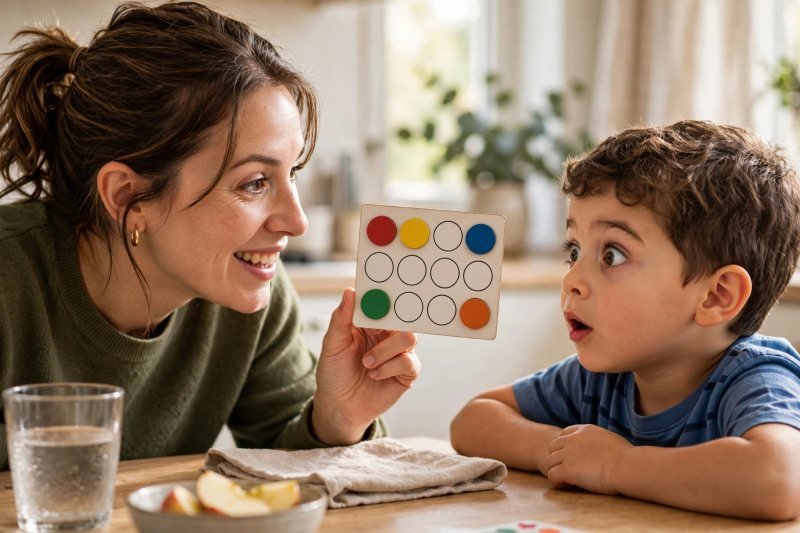
Quick-look flash cards: Flash a filled frame for three seconds: "How many?" Too quick to count.
Ten frame bingo: Four-frame bingo cards; flash a filled frame, shade the match — first done shouts "Bingo!"
Make-10 pairs: Partly fill the frame — say 7: "How many more to make 10?" ("7 and 3 make 10.") The pairs that make 10 are the heart of our number bonds to 10 activities.
Two-color counters: Red left, yellow right: "4 red and 3 yellow make 7" — parts in the whole.
Playdough press: Press ten playdough balls into a big frame's boxes; the squish doubles attention span.
Egg-box frame: A lidless egg box is a ready-made ten frame — fill the cups with pom-poms.
Sticker frames: Hand over dot stickers and blank frames; call out "Show me 8."
Fill race: Each player takes a frame and a die; alternate rolling — first to ten wins.
Snack math: Line ten grapes in the frame, play make-10, then eat them — zero cleanup.
Toss-and-count: Toss pom-poms into the egg-box cups; count filled, then empty. Moving engages wigglers.
Frame memory: Matching filled frames on six cards (two 4s, two 7s, two 9s) — the match is the quantity.
Ten minutes, one frame, ten counters. Learn the order first; then let your child lead.
What you'll need
- A ten frame: a 2-by-5 grid or lidless egg box
- 10 small counters: beans, buttons, pom-poms, or cereal
- One die, index cards, and a marker
- Playdough and a tray (optional)
Before you start
1. Draw two rows of five boxes, or use a lidless egg box. 2. Count 10 counters into a bowl beside the frame. 3. Clear a spot to sit side by side.
How to do it
-
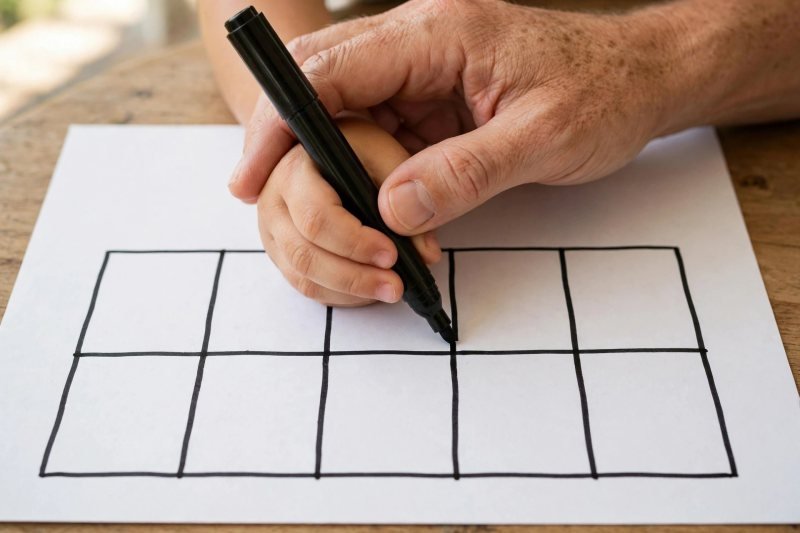
Draw. Draw the grid: "five on top, five below — ten in all."
-
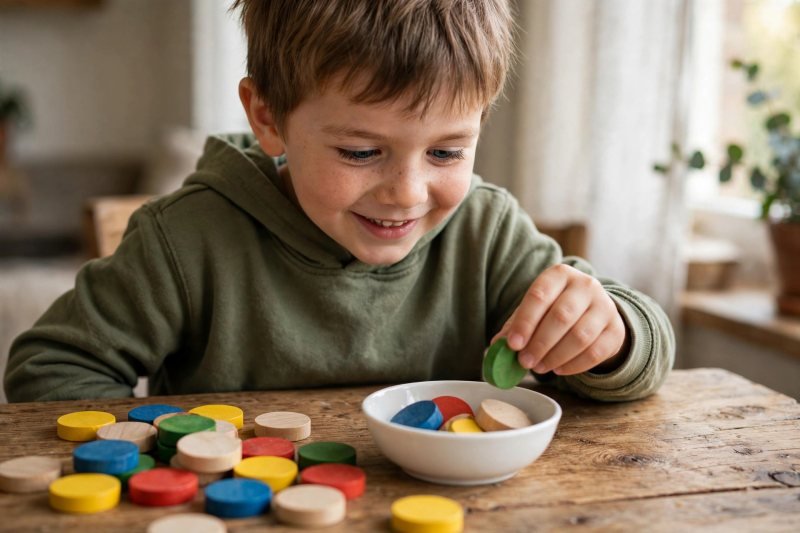
Count. Count ten into the bowl; your child picks.
-
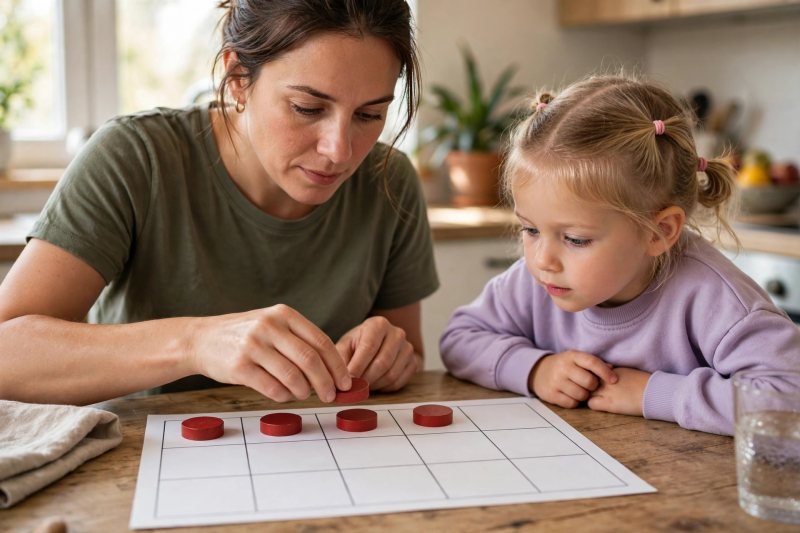
Model. Fill it left to right, top row first, counting aloud.
-
Just look. "How many — no counting!" Celebrate, then check.

-
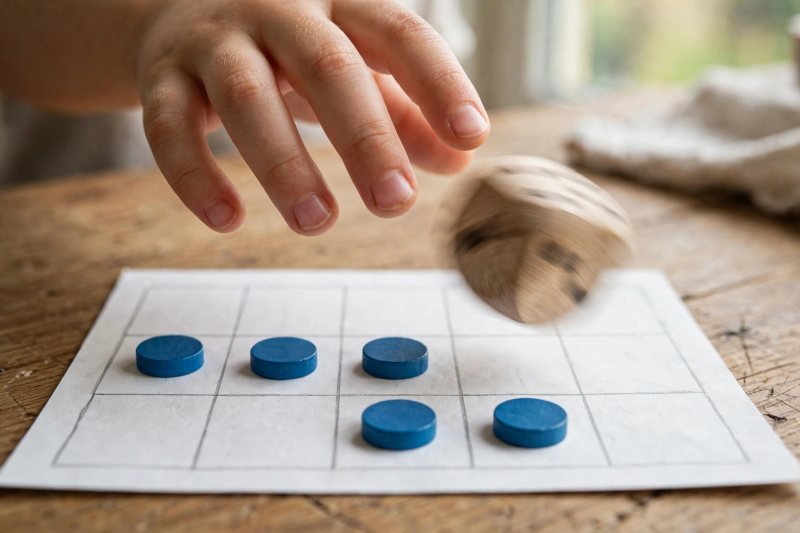
Roll. Empty, roll, add that many: "How many now? How many empty?"
-
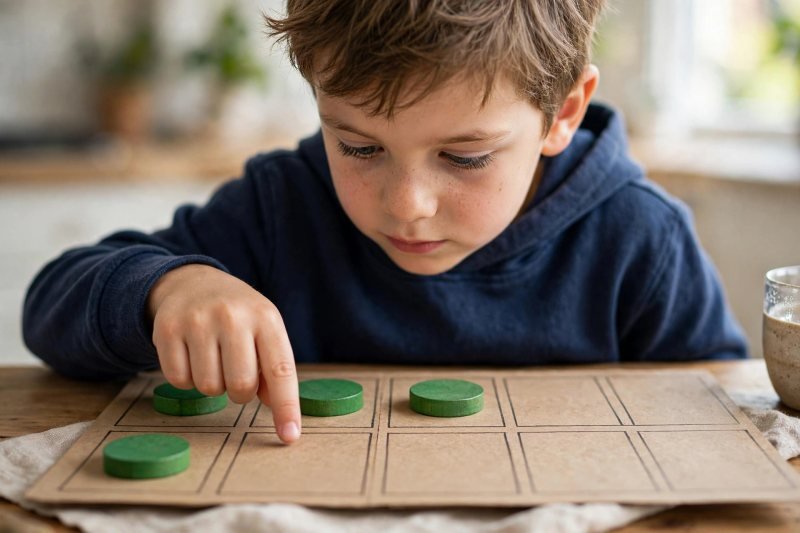
Empties. Half-fill it: "How many empty boxes?"
-
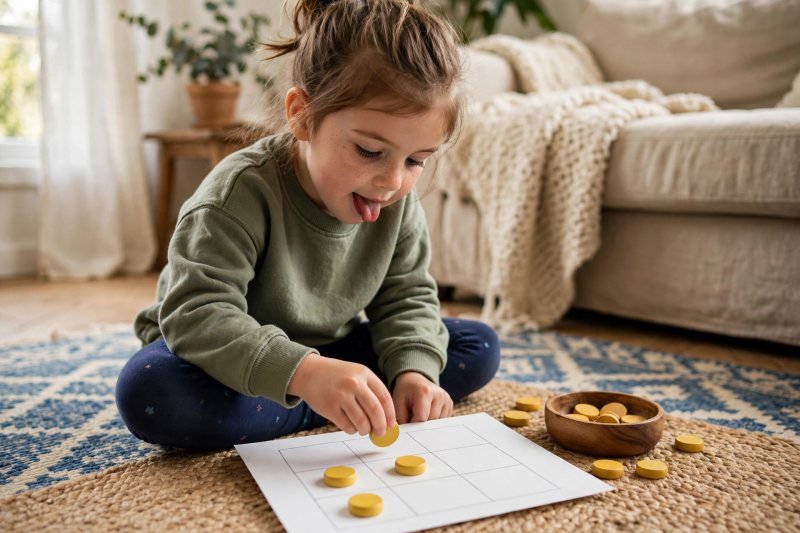
Solo. Your child rolls, fills, counts; you narrate.
-
Flash. Flash a filled frame: "How many?" Start 5, 10, 2, then 6–9.
-
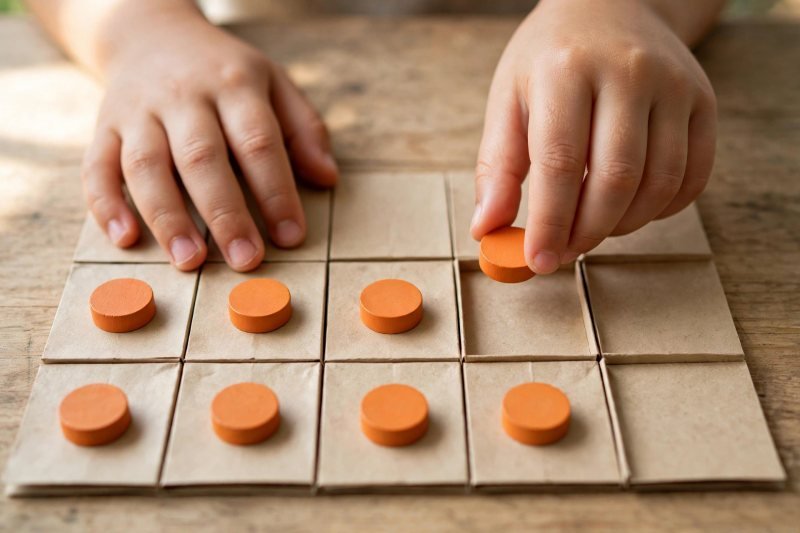
Make 10. Fill 7: "How many more?" Try 4, 6, 9.
-
Expert. "Show me any number and I'll guess it" — they quiz you.


Make it easier
Cover the bottom row; master 5 first. Use ten identical one-color counters. Play roll-and-fill for a week before make-10.
Make it harder
Roll two dice and add them before filling. Adding two dice is the same combining skill as our addition games for kindergarten. "10 take away what's showing?" — count empties to check. Taking away from 10 is the same thinking as our subtraction activities for kindergarten. Two frames build to 20: full plus 4 is 14. Skip-counting past 10 is the same skill our money games for kids build on with real coins.
Other ways to play it
- Frame war: flip cards; bigger quantity wins.
- Chalk frame: giant driveway frame filled with pinecones.
- Partner swap: teach a sibling — explaining cements it. Younger siblings can start with our counting activities for toddlers.
- Story frames: "Seven ducks hopped in. How many more fit?"
How it changes by age
- Ages 5–6 is the sweet spot. Eager 4-year-olds can start with a five frame.
What they're learning
Subitizing: recognizing quantities to 10 at a glance. Composing and decomposing: 8 as 5 + 3. The anchor of 5: the full top row. Adding and subtracting within 10, visually.
Clearing up
Counters live in one tub or zip bag. Paper frames last weeks; egg-box versions longer.
Questions parents ask
What is a ten frame in math?
What age should kids start using ten frames?
How do ten frames help with number sense?
Do you fill a ten frame left to right or right to left?
What can I use instead of a printed ten frame?
How long should a ten frame activity last?
Short, happy repetition wins — five focused minutes beat thirty reluctant ones.

save it for later
Pin this for the next rainy afternoon
Keep it on a board so it is there when you need it, rather than when you happened to find it.
Save to Pinterest


