


Number Bonds to 10 Activities: The UK Parent's Guide
Ten hands-on activities to help your 5–6-year-old master number bonds to 10 — pairs like 3 + 7. No worksheets, just games you play together.
Number bonds to 10 are the pairs of numbers that add up to 10: 1 + 9, 2 + 8, 3 + 7, 4 + 6, 5 + 5, plus the reverses. They underpin Year 1 addition and subtraction in the UK curriculum — best taught through short, hands-on games that let children see, touch and chant each pair until it is automatic.

The short version
- Bonds to 10 are pairs summing to 10: 1+9, 2+8, 3+7, 4+6, 5+5 (and reverses).
- Hands-on games beat worksheets: ten of something, split and paired.
- Little and often — one short game a day builds fluency fastest.
- Age
- Ages 5–6
- Prep
- 10 min
- Play time
- 20 min
- Mess
- None
- Difficulty
- Easy
- Where
- Both
Why kids love this
No sitting still and no worksheets — just throwing, hopping, threading and baking, with an "I knew that!" moment in every game.
What are number bonds to 10? Number bonds to 10 are the pairs of numbers that add up to 10: 1 + 9, 2 + 8, 3 + 7, 4 + 6, 5 + 5 — and the reverses. "Number bonds" is standard UK curriculum language, the exact phrase used in Year 1 maths. All six pairs, with their reverses, are: 1 + 9 and 9 + 1; 2 + 8 and 8 + 2; 3 + 7 and 7 + 3; 4 + 6 and 6 + 4; 5 + 5. Order does not change the pair — 3 + 7 and 7 + 3 are the same bond — and saying both forms out loud ("three and seven make ten; seven and three make ten") is part of learning them. The 5 + 5 pair is the one most children meet first, because doubling is easy to see on two hands.
Why do number bonds matter for young children? These pairs underpin primary maths. Once automatic, bigger additions feel easy — 3 + 7 = 10 makes 13 + 7 = 20 straightforward — and subtraction comes free, since 5 + 5 = 10 reveals 10 − 5 = 5. That is why schools teach them explicitly in Year 1. Bonds also teach missing-part thinking: "10 minus 6 leaves 4" is the same knowledge as "6 and 4 make 10", seen from the other side. You will know a bond is sticking when your child answers without counting up on their fingers — a pause, then the partner number, straight away. If a pair keeps slipping, go back to fingers and beads for that pair alone; fluency for one pair at a time beats a shaky grasp of all six.
How can you teach number bonds to 10 at home? Every game uses ten of something — fingers, beads, counters, balls. Work through the steps as one session or a few across the week; little and often beats one long session. One game a day is plenty: play it, chant the pair a few times, and move on while it is still fun. Mix the pairs up rather than always running them in 1-to-9 order, so your child recalls each bond rather than reciting a sequence. The games sit inside the counting and early-number work in the counting hub and the wider math hub, and if the egg-box frame clicks, addition with ten frames offers more games in the same format.
What you'll need
- Egg box (lid removed), 10 counters, 2 dice, dominoes
- Cord with 10 large beads; 10 ping-pong balls, 2 buckets
- String, pegs, number cards 1–9; chalk; 10 paper bun cases in two colours, muffin tray
Before you start
Snip the egg-box lid off, thread the beads onto the cord, and write numerals 1–9 on the cards. Set the buckets a few metres apart; everything else can be grabbed as you go.
How to do it
-
Finger pairs warm-up. You hold up 3 fingers; your child holds up the rest (7): "3 add 7 makes 10!" Try 5 + 5, 6 + 4, 2 + 8, 9 + 1.

-
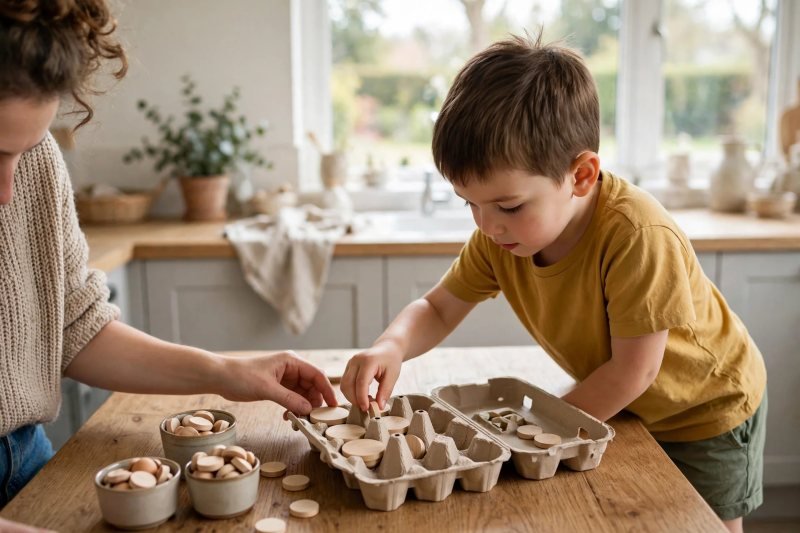
Egg-box ten frame. Place 4 counters in the cups; your child fills the empties: 4 + 6 = 10. Rearrange — 7 + 3, 2 + 8, 1 + 9.
-
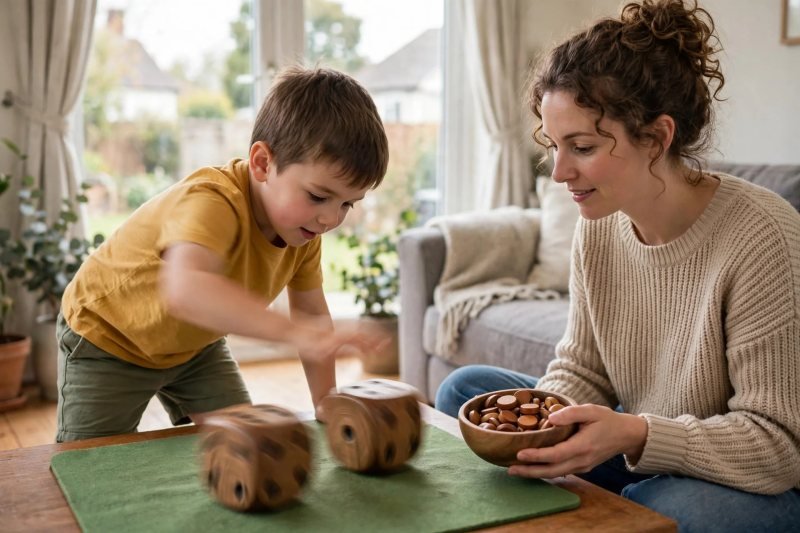
Dice pairs. Roll two dice and add the spots. Totals of exactly 10 — 4 + 6, 5 + 5 — win a counter and a shout of "Bond!"
-
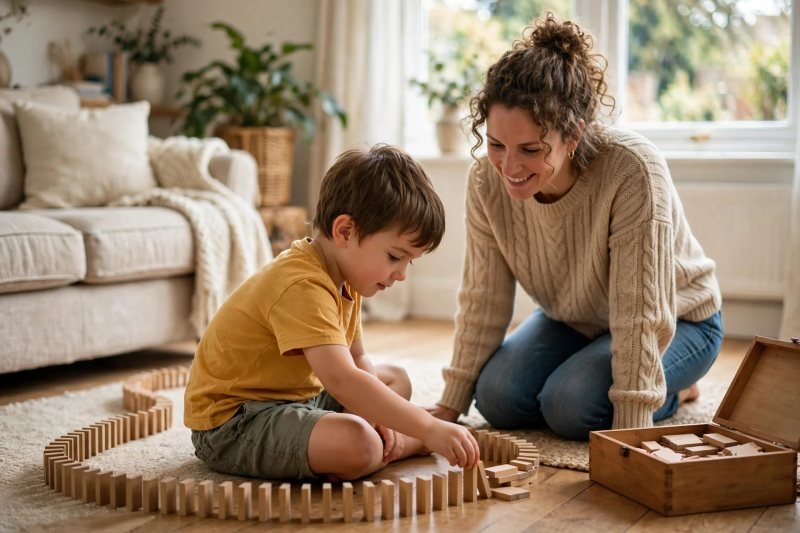
Domino hunt. Find dominoes whose ends total 10 — 3 and 7, 5 and 5 — and lay them in a snake.
-
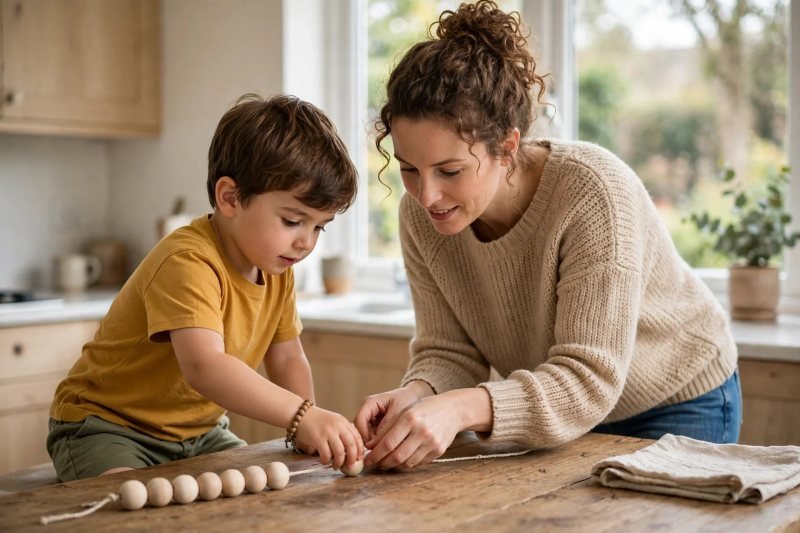
Bond bracelet. Slide 6 beads to one end; your child slides the rest: "6 and 4 make 10." It stays on their wrist all day.
-
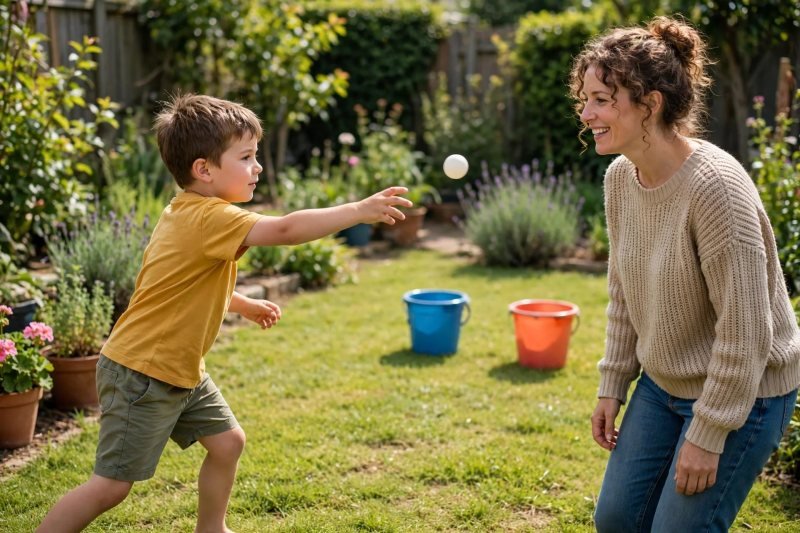
Bucket toss. Toss ten ping-pong balls between two buckets. Count the split — 3 and 7 means 3 + 7 = 10.
-
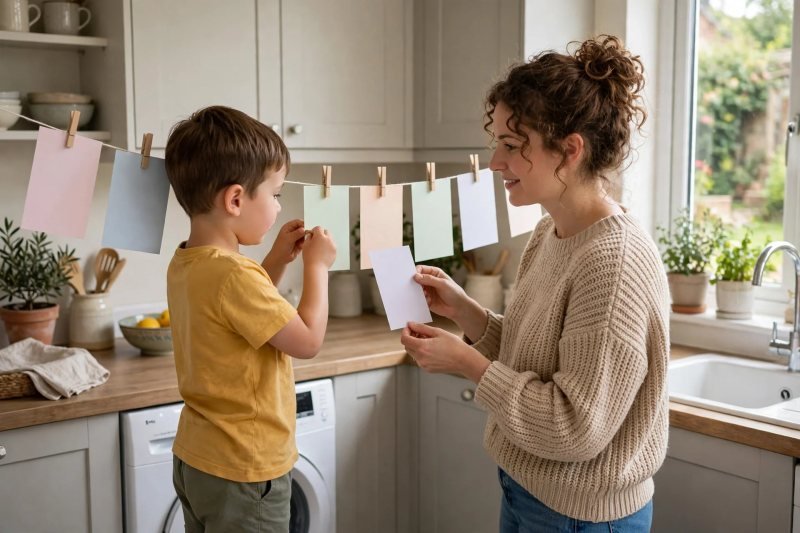
Washing-line pairs. Peg cards 1–9 to a string. Hand your child a card — say 8 — and ask them to peg its partner (2) beside it.
-
Bond hopscotch. Chalk a hopscotch with a pair beside each square — 3 and 7 — and hop the course calling out the bonds.

-
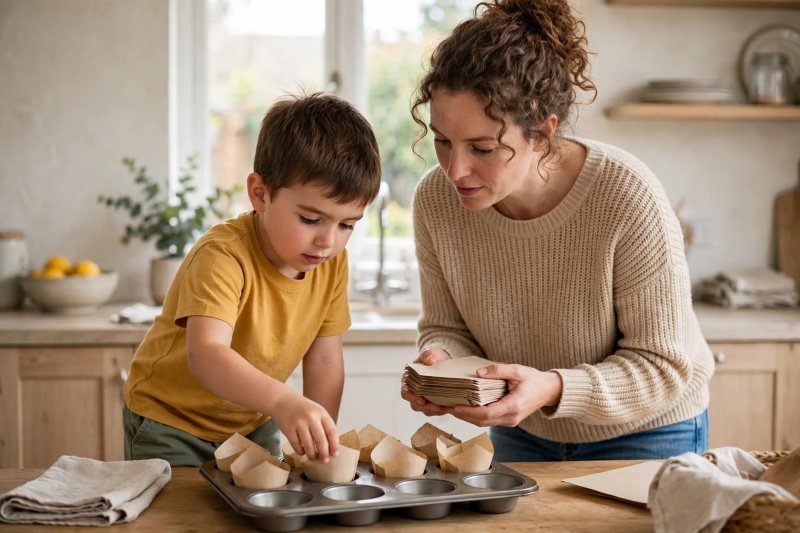
Bun-case bakery. Line up ten paper bun cases in two colours in a muffin tray. Your child splits them by colour; count the split: 2 + 8 = 10.
-
Clap-and-chant recap. Clap together: "1 and 9, 2 and 8, 3 and 7, 4 and 6, 5 and 5 — all make 10!" Once slow, once at top speed.



Make it easier
Start with 5 + 5, 1 + 9 and 2 + 8; add the rest over days. Play one game a day rather than all ten at once.
Make it harder
Ask: "What goes with 6 to make 10?" — bonds work backwards too. Try bonds to 20 with the same games: 15 + 5, 12 + 8. Once bonds are instant, comparing numbers games stretch the same number sense to bigger-or-smaller thinking, and more early-addition play lives in our addition games for kindergarten collection.
Other ways to play it
- Memory match: Cards face down; match pairs totalling 10.
- Bond towers: Two block towers using exactly ten blocks.
- Car-game bonds: You say a number; they shout its partner.
- Toy hunt: Hide ten toys; find some, work out how many remain.
- Number-bond printable: the maths number bonds printable gives the same pairs as a quiet table activity for rainy days.
How it changes by age
- These games suit ages 5–6, when most UK children meet number bonds in Year 1. The 5-year-olds age hub has more activities pitched at this year. Confident 4-year-olds can start with 5 + 5 and 1 + 9; older strugglers benefit from revisiting them. Younger siblings still building one-to-one counting can start with counting activities for toddlers before tackling pairs.
What they're learning
All six bonds to 10: 1 + 9, 2 + 8, 3 + 7, 4 + 6, 5 + 5 (and reverses). The addition–subtraction link: 6 + 4 = 10 reveals 10 − 6 = 4. Subitising — recognising small quantities at a glance. Finding a missing partner: a first taste of equations.
Clearing up
Counters, beads and cards go back in one labelled tub for next time. Rinse the egg box if grubby; wipe chalk dust from the patio with water.
Questions parents ask
What are number bonds to 10?
At what age should children learn number bonds to 10?
Why are number bonds to 10 so important?
How can I help my child remember number bonds to 10?
Bonds reward repetition without drill. If your child groans at one game, swap to another — the pairs are identical in every activity. Celebrate instant recalls ("you just knew that!"); fluency grows when children notice they are getting faster.

save it for later
Pin this for the next rainy afternoon
Keep it on a board so it is there when you need it, rather than when you happened to find it.
Save to Pinterest


