


Estimation Activities for Kids: 10 Guess-and-Check Games
Ten estimation activities for kids ages 6–8 that turn guessing into real math practice: jar guessing games, how-many-steps challenges, and guess-then-measure experiments. Guesses land in sensible ranges (tens, not thousands), and every guess gets counted, measured, or weighed to check it.
Estimation activities for kids are guess-then-check games: children guess how many beans fill a jar or how many steps cross a hallway, then count or measure to check. Keep ranges sensible (tens, not thousands), count the check in groups of ten, and score who landed closest. Ten-minute rounds build number sense, place value, and measurement intuition for ages 6–8 — no worksheets needed.

The short version
- Guess before counting — the checking is what builds number sense.
- Keep ranges sensible: jar guesses in tens, step guesses in fives.
- Count the check in groups of ten to build place value.
- Score closeness, not just exact answers — "3 away" is a win.
- Log every round in an estimation journal.
- Age
- Ages 6–8
- Prep
- 5 min
- Play time
- 20 min
- Mess
- None
- Difficulty
- Medium
- Where
- Indoor
Why kids love this
There is no wrong answer in an estimation game — only a checked one. Kids who freeze at worksheets will happily shout a guess at a jar of beans, because guessing feels safe and the checking feels like a reveal. When the count lands near a guess, the room erupts; when it is way off, the surprise is even funnier. Estimation activities for kids thrive on this loop: guess, check, laugh, guess again. It also feels like grown-up math. Rounding, ranges, and close-enough answers give 6- to 8-year-olds a sneak preview of the math older kids do — and the games are social: siblings argue about whose guess is smarter, parents get caught being wrong, and the whole family debates whether the hallway takes 15 steps or 20.
What you'll need
- A clear jar or large plastic cup
- Dried beans, marbles, or pasta (40–120 pieces)
- Index cards and a crayon (guess cards)
- A kitchen scale
- A tape measure or ruler, plus wooden blocks
- A notebook for the estimation journal
- A hallway or long room for the steps game
- Two pieces of fruit, a cushion, a paperback book, a water bottle
Before you start
1. Fill the jar before your child watches — guessing only works if nobody knows the real number. Count 40–80 beans as you pour (a sweet spot for 6-year-olds) and hide the count on a folded card. Make tent cards from folded index cards for secret guesses. Pick a fixed route — couch to front door works anywhere — and lay out the scale, blocks, and notebook so checking is instant. 2. The key setup is the range rule. Before the first guess, agree on sensible ranges: jar guesses in tens ("20 to 60"), not hundreds; steps in fives ("10, 15, 20, 25"), not in the hundreds. This one rule turns guessing from wild shouting into real number sense.
How to do it
-
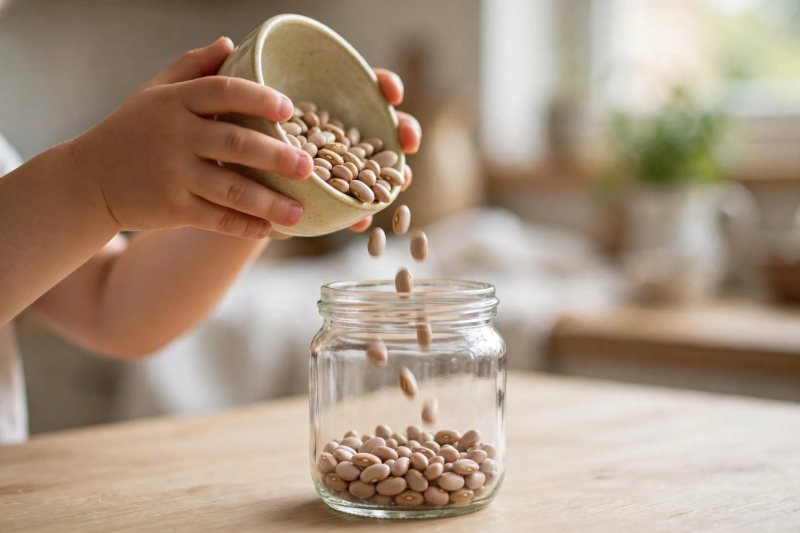
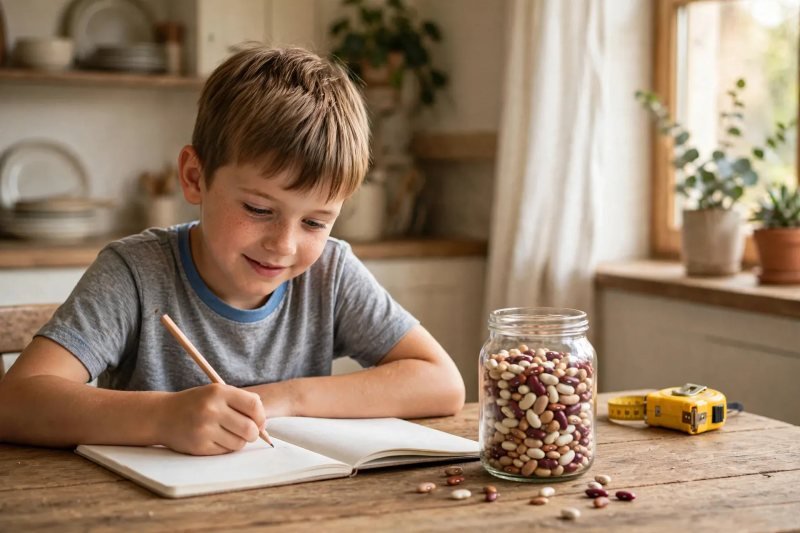
Fill the guessing jar. Pour 40–120 beans, marbles, or pasta into the clear jar — enough that nobody can count them at a glance. Count them as you fill it, write the number on a card, and hide it.
-
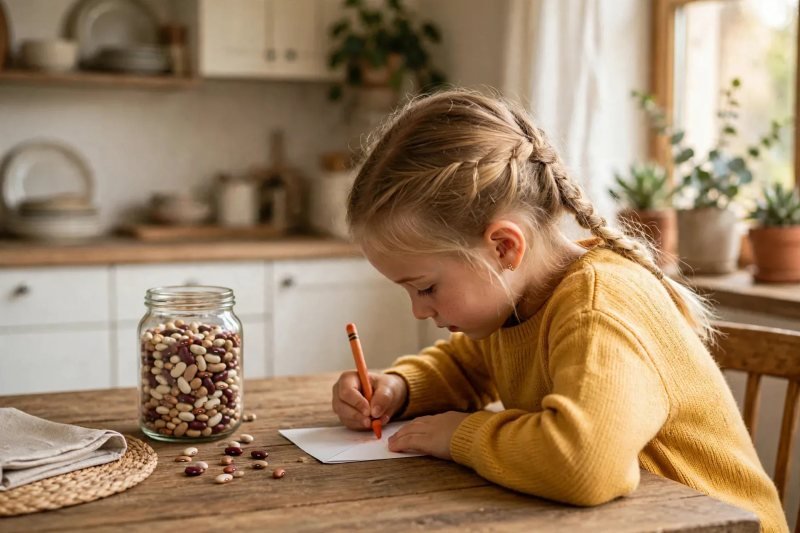
Write your guesses in secret. Everyone writes a guess on a folded card in secret — the secrecy is half the fun. Remind players of the range rule: sensible guesses in tens, sized to the jar.
-
Read the guesses out loud. Line the cards up and read each guess. Kids hear how guesses cluster — "three of us said 40-something" — and learn reasonable guesses fall in a range.

-
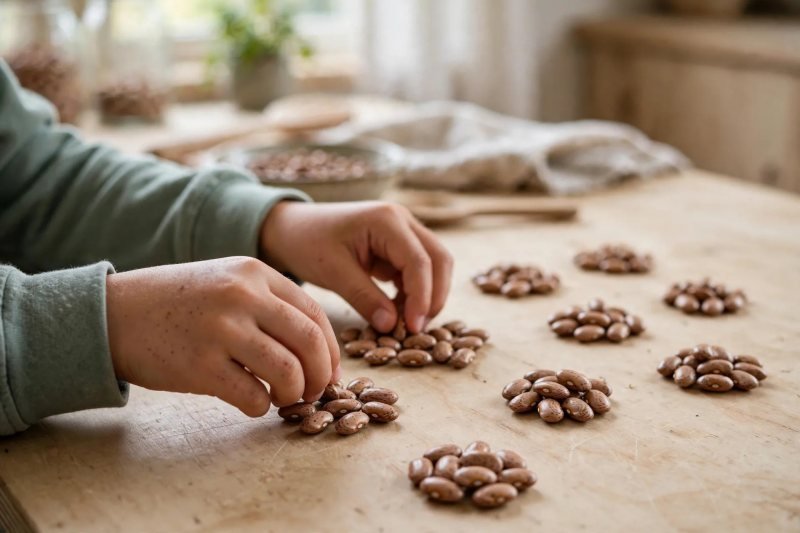
Count in groups of ten. Pour the beans out and count in tens: little piles of 10, then the leftovers. This grouping is the math of the game — it shows children that 47 is "four tens and seven more," the place-value idea behind counting to 100 activities.
-
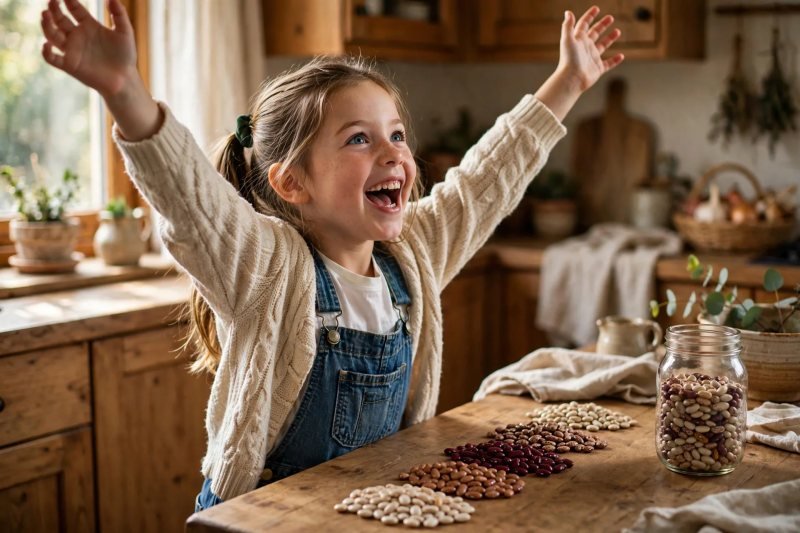
Crown the closest guesser. Whoever landed nearest the real number wins the round — being 3 away beats being 20 away. Keep score on the fridge: three rounds, best of three, the same near-or-far judging comparing numbers games build.
-
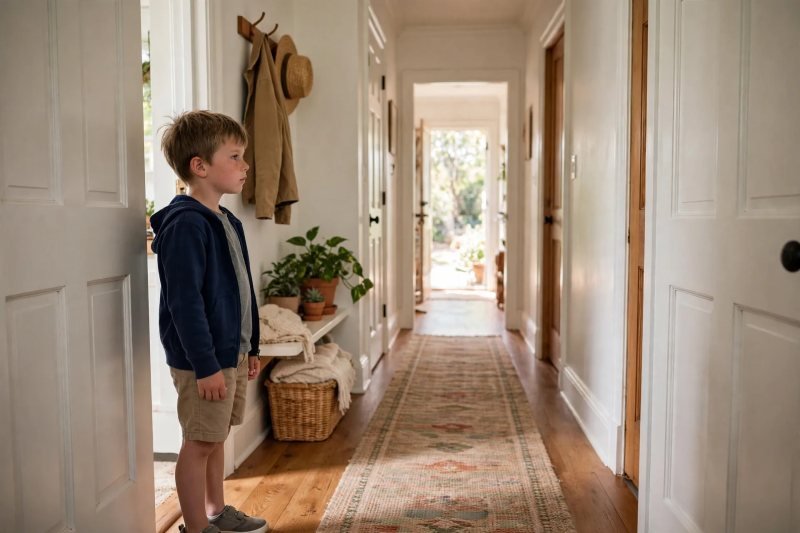
Play how-many-steps. Stand at one end of a hallway and guess how many steps reach the other end — sensible ranges only ("10 to 25"). No practice walks; the guess comes first.
-
Walk and count. Walk heel-to-toe, counting every step out loud while a parent counts behind you. If the counts disagree, walk it again and find the skipped or double-counted step.

-
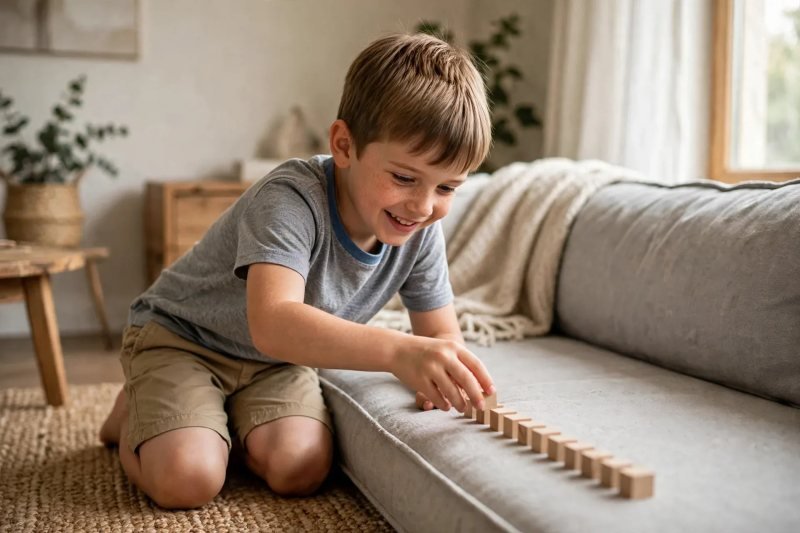
Guess, then measure. Pick an object — a cushion, a book, a water bottle. Guess how many blocks long it is, then measure with blocks — the guess-then-check routine at the heart of measurement activities for preschoolers. The gap between guess and measure is where estimation skill grows.
-
Guess, then weigh. Pick up two fruits — an apple and an orange — and guess which is heavier and roughly by how much. Check on the kitchen scale. Kids are stunned by how often the bigger one is not the heavier one.

-
Start an estimation journal. Tape a page in a notebook with three columns: what we guessed, our guess, the real answer. Log every round. Over weeks, kids watch their guesses drift closer — proof, in their own handwriting, that their number sense is sharpening.


Make it easier
Fill the jar with 15–25 pieces and guess in ones, not tens. Count the check in fives or ones instead of grouping by tens — the gentler counting in counting activities for toddlers. Use short distances (door to couch, not hallway to kitchen). Let the child be the guess-checker: counting is the easier job.
Make it harder
Push the jar count to 100–200 and guess to the nearest ten. Re-estimate after seeing half the jar — the double-check round. Guess the weight of the whole jar, then weigh it. Bet a range ("between 40 and 50") instead of one number — double points if the answer lands inside.
Other ways to play it
- Mystery bag: guess by touch alone — no looking.
- Sound jar: shake the jar, guess by the sound, then count.
- Nature walk: estimate the pinecones under a tree, then gather and count.
- Sibling showdown: two kids, two jars, best of five rounds — a family contest in the spirit of counting games for preschoolers.
How it changes by age
- These games fit ages 6–8: children who can count past 50, group by tens, and hold two numbers in their heads long enough to compare them. Five-year-olds can play the jar game with 15–25 items and guesses in ones — that is the on-ramp. Eight-year-olds thrive on the 100–200 jar and the range-bet scoring. Watch for the frustration signal: a child who always guesses wildly (3 or 3,000) needs a smaller jar and more small-range practice. Shrink the quantities, celebrate near misses, and let sensible guessing grow with the child.
What they're learning
Estimation bridges counting and calculating. Guessing "about 50" for a jar practices magnitude — the sense of how big a number is — an important foundation for later math confidence. Counting the check in tens builds place value. Comparing a guess to the answer builds subtraction and error-checking, the same thinking subtraction games for kids practice. Guessing steps and lengths builds measurement intuition no ruler lesson can hand over.
Clearing up
- Wipe bean dust off the table before the guess cards go down. - Store the jar sealed between rounds so the count stays a mystery.
Questions parents ask
What is estimation for kids?
How do you teach estimation to a 6-year-old?
What are easy estimation activities to do at home?
Why should kids guess before counting?
How can estimation help with math homework?
At what age should children start learning estimation?
- Keep first rounds short — 10 minutes of guess-and-check beats 30 minutes of setup.
- Never reveal the hidden count card early; the reveal is the whole game.

save it for later
Pin this for the next rainy afternoon
Keep it on a board so it is there when you need it, rather than when you happened to find it.
Save to Pinterest


