


Best Sunscreen for Toddlers: Safe Picks for Little Skin
The best sunscreen for toddlers is a broad-spectrum, mineral-first formula your child will tolerate, applied generously before you head out and reapplied after swimming. A complete label-reading, format-choosing, and applying guide for ages 2–3 — no brands, just the criteria that matter.
The best sunscreen for toddlers is a broad-spectrum, mineral-first (zinc oxide or titanium dioxide) formula made for children — lotion for the body, a stick for the face and ears. Apply generously before heading out — ears, neck, hands, feet included; reapply at least every two hours outdoors and right after swimming, sweating, or toweling. Patch-test new formulas a day ahead, check expiry dates, and pair with hats and shade.

The short version
- Mineral-first: zinc oxide and titanium dioxide sit on top of skin and work immediately — the usual first pick for toddlers and sensitive skin.
- "Broad spectrum" is the must-have label line; check water resistance for swim days, fragrance-free for sensitive skin, and the expiry date always.
- Formats have jobs: lotion for body coverage, stick for face and ears, spray only as a rubbed-in backup — never sprayed at a face.
- Amount and timing beat brand: a generous visible layer, reapplied every couple of hours and after every swim.
- The missed-spot map: ears, back of neck, hairline, backs of hands, behind knees, tops of feet.
- Sunscreen is one layer: hats, shade breaks, fluids, and midday care complete the system.
- Age
- Ages 2–3
- Prep
- 10 min
- Play time
- 5 min
- Mess
- Low
- Difficulty
- Easy
- Where
- Both
Why kids love this
Toddlers love sunscreen when it's a ritual, not an ambush: their own stick to hold, a "paint the statue" game, dots of cream to rub in themselves, and a song that ends when the rubbing does. The best formula is partly chemistry — and partly the one your toddler has decided is theirs.
What you'll need
- A broad-spectrum sunscreen made for children (mineral-first — see step 2)
- A sunscreen stick for the face and ears
- A soft towel for sandy hands and post-swim drying
- A sun hat and shade option (umbrella, tent, or tree) — sunscreen's partners
- A phone timer or watch for reapply reminders
- A small bag that lives by the door or in the swim bag, so sunscreen travels
Before you start
1. Buy before you need it: mid-beach-trip purchases end with whatever the kiosk stocks. Choose at home with the label checklist in step 4. 2. Patch-test any new sunscreen on the inner forearm and wait 24 hours before the first full use. 3. Check the expiry date on last year's bottle before trusting it — expired sunscreen is a false promise; replace it. 4. Set up the exit station: sunscreen, hat, and towel together by the door or in the swim bag, so applying before leaving is the path of least resistance.
How to do it
-
Start with what "best" actually means for toddler skin. Forget the wall of bottles for a second and define the job: the best sunscreen for toddlers is one that blocks broadly (both kinds of ultraviolet rays — look for "broad spectrum"), suits young and often sensitive skin, survives toddler life (water, sweat, sand, rubbing), and — the underrated criterion — goes on without a daily war, because the sunscreen that stays in the bag protects nobody. Say it as the family rule: "Best means gentle, strong, and actually used." Notice what's not in the definition: a brand name, a price tag, or the fanciest claim on the shelf. The next steps build the definition into choices.

-
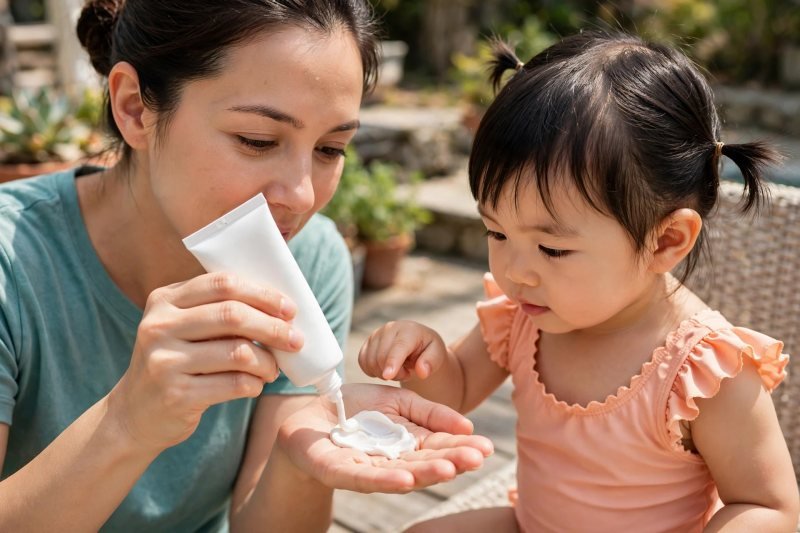
Go mineral first for the youngest skin. Most toddler sunscreen guidance starts with mineral (also called physical) formulas, whose active ingredients — zinc oxide and titanium dioxide — sit on top of the skin and reflect ultraviolet light rather than soaking in. Parents pick them for toddlers because they start working as soon as they're applied, they're a common recommendation for sensitive and eczema-prone skin — these eczema care tips for toddlers cover what helps at home between flare-ups — and the ingredient list is short and recognizable. The trade-off is texture: mineral creams are thicker and can leave a white cast — which, honestly used, is a feature: you can see exactly where you've covered and what you've missed. If a mineral formula is a hard no, a tolerated non-mineral sunscreen made for children beats a mineral one that never gets applied — but mineral is the sensible first shelf to shop. Chosen the family, now match the format to the body part.
-
Match the format to the job: lotion, stick, spray — in that order. Lotion is the workhorse: it gives the most reliable, even coverage over arms, legs, and torsos, and you can see and feel how much you've used — for a toddler's body, lotion is the default. A stick is the face specialist: it glides over cheeks, nose, ears, and the back of the neck without dripping toward eyes, and toddlers can hold it and "help," which buys real cooperation. Sprays are the tricky third: they're easy to under-apply, wind steals half the dose, and they must be rubbed in after spraying to count — never spray directly at a toddler's face (spray your hands, then apply), and keep sprays as the backup for a wiggly reapply rather than the main event. Say: "Lotion for the body, stick for the face, spray only in a pinch — and always rub it in." Formats assigned, learn to verify any bottle in twenty seconds.

-
Read the label like a five-point checklist. Turn any candidate bottle around and check, in order: one, "broad spectrum" on the label, meaning it covers both UVA and UVB rays; two, a meaningful SPF rating (dermatology guidance for children generally points to higher-rated formulas; your pediatrician can advise); three, water resistance if swimming or sweating is in the plan, knowing "water resistant" never means waterproof — it always wears off in the water; four, formulation fit — fragrance-free and made-for-children formulas suit sensitive toddler skin best; five, a valid expiry date and, on mineral picks, zinc oxide or titanium dioxide in the active ingredients. Five checks, twenty seconds, and any bottle on any shelf becomes judgeable without a single brand name. Say the shortcut: "Broad, rated, water-wise, gentle, in date." Label passed: one safety step remains before the first beach day.

-
Patch-test first, and solve the sting problem before it starts. New sunscreen goes on the inner forearm first; wait 24 hours and look for redness, bumps, or itching before it graduates to full-body duty — sensitive toddler skin votes quickly, and a rash discovered at home beats one discovered at the pool. The other classic complaint is stinging eyes, and it's usually application, not formula: use the stick around the face, apply below the eye line and above the cheek, keep hands (theirs and yours) from rubbing cream into eyes, and let your toddler wear their hat so there's less face to cover. If a formula consistently stings or brings a rash, retire it and try the other format or the other ingredient family — tolerance is a selection criterion, not a character test. Tested and tolerated: the remaining skill is purely technique, and it decides whether any of this works.

-
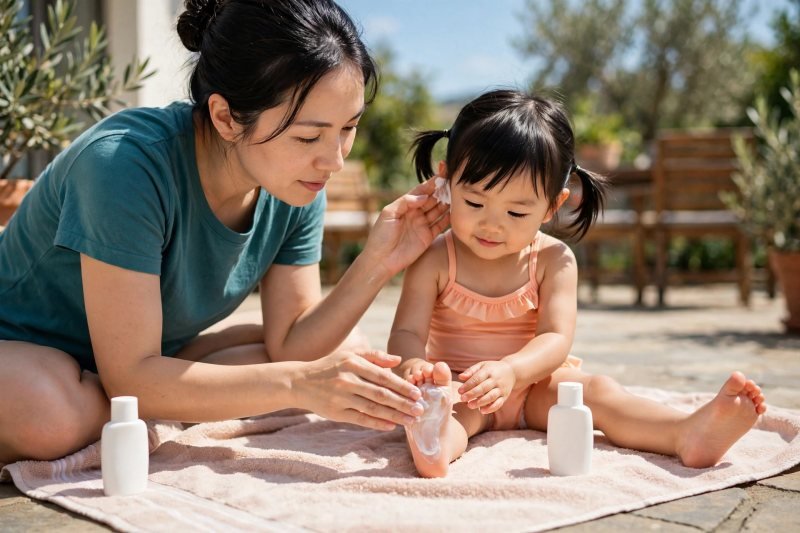
Apply generously, before you head out — and hunt the missed spots. Sunscreen applied thin protects thin, so be visibly generous: a smooth, even layer you can see, rubbed in fully, over every bit of skin the sun can reach. Apply at home or in the shade before the fun starts, following the label's directions — creams need even coverage more than they need a head start, and a calm application at the door beats a chase across hot sand. Then run the missed-spot map, the places toddler applications always forget: ears (front and back); the back of the neck; the parting line and hairline; the backs of the hands; behind the knees; the tops of the feet and between sandal straps. Say it as a rhyme while you work: "Ears and neck, feet and hands — check, check, check." Sunscreen is one job inside the wider kids skincare routine — wash, moisturize, protect — so it slots into the same sink-side rhythm. Let your toddler rub in one arm themselves; participation now is independence later. Applied: the last skill is the one that separates protected days from lucky ones.
-
Reapply on the clock, after water, without negotiation. Sunscreen is a subscription, not a purchase: outdoors, it wears down over a couple of hours, and it comes off much faster with swimming, sweating, and toweling. So reapply at least every two hours outside, and immediately after swimming or a good towel-dry, whichever comes first — set a phone timer, because nobody's internal clock survives a beach day. Reapply with the same missed-spot map, ideally in the shade, and treat the reapply break as a bundled reset: shade, a drink, a snack, fresh sunscreen, back to play. Pair all of it with the standing partners — hat on, shade breaks, extra care around the middle of the day when the sun is strongest. For a sunny backyard celebration, stage the sunscreen-hat-shade station by the gate — these 2nd birthday party ideas for toddlers show how the station fits the party flow. And at the end of the day, a dab of moisturizer for kids' dry skin soothes any tight, dry patches. Say: "Timer rings, cream on — that's the deal." Rhythm running, one maintenance step keeps the whole system honest all season.

-
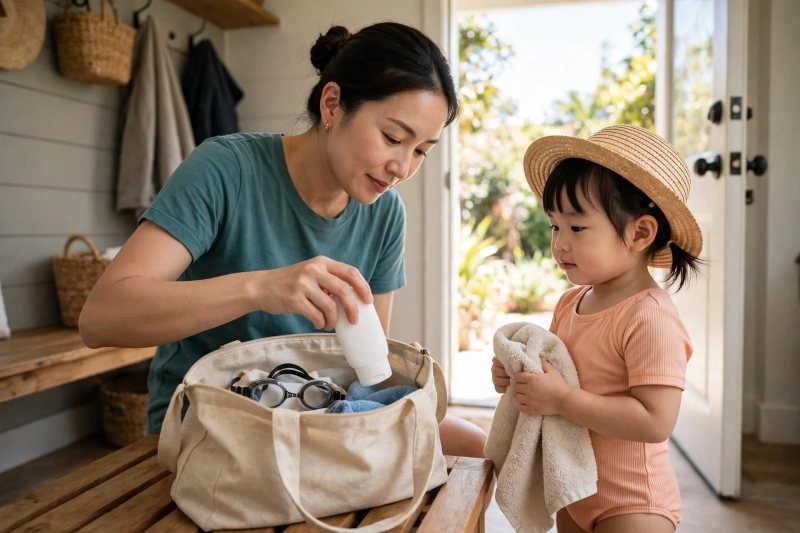
Store it cool, check the date, and know when to ask the pediatrician. Sunscreen degrades in heat, so the bottle that lives in a hot car is quietly retiring — store it in the house or the swim bag indoors, keep a spare in the stroller or day bag — this baby first beach trip packing list makes sure the sunscreen, hat, and towel actually make it into the bag — and replace any bottle past its expiry date or with a changed smell or texture. For babies under 6 months, shade and clothing are the first line and sunscreen is a pediatrician conversation, not a default. And some questions outrank any guide: a spreading reaction, skin that blisters or burns despite careful use, or eczema that flares with every formula — all go to your pediatrician. That's the complete system: define best, go mineral, match formats, read labels, patch-test, apply fully, reapply on time, and store it like it matters — because it does.


Make it easier
Apply at the door before the swimsuit goes on — naked-then-dressed application catches every strap line and edge. Give your toddler one job (rubbing in their own arm, holding the stick) — cooperation doubles when hands are busy. Anchor sunscreen to fixed moments — leaving the house, lunch, timer rings — using the kids skincare routine for how it fits the wider gentle routine.
Make it harder
Teach your preschooler the missed-spot map as a song and let them audit you: kids who can recite "ears and neck, feet and hands" start reminding you. Run a white-cast check game with the mineral lotion: they hunt for un-rubbed white patches on their arms — a coverage audit disguised as a game. Outdoor-party proof the system: for a sunny backyard celebration, stage the sunscreen-hat-shade station by the gate so reapplying is part of the party flow.
Other ways to play it
- Pool and beach days: water-resistant lotion for the body, stick for the face, reapply after every swim without waiting for the timer; rinse sand off hands before reapplying so you're not exfoliating with the cream.
- Sensitive or eczema-prone skin: mineral-first, fragrance-free, patch-tested for longer, and your pediatrician's guidance outranks general picks — including these.
- Cloudy days and winter sun: ultraviolet rays pass clouds and reflect off water, sand, and snow; on long outdoor days the same apply-and-reapply rhythm holds, even when it doesn't feel hot.
How it changes by age
- Under 6 months: shade, clothing, and hats are the protection plan; sunscreen on tiny areas only with your pediatrician's agreement. Keep babies out of direct sun as the default.
- 6–24 months: mineral lotion on exposed skin for outings, patch-tested, with shade and hats doing most of the work; application is fully adult-run.
- Ages 2–3: the guide as written — lotion body, stick face, toddler rubbing in one arm, reapply timer as a family sound everyone obeys.
- Ages 4–5: kids can learn the missed-spot map, apply to their own arms and legs with an adult audit, and start owning the "timer rings, cream on" rule — the independence that carries into school and camp.
- All ages: no sunscreen makes all-day direct sun safe for little kids. Shade, hats, timing, and fluids are permanent partners, not optional extras.
What they're learning
Body care as routine: sunscreen at fixed moments teaches health habits the same way toothbrushing does — by rhythm, not reasoning. Participation and independence: rubbing in an arm, holding the stick, reciting the spot map — graded jobs that grow with the child. Cause and effect: cream on, skin stays comfortable; timer rings, cream again — toddlers learn protection is maintained, not one-and-done. Sensory flexibility: tolerating new textures (thick mineral cream, a stick glide) during favorite activities builds adaptability that pays off everywhere.
Clearing up
Sunscreen life is a bag system: bottles stand in the door/swim bag (never loose in a hot car), the stick rides in the small pocket, sandy towels go straight to the wash, and the timer gets reset for tomorrow. Check stock on Sunday — running out mid-heatwave is how kiosk roulette starts — and note the expiry dates when you restock.
Questions parents ask
Is mineral or chemical sunscreen better for toddlers?
How much sunscreen does a toddler need, and how often should I reapply?
What SPF should a toddler sunscreen be?
Can I use spray sunscreen on my toddler?
What if my toddler hates sunscreen or it stings their eyes?

save it for later
Pin this for the next rainy afternoon
Keep it on a board so it is there when you need it, rather than when you happened to find it.
Save to Pinterest


