


Sun Hats for Kids: How to Choose One They'll Actually Wear
How to choose hats for kids sun protection for ages 3-4: wide brims, neck flaps, honest UPF fabric, breakaway straps, and a simple wear-it test so the hat they pick is the hat that stays on at the park, beach, and playground.
Choose a sun hat for a 3- or 4-year-old by coverage first: a wide brim all around, a neck flap for long sunny days, tightly woven or UPF-labeled fabric, and a breakaway chin strap — or none. Measure the head, check the inside feels soft, then run a ten-minute wear-it test. If it comes off three times, it fails.

The short version
- Coverage first: the hat must shade the face, both ears, and the back of the neck — anything less is decoration.
- Wide brim all the way around beats a front-only cap; legionnaire neck flaps suit long, sunny sessions.
- Tightly woven fabric and a UPF label give more protection; a loose-weave fashion hat does not protect.
- Chin straps must be breakaway and release under a pull; no strap is safer than a non-release cord.
- Fit is measured, snug not tight — and the ten-minute wear-it test, chosen by the child, decides the winner.
- Age
- Ages 3–4
- Prep
- 20 min
- Play time
- 20 min
- Mess
- None
- Difficulty
- Easy
- Where
- Both
Why kids love this
The best hats for kids sun protection are not the cutest ones on the shelf; they are the ones a 3- or 4-year-old forgets they are wearing. Kids love a hat that shades their eyes without flopping into them, feels soft inside, and was partly their own choice — picked between two finalists, tested in real play, and hung on their own hook by the door like shoes. When a hat passes those tests, wearing it stops being a negotiation and becomes part of getting ready: hat on, door open, sunshine handled. This guide walks through every check in order, so you can judge any plain, unbranded hat in any shop with confidence.
What you'll need
- 2–3 candidate hats to try — plain and unbranded, ideally one wide-brim style and one with a neck flap, so you can compare coverage side by side
- A soft measuring tape for measuring around the forehead
- Sunscreen for the skin a hat does not cover — nose, arms, and legs, and ears if uncovered
- A water bottle for the wear-it test and for every sunny outing after it
- A mirror at child height for the mirror moment in step 8
- A hook or basket by the door for step 9's habit
Before you start
1. Measure first: wrap the soft tape around your child's forehead, just above the eyebrows and ears, and note the measurement before you shop. 2. Shortlist two finalist hats that pass the brim, fabric, and strap checks in steps 2 to 5 — your child chooses between finalists, not between everything. 3. Plan the wear-it test for a calm moment at home, not in the shop and not on the morning of a trip.
How to do it
-
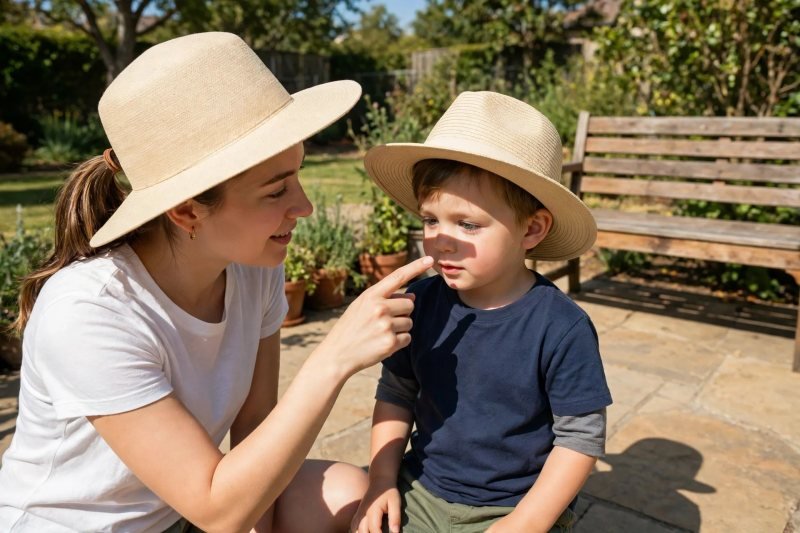
Start with what a sun hat must shade — face, ears, and neck. A sun hat is shade your child carries with them, and shade only counts where it actually falls: across the face, over both ears, and down the back of the neck — the spot sunscreen rubs off first and small hands cannot reach. Hold any candidate up and picture those three zones; if the ears stick out into full sun or the neck is bare, the hat is a fashion accessory, not protection, however sweet it looks. Say, "Your hat is your own little shade tree — it goes where you go." This coverage test is the first filter, and a hat that fails it does not reach the finalist pile.
-
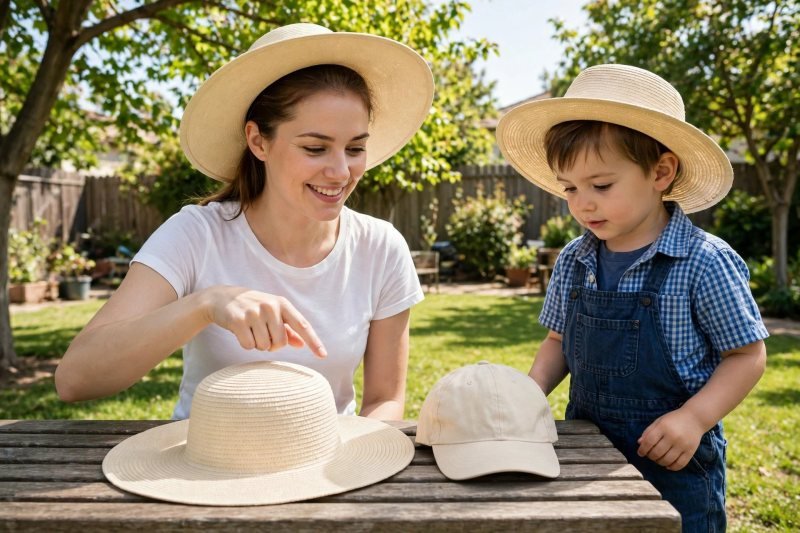
Choose the brim — wide all the way around wins. A wide brim circling the whole head beats a front-only cap brim every time, because a cap shades the forehead and leaves the ears and neck in direct sun. Look for a brim wide enough to cast a real shadow over the face, yet firm enough not to flop over the eyes when your child looks down at a puddle, a bug, or their own shoes; a brim in the eyes is the top reason hats get pulled off. Check from the side in good light: the shadow line should reach at least to the chin. Say, "Let's see your shade — if your face is in shadow, your hat is doing its job." Set a wide-brim hat and a cap side by side once, and the difference teaches itself.
-
Check the back — neck flaps for long sunny sessions. For beach days, pool afternoons, and long stretches with little tree shade, a legionnaire-style hat with a soft flap over the back of the neck gives the most complete coverage, protecting exactly the skin children cannot see or reach. For everyday playground trips and short walks, a softer, shorter flap — or a wide brim extending further at the back — can be enough and may feel lighter to a child who dislikes fabric on their neck. The flap should hang loose, never tight, and not stick to sweaty skin. Say, "This flap is a curtain for your neck — it keeps the sun off while you play." Match the back to the outing: maximum cover for maximum sun, lighter cover for everyday.

-
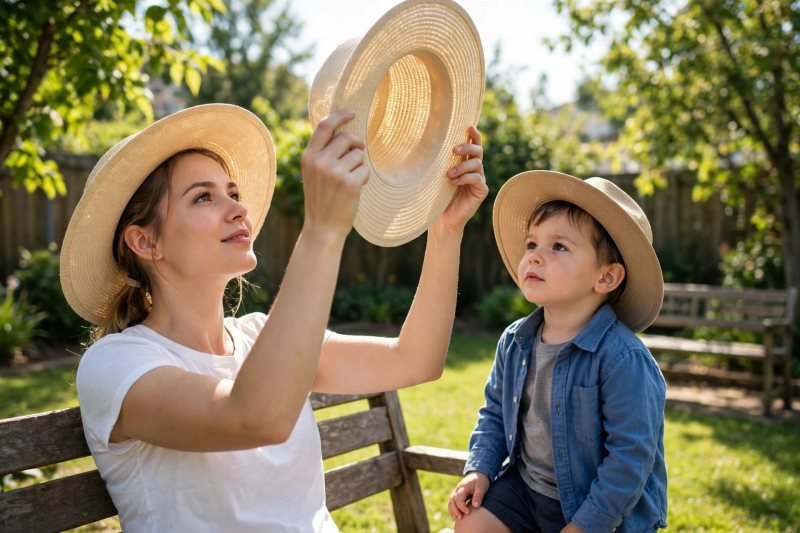
Read the fabric honestly — weave and UPF labels matter. Tightly woven fabrics block more sun than loose, open weaves; hold the hat up to the light — if bright light shows clearly through the weave, sun is getting through too. Many protective hats carry a UPF rating on the label, a rating for how much ultraviolet light the fabric lets through; treat a labeled rating as one useful check alongside weave, brim, and coverage, never as magic. Be blunt here: a thin, loose-weave cotton fashion hat is decoration, not protection, even if it is adorable. Say, "We check the fabric like detectives — tight weave, good shade." No wording or number on any single hat proves anything alone; coverage plus weave plus a hat that stays on is the real protection.
-
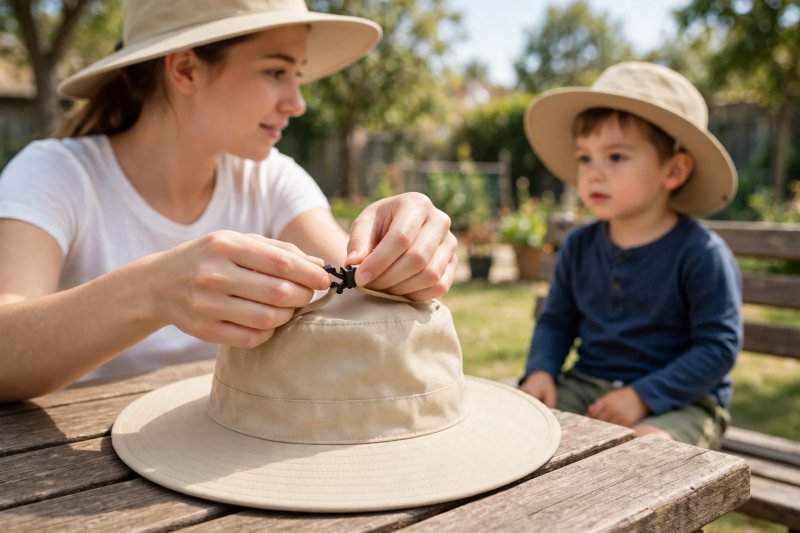
Demand a safe strap — breakaway or none at all. A chin strap keeps a hat on in wind and motion, but the strap itself must be safe: it must be breakaway, designed to release under a firm pull, and never a long, looped cord that can catch and tighten. Test the release yourself in the shop with a steady pull before the hat goes near your child. If a strap does not release, remove it if it detaches cleanly or choose a different hat — no strap at all is safer than a non-release cord. Straps also come off, or the hat comes off, for climbing frames and slides, where anything around the neck is a catching hazard. Say, "The strap's job is to hold your hat — and its other job is to let go." Never tie, extend, or improvise a strap with string or ribbon.
-
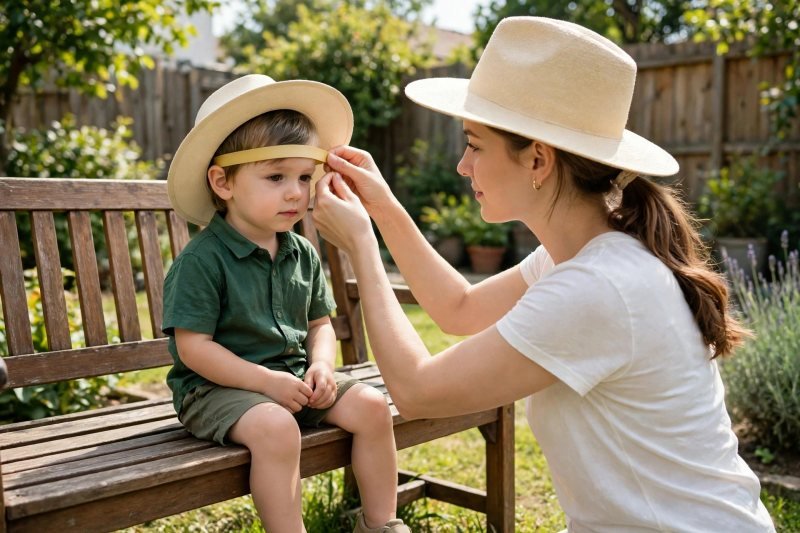
Fit it on the real head — snug, not tight, with room to grow. Measure around the forehead with the soft tape, just above the eyebrows and around the fullest part of the head, then match that measurement to the hat's size guide rather than guessing by age — heads at 3 and 4 vary enormously. The right fit stays put when your child shakes their head and looks down, but never leaves a red line or a headache complaint; you should slip one finger between band and forehead. Leave a little room to grow, but not so much the brim drops over the eyes. It is the same fit logic parents use for seasonal gear in our guide to toddler winter outfits — measure the child in front of you, not the age on the label. Say, "Shake test! If it stays on and feels soft, it fits." Try the hat on at home before a trip, with time to exchange it calmly.
-
Check comfort details — the inside decides everything. Children rarely reject hats in general; they reject one scratchy seam, one sweaty band, one rough edge — then announce they hate hats. Turn every finalist inside out and run your fingers around the inner band: it should feel soft and smooth, with no scratchy seams, stiff tags, or rough stitching against the forehead. Ventilation helps on hot days — small eyelets or a mesh panel in the crown let heat escape so the hat does not become a little oven. Check too that the brim's underside is not a glaring bright color bouncing light into the eyes. Say, "Feel inside with your fingers — is it soft everywhere?" A comfortable hat is the one that stays on, and comfort is checked with fingertips, not eyes.

-
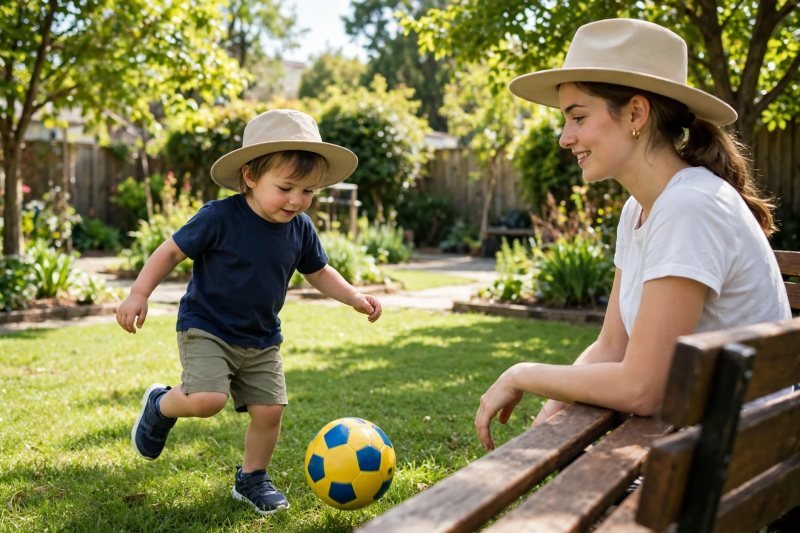
Run the wear-it test — ten minutes of real play decides. Start with a mirror moment: your child puts the hat on, sees themselves, and adjusts it — children wear what makes them feel like themselves. Then let them choose between the two finalists; a chosen hat has a defender, a handed-down verdict does not. Follow with ten minutes of ordinary play — running, bending, looking up and down, a drink of water — ideally outside, perhaps watching for butterflies and talking through the butterfly life cycle as you walk the yard. Count quietly: if the hat comes off three times in ten minutes, it fails, whatever its label says, and the other finalist gets its turn. Say, "Ten minutes of playing — let's see if your hat wants to play too." Trust the test over every promise, including this guide's.
-
Make the hat a habit — same hook, same moment, every day. A chosen hat still fails if it lives in a random drawer. Give it a home: a hook at child height by the back door, right where shoes go on, so the routine becomes shoes, hat, door — in that order, every sunny day. Keep a spare plain hat in the go-bag or car for forgotten-hat emergencies, because the best protection is the hat that is actually there. Wear a hat yourself; small children copy what they see far more reliably than they obey what they hear, and a hatted parent makes hats normal. Praise the routine, not the compliance: Say, "Hat on, shoes on — ready team." Within a couple of weeks, most children start reaching for the hook themselves, and the morning argument quietly disappears.

-
Care for it and team it up — hat plus sunscreen plus shade. Follow the hat's own care label for washing or rinsing — many sun hats simply need a rinse after a salty or sweaty day, dried reshaped with the brim flat — and recheck the strap release and fabric now and then, because a stretched or torn hat protects less than it did. Most importantly, a hat works with sunscreen and shade, never instead of them: sunscreen goes on every exposed area the hat does not cover, and our simple kids skincare routine shows how sunscreen fits a calm morning sequence; plan shade breaks and water on long days too. Learn the heat warning signs — a child who looks flushed, feels very hot, or seems dizzy, tired, or unwell needs shade, water, and cooling down right away, and you should see a doctor if symptoms persist or you are worried. Say, "Hat, sunscreen, shade, water — that's our sunny-day team."



Make it easier
Start with two finalists only: pre-filter by brim, fabric, and strap yourself, then let your child make the final, real choice between two good hats. Practice indoors first: five minutes of hat-on play at home, with the mirror moment, before the hat has to perform on a real outing. Pair the hat with a loved routine — hat goes on with favorite shoes or "explorer" play — so it borrows enthusiasm from something already liked. The same patient, choice-first approach works for getting a toddler to wear sunscreen.
Make it harder
The detective upgrade: let your child hold each hat up to the light for the weave check and announce "tight" or "see-through" — a 4-year-old inspector takes the job seriously. The shadow check challenge: at different times of day, stand in the sun together and check whose face is fully in hat-shadow; your child learns to read their own shade line. The packing job: your child becomes hat keeper for outings — hook check before leaving, spare-hat check in the bag — real responsibility for a routine they own.
Other ways to play it
- Beach and pool days: choose the legionnaire style with the longest neck flap, a strap that passes the breakaway test for breezy shorelines, and a fabric you are happy to rinse daily; re-shade and re-dry the hat at every swim break. Our guide to sun safety for kids covers shade and water breaks for long beach days.
- Playground and everyday: a wide-brim hat with a shorter back or softer flap is lighter for running and climbing — remembering that straps come off, or the hat comes off, for climbing frames and slides.
- Very sunny trips: go maximum coverage — widest brim, full neck flap, tightest weave of your finalists — and shorten the plan itself: earlier outings, longer shade breaks, and more water stops built into the day.
How it changes by age
- Age 3: Threes are led by comfort and imitation. Keep choices to two finalists, give the wear-it test a playful frame (a mirror, a race to the door), and do the strap, fit, and fabric checks entirely yourself. A 3-year-old's job is to wear and enjoy; a parent's job is every safety check in steps 4 to 6. Short, successful outings build the habit faster than one long, hot battle.
- Age 4: Fours can join the judging: they can do the light-through-the-weave check, feel inside for scratchy seams, report honestly whether a band feels tight, and own the hook-by-the-door routine with pride. Give them the vocabulary — brim, flap, strap, shade — and their wear-it-test verdict deserves real weight; a 4-year-old who chose and tested a hat defends it like a decision, not a rule.
What they're learning
Sun awareness: face, ears, and neck need shade, and shade can be carried — an early, concrete health habit they can see and check themselves. Decision-making: choosing between two real finalists, then living with the result through a ten-minute test, is genuine evaluate-and-choose practice. Body awareness and vocabulary: snug versus tight, soft versus scratchy, shadow versus sun — precise words for what their own body feels. Routine and responsibility: hook, shoes, hat, door — a self-managed sequence, plus caring for a belonging so it keeps working.
Clearing up
Back home, the hat goes straight onto its hook by the door — that single motion is the cleanup and the habit in one. Rinse or wash it when the care label calls for it after sweaty, salty, or sandy days, reshape the brim while it dries, and let it dry fully before the next outing so it never smells like yesterday's beach bag. Check the strap release and inner band as you hang it up; a hat stored clean, dry, and in its place is a hat that gets worn tomorrow without a search party. For younger siblings still in toddler sizes, the same coverage checks apply — see toddler sun hats.
Questions parents ask
What type of sun hat is best for a 3- or 4-year-old?
Does my child need a hat with a UPF rating?
How should a child's sun hat fit?
Are chin straps on kids' sun hats safe?
What should I do if my child keeps taking their sun hat off?

save it for later
Pin this for the next rainy afternoon
Keep it on a board so it is there when you need it, rather than when you happened to find it.
Save to Pinterest


