


Preschool Summer Outfits: Easy Warm-Weather Looks
Preschool summer outfits are easier when your child can choose and dress herself: 10 warm-weather looks built on breathable cotton, elastic waists, and simple closures, with a dressing skill to practice in every single outfit.
Preschool summer outfits work best as light, breathable pieces a young child can pull on herself: cotton tees, elastic-waist shorts, simple dresses, and rompers, finished with a sun hat, sunscreen, and secure shoes. Give her two choices, let her dress at her own pace, and practice one small skill with each outfit.

The short version
- Ten mix-and-match looks cover the season: park basics, tank and bike shorts, a sundress, a romper, swim layers, a polo outfit, a cardigan layer, sports gear, a rain outfit, and a travel set.
- Elastic waists, one-piece outfits, and one simple fastening make self-dressing possible at ages 3–4.
- Light, breathable cotton in a loose fit keeps preschoolers cooler than heavy or tight clothes.
- Hat and sunscreen are the last step of every outfit; check shoulders on rash-guard days.
- No drawstrings, secure shoes, and buttons checked tight keep dressing safe.
- Age
- Ages 3–4
- Prep
- 15 min
- Mess
- Low
- Difficulty
- Easy
- Where
- Indoor
Why kids love this
Preschoolers love being in charge, and preschool summer outfits give them a real job with a real result: a look they picked, all by themselves. Every outfit ends the same satisfying way — hat on, sunscreen on, ready to go.
What you'll need
- Cotton t-shirts and sleeveless tanks in light colors
- Elastic-waist shorts and stretchy bike shorts
- Cotton sundresses and one-piece rompers with one simple fastening
- A rash guard and swim shorts over a swimsuit
- A soft polo shirt and khaki shorts
- A light cardigan for air-conditioned rooms
- An athletic tee, stretch shorts, socks, and secure sneakers
- A light rain jacket and rain boots
- A soft matching top-and-shorts travel set
- A wide-brim sun hat and sunscreen
- A low rack or open drawer she can reach
Before you start
1. Set up the station: a low rack or open drawer at her height, two outfit choices laid out the night before. 2. Check every piece: elastic that snaps back gently, buttons tight, no drawstrings or dangling cords, scratchy tags removed. 3. Keep hat and sunscreen in one fixed spot by the door — the last step of every outfit. 4. Agree the rule out loud: she chooses between two outfits, dresses at her own pace, and you help only when she asks. 5. Check your preschool's own rules before the first week — some settings ask for closed shoes, no drawstrings, or spare clothes in a named bag — and put her name in hats, cardigans, and the rain jacket, the pieces most likely to come home in another child's cubby.
How to do it
-
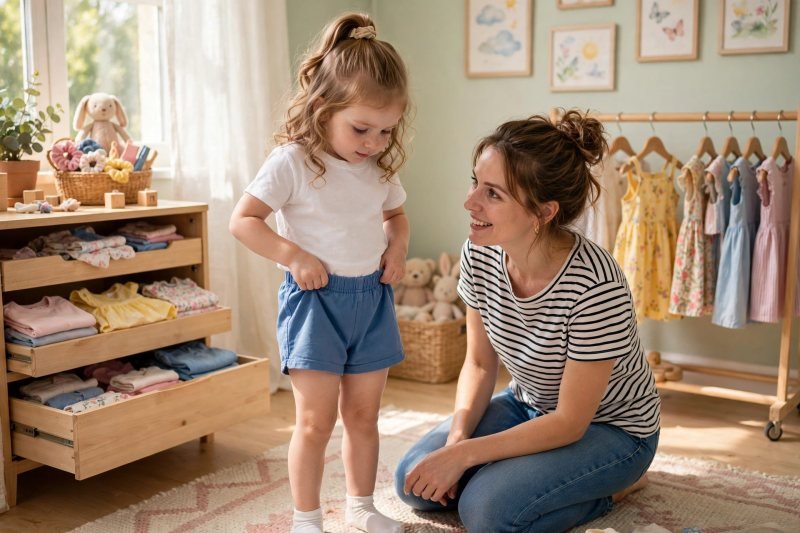
Pick the park-day basics. Lay a soft cotton t-shirt and elastic-waist shorts on the rug and say: "Park day — you can do this whole outfit yourself." Teach today's skill: thumbs hooked inside the waistband, step in one leg at a time while sitting, then stand and pull the elastic up in one smooth tug. She smooths the t-shirt down, checks nothing is twisted in the mirror, and wiggles her hips to prove the waistband stays put. Cotton breathes and elastic needs no button; tomorrow, a sleeveless look is waiting.
-
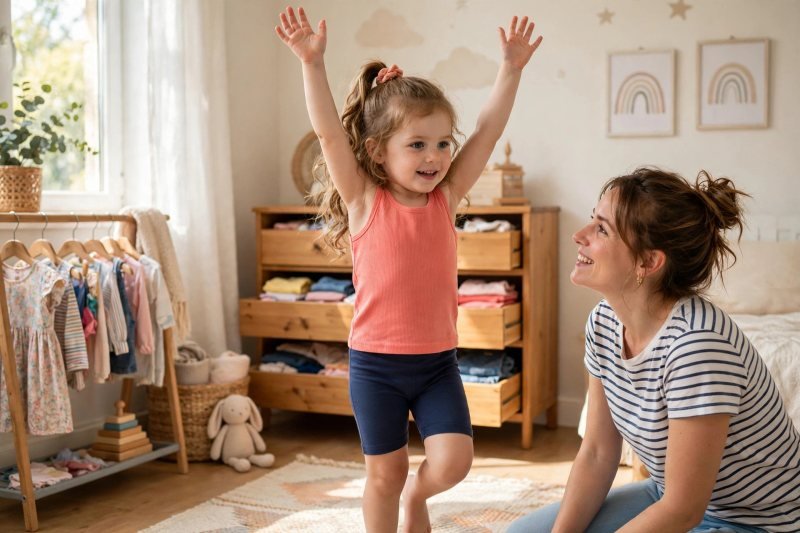
Slide on a tank and bike shorts. For the hottest morning, offer a sleeveless tank top with stretchy bike shorts and say: "Today your arms are detectives — find each arm hole by feel before you peek." Lay the tank flat, neck hole away from her; she slides both arms through first, then pulls the top over her head in one go, so nothing tangles around her face. The bike shorts pull up like yesterday's elastic waist and stay in place on slides and trikes. She raises both arms and marches: smooth tank, steady shorts — the fit passes. Tomorrow needs no matching at all.
-
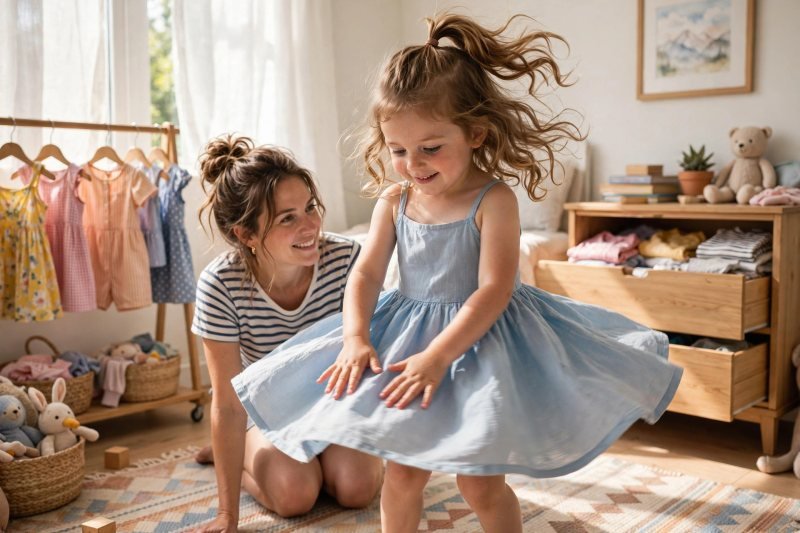
Twirl in a cotton sundress. Hang a one-piece cotton sundress where she can reach it and say: "One piece, nothing to match — one brave pull over your head." Teach the dress skill: find the neck opening, gather the skirt in both hands so it cannot catch, arms up first, then let the dress fall and smooth it down with flat palms. Air moves freely under a sundress, with no waistband pressing a warm tummy. She does the twirl test, sits cross-legged, and reaches high. Tomorrow's one-piece adds a fastening.
-
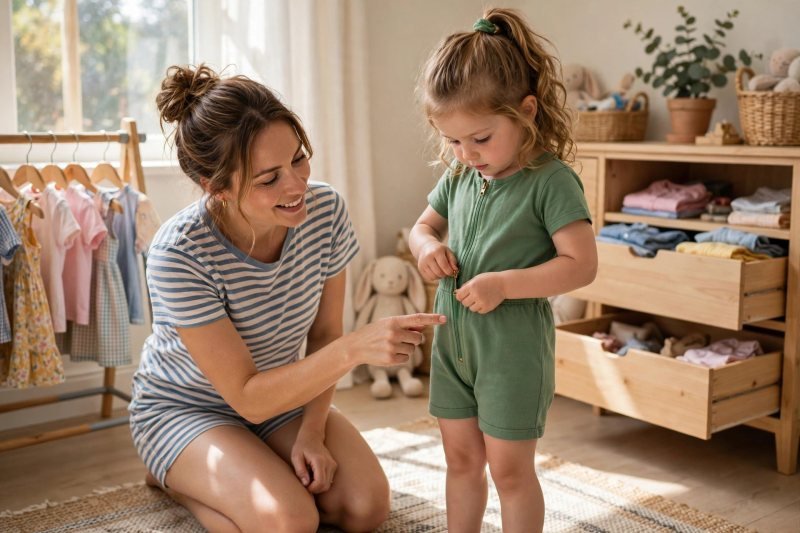
Zip a one-piece romper. Present a short romper and say: "A romper is a top and shorts already holding hands, and you are in charge of its one fastening." Practice the single closure on the bed first — lining up a zipper pull or one large snap until her fingers know the motion — then she steps in, pulls it up, and works the fastening herself while you steady nothing but the mood. Add the bathroom-planning talk: "This outfit takes longer in the bathroom, so we try before we leave, and we tell a teacher early." Tomorrow is built for water.
-
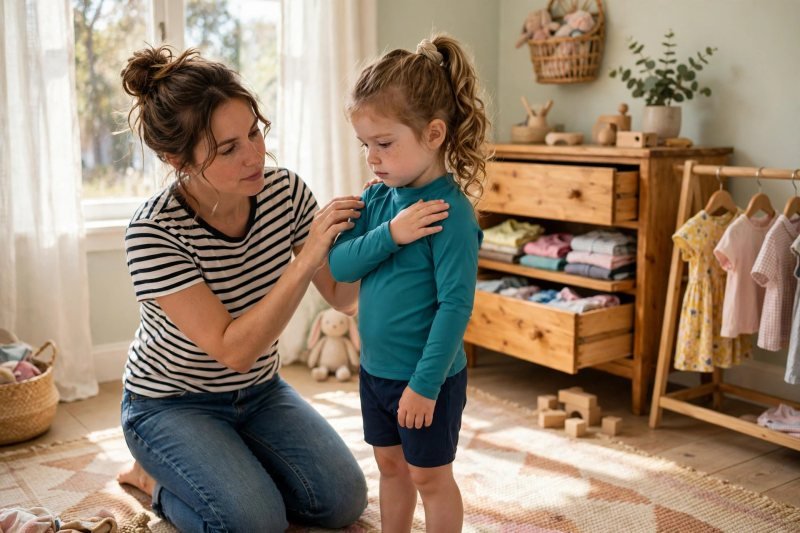
Suit up for the splash pad. Lay out a swimsuit with a rash guard top and swim shorts over it and say: "Splash pad day — a sun shield you can swim in." She pulls the swimsuit on, steps into the swim shorts with her practiced elastic pull, then slides the rash guard over her head like the tank, arms finding the long sleeves by feel. Now the sun coverage check, shoulders first: she pats her shoulders, upper arms, and neck while you ask, "Covered or bare?" Face, ears, legs, and feet get sunscreen, applied the way our simple kids skincare routine sets it out. Tomorrow is picture day.
-
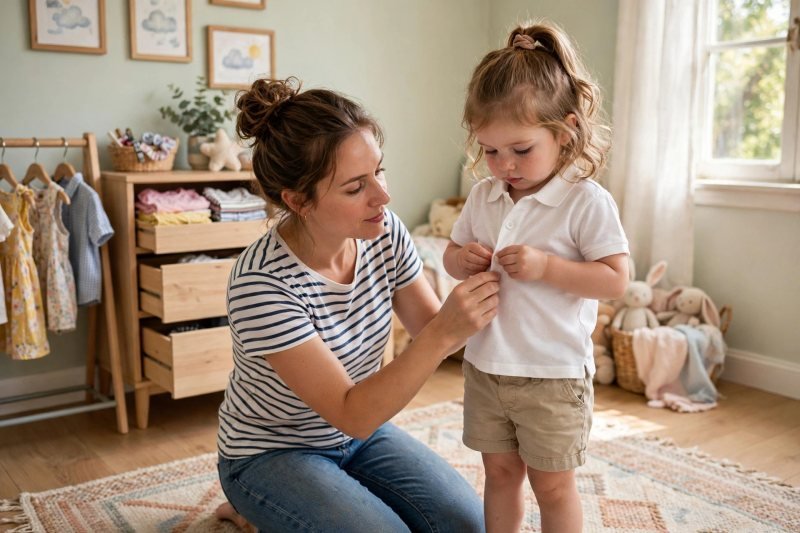
Button a polo for picture day. Bring out a soft polo shirt with khaki shorts and say: "This shirt has buttons, and you only have to win one of them." The elastic-waist shorts are old friends, so save her focus for the polo skill: pinch one big button, push it halfway through its hole, and pull gently from the other side while you coach the angle and hold the fabric steady. One button fastened by her own fingers is the whole goal. Mirror check: collar flat, shirt smooth, big practice smile. Tomorrow solves chilly rooms.
-
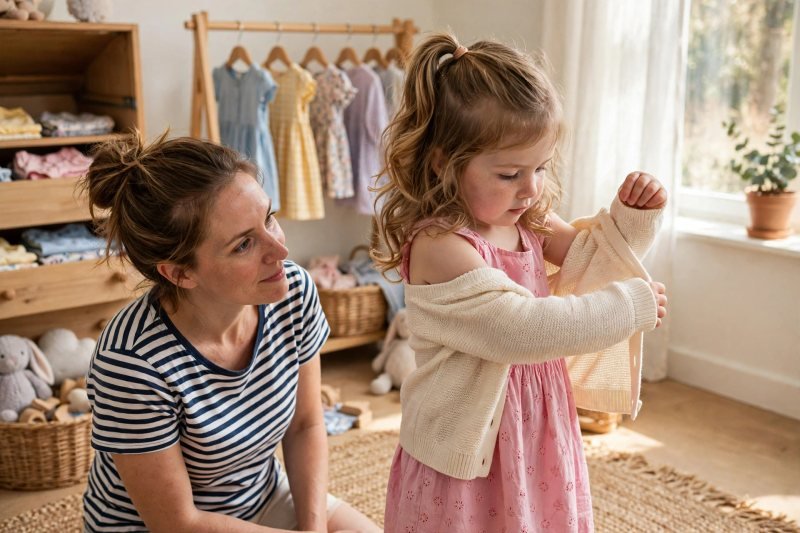
Layer a cardigan for chilly indoors. For the library, where air conditioning runs cold, lay out a sleeveless dress with a light cardigan and say: "Hot outside, chilly inside — this layer comes off and goes back on all by yourself." She starts with the dress, then learns the cardigan skill: hold it behind her by the shoulders, slide one arm in, reach around for the second sleeve, and shrug it into place. Practice off-and-on twice — on for the chilly room, off in the sun — so she never chooses between shivering and overheating. Tomorrow: sports day.
-
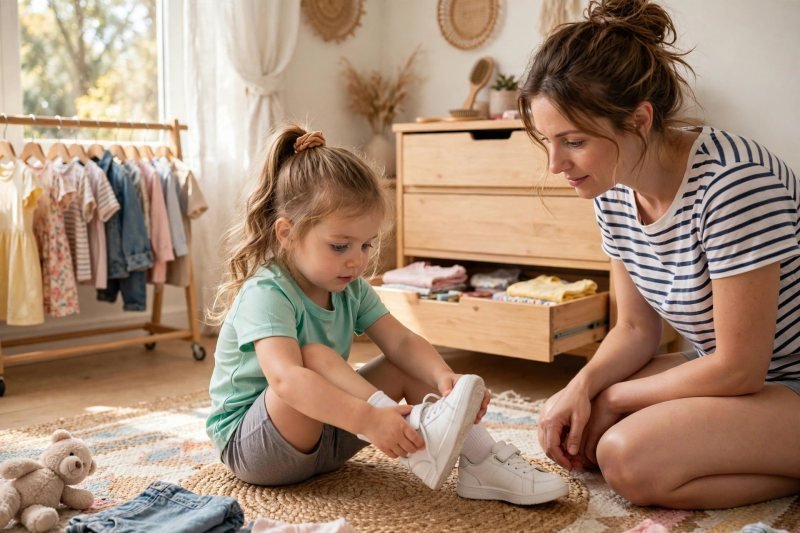
Gear up for sports morning. Set out an athletic t-shirt, stretch shorts, socks, and sneakers and say: "Fast outfit — and the secret is doing your feet in the right order." The tee and elastic shorts go on in record time, so slow down for today's skill: socks before shoes, always, each sock scrunched up, toes in first, then unrolled smoothly so no lumpy seam hides inside the shoe. She slides each sneaker on, presses the fastenings closed, then tests: ten marching steps, five jumps, a run across the rug. Tomorrow, rain picks the outfit.
-
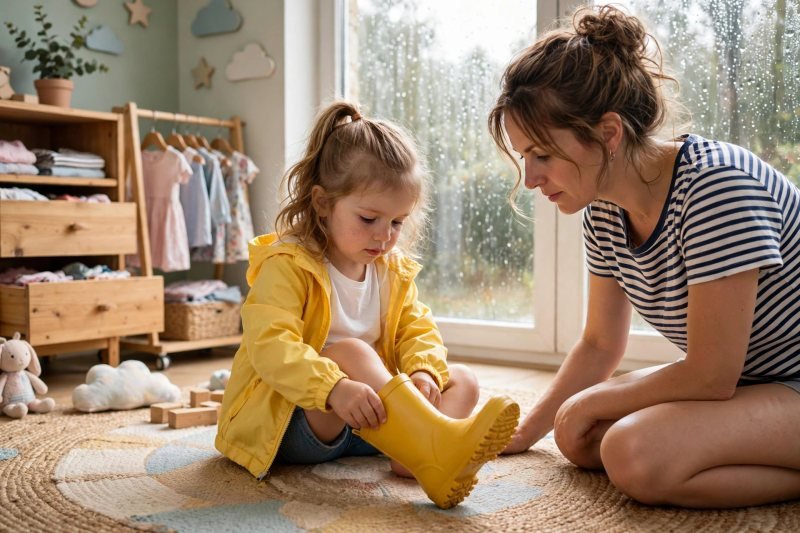
Splash in a summer rain outfit. On the wet morning, gather shorts, a t-shirt, a light rain jacket, and rain boots by the bedroom window and say: "Same summer clothes underneath, one waterproof layer on top — and boots must land on the right feet." She dresses in her basics, fastens the jacket over the top using her romper and cardigan practice, then sits for the boot skill: match each boot's shape to each foot, toes pointing out, and push her heel all the way down before standing. Shorts keep hems out of puddles. For more warm-weather plans across the season, see our summer hub. One look left.
-
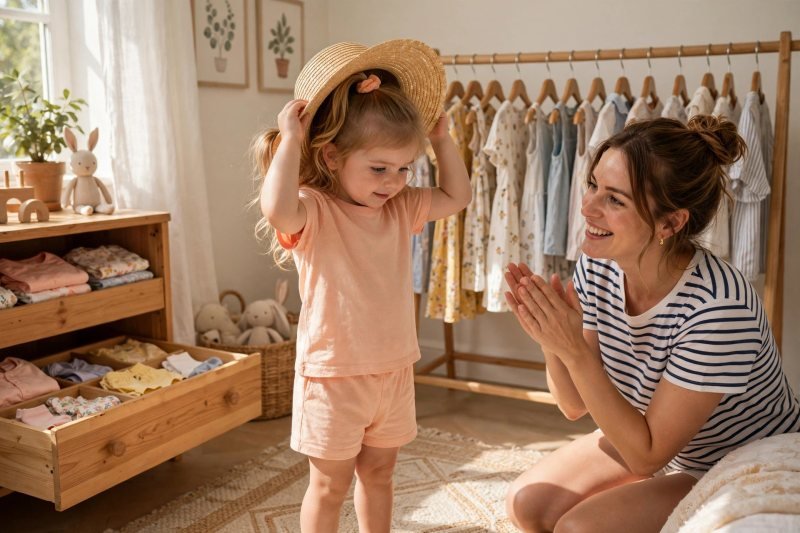
Wind down in a comfy travel outfit. Lay out a soft matching top-and-shorts set and say: "Travel day — the coziest look of the week, because these pieces were made to go together." The matching is done, the waist is elastic, and by now she dresses start to finish with barely a word from you — the point of the week. Finish with the ritual that closed every outfit: sun hat on, shading her face, and sunscreen on bare skin, saying together, "Hat and sunscreen are the last step of every outfit, always." Ten looks, all chosen and worn by her.


Make it easier
Offer two choices only — "blue shorts or green shorts?" keeps choosing fun. Lay pieces out in wearing order, top first and shoes last, so the sequence teaches. Sit down for bottoms and boots; both are far easier sitting. Do fastenings hand-over-hand, then let her do only the last push or pull so she still gets the win.
Make it harder
Let her pick from three outfits and explain: "Which is best for the splash pad, and why?" Add the weather check: she rules out one outfit that does not fit the day, then picks the day's plan from our summer activities for kids. Hand her the finishing ritual completely: hat, sunscreen on easy spots, and the rash-guard shoulder check.
Other ways to play it
- Beach-day swap: a swimsuit under a loose cotton cover-up dress, keeping the rash guard and shoulder check.
- Garden-party version: the sundress or polo look, plus the cardigan if the evening turns breezy. See summer outfits for girls for more combinations in the same palette.
- Cold-snap surprise: for the cold-weather counterpart, see our guide to preschool winter outfits and borrow its layering order.
- Sibling dressing race: a friend picks from his own two choices; first one hat-and-sunscreen ready picks the morning song.
How it changes by age
- Ages 3–4: this is the plan as written. Threes need hand-over-hand help with buttons, zippers, and boot heels, and dress in bursts — one piece, a dance break, the next piece. Fours usually manage elastic waists, dresses, socks, and one practiced button. Expect backwards shorts as normal learning, and praise the attempt before fixing it. For younger siblings, our toddler winter outfits guide adapts the same idea for ages 2–3, with simpler closures.
- Just turned 5 or starting school: keep all ten looks, but hand her the evening-before job — she lays out tomorrow's choices and puts hat and sunscreen by the door unasked.
What they're learning
Independence and self-care: choosing, dressing, and finishing an outfit alone is a job she can truly own. Sequencing: bottoms sitting down, tops over the head, socks before shoes, hat last. Fine motor control: pinching buttons, pulling zippers, hooking waistbands, and unrolling socks strengthen school-ready fingers. Body and comfort awareness: noticing bare shoulders, a lumpy sock, or a pinching waistband teaches her to speak up.
Clearing up
"Preschoolers need a big summer wardrobe." No — ten mix-and-match looks on a handful of basics cover a season; more clothes means harder choices. "Dressing herself makes mornings slower forever." The first week is slower, honestly — then skills stack up, and practiced waists, dresses, and socks-before-shoes often beat the helped routine. "A t-shirt is fine sun protection at the splash pad." A wet, stretched t-shirt lets sun through; hence the rash guard plus sunscreen on bare patches. "Pricey fabrics keep kids coolest." Light cotton in a loose fit does the job; airflow beats a label.
Questions parents ask
What should a preschooler wear in summer?
How do I teach my preschooler to dress herself?
What fabrics are coolest for kids?
How many summer outfits does a preschooler need?
What should she wear to preschool in hot weather?
Suggested follow-ups: a first-week-of-preschool morning routine; choosing secure summer shoes; a printable outfit-choice chart.

save it for later
Pin this for the next rainy afternoon
Keep it on a board so it is there when you need it, rather than when you happened to find it.
Save to PinterestTry this next
-
First 10 Sight Words for Preschoolers: Where to Start (and What to Skip)
Ages 3–4
-
Preschool Sight Words List: The First 40 Words (Dolch Pre-Primer)
Ages 3–4
-
Rhyming Games for Preschoolers: 12 Playful Ways to Hear the Rhyme
Ages 3–4
-
Words That Rhyme With Sun: 15 Bright Rhymes for Little Learners
Ages 3–4


