


Best Hair Brush for Toddlers: Gentle Picks for Every Hair Type
Finding the best brush for toddler hair is about matching the brush to your child's hair type — fine, curly, thick, or tangle-prone — and testing feel and flex before you buy. This guide shows what to look for and how to brush gently, ends to roots.
The best brush for toddler hair depends on your child's hair type: soft bristles for fine hair, flexible widely spaced teeth for curls, and a gentle detangling design for thick or tangle-prone hair. Choose by feel, flex, and handle size, test with one gentle stroke, and brush ends-to-roots in small sections.

The short version
- Match the brush to hair type — fine, curly, thick, and tangle-prone hair each need different teeth.
- Test feel on your own wrist and flex against the counter before any brush touches your toddler.
- Choose a short, chunky handle that both toddler hands and yours can grip without slipping.
- Brush ends to roots in small sections; use fingers and plain water first on stubborn tangles.
- The winner is decided by your toddler's face during one gentle stroke — flinching means fail.
- Clean the brush regularly and replace it when teeth crack, bend permanently, or tips are damaged.
- Age
- Ages 2–3
- Prep
- 10 min
- Play time
- 5 min
- Mess
- None
- Difficulty
- Easy
- Where
- Indoor
Why kids love this
Toddlers love a brush that does not pull. When brushing stops hurting, it stops being a battle and becomes a cozy ritual — sitting on the stool, holding their own brush, copying you in the mirror. The best brush for toddler hair is the one your child will sit still for, and that almost always comes down to gentle teeth, a handle little hands can grip, and a parent who works in small sections instead of dragging through knots. If your toddler dreads anything near their head, the same calm, unhurried approach in our haircut anxiety tips for kids helps here too.
What you'll need
- Two or three brush styles to compare — a soft-bristle brush, a flexible detangling brush, and a wide-tooth comb cover most hair types
- A small spray bottle of plain water for dampening tangles
- A soft towel and a low stool or step so your toddler sits at mirror height
- A hair tie or clip for sectioning longer hair
- Your toddler's regular routine moment — after bath or before getting dressed works best
Before you start
1. Compare brushes when hair is dry and calm, not during a rushed morning — you want honest reactions, not hurry. 2. Run every candidate brush across the inside of your own wrist first; if it scratches you, it will scratch a toddler scalp. 3. Note your child's hair type honestly: fine and straight, fine and wavy, curly, thick, or very tangle-prone after sleep. 4. Set a regular brushing moment from the start, so the new brush arrives as part of a familiar routine, not a surprise.
How to do it
-
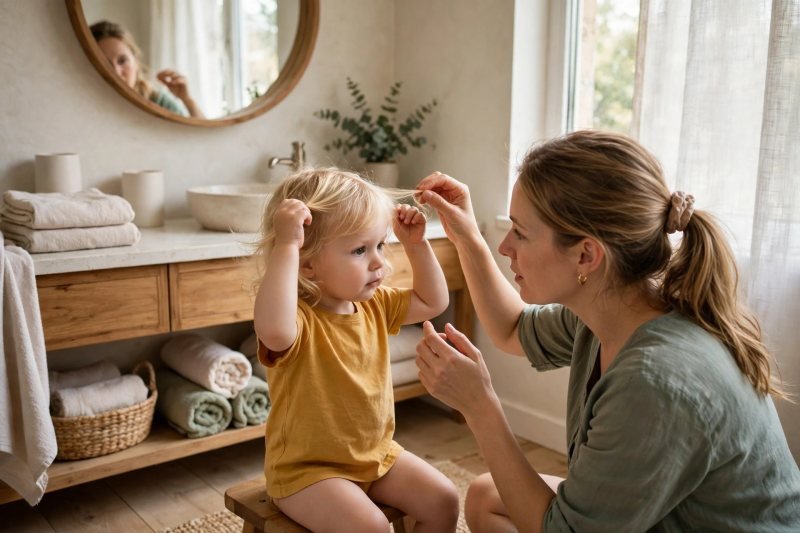
Start with a hair-type check. Sit your toddler on the stool and look together in the mirror while you gently lift sections of hair — fine hair lies flat and tangles into wispy nests; curly hair springs and tangles at the ends; thick hair tangles underneath where you cannot see. Say: "We are picking a brush that is kind to your hair — your hair gets to choose." Let your toddler touch their own hair and yours so the differences feel real. This check decides everything that follows, because no single brush is best for every head. Hair type named — now you sort the brushes by feel.
-
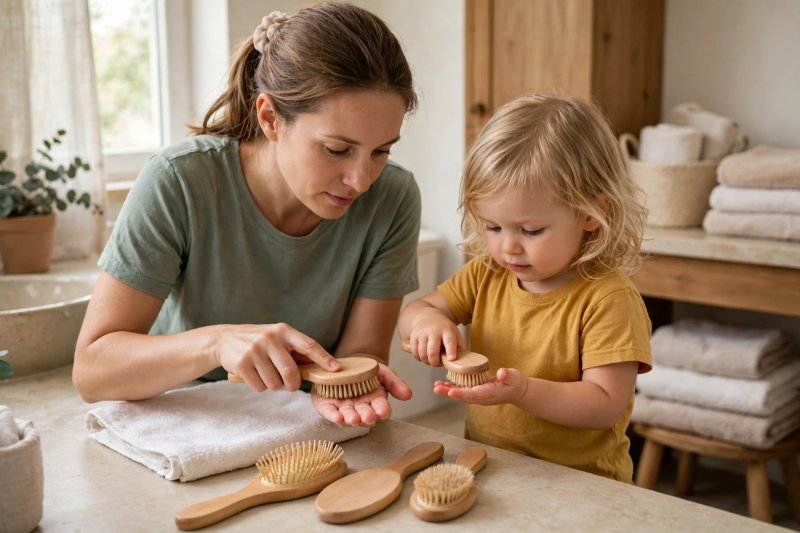
Sort brushes by bristle feel. Line up your candidates and press each one into your palm, then let your toddler press them too — soft bristles bend and sweep; flexible detangling teeth give and spring back; wide comb teeth stay smooth and spaced. Say: "Soft for smooth hair, bendy for tangles, wide teeth for curls — feel how this one bends?" Cross off any brush with sharp, stiff, or scratchy tips, bare metal pins, and any with tiny ball tips that are loose or cracked, since damaged tips snag. Keep the two gentlest options for the live test. Brushes sorted by feel — next, check how much each one flexes.
-
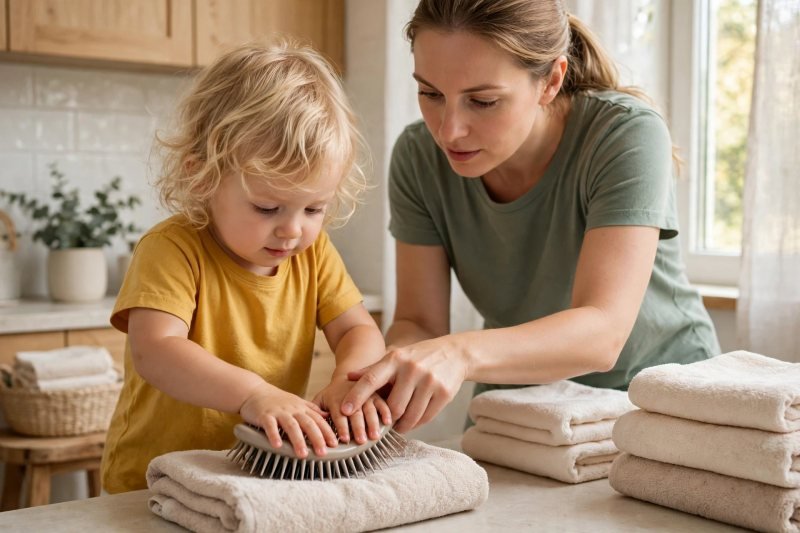
Test the cushion and flex. Press the brush head into a folded towel and watch what gives: a cushioned base or flexible teeth should yield under gentle pressure and spring back, which is what lets the brush glide over a knot instead of ripping through it. Say: "A good brush bends like this, so bumps do not hurt." Let your toddler push the brush into the folded towel and watch it flex — that bend is the comfort feature, more than color or shape. A brush that feels like a hard paddle on your palm will feel harsher on a small scalp. Flex checked — now make sure little hands and yours can actually hold it.
-
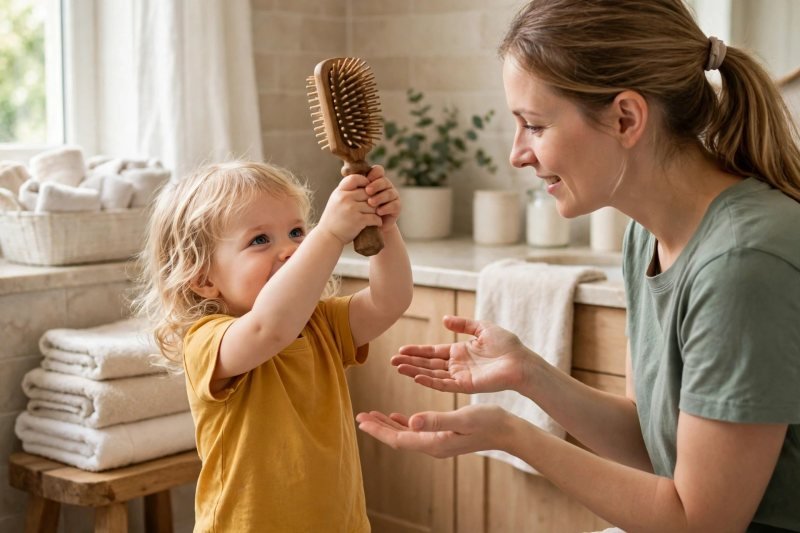
Check handle size and grip. Put the brush in your toddler's hand first: the handle should be short, chunky, and easy to wrap small fingers around without slipping, because toddlers who can hold the brush cooperate with brushing. Then hold it yourself for a full minute of pretend strokes; a handle that cramps your hand will rush every real session. Say: "Your turn to hold it — does it feel like it fits your hand?" Avoid very long, thin, or slippery handles and heavy brush heads that tip out of a toddler's grip. Handle approved by both of you — time for the one-stroke test that decides the winner.
-
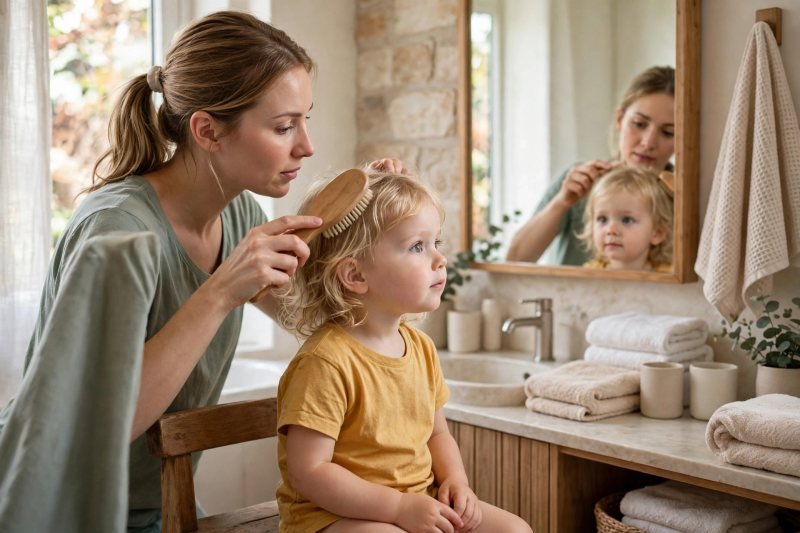
Do the gentle first-stroke test. Take the softest candidate and make one slow stroke through a small, tangle-free section near the front, where your toddler can watch in the mirror. Say: "One gentle stroke — tell me, soft or scratchy?" Watch the face, not just the hair: flinching, leaning away, or a hand flying up means this brush fails, whatever its promises. Try the second candidate on the matching section on the other side and compare reactions honestly. The winner is the brush that gets a shrug or a smile. If both pass, prefer the one that flexed best in step 3. Winner chosen — now learn the brushing order that keeps it gentle.
-
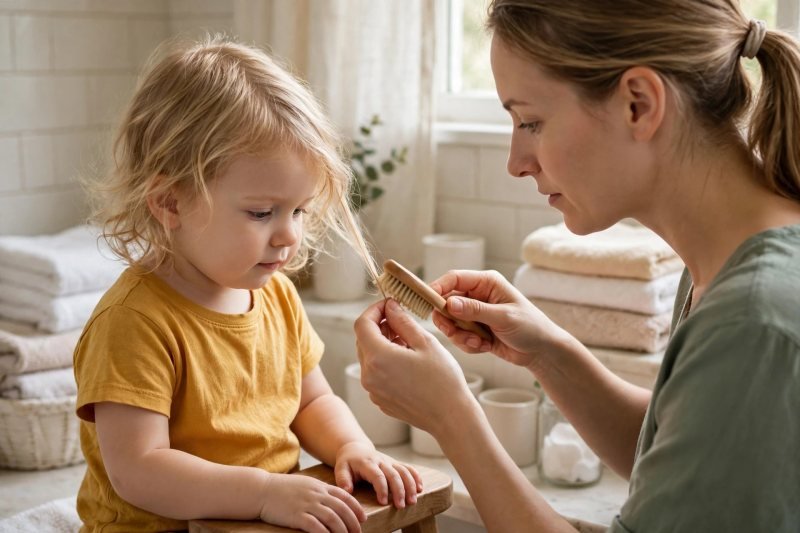
Brush ends to roots in sections. Clip or hold the top hair up and start with the bottom layer: hold a small section gently in one hand and brush only the last inch or two first, then move a little higher, and only stroke from roots to ends once the section runs smooth. Say: "We untangle the ends first, then the brush can slide all the way down." Work around the head in small sections, letting your toddler hold the brush for the easy front strokes. This order is the whole secret — it is the same patience a good stylist uses before a toddler first haircut, and it prevents the painful downward drag through a knot. Sections smooth — one tool remains for stubborn sleep tangles.
-
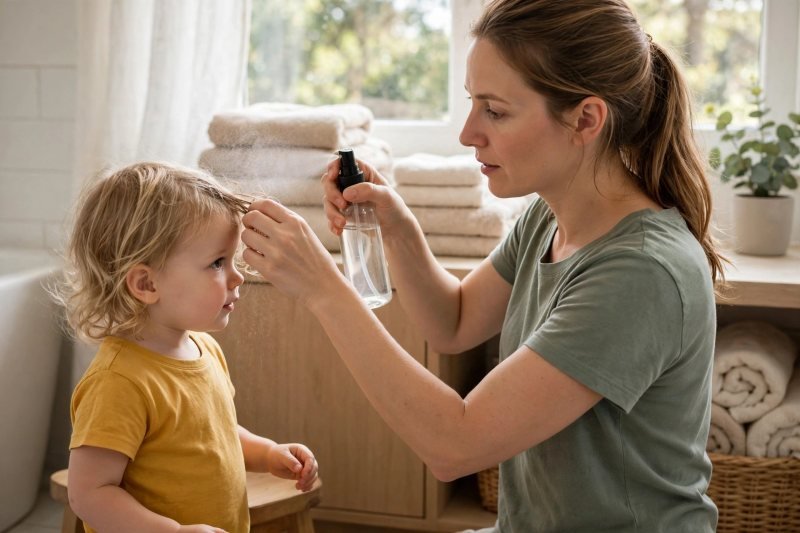
Use water and fingers for stubborn tangles. For a matted patch, do not brush harder: mist it lightly with plain water, work the knot apart gently with your fingers first, and only then use the wide-tooth comb or flexible brush in tiny strokes from the very ends. Say: "Fingers first for big tangles — the brush is for finishing, not fighting." If a tangle truly will not loosen, leave it for bath time, when wet hair washed with a gentle shampoo for kids and toddlers gives more easily, rather than turning the morning into a struggle. Gentle detangling pairs naturally with a simple wash-and-care routine like a kids skincare routine with simple steps — same less-is-more idea, for hair. Tangles handled kindly — finish by giving the winning brush a home and a cleaning habit.
-
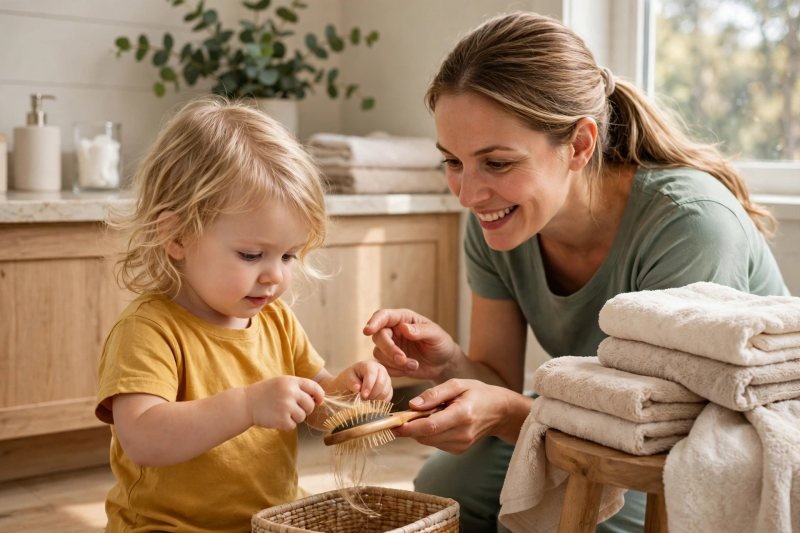
Clean and store the winner together. Show your toddler how to pull loose hairs from the brush after each session and drop them in a small basket, and wash the brush regularly with warm water and a drop of mild soap, rinsing well and drying teeth-down. Say: "Our brush lives here, clean and ready — you are in charge of the hairs." Store it teeth-up or flat in its own spot, away from adult styling tools and heat products, and replace it when teeth bend permanently, crack, or the cushion splits. A cared-for brush stays gentle longer, and the little closing ritual makes tomorrow's brushing start calm. Brush stored and stool tucked away — the tangle battle is officially retired.


Make it easier
Brush at the same calm moment daily — after bath, hair is softer and toddlers expect it; a wash without tears routine makes the whole moment calmer. For very short hair, a soft-bristle brush or even a wide-tooth comb may be all you ever need; skip extra tools. Let your toddler brush a doll or your hair first; practicing the gentle stroke on someone else teaches pressure fast.
Make it harder
Teach your 3-year-old to do the front sections solo while you handle the back — ends first, just like you. Add a mirror narration game: your toddler names each section (side, back, top) as you reach it. Let your child be the brush inspector: after each wash, they check teeth for cracks or bends and report back.
Other ways to play it
- Curly hair version: favor the wide-tooth comb or very flexible, widely spaced teeth; brush when damp, work in smaller sections, and expect to use fingers more than bristles.
- Fine, straight hair version: a soft-bristle brush is usually the winner; tangles are wispy, so light strokes and patience beat heavy detangling tools.
- Thick or long hair version: sectioning is non-negotiable — four clips, four small sections, ends to roots each time; a flexible detangling brush usually earns its keep here.
How it changes by age
- Ages 2–3: the target band. You choose and you brush, but let your toddler hold, press, and vote with their face at every test — cooperation at this age is built on being consulted. Keep sessions under five minutes and stop while it is still going well.
- Ages 4–5: most can do front sections independently with their chosen brush and will have strong opinions about handles and colors. Keep the ends-to-roots rule and the finger-first tangle rule as the non-negotiables.
- When to get help: if brushing reveals scalp redness, flaking that does not settle, patches of hair loss, or tangles caused by something stuck in the hair, check in with your pediatrician rather than treating it at home. Persistent distress around hair care is also worth raising — sometimes the issue is sensory, not the brush.
What they're learning
Sensory awareness: comparing soft, bendy, and wide teeth — and naming soft versus scratchy — builds precise body vocabulary. Fine motor control: gripping a chunky handle and making slow, short strokes practices the same control pencils will need. Sequencing: ends first, then higher, then full strokes is a three-beat order a toddler can learn and recite. Self-care independence: holding their own brush, cleaning it, and storing it builds real ownership of a daily routine.
Clearing up
The biggest myth is that one brush style is best for every toddler. Hair type decides: soft bristles shine on fine hair, flexible teeth earn their place on tangle-prone hair, and wide teeth respect curls. Next, the idea that a firmer brush detangles faster. Firmer usually just means more pulling — flex is what gets through knots kindly. Finally, brushing harder on a matted patch does not save time; it breaks hair and trust. Fingers, water, and tiny ends-first strokes are slower for ten seconds and faster for the whole morning. Washing less often also means fewer tangles to fight — see how often to wash toddler hair. And if the ends are split or ragged, a trim helps more than more brushing — see how to cut toddler hair at home.
Questions parents ask
What type of brush is best for toddler hair?
How do I brush my toddler's hair without hurting?
Should I brush my toddler's curly hair dry or damp?
How often should I replace a toddler's hair brush?
Why does my toddler hate having their hair brushed?

save it for later
Pin this for the next rainy afternoon
Keep it on a board so it is there when you need it, rather than when you happened to find it.
Save to Pinterest


