


How to Apply Moisturizer to a Squirmy Toddler
Learning how to moisturize toddler skin without a wrestling match comes down to timing, dots, and games: cream on damp skin right after the bath, dotted on like polka dots, and rubbed in with copy-me play. Here is the full squirm-proof routine for ages 2–3.
To moisturize a squirmy toddler, work right after the bath while skin is still damp, let your toddler squeeze and dot the cream like polka dots, then rub it in with copy-me games and counting strokes, section by section. Finish with the face, dress quickly, and keep the whole routine under five playful minutes.

The short version
- Timing is the trick: cream goes on within about three minutes of the bath, while skin is still damp.
- Dot first, rub second — pea-sized polka dots guarantee even coverage on a moving toddler.
- Games beat holding: copy-me circles, counting strokes, and promised wiggle breaks keep toddlers still.
- Use a fixed order — arms, legs, trunk, feet, face last — so no section gets skipped.
- Choose a fragrance-free moisturizer and patch-test anything new on the inner forearm for 24 hours.
- Dress immediately after; freshly creamed feet are slippery, so skip the post-cream running.
- Age
- Ages 2–3
- Prep
- 2 min
- Play time
- 5 min
- Mess
- Low
- Difficulty
- Easy
- Where
- Indoor
Why kids love this
Toddlers do not hate moisturizer — they hate waiting. The moment cream becomes a game, with dots to poke, strokes to count, and a parent copying their silliest arm circles, the squirming turns into showing off. Knowing how to moisturize toddler skin the playful way means your child gets a job in every step: squeezing, dotting, rubbing, and racing you to finish a leg. Kids who help apply their own cream stop fleeing it, because it is no longer something done to them.
What you'll need
- A fragrance-free moisturizer — a cream in a tub or a pump lotion your toddler can help press
- A towel and your toddler's regular post-bath spot — bath mat, bed, or changing table with a towel down
- Pajamas or clothes laid out ready, so dressing is instant when you finish
- A small washcloth for sticky hands at the end
- Optional: a favorite short song to time the routine
Before you start
1. Moisturize within about three minutes of the bath ending, while skin is still damp — set the tub and pajamas out before the bath starts. 2. Patch-test any new moisturizer on the inner forearm and wait 24 hours before first full use. 3. Warm your hands under warm water first; cold hands on a wet toddler guarantee squirming. 4. Decide your order in advance — arms, legs, trunk, feet, face last — so you never pause to think while holding a slippery toddler.
How to do it
-
Set up right after the bath. Lift your toddler out, wrap them in the towel, and pat — never rub — until the skin is just damp, not dripping. Sit them on the towel on the bath mat or bed with pajamas within reach and the moisturizer already open. Say: "Bath done, cream time — the cream drinks the water on your skin before it disappears." Speed matters here for a real reason, not just squirm control: cream applied to damp skin locks that water in, which is the core of any good kids skincare routine with simple steps. Setup done and skin still damp — hand over the most popular job, the squeezing.

-
Let them squeeze and warm the cream. Hold the tub steady or guide the pump and let your toddler press out a grape-sized amount onto your palm or theirs, then rub your hands together to warm it so the first touch is never cold. Say: "Your turn to squeeze — now we warm it up so it feels cozy, not chilly." If too much comes out, celebrate rather than scold; extra cream just means a more generous coat, and you control the tub next time. A toddler who squeezed the cream feels ownership of what happens next. Cream warm and ready — turn application into the polka-dot game.

-
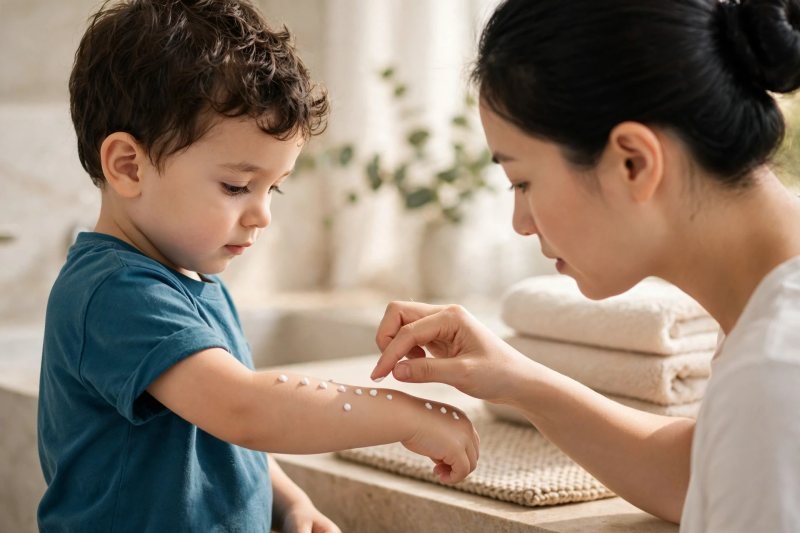
Dot the cream like polka dots. Using one fingertip, dot cream in a line of small spots down one arm — shoulder, elbow, wrist — and let your toddler add the dots on the other arm, counting together as you go. Say: "Polka dots first, rubbing second — dot, dot, dot, how many dots is that?" Dots solve the classic problem of one thick smear and dry patches everywhere else: every section starts with its own supply. Keep dots pea-sized and spaced a few inches apart on arms and legs, with a few extra across the back and belly. Dots placed and counted — now rub them in with the game toddlers love most.
-
Rub arms in with the copy-me game. Smooth the dots on the first arm with long, gentle strokes from wrist to shoulder, then make a big slow circle and challenge your toddler: "Copy me — big circles, now tiny circles, now super slow!" They rub their dotted arm while you finish yours, and the mirroring keeps both arms still far longer than holding would. Say the rule once: "We rub until the dots disappear." When both arms feel soft and the shine fades, give a quick check behind the elbows, a classic dry spot. Arms done and the game is working — carry the same energy to the legs, with counting.

-
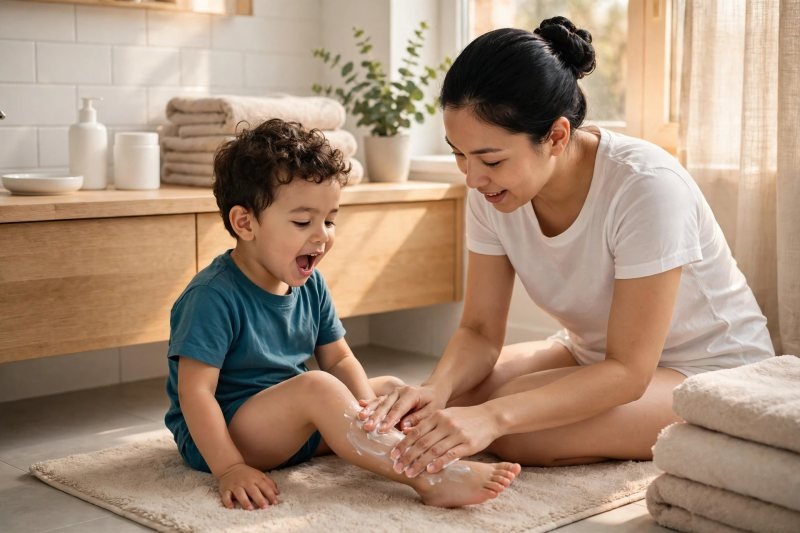
Do legs with counting strokes. Dot each leg the same way — thigh, knee, shin, ankle — then rub in with a count your toddler controls: "How many rubs for this leg — five or ten?" Count out loud together, up and down, and let them shout the final number. Lifting each foot briefly to check the tops and heels keeps wiggly legs engaged because the position keeps changing. Say: "Hold still like a statue until we reach the number — then wiggle break!" A promised wiggle break after each leg is a small deal that works, because the stillness is always short. The counting itself is real practice — the same kind of play in these counting activities for toddlers. Legs smooth and counted — move to the big middle sections before the face finale.
-
Cover trunk, back, and feet. Dot across the belly and chest and rub in with wide, flat-hand sweeps while your toddler takes huge pretend breaths that make the belly rise to meet your hand. Turn them gently or have them hug a towel while you dot and smooth the back in long strokes, then finish each foot with dots on top and a quick smooth over the sole while you name the toes. Say: "Belly breaths, back sweeps, toe roll call — nobody gets skipped." Trunk and feet take under a minute when the dots are already placed. One delicate area remains — the face, which gets the gentlest version of the same game.

-
Finish the face with gentle dots. Put a single pea-sized dab on your fingertip and dot it onto the forehead, each cheek, the nose, and the chin, then smooth outward with feather-light strokes while your toddler makes funny faces in the mirror or at you. Say: "Tiny dots for your face, gentle touches only — make your fish face!" Keep cream away from the eyes, and use less on the face than anywhere else; a thin, even layer is plenty. Funny faces keep the head still better than any instruction to be still. Face finished — the only job left is getting clothes on before the post-cream zoomies scatter your work.

-
Dress fast and celebrate the finish. Pull pajamas on immediately, starting with the trunk and legs you just covered, while the last of the cream settles — clothes over freshly creamed skin also help hold the moisture in. Say: "Cream on, pajamas on — we beat the squirmies again!" Finish with your closing ritual, the same every night: a high-five, a sticker, or three big claps, so the routine ends with a win your toddler can anticipate. Wipe sticky hands — yours and theirs — with the washcloth. Short routines with a fixed order build the kind of sequenced independence a kindergarten readiness checklist looks for later. The dotting and rubbing quietly builds hand strength too, the same skill behind these fine-motor activities for preschoolers. Routine complete, toddler dressed, squirm defeated for another day.



Make it easier
Shorten the game, not the coverage: on exhausted nights, skip counting and just dot and smooth in your fixed order. Moisturize in the empty tub for a contained, warm, no-escape workspace with easy cleanup. For ages closer to 2, you do all the rubbing; their jobs are only squeezing and dotting — that still counts as helping.
Make it harder
Hand over a whole section: your 3-year-old dots and rubs both arms solo while you do legs, then you inspect together. Add a body-map recap at dressing time: your toddler points to each part and confirms it got cream. Let your toddler lead the copy-me game — they invent the stroke, you copy, then swap.
Other ways to play it
- Morning version: skip the bath; dampen hands with warm water, pat a little water on dry patches, and run the same dot-and-rub routine before dressing.
- Extra-dry winter version: use a thicker cream — if you are still choosing one, this guide to the best moisturizer for kids dry skin compares what to look for — add a second thin pass over elbows, knees, and cheeks, and keep baths short and lukewarm.
- Travel version: pack a small tub in the diaper bag and run the identical dot game in the hotel bathroom — familiar steps calm unfamiliar places.
How it changes by age
- Ages 2–3: the target band. Expect movement and plan for it — games, counting, and wiggle breaks are the strategy, not a failure of discipline. Sessions should stay under five minutes, and ending while it is still fun protects tomorrow's session.
- Ages 4–5: most can dot and rub entire sections alone with you supervising, and they love timing the routine against a song. Hand over the face last — pressure control there takes the longest to learn.
- When to get help: if dry patches crack, bleed, ooze, or do not improve with regular gentle moisturizing, or if you see a spreading rash, see your pediatrician. Never use adult or prescription creams meant for someone else on your toddler.
What they're learning
Fine motor control: squeezing a pump, placing fingertip dots, and rubbing in circles build hand strength and control. Counting and sequencing: dots counted, strokes counted, sections in a fixed order — early math inside a care routine, and the same kind of everyday counting in these toddler learning activities at home. Body awareness: naming arms, elbows, knees, heels, and cheeks while touching them builds body vocabulary fast. Cooperation and patience: short stillness with a promised wiggle break practices waiting in a safe, tiny dose.
Clearing up
First myth: you need to pin a squirmy toddler down to moisturize properly. Pinning guarantees a fight tomorrow; dots, games, and a fixed order get better coverage with a moving toddler than force gets with a miserable one. Second myth: more cream is always better. Thick, unabsorbed layers mostly end up on pajamas — pea-sized dots, rubbed in fully, do the real work. Third myth: moisturizer only matters in winter. Air conditioning, swimming, sun, and frequent washing dry toddler skin all year; the after-bath habit is a year-round one.
Questions parents ask
How often should I moisturize my toddler?
What is the best way to put lotion on a toddler who will not sit still?
Should moisturizer go on before or after pajamas?
How much moisturizer does a toddler need?
Can I use my own moisturizer on my toddler?
If the routine falls apart one night, skip the games and just dot and smooth — a short, calm pass still counts, and tomorrow you can play again. When your toddler starts asking for the cream themselves, hand them the tub and let them lead — that is the routine working. Keep the same order and the same closing ritual every night, even on mornings or travel days, so the habit holds when the setting changes.

save it for later
Pin this for the next rainy afternoon
Keep it on a board so it is there when you need it, rather than when you happened to find it.
Save to Pinterest


