


Addition Word Problems for Kindergarten: Picture Stories Within 10
Addition word problems for kindergarten, told as picture stories: your 5–6-year-old hears each story, acts it out with counters, draws it, and solves it. Ten ready-to-tell stories, every sum 10 or less.
Addition word problems for kindergarten are short picture stories with two small numbers hiding inside: your 5–6-year-old hears the story, finds the numbers, acts them out with counters, draws the scene, and says the addition sentence. Every sum stays at 10 or less; two or three stories per sitting is plenty.

The short version
- Picture stories teach what addition means before pencil work: hear, find, act out, draw, say.
- Every problem sums to 10 or less; all arithmetic hand-checked.
- Same five-move routine every time — familiarity frees up effort for the adding.
- Start with totals of 5 or less; "make 10" stories are the stretch goal; counters on the table, drawing cements it.
- Age
- Ages 5–6
- Prep
- 5 min
- Play time
- 20 min
- Mess
- None
- Difficulty
- Easy
- Where
- Indoor
Why kids love this
Word problems feel like storytime, not math time: ducks to count, cookies to share — and your child is the hero who figures out the ending. Acting each story out with real objects means they never guess what "plus" means.
What you'll need
- 10 picture-story cards, printed single-sided (publish-time pack — see Additional notes)
- Bowl of ~20 small counters: dried beans, buttons, or wooden blocks
- Thick beginner pencil or short crayons, plain paper, a folder for finished cards
- Optional: star sticker per solved story
Before you start
Print the cards single-sided, pictures-up. Set counters within reach with drawing paper beside them. Read the first story to yourself once — a calm, storytime delivery makes the numbers easier to hear.
How to do it
-
1. Set the cards face-down with the counter bowl between you and your child.

-
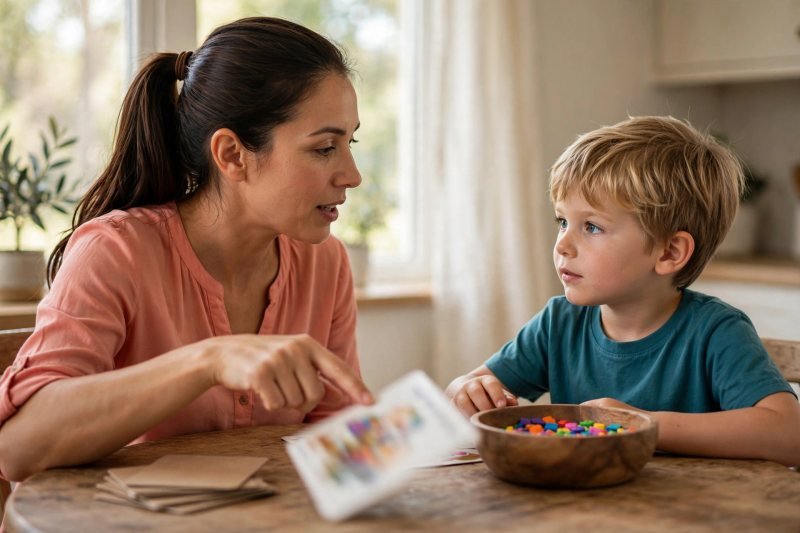
2. Turn over the first card and read the story slowly, pointing at each picture.
-
3. Ask, "What were the two numbers hiding in that story?" Let your child say them back.

-
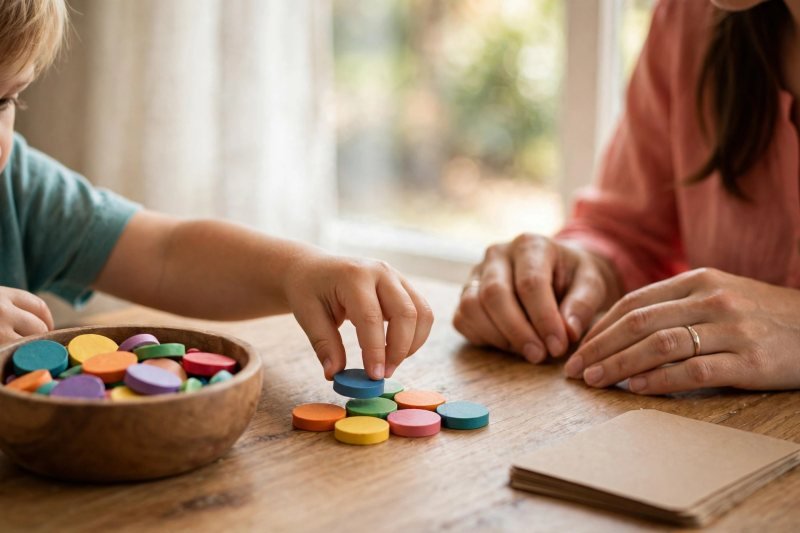
4. Your child builds the first group — three ducks means three counters — touching each one.
-
5. Your child builds the second group beside the first, counting those too.

-
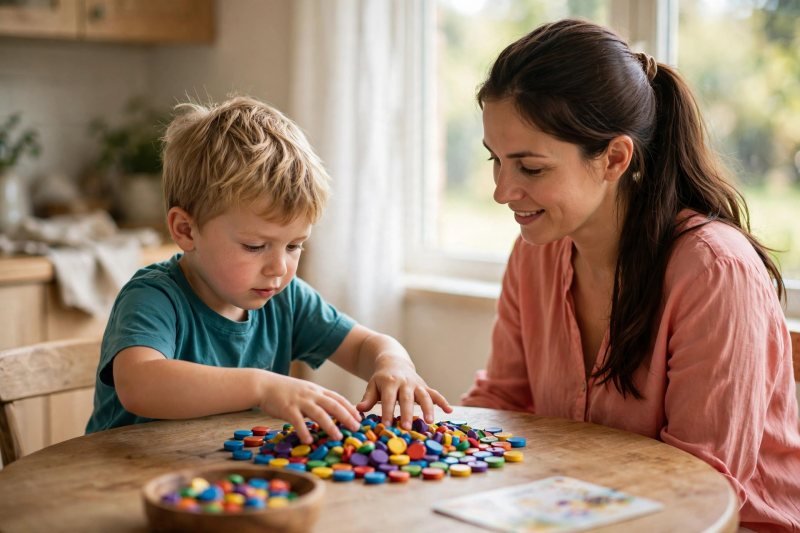
6. Your child pushes both groups together into one big group.
-
7. Count the whole group together, touching each counter, to find the answer.

-
8. Say the full sentence together: "Three ducks plus two ducks makes five ducks."

-
9. Hand over paper and crayons; your child draws the story as it happened.

-
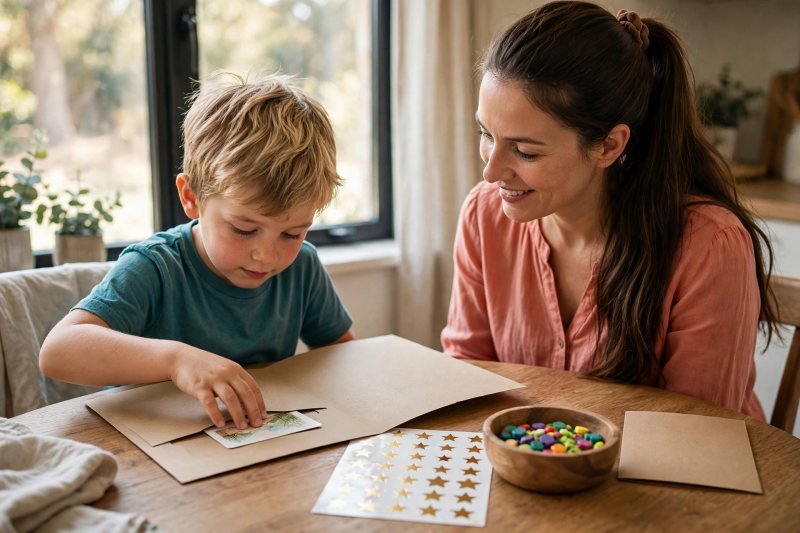
10. Slide the finished card into the folder — star sticker optional — and take the next story when ready.


Print it out
Make it easier
Start with totals of 5 or less: ducks, birds, cats, shells. Use two counter colors so the groups stay separate until the push-together step. Read each story twice before asking for the numbers — hearing it again is not cheating.
Make it harder
Try the "make 10" stories (crayons, fish, cars): "What do you notice about the answer?" Your child invents the story, you act it out, then swap roles. Tell a story with the picture covered, so the numbers must be heard. Once adding to 10 is automatic, [counting coins activities](https://brightplaydays.com/activities/counting-coins-activities/) build the underlying number sense.
Other ways to play it
- **Snack stories:** raisins or blueberries as counters — then eat the answer (count first!).
- **Toy stories:** act it out with stuffed animals or toy cars.
- **Bedtime stories:** one whispered story before sleep — no counters, just fingers.
How it changes by age
- Built for ages 5–6, when children count to 10 reliably and start joining two small groups. Confident 4-year-olds can try the stories totaling 5 or less with a parent acting alongside. If adding to 10 already feels easy, use this for story comprehension and move on.
What they're learning
What "plus" and "altogether" mean in real situations, not just on paper Pulling numbers out of spoken language — the listening skill word problems test Joining two groups and counting the total, then saying the full addition sentence
Clearing up
Tidy together: counters in the bowl, cards in the folder, crayons in the box. Keep the folder visible — children love flipping through solved stories, and each retelling quietly rehearses the facts.
Questions parents ask
When should my child start addition word problems?
What is a picture-story word problem?
My child can add 2 + 3 but freezes on word problems. Is that normal?
How many word problems should a kindergartner do at once?
Should I read the word problem to my 5-year-old?
A storytelling routine, not a worksheet drill: the printable pack keeps stories ready, but the learning happens in the telling, acting out, and drawing. The 10-story PDF is a publish-time item via the CMS Downloads repeater ("Print the 10 picture stories"). For pencil practice later, the addition worksheets for kindergarten pack covers picture addition, ten-frames, and number lines within 10.
What do addition word problems for kindergarten look like?
A two-sentence story with two small numbers hiding inside — never a bare number sentence. Instead of "3 + 2 = ?", your child hears: "Three ducks are swimming in the pond. Two more swim over to join them. How many ducks now?" The picture shows the ducks, the story gives the adding a reason, and your child acts it out before writing anything. If adding is still shaky, [addition games for kindergarten](/activities/addition-games-for-kindergarten/) first makes these stories click faster.
How does the picture-story method work?
Five moves, same order every time: hear it, find the numbers, act it out, draw it, say it. You read the story slowly; your child hunts for the two hidden numbers, builds both groups with counters, pushes them together, and counts everything. Then they draw the story and say the full addition sentence aloud. The unchanging routine is why it works — a familiar rhythm means all effort goes into the adding.
What are 10 picture stories we can start with today?
Hand-checked, sums of 10 or less, in any order:
1. Three ducks are swimming in the pond. Two more ducks swim over to join them. How many ducks are swimming now? **(3 + 2 = 5)** 2. Sam picked four red apples. Then he picked five green apples. How many apples did Sam pick? **(4 + 5 = 9)** 3. Two blue birds are sitting on the fence. Three red birds fly down to sit with them. How many birds are on the fence? **(2 + 3 = 5)** 4. Lily has six crayons in her box. Her brother gives her four more. How many crayons does Lily have now? **(6 + 4 = 10)** 5. One cat is sleeping on the rug. Four more cats come in to nap. How many cats are napping? **(1 + 4 = 5)** 6. Seven fish are swimming in the fishbowl. Three more fish join them. How many fish are in the bowl? **(7 + 3 = 10)** 7. Tom baked five cookies. Grandma gave him two more. How many cookies does Tom have? **(5 + 2 = 7)** 8. Three butterflies are sitting on a flower. Six more butterflies land beside them. How many butterflies are on the flower? **(3 + 6 = 9)** 9. Mia found two shells at the beach. Then she found two more. How many shells does Mia have? **(2 + 2 = 4)** 10. Eight cars are parked in the driveway. Two more cars park beside them. How many cars are in the driveway? **(8 + 2 = 10)**


