


Subtraction With Ten Frames: See What's Left
Subtraction with ten frames, taught as a three-beat method: fill the frame with the starting number, lift the taken-away counters off, and count what's still there.
To subtract with ten frames: fill the frame with the starting number (left to right), lift the taken-away counters off into a bowl, and count what's left in the frame. The empty boxes match the taken-away group, so your child can check their own answer — 7 take away 2 leaves 5.

The short version
- Subtraction with ten frames runs in three beats: fill, take away, count what's left.
- Use 10 counters in one color — one color makes your child count the frame instead of matching colors.
- If your child says the taken-away number, point at the frame: "Those went away — how many stayed behind?"
- Empty boxes are a built-in self-check: they should match the counters in the away bowl.
- The five starter problems: 7−2=5, 6−1=5, 10−3=7, 9−5=4, 8−8=0.
- Age
- Ages 5–6
- Prep
- 5 min
- Play time
- 20 min
- Mess
- None
- Difficulty
- Easy
- Where
- Indoor
Why kids love this
The frame does the hard work for them: they can see the starting number, see the counters leave, and see what is left — all in one small grid. There is no guessing, no finger-counting under the table, and no wrong answer hiding in a row of numbers. And the empty boxes are a built-in self-check: if two boxes are empty and two counters sit in the bowl, the answer has to be right. For a five-year-old, that kind of visible certainty is the whole game.
What you'll need
- One ten frame — draw a 2-by-5 grid on card, print one, or use a lidless egg box.
- 10 counters in ONE color (red works well).
- A small bowl or cup — the "away bowl".
- One die.
- Index cards and a marker (optional).
Before you start
1. Draw or print a blank ten frame — two rows of five empty boxes. 2. Put the 10 counters in one bowl and the empty away bowl beside it. 3. Sit side by side, with the die nearby.
How to do it
-
Draw the frame. Subtraction with ten frames works in three beats: fill the frame with the starting number, take some counters away, and count what's left. Draw a grid of two rows of five boxes — ten empty boxes in all — and set it flat on the table between you. If you want more ways to use the grid, ten-frame activities build the same fill-and-count habit in different games.

-
Count the counters. Tip all 10 counters into the bowl and count them together — one, two, three, all the way to ten. This is the whole supply: every subtraction you do today starts from a number no bigger than 10, and every counter you need is already in the bowl.

-
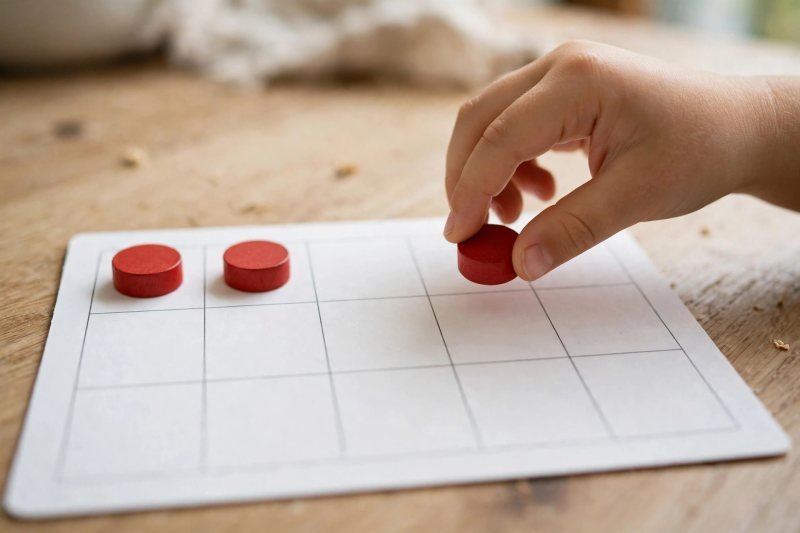
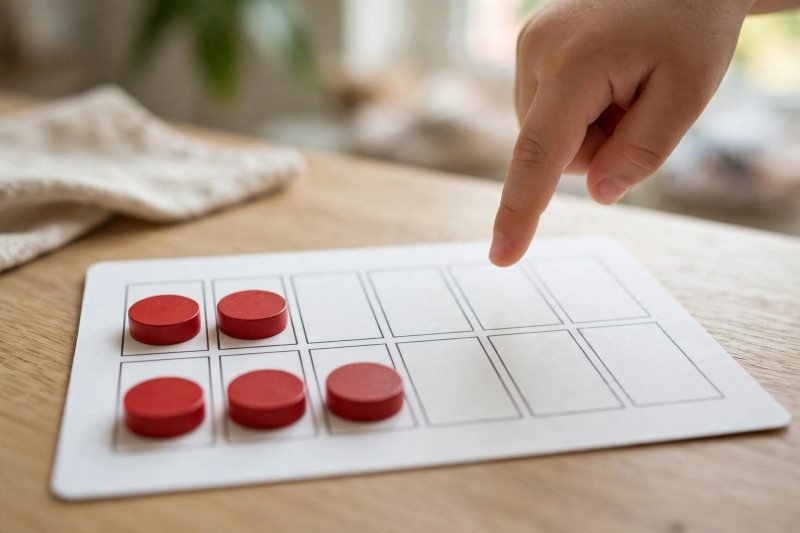
Fill the starting number. Pick a starting number and fill the frame from the left, one box at a time — seven counters, say, left to right, top row first. Count them in as you go: one, two, three, four, five, six, seven. The frame is full to seven, and three boxes sit empty, waiting.
-
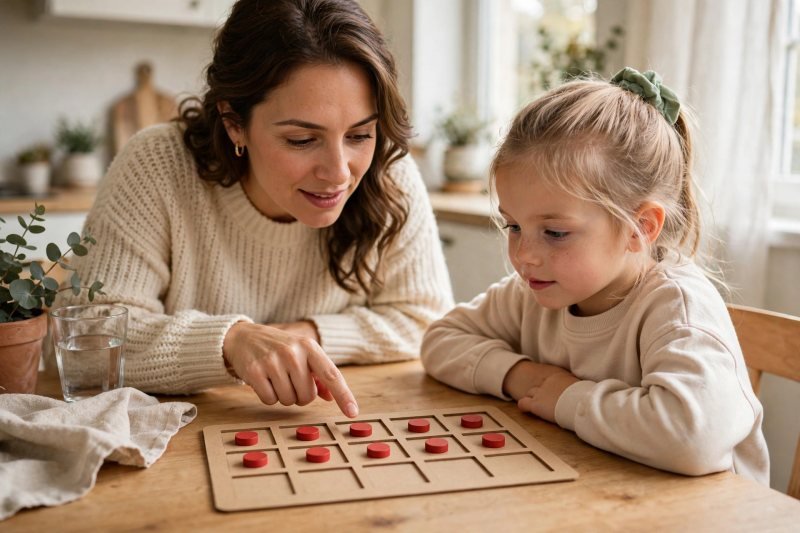
Name the group. Say the starting number out loud together — "Seven" — and point at the filled boxes so the number has a picture attached to it. The same frame works the other way too: addition with ten frames shows how the group grows before it shrinks, so if your child already knows the addition side, this step will feel familiar.
-
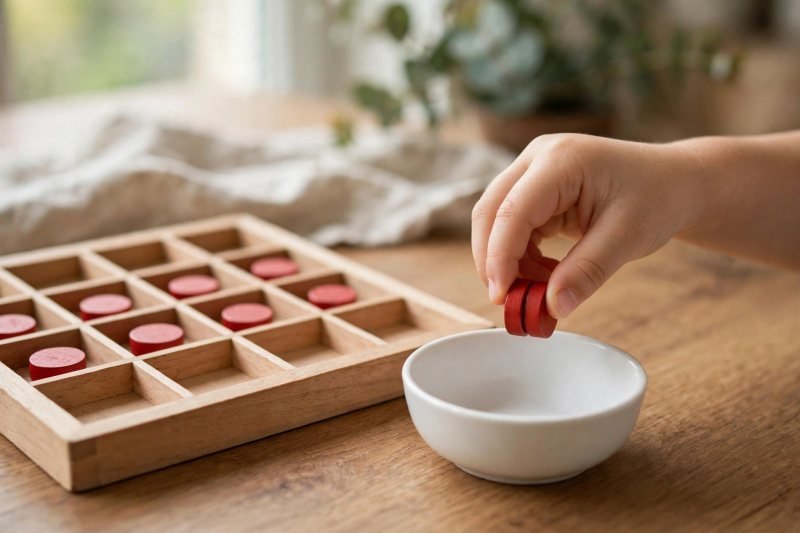
Take some away. Now take some counters off — two, say — lifting them from the end of the row and dropping them into the away bowl, one by one. Say it as you go: "Two go away." The taken-away counters are not gone; they are sitting in the bowl, where your child can see them.
-
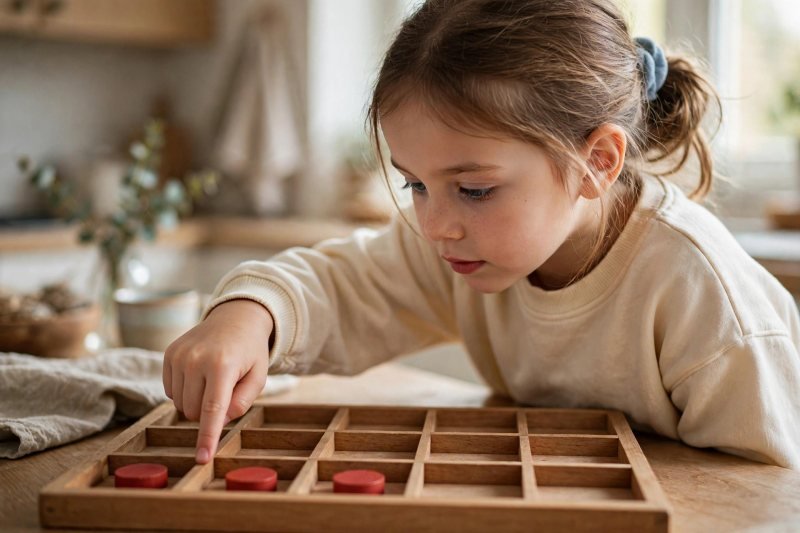
Ask what's left. Point at the frame and ask, "Seven take away two leaves...?" — then count what's still sitting in the frame, touching each counter: one, two, three, four, five. The slow, careful counting is the same habit that counting to 10 activities practice — never let your child rush past it. If your child announces "Two!" — they counted the group that left, not the one that stayed. Point at the frame and say, "Those went away — how many stayed behind?"
-
Check the empties. Here is the frame's built-in self-check: count the empty boxes. Two boxes are empty, and two counters sit in the bowl — they match, so the answer has to be right. Five counters left in the frame means 7 − 2 = 5. Two empties and two in the bowl is also a pair that makes 10 in disguise — the same pairs that number bonds to 10 activities build as a game.
-
Try a story. Give the numbers a story so the frame means something: "You had 8 apples in the basket. 3 fell off. How many are left?" Fill the frame with 8, lift 3 away into the bowl, count what's left — 5. Then write it together: 8 − 3 = 5. The story turns the frame from a grid into a picture of something that really happened.

-
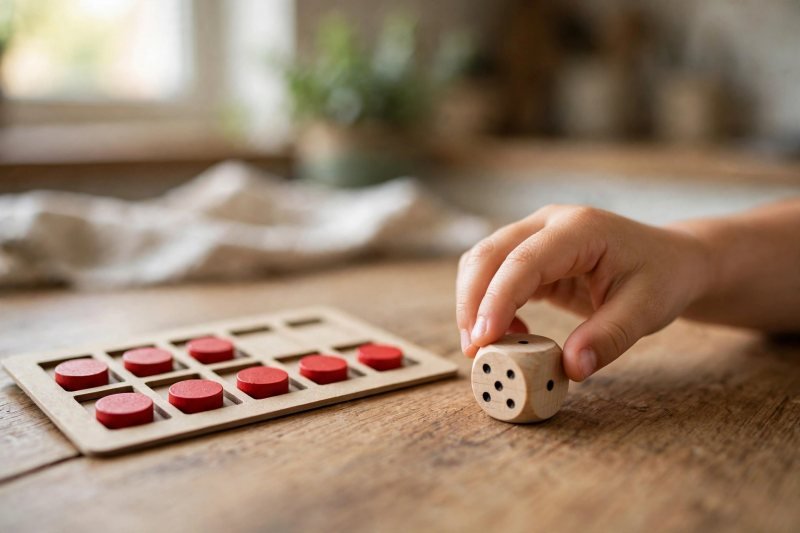
Roll and subtract. Now let the die choose the numbers: roll once for the starting number, roll again for the take-away, and run the three beats. If the take-away is bigger than the start, roll again — the frame only holds numbers up to 10. The die keeps it a game, and counting games for preschoolers use the same roll-and-count rhythm when you want more ways to play.
-
Let them teach. Hand the frame to your child and let them run the whole method — they pick the numbers, fill the frame, take some away, and ask you what's left. Start them with the five problems we tried first: 7 − 2 = 5; 6 − 1 = 5; 10 − 3 = 7; 9 − 5 = 4; 8 − 8 = 0. When they can teach it back to you, they own it — and addition games for kindergarten make a natural next session, same counters, opposite direction.


Make it easier
Start with numbers up to 5 so the frame is half full at most. Keep the take-away small — one or two counters — until the three beats feel automatic. Let your child move the counters themselves; watching is not the same as doing.
Make it harder
Chain two take-aways: 10 − 2 − 3 = 5, checking the empties after each step. Ask for the number sentence before counting what's left — can they predict the answer from the empties? Let your child invent a story for the frame, then solve it with the three beats.
Other ways to play it
- Story problems: turn every subtraction into a mini-story — apples falling off a tree, birds flying away, cookies being eaten — and let the frame show what happened.
- Die decider: roll the die for both numbers and race to see who can run the three beats fastest — speed comes last, accuracy first.
- Two-color check: use a second color only for the taken-away group, so the two groups are easy to tell apart — then go back to one color, because one color makes the child count the frame instead of matching colors.
How it changes by age
- Ages 5–6: sit beside them, run the three beats together, and let them move the counters. Keep the numbers small and the stories simple.
- Ages 6–7: let them run the method alone and teach it back to you — the teaching step is where the understanding settles.
- Younger than 5: the frame itself is the lesson — filling it, counting it, emptying it — without the subtraction language yet.
What they're learning
Subtraction as take-away — counters leave the frame, and the frame shows what remains. The three-beat method — fill, take away, count what's left, in the same order every time. Self-checking — empty boxes match the taken-away group, so the child can verify their own answer. Number sentences — writing 7 − 2 = 5 from something they just acted out. Zero as an answer — 8 − 8 = 0 is a real result, and the empty frame proves it.
Clearing up
The classic mistake is counting the group that left: your child lifts 2 counters off the frame and announces "Two!" as the answer. They are not wrong about the 2 — they are answering the wrong question. Point at the frame and ask, "Those went away — how many stayed behind?" The frame makes the correction visible: the answer is the counters still sitting in the boxes, not the ones in the bowl. End on a win: finish with a problem your child can already do, and let them teach it back to you before you pack the frame away.
Questions parents ask
How do you do subtraction with ten frames?
What age is subtraction with ten frames for?
Why does my child say the taken-away number as the answer?
Should I count backward or count what's left?
Do I need two colors of counters?

save it for later
Pin this for the next rainy afternoon
Keep it on a board so it is there when you need it, rather than when you happened to find it.
Save to Pinterest


