


Shrinkage in Kids' Curly Hair: What It Means and How to Manage It
Hair shrinkage in kids is normal and healthy — tight coils spring up as they dry because the hair is elastic. Learn the gentle stretch test, moisture basics, twist-outs, braids and banding for ages 4-5, all low-tension and pain-free.
Hair shrinkage in kids is normal and healthy: tight coils look longer when wet because water stretches the springs down, then spring back up as they dry. That bounce-back shows good elasticity. Gentle twists, braids and banding on wet, conditioned hair can show more length for a day, with no heat and no pulling.

The short version
- Shrinkage is a healthy sign: spring-back means the hair is elastic and well cared for, not damaged or failing to grow.
- Wet hair hangs longer and dry coils spring up — the length is still there, folded into every curl.
- Detangle only on wet, conditioned hair, in sections, fingers first, from the ends upward — never with force.
- Twists, braids and gentle banding stretch coils softly and temporarily, always low-tension and pain-free, with no heat.
- Watch the scalp: persistent itching, flaking, sores, patches of hair loss or one area of broken hairs deserve a pediatrician or dermatologist visit.
- Age
- Ages 4–5
- Mess
- Some
- Where
- Indoor
Why kids love this
Four- and five-year-olds love hair that boings. When a coil stretches down long in the bath and springs right back up in the mirror, that is not hair misbehaving — that is hair showing off how stretchy and strong it is, and children who learn to see it that way feel proud of their curls instead of puzzled by them. This guide turns wash day into a small science show your child can join in with: spotting the wet-versus-dry difference, doing the gentle stretch test with you, counting twists, and choosing between two gentle styles for the day. Everything here is low-tension and pain-free by design, because a child who trusts that hair care never hurts is a child who sits happily, helps with the spray bottle, and starts building a kind, confident relationship with their own hair. The styles are also genuinely fun to wear — springy twists that swing, neat braids for busy days, and banded puffs that show a little more length while the coils underneath stay exactly as healthy as they are.
What you'll need
- A spray bottle filled with plain water — unlabeled, used for refreshing and for the wet-versus-dry spot in step 1
- A gentle, child-appropriate shampoo — chosen by criteria only: mild, made for children, and comfortable on your child's scalp with no stinging
- A slippery conditioner — chosen by criteria only: moisturizing, easy to rinse, and giving enough slip that a wide-tooth comb glides without pulling
- A leave-in conditioner or light moisturizing cream — chosen by criteria only: lightweight, child-appropriate, and non-greasy so coils stay soft rather than coated
- A wide-tooth comb and a soft detangling brush — smooth teeth and flexible bristles only; nothing sharp, nothing that scratches the scalp
- Sectioning clips — smooth, snag-free clips that open easily and never pinch
- Soft, seamless hair bands — fabric-covered or stretchy bands with no metal join, for braids, twists and gentle banding
- A soft microfiber towel or an old cotton T-shirt — gentler on coils than a rough bath towel and kinder to wet, fragile strands
- A small hand mirror as well as the bathroom mirror — so your child can see the back of a style and join in the spotting game
- A cushioned stool at a comfortable height — so your child sits steady and relaxed and you are not bending or rushing
Before you start
Pick a calm, unhurried time — after a meal and before your child is tired — and lay out the comb, clips, bands, spray bottle and towel within reach so you never leave a wet child mid-style. Talk about shrinkage before any water touches hair: explain in simple words that curly hair is springy like a tiny slinky, that wet curls hang longer and dry curls bounce up, and that bouncing up is a healthy sign. Check the scalp gently with your fingertips and eyes — look for anything sore, flaky, broken or unusual, and if you spot something that worries you, pause styling plans and read the Safety notes before continuing. Fill the spray bottle with fresh water, set the stool where the light is good, and invite your child to choose one small job — holding the mirror, counting twists, or spritzing — so wash day starts as teamwork.
How to do it
-
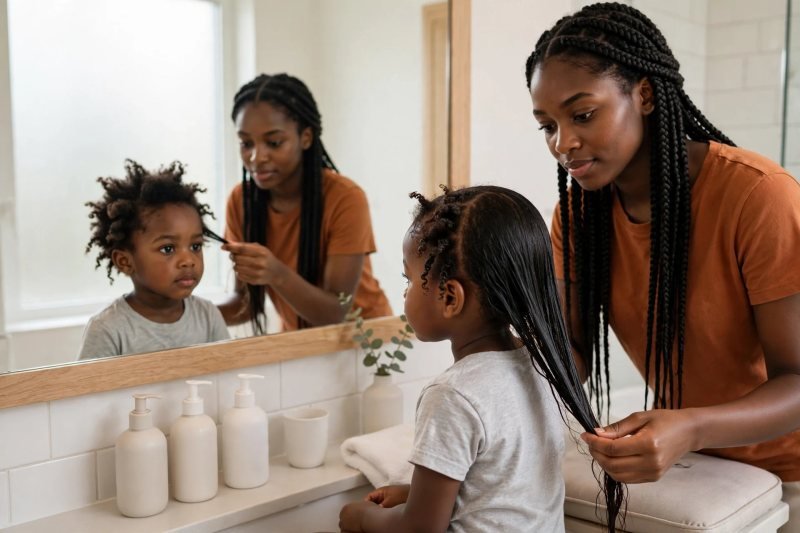
Spot the wet-versus-dry difference together. Start by making shrinkage visible, because a child who sees it understands it — in the bath or at the sink, gently smooth one wet coil down along your child's cheek or shoulder and notice together how long it reaches when it is wet and stretched by water; then let that same section air-dry while you wash the rest, and look again in the mirror once it is dry, when the coil will have sprung up and can look like a much shorter curl sitting higher on the head; the hair has not changed or been cut — only the spring has tightened as the water left. Turn it into a spotting game you repeat every wash day — find the longest wet coil; watch one puff shrink as it dries; compare a morning twist-out with an afternoon wash-and-go. This is also a natural moment to connect hair care to the rest of a calm getting-ready routine, the same unhurried rhythm you use for a kids' skincare routine — gentle, predictable and never rushed. Say, "Look — wet, it stretches down long, and dry, it boings back up. That boing means your hair is springy and healthy." Naming the change out loud, wash after wash, teaches your child that shrinkage is simply what happy coils do, and that the length is still there, folded into every spring.
-
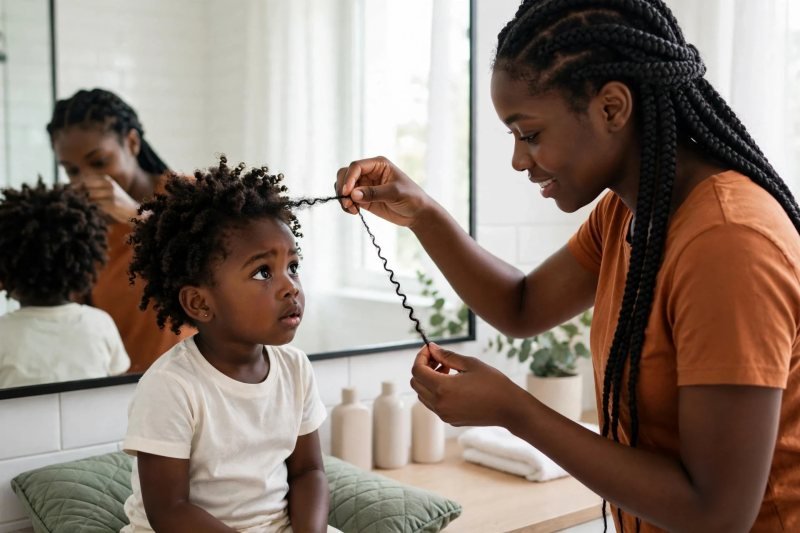
Explain why coils spring up. Once your child has seen the difference, give them the simple science they can repeat — each curly strand grows in a spiral shape, like a tiny spring or the curl of a ribbon; water weighs the spring down and relaxes it for a while, so wet hair hangs longer; as the hair dries, the spring remembers its shape and coils back up, which is why dry curly hair sits shorter, fuller and bouncier than wet hair. That spring-back has a proper idea behind it that grown-ups call elasticity — healthy hair can stretch gently and return to its shape instead of staying stretched out or snapping — and strong spring-back is one of the clearest signs that curly hair is well cared for. Use comparisons a four- or five-year-old already knows — a slinky that stretches down the stairs and gathers back up; a party streamer that curls again after you pull it straight; a rubber band that pings back to its circle. Keep the language positive every time — springy, bouncy, strong and clever are the words to reach for, never broken, wrong or bad. Say, "Your hair is made of tiny springs. Water stretches them down, and drying lets them bounce back — that bounce is your hair being strong." A child who can explain their own shrinkage to a grandparent or a friend carries real confidence about their hair into school and beyond.
-
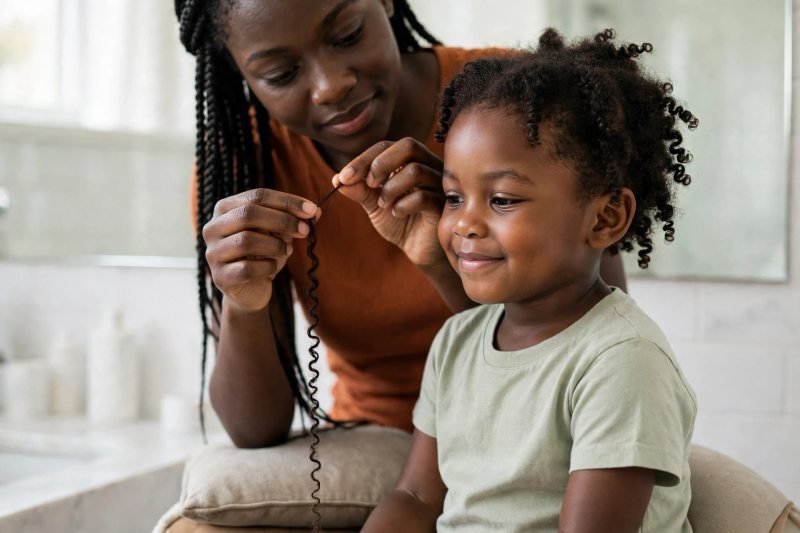
Try the gentle stretch test. The stretch test is the hands-on version of that science, and it takes less than a minute — choose one small coil at the nape or behind an ear, where testing is easy to hide if your child gets wiggly; hold the coil lightly between two fingertips, close to the end rather than at the root; stretch it down very gently, only as far as it moves with no resistance and absolutely no pulling on the scalp; then let go and watch it spring back up to its resting length. A coil that stretches a little and bounces back happily is showing you good elasticity, and the gap between the stretched length and the sprung length is shrinkage made visible — on tight coils that gap can look like a lot, sometimes startlingly so, and that is completely normal for this curl pattern. Do the test on dry hair during a calm moment, or on damp hair on wash day, and let your child do the letting-go part, because the boing is the reward. Never stretch wet hair hard, never stretch the same strand over and over, and stop instantly if your child says it hurts — the test should feel like nothing at all. Say, "I will stretch this one curl down, down, down — now let go and watch it boing back. That is your hair showing how springy it is." Done gently and rarely, the stretch test gives you a quick, friendly way to check in on hair health without any tools or fuss.
-
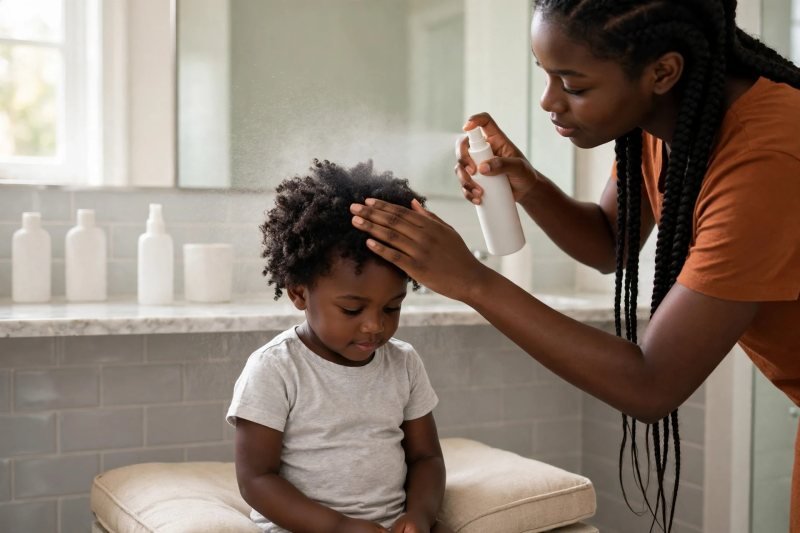
Build moisture basics that keep coils soft. Shrinkage itself needs no treatment, but dry coils tangle faster, feel rougher and break more easily, so moisture is about comfort and care rather than changing how much hair springs up — think of it as keeping the springs soft and slippery instead of dry and grabby. The basics are simple and repeatable — wash with a gentle shampoo only as often as your child's hair and scalp need it, since tight coils are often happiest washed once a week or so, guided by how the hair feels rather than a strict calendar; follow every wash with conditioner, because conditioned coils are softer, springier and far easier to handle — the same wash-and-condition rhythm in curly hair care for toddlers keeps coils soft between washdays; add a small amount of leave-in on damp hair to hold softness between washdays; and refresh on in-between mornings with a light spritz of water and a pea-sized touch of leave-in smoothed over with palms, rather than soaking the hair all over again. Judge products by criteria only — mild and child-appropriate; moisturizing without feeling heavy or waxy; easy to rinse; and comfortable on your child's scalp — and change one thing at a time so you can tell what actually helps. Say, "We give your curls a drink so they stay soft and springy — soft springs do not get tangled up together." Framed this way, moisture is care your child can feel immediately — hair that is softer to touch, easier to style and happier to leave alone between washdays.
-
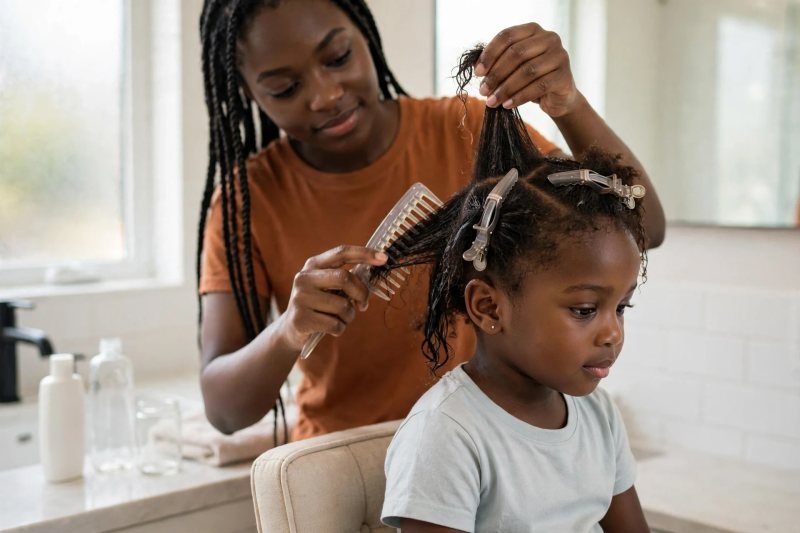
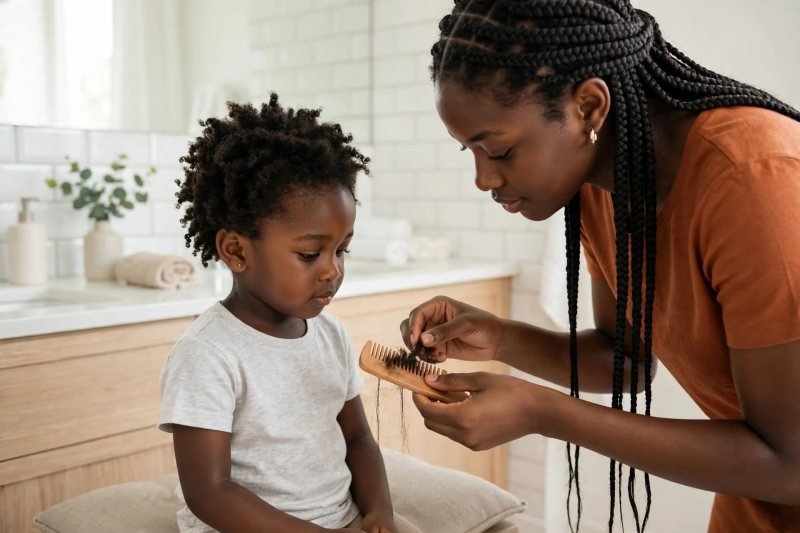
Detangle only on wet, conditioned hair. Detangling is where patience protects both length and trust, because dry detangling pulls, hurts and snaps coils, while wet, conditioned hair lets tangles melt apart — so save all combing for wash day, with hair soaked and conditioner worked through every section until the strands feel slippery. Work in a calm order every time — divide the hair into four to six sections with clips so you are never fighting the whole head at once; start each section with your fingers first, gently teasing apart any knots you can feel and easing out shed hairs that have wrapped around their neighbors; then take the wide-tooth comb from the very ends upward, in short, small movements, holding the hair above the tangle with your other hand so the pull never reaches the scalp; and only move up toward the roots once the ends below are completely clear. If a knot resists, add water and conditioner rather than force — slip, not strength, is what untangles curly hair, and the tear-free routine in wash toddler hair without tears uses exactly that order. Keep checking in, keep it pain-free, and take a wiggle break between sections if your child needs one; a detangle that never hurts teaches a child that wash day is safe. If big hair milestones are part of your family story, this gentle handling is also what keeps hair in its best condition around events like a toddler first haircut — calm, cared-for coils are easier for everyone. Say, "We only comb when your hair is wet and slippery, and we start at the ends — if anything pulls, you tell me and we add more conditioner, never more pulling." That promise, kept every single time, is the foundation every other style in this guide stands on.
-
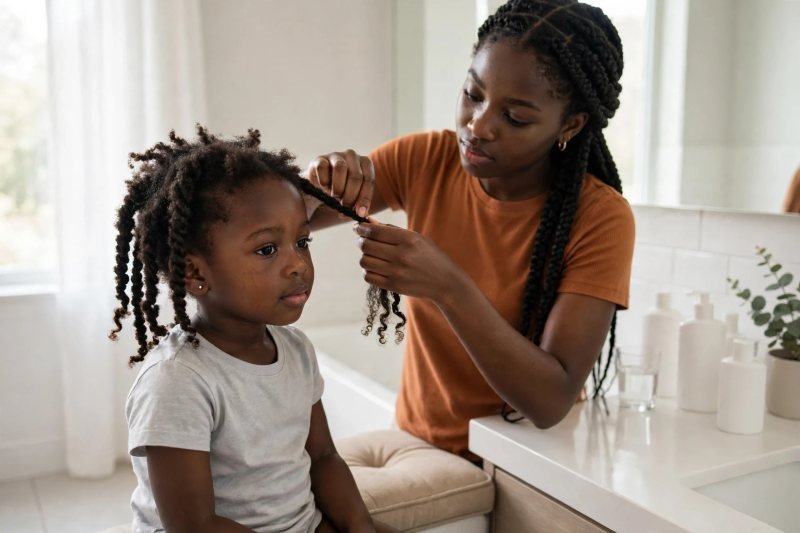
Use twist-outs as a gentle stretch. Twists are the friendliest way to show a little more length for a day or two while adding zero tension at the roots — on damp, detangled, moisturized hair, take one section at a time; divide it in two; and wind the two parts around each other from root to tip in a simple rope, keeping your hands relaxed so the twist is soft and chunky rather than tight and thin. For four- and five-year-olds, bigger twists are better — roughly six to ten twists over the whole head is plenty — because chunky twists are faster to do, gentler to sleep near, and quicker to unpick without tangling. Leave the twists in overnight under a soft covering if your child tolerates one, or for a few happy hours during the day, then untwist each rope slowly with lightly moisturized fingertips, separating the waves gently with your fingers only — no comb, no brush — so the soft stretched waves stay smooth instead of puffing apart. The result shows more length than a fully sprung wash-and-go while the hair stays completely heat-free, and when the waves spring back up over the next day or two, that is simply shrinkage returning, exactly as it should. Say, "Twists are like giving your springs a gentle rest — they stretch out soft and wavy, and later they boing back whenever they are ready." A twist-out teaches the loveliest lesson in this guide — length and shrinkage are both real, both normal, and your child gets to enjoy each in turn.
-
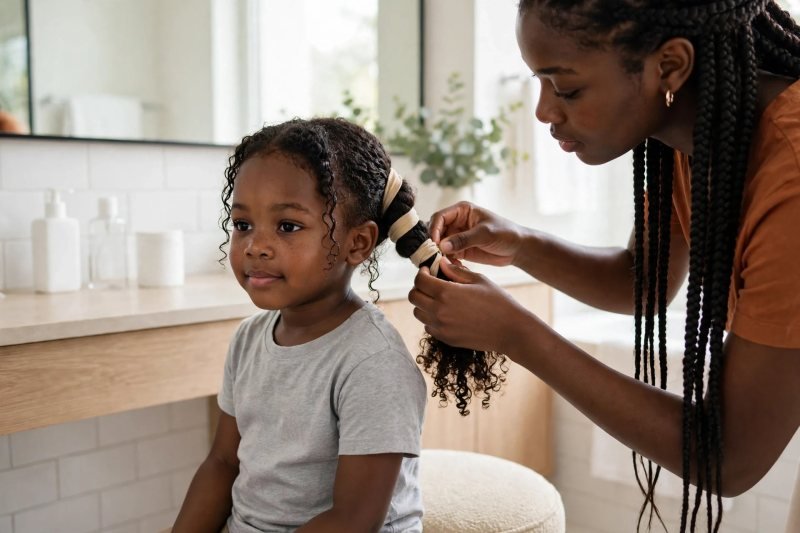
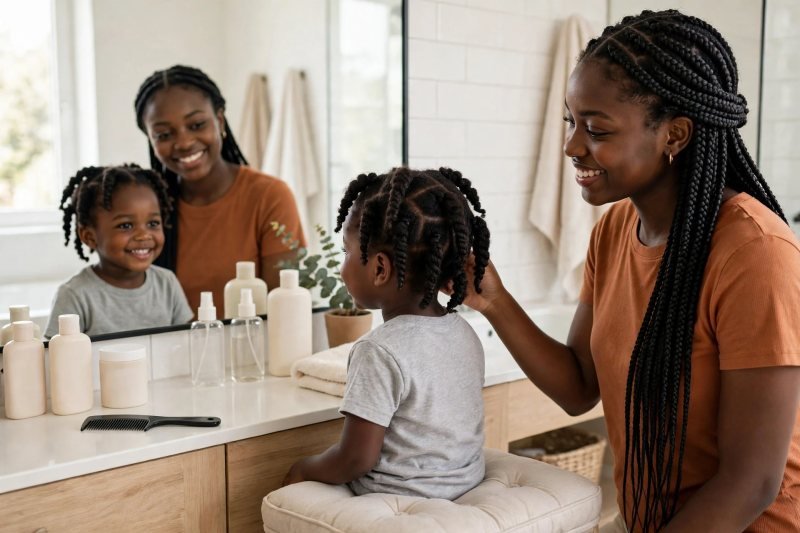
Try braids and gentle banding. Braids and banding offer two more low-tension ways to stretch coils softly, and both double as protective styles that keep ends tucked and tangles down for busy days — see protective hairstyles for toddlers for more gentle styles that keep ends tucked — for braids, work on damp, detangled hair and plait each section loosely in a simple three-strand braid, or in two-strand flat twists close to the head if you prefer, always loose enough that you can slide a fingertip under the braid at the scalp, that the skin is never pulled taut, and that your child can smile, frown and raise their eyebrows without anything tugging; for banding, gather a damp, moisturized section into a soft ponytail and wrap soft, seamless bands down its length at gentle intervals — snug enough to hold the stretch, never tight enough to dent or squeeze — leaving the section softly elongated while it dries or overnight. Undo both styles slowly and kindly — bands slid or carefully snipped off the band itself, never dragged down the hair; braids unpicked from the ends upward with your fingers — and moisturize lightly afterward. Stop and redo any braid or band that causes complaints, bumps or tenderness, because gentle is the whole point. Say, "Braids and bands give your curls a gentle stretch while they rest — nothing tight, nothing sore, and you can always tell me to make it looser." Giving your child the words and the permission to ask for looser turns styling into something done with them, not to them.
-
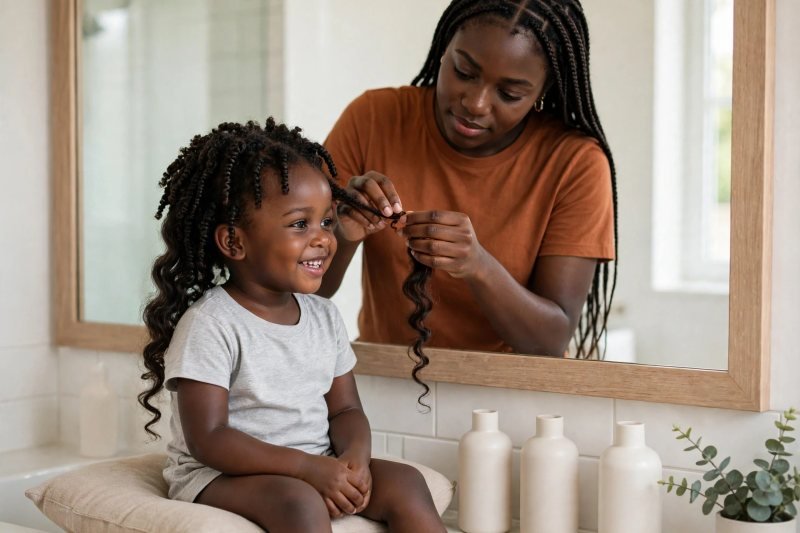
Show length with heat-free styles. Some days your child will simply want to see how long their hair really is — for a photo, a party, or pure curiosity — and there are kind ways to honor that wish without any hot tools at all — a twist-out or braid-out worn loose, from the steps above, shows length with soft waves; banded puffs and banded ponytails hold a gentle stretch through the day while the ends stay free and bouncy; stretched styles finished the night before — twists or braids undone in the morning — give the longest look with the least morning effort; and simply styling damp hair and letting it dry in twists, rather than loose, sets the spring in a more elongated shape from the start. Set expectations warmly and honestly — heat-free stretching shows some length, not all of it, and the springs will gradually rejoin the party through the day, especially around water play or humid weather — and treat that return as charm, not failure. Never chase a straighter look with hot combs, flat irons or chemical products on a young child's hair; the gentle methods here are the whole toolkit, and they are enough. Say, "Today we are wearing your waves stretched out long — and when they bounce back up later, that is your hair being itself again." A child who hears length and bounce celebrated in the same breath learns that neither one needs apologizing for.
-
Tell shrinkage apart from breakage. Because sprung-up hair looks shorter, parents sometimes worry that hair is not growing, or that ends are snapping — and learning the difference is reassuring — shrinkage looks like this: the whole head springs up evenly; wet hair still stretches down to its familiar longer length; the stretch test still boings back; ends look full and even; and shed hairs in the comb on wash day have their full length. Breakage looks different — short, broken pieces snapping off during gentle combing rather than full-length shed hairs; ends that feel rough, thin or see-through compared with the roots; one patch that stays noticeably shorter and does not stretch down like the hair around it; or hair that stretches and stays stretched, limp and gummy, instead of springing back. Steady, gentle care prevents most breakage — detangling only wet and conditioned; soft bands with no metal; low-tension styles; regular light moisture; and ends kept tucked in twists and braids on busy weeks. If you see the breakage signs above persisting, or you are ever unsure which one you are looking at, that is a good moment to ask a pediatrician or dermatologist for a look — see the Safety notes for the scalp signs that should always prompt that visit. Say, "Springy and even means growing and healthy. If we ever see lots of little snapped pieces, we will ask a doctor to peek — that is what they are for." Calm, factual checking turns worry into a simple habit your child never needs to feel anxious about.
-
Settle into a simple wash-day rhythm. Everything in this guide fits into one repeatable rhythm, and rhythm is what makes curly hair care feel easy for a five-year-old and manageable for you — on wash day, roughly once a week adjusted to your child's hair and life — the how often to wash toddler hair guide helps you settle the rhythm that suits your child's scalp: shampoo gently; condition generously; detangle wet and slippery in sections; moisturize lightly; then style into twists, braids or a banded style that can carry several days. Between washdays, keep input tiny and consistent — a morning spritz-and-smooth refresh on days hair looks dry; a soft covering or loose pineapple-style gathering at night if your child accepts one; a quick fingertip check for tangles behind the ears and at the nape; and hands-off the rest of the time, because coils thrive on being left in peace. Every few weeks, do the two friendly checks from this guide — the wet-versus-dry spot and one gentle stretch test — so you notice change early and your child keeps hearing the springy-strong story. End every wash day the same way — a mirror moment, a compliment that names the hair itself, and a style choice for tomorrow — so care closes with pride rather than relief. Say, "Wash, condition, detangle soft, twist — same steps every time, and your springs stay happy. Which style shall we pick for tomorrow?" Predictable steps, positive words and pain-free handling are the real management plan for shrinkage — because shrinkage, managed well, is mostly something to understand, enjoy and style around with love.


Make it easier
Do less, more gently: a wash-and-go with good conditioner and a finger-detangle only is a complete routine on tired weeks — twists and banding are invitations, never obligations. Shrink the session, not the kindness: style half the head into twists after the bath and finish the rest the next morning on spritzed hair if your child is done sitting for today. Let your child hold the mirror and do the letting-go in the stretch test — small jobs turn a seated child into a teammate and make every step faster.
Make it harder
Start a shrinkage spotter chart together: after each wash day, draw the wet length and the dry spring of one coil side by side — early measuring, comparing and recording, with your child as the scientist. Teach the two-strand twist as a skill: on a chunky, easy section at the front, guide your child's own hands through dividing and winding — many five-year-olds can manage one twist with help, and pride in doing it is enormous. Build a style-choice routine: offer two gentle options each wash day — twists or braids, bands or loose — and let your child plan the week, including one stretched style day for a photo or outing they care about.
Other ways to play it
- Very tight coils that spring the most: expect the wet-versus-dry gap to look the most dramatic, and lean into chunky twists and banding, which give this pattern the softest, most visible stretch; keep sections bigger and styles looser, since fine, tight coils tangle fastest when styles are small.
- Looser curls that spring less: the wet-versus-dry difference will be gentler, twists may unravel sooner, and braids often hold the stretch better than banding; a braid-out is this pattern's most reliable length-showing style, finished with fingers only.
- Short hair still growing out: skip banding until there is enough length to gather without tension, and use small, soft two-strand twists or a simple conditioned wash-and-go instead; the stretch test and spotting game work at any length and keep the positive story going from the very start.
How it changes by age
- Age 4: Four-year-olds are spotters and helpers, not sitters — keep every session short, narrate the springy story constantly, and do the stretch test and spotting game as the main event while you handle all combing and styling. Offer one simple choice per wash day — twists or braids — and accept wiggles, breaks and half-head finishes with good humor; gentle handling and positive words matter far more at four than a perfect style. Twists should be few and chunky, bands very soft and loose, and any complaint of pulling ends the session or gets the style redone looser on the spot.
- Age 5: Five-year-olds can join in for real — holding sections, counting twists and bands, spritzing with the spray bottle, and even winding one chunky twist with your hands guiding theirs. They can learn the elasticity story well enough to tell it themselves, do the letting-go in every stretch test, and start spotting the shrinkage-versus-breakage difference with you in the comb. Sessions can stretch a little longer with a story or song, but the rules stay identical: wet and conditioned detangling only, low tension always, and their "that pulls" always wins.
What they're learning
Early science — elasticity and observation: watching a coil stretch and spring back, comparing wet and dry lengths, and predicting what a twist-out will look like in the morning are real observe-hypothesize-check skills in miniature. Body confidence and positive identity: learning that shrinkage is a sign of healthy, strong hair — and having the words springy, bouncy and clever for their own curls — builds a kind, proud relationship with their natural hair. Language and storytelling: slinky springs, party streamers and boinging coils give children vivid vocabulary and a story they can retell — to you, to friends, and to themselves in the mirror. Patience and self-care routines: a predictable wash-day rhythm — wash, condition, detangle, moisturize, style — teaches sequencing, tolerance for a gentle routine, and the idea that caring for your body is normal, unhurried and kind.
Clearing up
Rinse the comb, clips and spray bottle after every wash day — shed hairs wrapped around combs sour quickly and make the next detangle harder — and leave them to air-dry on a clean towel rather than sealing them damp in a bag. Collect shed hairs from the sink, bath and stool area while surfaces are still wet, when they lift away in seconds, wipe the mirror your child used for spotting, and put bands and clips back in one small pot so the next session starts with everything findable. Hang the microfiber towel or T-shirt to dry fully before laundry day, wash it with the regular load, and note anything running low — conditioner especially — on the family shopping list while you still remember, so next wash day never starts with an empty bottle and a wet, waiting child.
Questions parents ask
Is shrinkage in kids' curly hair normal?
How can I show my child's hair length without heat?
How do I tell shrinkage from breakage?
Why does my child's hair look shorter after it dries?
When should I see a pediatrician or dermatologist about my child's scalp or hair?
How often should I wash and detangle tight curly hair at age 4 or 5?
Framing discipline: shrinkage is described throughout as normal, healthy and a sign of elasticity — never as a defect, flaw or problem to correct. Gentle stretching styles (twists, braids, banding) are presented as temporary, optional ways to enjoy a different look, always low-tension and pain-free. No chemical or heat-based straightening is recommended anywhere in this guide, and products are discussed by general criteria only, with no brand names and no prices. Length honesty: no statistics or percentages about shrinkage are presented as fact anywhere in this guide. Where the wet-versus-dry gap is described, it is framed as something families can observe on their own child's hair ("can look like"), because the visible difference varies widely by curl pattern and by child. Health guidance boundary: scalp red flags are listed in Safety notes and in the FAQ as general information to prompt a conversation with a pediatrician or dermatologist. Nothing in this guide diagnoses a condition or replaces professional advice.


