


Art Birthday Party Ideas: A Creative Painting Celebration
A creative art birthday party for a 5th birthday — washable painting stations, a take-home canvas favor, simple games, cake and a calm wrap-up plan for ages 4-5, with setup, safety and tidy-up covered.
An art birthday party for a fifth birthday works best with washable paints, smocks for every child, and one main painting that becomes the favor. Set up covered stations, start the take-home canvas early so it dries, add color mixing and simple games, then finish with cake, wrapped canvases, and a calm goodbye.

The short version
- Paint the take-home canvas first, while attention is fresh, so it has the whole party to dry before wrapping.
- Washable, non-toxic paints only, with smocks on every child and the table and floor fully covered before pots open.
- The painting is the favor — wrap each child's own canvas in paper or a bag and send art, not small toys, home.
- Keep decorations 100% generic: plain colored bunting and paper chains with no letters or words.
- Cake has exactly five candles for a fifth birthday, with allergy information checked in advance and adults handling lighting and cutting.
- Age
- Ages 4–5
- Prep
- 45 min
- Mess
- High
Why kids love this
Four- and five-year-olds love a party where the main event is something they are allowed to make a glorious mess doing. Painting gives them exactly that: big brushes, bright washable colors, a real canvas that is theirs alone, and the freedom to cover it however they choose — swirls, dots, handprints, rainbows, or one determined patch of purple from corner to corner. There is no right way to finish, no winner, and no waiting in line for a turn on the fun, because everyone paints at the same time at their own station. Children this age also love taking something home, and here the painting itself is the favor. Add simple games, songs around a cake with five candles, and friends in smocks like a team of real artists, and the celebration feels grown-up, creative, and completely theirs. For the birthday child, hosting friends in a room that looks like an art studio is a fifth-birthday memory that lasts.
What you'll need
- Small stretched canvases or canvas boards — one per child, plus two spares for a dropped or torn painting; this is the main favor, so count guests carefully
- Washable, non-toxic tempera paint in a rainbow of colors, decanted into small lidded pots so spills stay small
- Thick washable paint in squeeze bottles for younger or less confident painters who find pots tricky
- Brushes in two or three sizes per child, plus chunky sponge dabbers, cotton swabs, and cut vegetable or sponge shapes for stamping
- Painting smocks or long aprons with sleeves — one per child, plus spares; ask families in advance if you are short
- A large plastic table cover, a floor covering or old sheet for under the table, and paper towels and a damp cloth at every station
- Thick paper or card stock for warm-up painting, practice sheets, and the games, so the canvas feels special by contrast
- Cups of water for rinsing brushes — half full only — plus a bucket for dirty water refills
- Paper plates as palettes, wooden craft sticks for mixing, and a tray or drying rack, clothesline with clothespins, or a cleared shelf for drying paintings
- Plain colored bunting and paper chains with no letters or words, plain paper tableware, and balloons kept tied up high and out of the painting area
- A simple birthday cake with exactly five candles, matches or a lighter kept with an adult, a cake knife for adult use only, and small plates and forks
- Brown paper, tissue paper, or plain paper bags and ribbon or stickers for wrapping dry canvases as favors at the end
- Simple snacks and drinks served away from the painting table — water, and easy finger foods checked against every guest's allergy information
- A change of clothes for the birthday child, a laundry basket for smocks, and a trash bag and recycling bag placed ready before guests arrive
Before you start
1. A week ahead, confirm your guest list and ask every family about food allergies and any paint or latex sensitivities, and note the answers where you will see them while you shop and bake or order the cake. 2. The day before, count canvases, smocks, brushes and pots against the guest list, add spares, decant washable paint into small lidded pots, and set the cake plan — exactly five candles, checked and placed in a safe adult-only spot. 3. On the morning of the party, move breakable items out of the party room, cover the table and floor completely, and tape the covering edges down so small feet do not slide on loose corners. 4. Set one station per child: a canvas, a paper practice sheet, a palette plate, brushes, a half cup of water, paper towels, and a name-free way to tell paintings apart, such as a different colored dot sticker on the back of each canvas. 5. Hang plain colored bunting and paper chains with no letters or words, set the drying area up in a low-traffic corner, and lay out the wrapping paper and bags for the favor moment at the end. 6. Put snacks and drinks on a separate table away from paint, fill a handwashing station with soap and towels near the sink, and do a final floor check for small loose items before younger siblings arrive.
How to do it
-
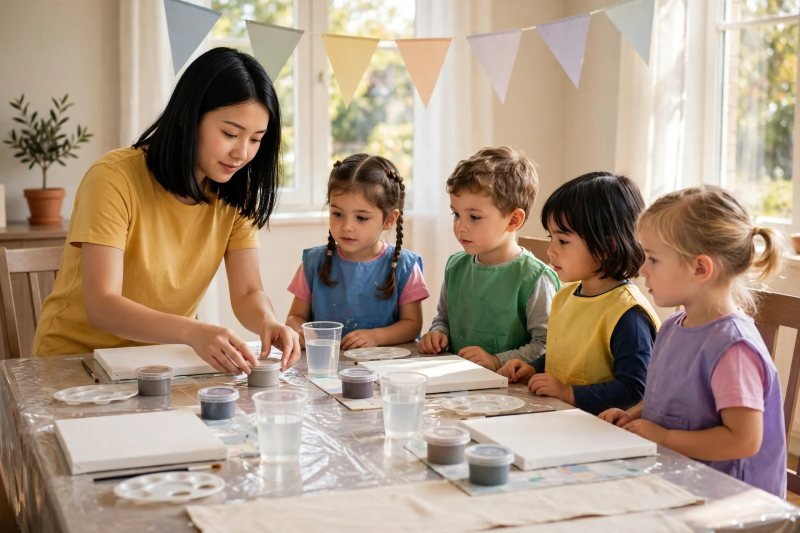
Step 1: Cover everything and set up painting stations. Start the party long before the doorbell by turning one room into a studio that can survive anything washable paint can do — cover the table with a plastic cloth taped underneath so it cannot bunch; cover the floor beneath and around the chairs with a sheet or second cloth; push spare chairs, cushions and anything precious well out of splash range; and set each place the same way so no child has to reach across another child's work — canvas in the middle, palette plate to one side, brushes and a dabber within easy reach, a half cup of rinse water at the top corner where elbows knock it least, and paper towels folded beside every seat. Keep paint pots lidded until painting begins, put the drying line or rack in a corner nobody walks through, and place a trash bag and a damp-cloth basket where you can reach them without leaving the table. If you have hosted younger parties using 2nd birthday party ideas, keep that same covered-floor habit and simply scale it up — bigger table, more stations, same calm setup. Say, "Artists, this room is ready for real painting — everything here can be splashed, and we will show you your very own station." A room that is visibly prepared tells children the mess is welcome here, and tells you that you can enjoy the party instead of guarding the furniture.
-
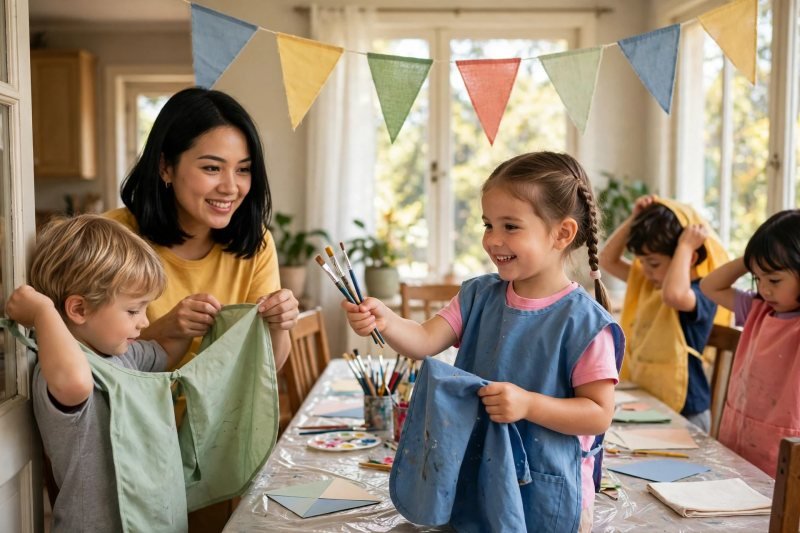
Step 2: Welcome everyone and smock up. Greet each guest at the door with the birthday child beside you, take coats and party bags to a spot away from the painting room, and walk the group in together so nobody drifts to the paint before the rules are shared — then make putting on smocks the first ceremony of the party, not a chore before it; hold each smock open, help with sleeves and ties, roll any loose shirt sleeves up above the elbow, tie long hair back, and line everyone up for one cheerful look at the team of artists in their plain colored smocks. Show, in thirty seconds, the three things that keep the party happy — brushes stay at the table, paint stays on paper and canvas, and anyone who needs the bathroom or a drink asks and washes hands first — and point out the handwashing spot and the snack table so children know paint food and party food live in different places. Seat each child at a station, place a practice sheet in front of them, and let the birthday child hand out brushes like a host with an important job. Say, "Smocks on, sleeves up — now you look like real artists, and real artists can get as colorful as they like." The smock ritual settles arrivals, staggers the excitement into one shared moment, and means the first splash lands on a smock instead of a party outfit.
-
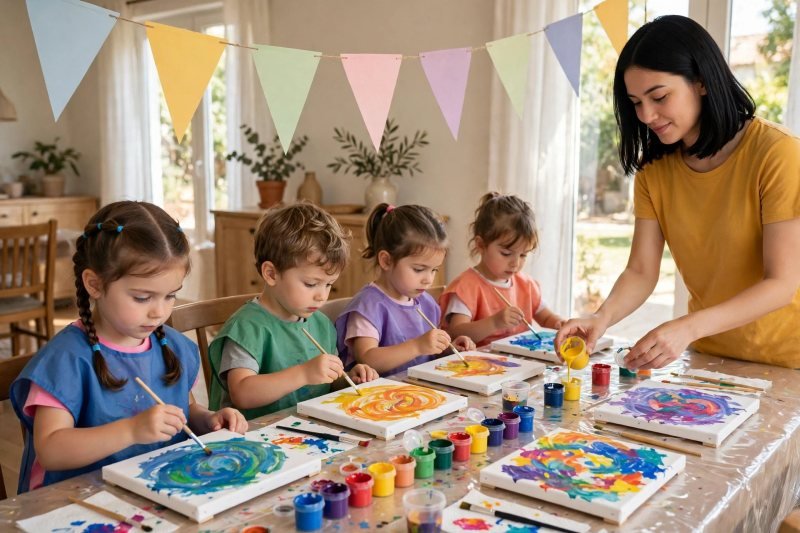
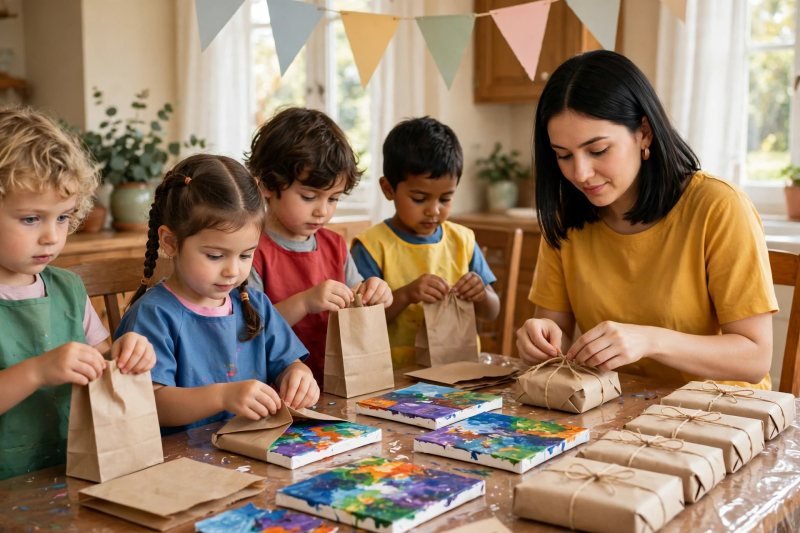
Step 3: Paint the take-home canvas first. Begin with the painting that matters most while energy and attention are at their freshest — the small canvas each child will take home as the party favor — because a canvas started first has the full party to dry, and a canvas started last goes home wet and smudged in a car. Take the lids off together, show how to load a brush without scooping half the pot, how to wipe the extra on the palette plate, and how to rinse and blot before changing color so the bright colors stay bright; then step back and let them paint whatever they truly want — a house, a storm, a dinosaur shape, a field of dots, or pure color for the joy of it — resisting every urge to correct, direct, or add a helpful cloud to someone else's sky. Walk the table slowly, refill pots, swap muddy rinse water before it turns every color brown, and talk about what you see in specific words — the zigzag, the two suns, the brave red corner — so each child hears their choices noticed. When a child says they are done, believe them, carry the canvas flat with two hands to the drying area, and put the colored dot for that child on the back if you have not already. Say, "This canvas is yours — you will wrap it and take it home today, so paint the picture you most want to keep." Framing the canvas as a keepsake from the very first brushstroke gives the whole activity weight, pride, and a natural finish line. If a child asks what to paint, borrow a prompt from these children's painting ideas and let them make it their own.
-
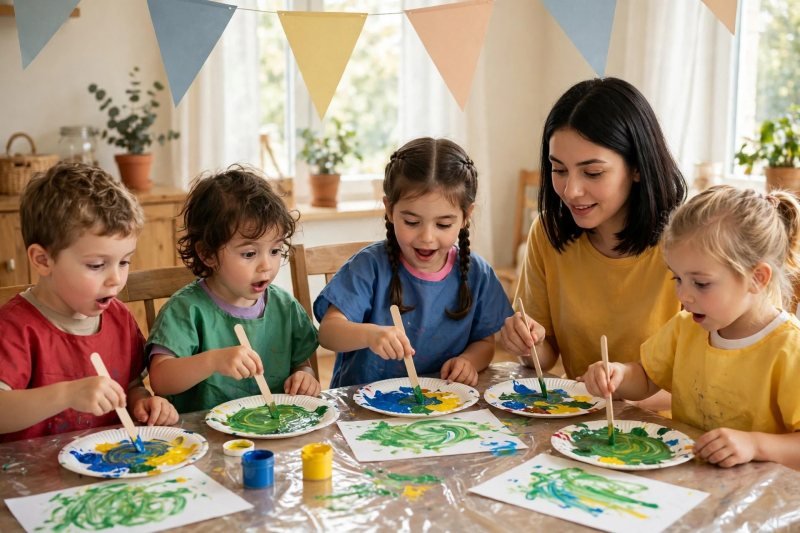
Step 4: Mix new colors together. Once every canvas is safely drying, turn the practice sheets into a color laboratory — put only two or three washable colors on each palette at a time, hand out craft sticks for stirring, and invite children to predict before they mix: what will blue and yellow do, what happens if white joins red, can anyone make a color for a frog, a pumpkin, or the sea at night. This playful experimenting is exactly the joy at the heart of color mixing activities, scaled up for a party table where every child can compare results with a neighbor and hold up a palette like a discovery. Keep a spare pile of practice sheets ready because mixing is the moment some children happily use six sheets in ten minutes, and keep one sheet yourself to mix alongside them — a grown-up who also gasps at a new green gives the whole table permission to be amazed. Name the new colors together with invented, generous names — dragon green, sunset pink, midnight purple — and let children paint a stripe of each discovery along the edge of a sheet to take home or add to the drying line. If a palette turns to swamp, celebrate it, scrape it off, and start again; mixing has no failure state, only surprises. Say, "You are color scientists now — guess first, stir second, and shout when a brand-new color appears." Prediction, surprise, and a table full of witnesses make this simple step one of the loudest, happiest parts of the party.
-
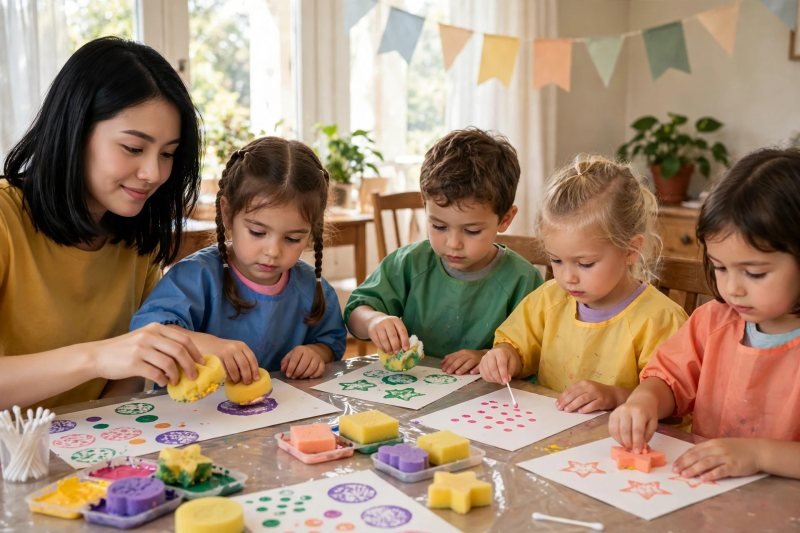
Step 5: Press, dab and squeeze for fine-motor fun. Change the tools and you change the whole painting — clear the brushes to a soaking tray for a few minutes and bring out chunky sponge dabbers, cotton swabs for tiny dots, sponge shapes for stamping, and thick squeeze bottles for children who love a line of paint they can steer; show how a dabber makes a soft round print when it is pressed straight down and lifted straight up, how a swab makes the smallest dot in the room, and how a stamp needs a thin, even coat of paint rather than a deep dip. These pressing, pinching and squeezing actions are the same playful movements celebrated in fine motor activities, and they give every child a tool that feels right in their hand. Set out fresh thick paper for this round, suggest easy prompts for anyone stuck — a bunch of grapes from dabber circles, a night sky from swab stars, a garden row from stamped shapes — and let confident children invent their own tools challenge, such as painting a whole picture without a brush at all. Keep wipes and paper towels moving, because hands get painty fastest in this round, and remind everyone that painted fingers wash clean at the sink. Say, "No brushes allowed for this game — press it, dab it, squeeze it, and see what your hands can invent." A tool swap halfway through restores tired attention better than any new instruction, and the stamped and dotted sheets dry fast enough to join the favor wrapping later. For more projects pitched at this age, keep these craft ideas for 4-year-olds in mind for the next art afternoon.
-
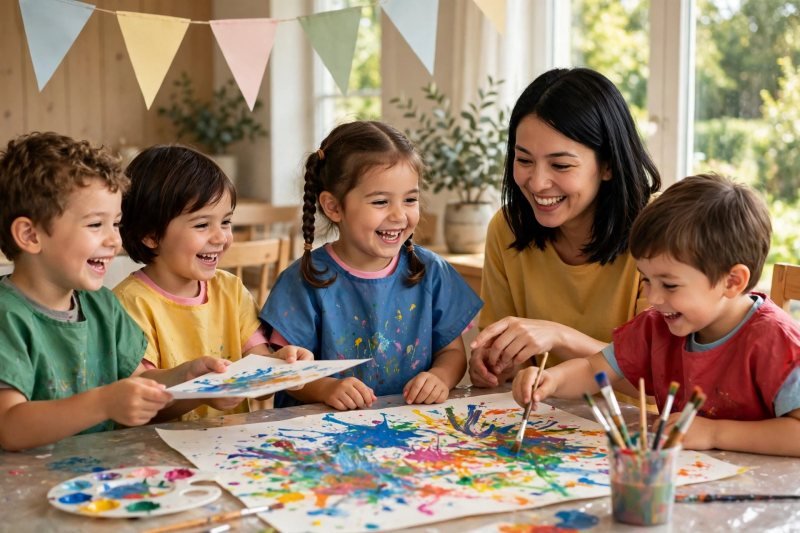
Step 6: Play painting games together. When bottoms start to wriggle, keep the paint but add the game — try a color hunt first, calling a color and having everyone add one mark in it somewhere on a shared big sheet in the middle of the table; then pass-and-paint, where each child paints for the length of one song on a practice sheet, passes it to the next artist when the music stops, and adds kindly to whatever arrives in front of them, round after round until every sheet has traveled the whole table and come home covered in everyone's ideas. A shared sheet and a traveling sheet teach making something together and adding to a friend's work with care, and both burn energy without anyone leaving the table. Keep rounds short, songs cheerful, and praise specific additions out loud: the border someone framed, the dots that became rain. Any child who does not want their sheet passed keeps their own and joins the shared-sheet game instead, because games only work when opting out is easy and unembarrassing. Finish with a silly challenge — paint with the brush in the other hand for one minute — and expect the table to dissolve, happily, into laughter. Say, "When the music stops, pass your picture with two hands — you are adding a gift to a friend's painting." Clear rules, short rounds, and an adult narrating the kindness keep competitive sparks out and collaboration in.
-
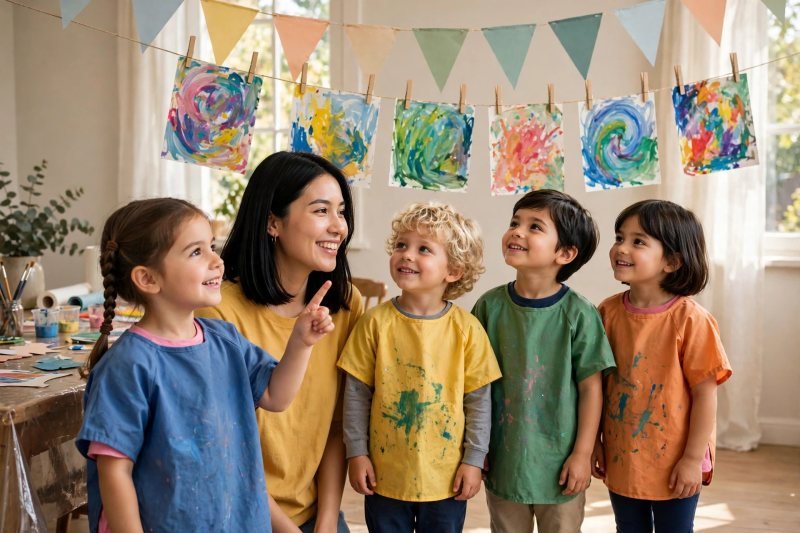
Step 7: Hang a mini gallery and let paintings dry. Gather the group for the quiet, proud middle of the party — carry finished sheets and check the canvases together, hang the practice paintings along the drying line or prop them on the shelf where everyone can see them, and walk the line slowly like visitors in a real gallery, with the birthday child leading and each artist invited to point to one thing they love about their own work and one thing they love about a neighbor's. This pause lets you check which canvases are dry, move any still-tacky canvas to a safer spot, and gives children a slower moment that resets the room before sugar arrives. Keep comments kind and concrete — colors, shapes, brave big brushstrokes — and gently steer any teasing straight back to the work in front of you. If a painting has torn or smudged, offer the spare canvas and a fresh start without fuss, framing it as an artist's second canvas rather than a disaster. Photograph the gallery line and the group of smocked artists in front of it now, while clothes are painty in the charming way and before cake adds its own decorations. Say, "Welcome to our gallery — artists, show us your favorite color in the whole room." A gallery walk makes children feel genuinely exhibited, and that feeling is the emotional heart of an art party. If you are still choosing a theme, these 5th birthday party ideas pair well with an art table.
-
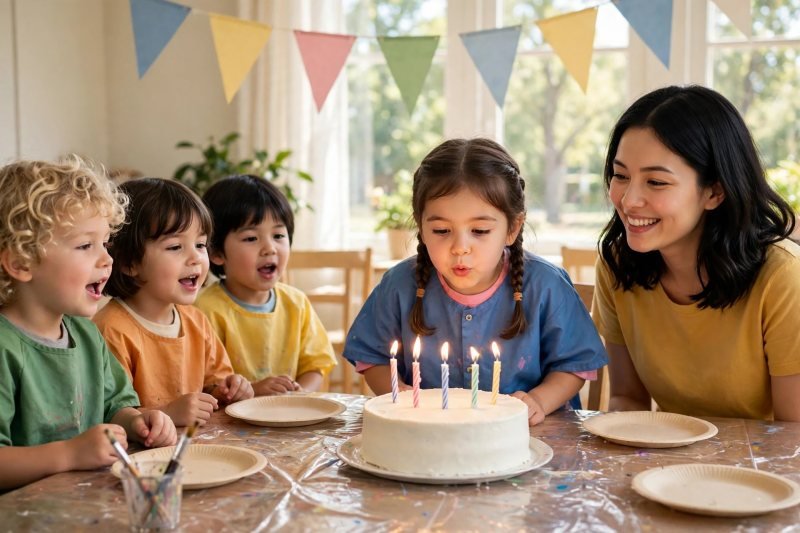
Step 8: Bring out the cake with five candles. Wash hands first — line everyone up at the sink, soap, rinse, dry, no exceptions between paint and food — then settle children at the clean snack table or a cleared, freshly covered spot away from wet paintings, bring the simple cake in with exactly five candles for a fifth birthday, and let an adult handle the lighter and the lit cake at all times while children stay seated. Sing together, let the birthday child make a wish and blow, and be ready with a second adult to steady the cake if little helpers lean in with enthusiasm; once the candles are out, an adult removes them straight into a safe spot, cuts the cake away from the children, and serves small slices on plain plates with forks, checking every serving against the allergy notes you collected — a child whose allergy means a different treat gets their special plate served at the same moment, in the same cheerful way, so nobody is singled out. Pour water, keep the pace unhurried, and let this be the party's sit-down, chatty, refueling pause; second helpings for anyone still hungry, fruit alongside for anyone who wants it, and no rushing children back to activities with full mouths. Say, "Count the candles with me — one, two, three, four, five — five candles for five wonderful years, so make a wish." Counting the candles together turns the cake into a small ceremony the birthday child will remember, and exactly five keeps the ritual true to the birthday being celebrated.
-
Step 9: Wrap the canvases as party favors. After cake, return to the now-dry canvases for the step children talk about on the way home — lay out brown paper or tissue, plain paper bags, ribbon and stickers, and show how to wrap a canvas simply: canvas face up in the middle of the paper, folds over, edges tucked, a sticker to seal, or, for the easiest route with wiggly hands, slide the canvas into a paper bag, fold the top down twice, and decorate the bag itself with a fresh dabber print or a big colored dot. The painting is the favor — no separate bag of small toys is needed — and wrapping their own work teaches children that something they made is worth presenting like a gift; add their practice-sheet discoveries to the same bag, help anyone whose canvas is still slightly tacky by slipping a sheet of plain paper over the surface before wrapping, and set each finished package in a row by the door with the child's colored dot visible so hand-out at pickup is calm and correct. Keep one spare wrapped canvas from your sample or a spare painting for any child whose work truly did not survive, offered quietly and kindly. Say, "You made this, you wrapped this — this is a present from you, and it is going home to be hung up." A favor a child created carries more pride out the door than anything bought, and parents genuinely hang these up.
-
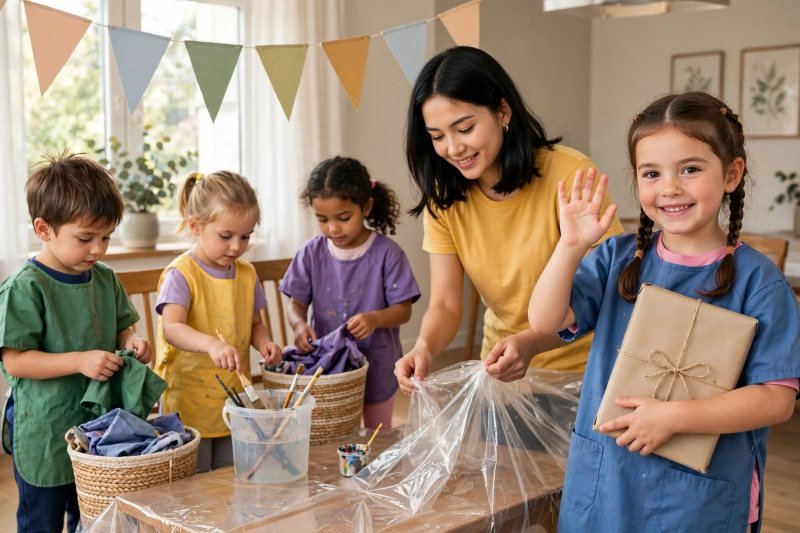
Step 10: Tidy together and say goodbye. End the party the way artists end a studio day — together, briefly, and with jobs sized for small hands: smocks off and into the laundry basket in one cheerful parade; brushes and dabbers into the soaking bucket; lids clicked back onto pots; palette plates and cups stacked by a helper team; and the table cover, in the party's final small ceremony, gathered up at the corners by adults with every spill, cup and crumb inside it, and carried straight to the trash so the floor underneath appears almost magically clean. As families arrive, hand each child their wrapped canvas package yourself or let the birthday child do the honors, tell each parent one true, specific thing their child made or mixed or stamped, and keep goodbyes at the door short, warm and moving so the room empties kindly rather than dissolving. Once guests have gone, let the birthday child choose one favorite moment to retell while you do the last jobs — smocks into the wash, brushes rinsed and stood to dry, leftover paint pots sealed, floor covering shaken outside and folded or binned, and the birthday child's own canvas hung up at home before bedtime if it is dry. Say, "Real artists clean their studio together — smocks in the basket, brushes in the bucket, and thank you for painting with us." A tidy-up that is part of the party, not after it, leaves children proud, parents impressed, and you facing minutes of clearing instead of an evening of it.


Make it easier
Run three stations only — the canvas, color mixing, and one stamping sheet — and skip the games round; a smaller art party still feels full and finishes calmer. Serve the cake as plain slices on plates with no decorating step, and send paintings home in plain paper bags instead of wrapping them. Invite fewer guests: four or five children at one table is the sweet spot for one adult running an art party solo.
Make it harder
Add a second canvas challenge for confident five-year-olds: paint the same simple subject — a tree, a fish, a house — twice, once with brushes and once with tools only, and hang them as a pair in the gallery walk. Set a gentle gallery talk: each child introduces their canvas to the group in one or two sentences, practicing speaking about their own choices. Offer a collaborative mural on one long shared sheet as the final activity, which the birthday child keeps — more children, more negotiation, more reward.
Other ways to play it
- Outdoor art party: move the covered table to a shaded patio or yard, weigh paper down against breezes, keep paint pots in a tray so grass spills stay contained, and let the drying line run between two chairs; everything else in the plan stays the same.
- Rainbow color party: lean fully into color — palettes arranged in rainbow order, a color hunt as the main game, and plain decorations in rainbow colors with no letters or words anywhere.
- Tiny gallery party for fewer guests: with three or four children, give everyone a larger canvas, add a frame-decorating moment using plain card frames and stickers, and take the gallery walk twice — once before cake and once with parents at pickup.
How it changes by age
- Age 4: Four-year-olds need the shortest instructions and the biggest tools: chunky brushes, dabbers and squeeze bottles over fine brushes, a practice sheet before the canvas so the first wobbles do not happen on the keepsake, and an adult seated at the table for refills and rinse-water swaps. Expect the canvas to be finished fast and joyfully — offer the stamping sheet early so fast finishers stay happily busy while slower painters take their time. Keep the games to the color hunt only, serve cake in small slices, and plan the whole party closer to ninety minutes than two hours.
- Age 5: Five-year-olds can handle the full arc in this guide: predictions in the color-mixing round, the pass-and-paint game with its turn-taking, introducing their own canvas on the gallery walk, and wrapping their own favor with only a little help. Give them real responsibility — handing out brushes, leading the candle count, handing favors to friends at the door — because jobs are what make a fifth birthday feel properly grown-up. Their canvases can carry a simple challenge, such as painting a place they love, for children who ask what to paint.
What they're learning
Color knowledge: naming colors, predicting mixes, and discovering that blue and yellow make green — real early science learned with a craft stick in hand. Fine motor control: gripping brushes, pressing dabbers, pinching cotton swabs, squeezing bottles and stirring with sticks — hand strength and control that feed directly into writing readiness. Creativity and decision-making: choosing subjects, colors and tools with no single right answer, and learning that their choices make a picture that is recognizably theirs. Social and language skills: passing paintings kindly, talking about a friend's work with specific kind words, introducing their own canvas, and counting candles together — vocabulary and confidence growing inside a celebration.
Clearing up
Gather the plastic table cover up at the corners with every spill and crumb inside and bin it, shake the floor sheet outside, and soak brushes, dabbers and pots in warm soapy water straight away so washable paint lifts without scrubbing. Smocks go into the wash the same day, leftover sealed paint pots store for the next art afternoon, and decorations fold flat for another party. Walk the room once with a trash bag, check under the table for dropped brushes, and hang the birthday child's canvas somewhere it will be seen at breakfast.
Questions parents ask
How do you plan an art birthday party for a 5-year-old?
What paint is safest for a kids' art party?
What can kids take home from an art party instead of a favor bag?
How do you keep an art birthday party from getting too messy?
How many candles should be on a fifth birthday cake?
Internal link targets: 2nd-birthday-party-ideas-toddlers (step 1, anchor "2nd birthday party ideas"); color-mixing-activities-for-preschoolers (step 4, anchor "color mixing activities"); fine-motor-activities-for-preschoolers (step 5, anchor "fine motor activities"); children-s-painting-ideas (step 3, anchor "children's painting ideas"); craft-ideas-for-4-year-olds (step 5, anchor "craft ideas for 4-year-olds"); 5th-birthday-party-ideas-themes (step 7, anchor "5th birthday party ideas").


