


Shapes Activities for Preschoolers: 20 Hands-On Geometry Ideas
Looking for shapes activities for preschoolers that go beyond flashcards? These 20 hands-on ideas — shape hunts, playdough geometry, block building, stamping, outdoor games and playful food crafts — teach circles, squares, triangles and rectangles through real play for ages 3–4.
The best shapes activities for preschoolers are hands-on games: shape hunts, playdough geometry, block building, stamping, outdoor play and food crafts. Teach circles, squares, triangles and rectangles by touching, building and finding them — 10–30 minute sessions using things you already own work better than any flashcard.

The short version
- Teach shapes through play: hunts, building, stamping, cooking and outdoor games beat flashcards.
- Start with circle and square, then add triangle and rectangle; count sides and corners together.
- Introduce 3D shapes early with a ball (sphere), box (cube) and can (cylinder) — the rolling test makes it click.
- Keep sessions short (10–30 minutes) and repeat favorites; repetition is where learning locks in.
- Use household materials: playdough, sponges, tape, blocks, felt and cookie cutters.
- Supervise small parts, paint and outdoor play; carve potato stamps yourself.
- Age
- Ages 3–4
- Prep
- 5 min
- Play time
- 10 min
- Mess
- Some
- Difficulty
- Easy
- Where
- Both
Why kids love this
Preschoolers learn shapes by touching, moving and making. A circle is just a word until a child has rolled one from playdough, hunted for one around the living room and stamped one in bright blue paint. These twenty ideas turn geometry into play — building, cooking, jumping, stamping and hunting — so it sticks without a single drill. Children repeat their favorites for days, and every repeat deepens what they know.
What you'll need
- Colorful wooden shapes or paper shape cutouts, playdough, dry spaghetti, a shallow tray, construction paper, a glue stick, clear contact paper, tissue paper, child-safe cookie cutters, washable paint, kitchen sponges, two large potatoes, wooden blocks, magnetic tiles, sidewalk chalk, masking tape, toy cars, a basket, felt sheets or craft foam, bread, spread and soft fruit, index cards or paper for bingo, small tokens such as pom-poms, cardboard boxes, paper and a marker for shape icons, sticks and pebbles from outdoors.
Before you start
Pick one or two steps per session — a preschooler does not need all ten at once. Lay the materials on a tray so everything stays contained, and tape the contact paper to a window ahead of time for the suncatcher. Cut the potatoes the night before so they dry overnight for sharper prints.
How to do it
-
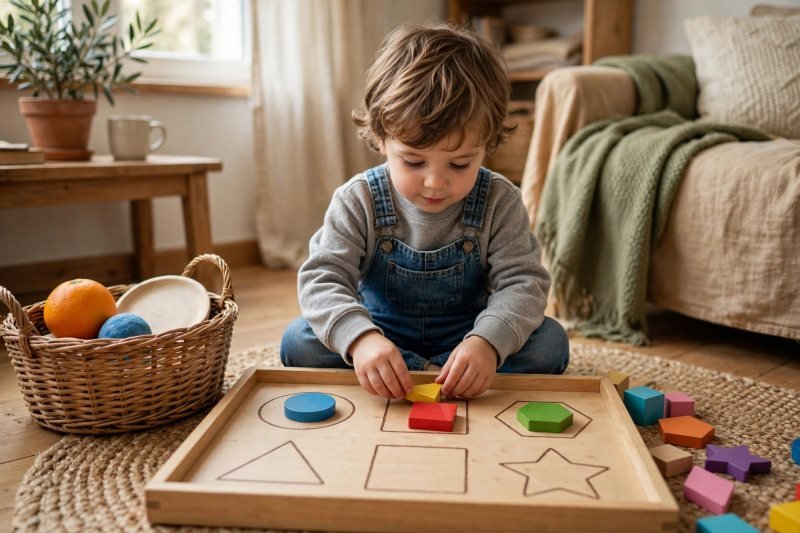
Shape hunt and sorting tray. Give your child one shape and ten minutes: "Find everything round in the living room." For a dedicated hunt, see our shape hunt around the house. Clocks, plates and oranges become circles; books and boxes become rectangles. Name each find together and drop it in a basket. Then draw big outlines of a circle, square, triangle and rectangle on a tray, and have your child match paper or foam shapes to each outline, counting sides together: "One, two, three sides — triangle!" Everyday objects are already teaching tools once you name their shapes.
-
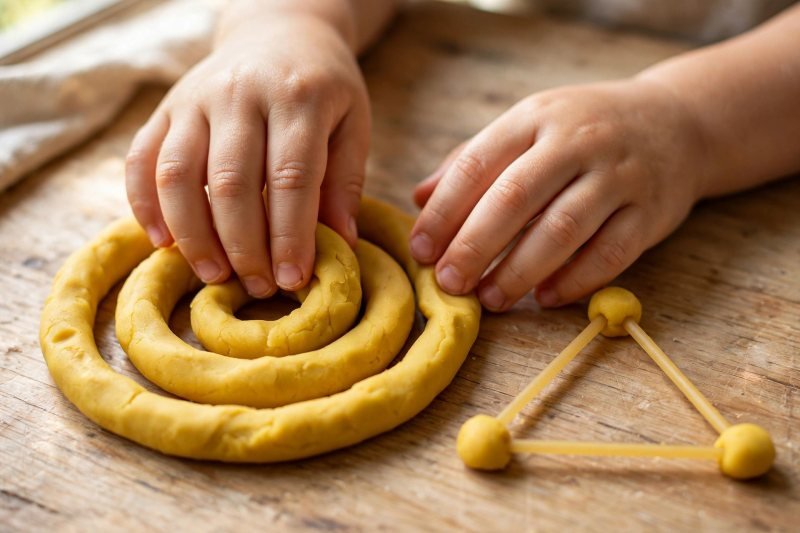
Playdough geometry, two ways. Roll playdough snakes, then coil one into a circle or press pieces into a triangle. Challenge your child to flatten a ball into a square with their palm — pressing in the corners is a satisfying puzzle. Then break dry spaghetti into short sticks, roll tiny playdough balls as corner joints, and build triangles, squares and rectangles together — part geometry, part engineering, and great concentration practice.
-
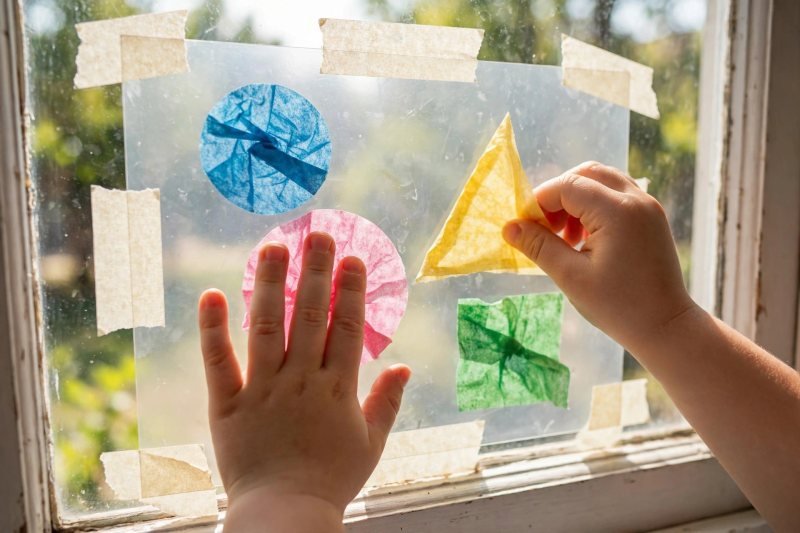
Torn-paper collage and suncatcher. Tear construction paper into rough triangles, squares and circles, then glue them into a picture: a triangle tree, a square house, a round sun. Tearing builds grip strength too — see our fine-motor activities for preschoolers for more tearing, pressing, and stamping ideas. For a window glow, tape clear contact paper, sticky side out, to a low window and have your child press small tissue-paper shapes onto it; frame the edges with tape — geometry that glows in the afternoon light. Art gives children a reason to look closely at shapes — and every print becomes a keepsake.
-
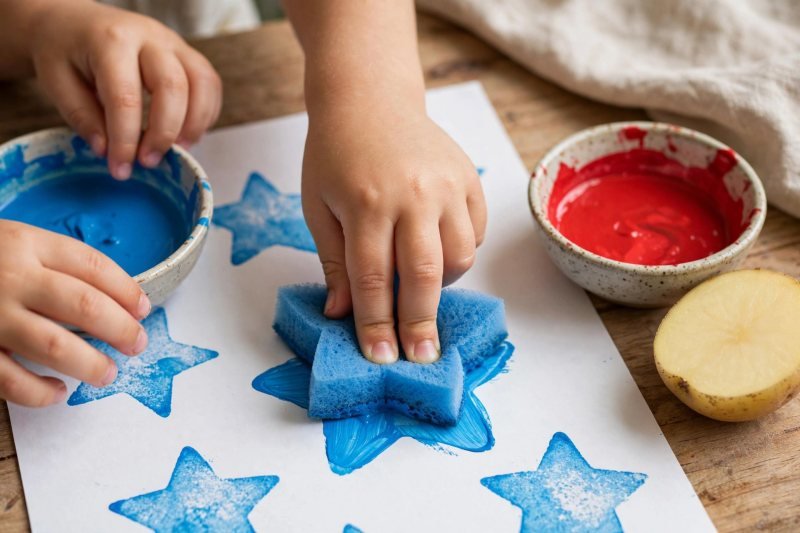
Sponge stamping and potato printing. Cut kitchen sponges into a circle, square, triangle and rectangle, dip in washable paint and stamp a long "shape train" across paper — children love reading the cars back to you. An adult cuts a potato in half and carves a simple shape — a star, heart or diamond — into the flat side; your child dips it in paint and presses prints onto paper. The shape appearing like magic delights every time.
-
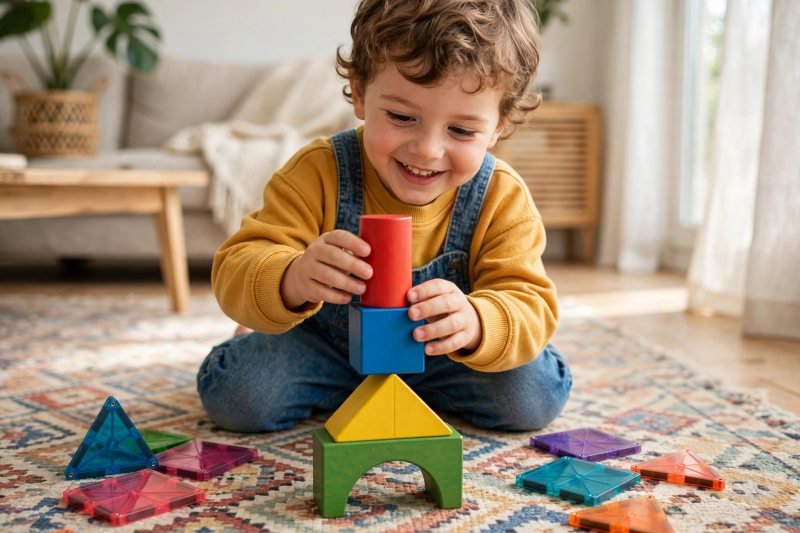
Block building and magnetic tiles. Narrate the shapes as you build: "Two squares stacked make a rectangle. The arch is half a circle." For flat-shape practice, try our 2D shapes activities. Then challenge your child to build a roof using only triangles. Click magnetic tiles into flat shapes, then fold four triangles up into a pyramid or squares into a cube — watching flat shapes become solid ones is a preschooler's first taste of real geometry. Big muscles and tall towers make shape names stick — children remember what their whole body has practiced.
-
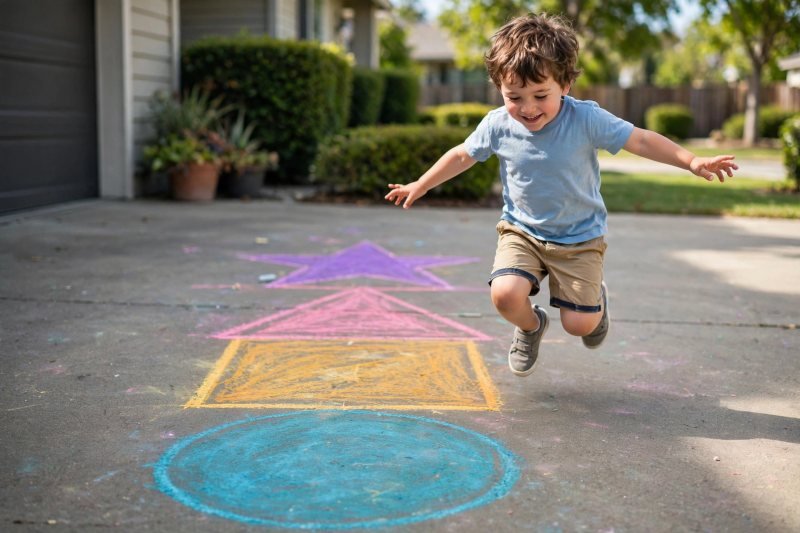
Chalk hopscotch and tape roads. Draw big shapes on a driveway with chalk; call out a shape and your child hops to it, lands inside and names it. Fresh air plus big movement makes memories that last. Indoors, tape a big triangle, circle and square on the floor and have your child drive toy cars along the edges, tracing the route with a finger first — corners slow the car down, so the edges are impossible to miss.
-
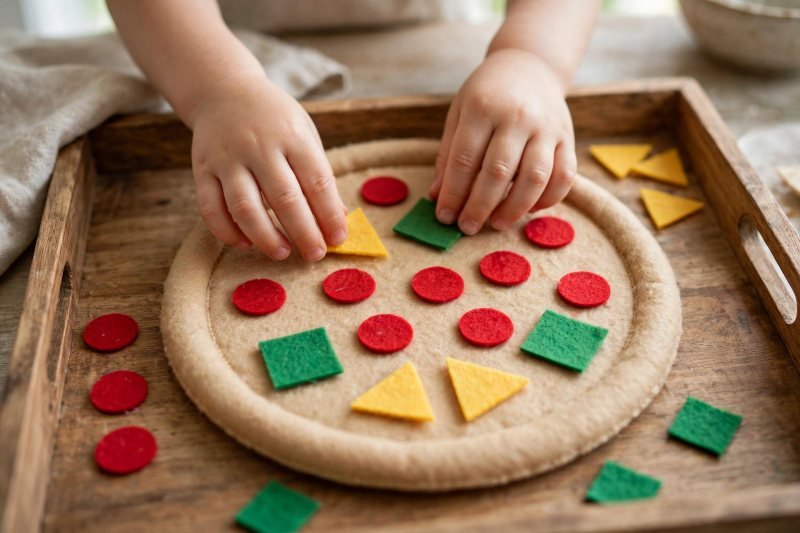
Felt pizza and shape sandwiches. Cut a big tan felt circle for the crust, plus round red pepperoni, triangle cheese and square mushrooms; your child "orders" toppings by shape: "Three circles, please." In the kitchen, press cookie cutters into a sandwich to cut out a star, heart or circle (eat the scraps), or spread peanut butter on a tortilla, add soft fruit and fold it into a triangle. Food and fresh air turn shape practice into something children ask for.
-
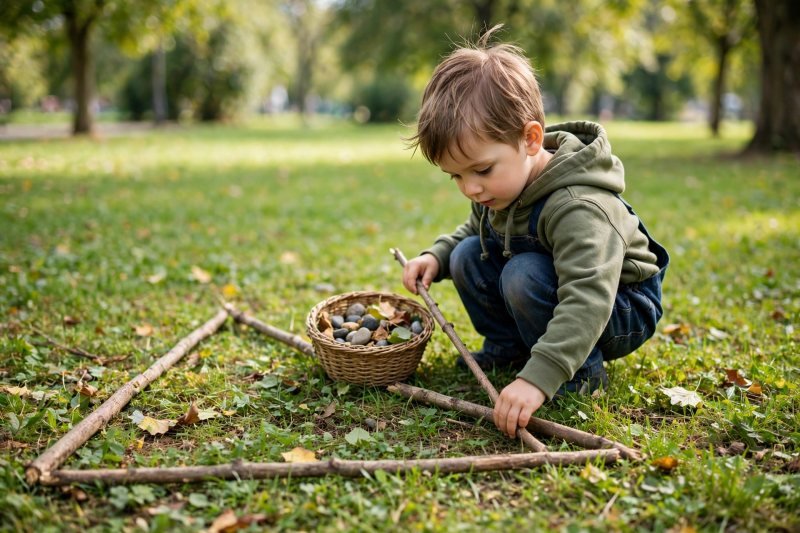
Nature walk and stick shapes. Hunt for shapes outside: a round sun, a triangular pine tree, a rectangular door, an oval leaf. Collect pebbles and sort them into roundish versus angular piles. Then gather sticks and lay them into triangles, squares and rectangles on the grass, and draw a giant circle in the dirt — full-body scale teaches size too; a triangle is still a triangle when it is as tall as they are.
-
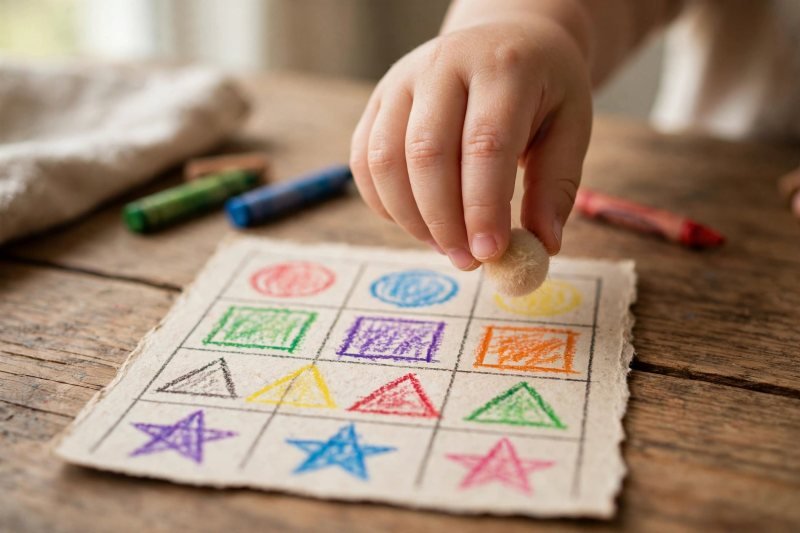
Shape bingo and I-spy. Draw a 2×2 grid with a colored shape in each square — no words, just shapes; call out "triangle!" and your child covers the match with a pom-pom. Four in a row earns a victory dance. For more counting and matching games, see our counting games for preschoolers. Then play "I spy with my little eye… something square!" — take turns spotting and describing: "Is it flat? Does it have corners?" The describing half is the real learning. Guessing games turn shape knowledge into a sport and lock the learning in.
-
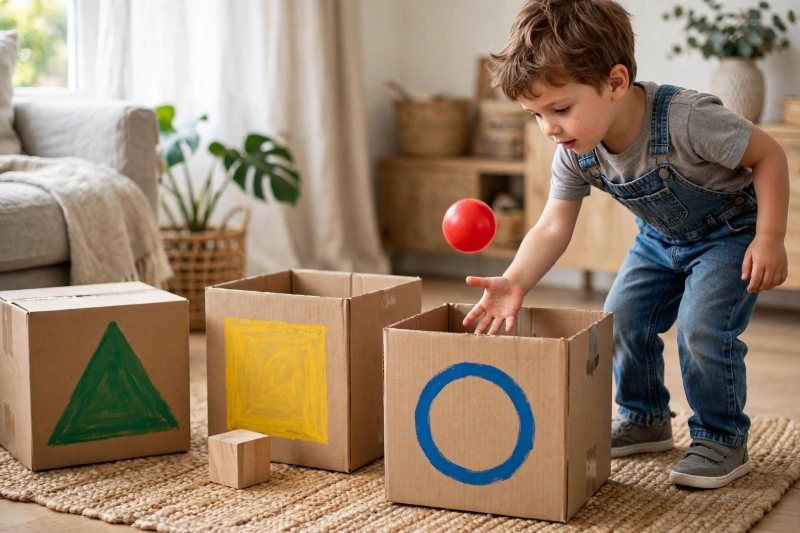
3D shape hunt and tidy-up race. Hunt for a sphere (ball, orange), a cube (box, dice) and a cylinder (can, paper towel roll). Roll the ball, then try to roll the box — the rolling test shows the difference instantly. Finish by drawing a simple shape icon on three cardboard boxes — circle, square, triangle — setting a timer and racing to sort toys by shape: balls in the circle box, blocks in the square box. Tidying becomes a game instead of a chore.


Make it easier
Start with just circles and squares — the easiest shapes to tell apart. Use bigger pieces and fewer choices, name the shapes yourself as your child plays, and repeat one favorite several days before adding a new one.
Make it harder
Add ovals, rectangles, diamonds and stars. Ask "how many sides?" and "how many corners?" for every shape, introduce the words "sphere," "cube" and "cylinder," or challenge your child to find two shapes hiding in one object — a rectangular door with round knobs.
Other ways to play it
- Rainy day: run steps 1, 3 and 9 as an indoor shape afternoon. For younger children, our counting activities for toddlers and the shapes learning hub round out the set. Party: set up stamping and the suncatcher as stations. Road trip: play I-spy shapes and the 3D hunt from the car. Fall: pumpkin (circle) and leaf (oval) hunts; winter: snowflake spotting.
How it changes by age
- Age 3: most threes recognize circles and squares and are learning triangles and rectangles. Expect guessing — "is this a triangle?" is the sound of learning, not failure. Keep sessions to 10–15 minutes and follow their energy.
- Age 4: most fours can name the four basic shapes, count sides and corners, and spot shapes around them. If your four-year-old shows no interest in shapes or cannot match identical shapes, mention it at their next routine check-up.
What they're learning
Shape recognition: naming circles, squares, triangles and rectangles on sight. Shape properties: sides, corners and curves — what makes each shape what it is. 2D versus 3D: flat shapes and solid shapes, and how they behave differently. Spatial reasoning: fitting, building, stacking and turning shapes in space. Math vocabulary: sides, corners, round, flat and solid — words later math builds on. Fine motor control: pressing, stamping, tearing and building strengthen little hands.
Clearing up
The tidy-up race (step 10) is the cleanup for half of these games. Shake paint shirts outside before washing, peel contact paper off the window while it is fresh, and store shape cutouts in a zip bag for next time. Five minutes of shared tidying is plenty.
Questions parents ask
What shapes should a 3-year-old know?
How can I teach shapes without worksheets?
My child keeps confusing squares and rectangles. What helps?
How do I introduce 3D shapes to preschoolers?
How long does it take a preschooler to learn their shapes?

save it for later
Pin this for the next rainy afternoon
Keep it on a board so it is there when you need it, rather than when you happened to find it.
Save to Pinterest
