


Preschool Halloween Costumes 2026: Easy Ideas for Ages 3-4
Preschool Halloween costumes for 2026 for ages 3–4: screen-favorite animal looks described generically, everyday heroes, dinosaurs, food suits, and gentle spookies — every one mask-free, layer-friendly, and rehearsed at a home try-on.
The best preschool Halloween costumes for 2026 are soft, mask-free looks built from what 3- and 4-year-olds already love: a blue puppy ears hood, a firefighter jacket, a dinosaur hood suit, a pizza tunic, and a friendly ghost — sized up over warm layers, rehearsed at a home try-on, and finished with real shoes and a glow light.

The short version
- Thirty ideas, one filter: faces visible, necks free, layers underneath, sitting and snacking possible.
- Trending looks are described generically — ears, spots, colors, and shapes — so any plain unbranded version works.
- Capes are short and breakaway; hats and hoods are soft and child-removable; props are soft, big, and optional.
- Dark costumes need light: glow stick or reflective tape on the tote, adult flashlight street-side.
- The home try-on a week early is the step that makes the night — rehearse layers, shoes, and sitting.
- Age
- Ages 3–4
- Prep
- 10 min
- Play time
- 10 min
- Mess
- Low
- Difficulty
- Easy
- Where
- Indoor
Why kids love this
Good preschool Halloween costumes for 2026 start from what a 3- or 4-year-old already loves at breakfast, story time, and dress-up — a blue puppy on screen, a firefighter waving from a truck, a dinosaur stomp in the hallway — and then pass a strict parent filter before they ever reach a shopping list. This guide names the trending themes honestly and describes each look by its plain elements — an ears hood, a spotted tunic, a tutu over leggings — so any unbranded version you find or assemble delivers the same delight without copying a protected design. Every one of the 30 ideas keeps the face fully visible (hoods, hats, and headbands instead of masks, because preschoolers need peripheral vision for curbs and steps and parents need to read their faces), keeps the neck completely free, layers over warm everyday clothes, and survives sitting, stumbling, and snacking. Shortlist by love, rehearse at home, and Halloween becomes the second happy wearing, not a stressful premiere.
What you'll need
- The shortlist method in step 1 — pick the category your preschooler already loves (animals, heroes, creatures, food, spooky-lite)
- Base layers in costume colors (long-sleeve tees, leggings, sweatpants) — the warmth and the backup plan in one
- The costume itself, sized UP one size so it layers (costumes are worn over clothes, not on skin)
- Real shoes, broken in — costume feet and slippers sit out wet pavement
- Optional: face paint crayons (water-based, patch-tested) for whiskers and noses — the mask substitute
- A tote or bucket with a handle your child can carry, plus one glow stick or clip-on light for visibility
- The home try-on: 15 unhurried minutes, a mirror, snacks — the rehearsal that saves the night
Before you start
1. Shortlist three ideas from three different steps — preschoolers choose best between a few loved options, not thirty. 2. Buy or assemble the winner a week early; the try-on (step 10) needs runway time in the schedule. 3. Check the forecast two days out and stage the warm layers — Halloween weather writes the final costume notes.
How to do it
-
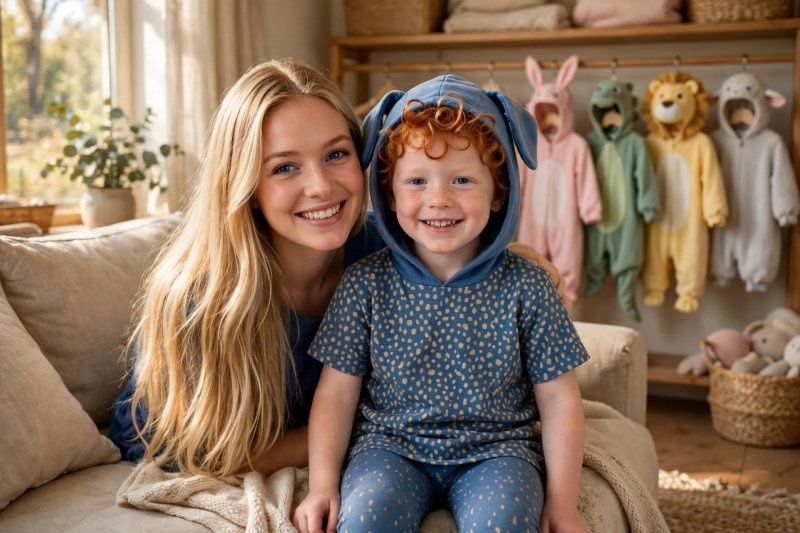
Start with the screen-favorite animals — blue heeler puppy, pink pig, dollhouse kitten. The three looks preschoolers ask for by name this year, described by their elements so any plain version works: (1) blue heeler puppy — a blue ears hood, a blue-and-tan spotted tunic over leggings, and a soft tail pinned high at the back waistband; the look reads entirely from the ears and spots, no printed character face needed; (2) pink pig — a pink hood or snout headband (the snout sits on the band, never strapped over his own nose), a pink tunic, and a curly felt tail; (3) dollhouse kitten — pink cat ears on a headband, a pink top with a soft skirt or tutu worn over leggings (never instead of them), and a ribbon collar worn loose or skipped entirely. The choosing rule for all thirty ideas starts here: one or two soft pieces, nothing at the throat, face fully visible. Say, "Pick your favorite — we build the look from ears, colors, and spots." If he chooses with his whole heart, half the night's battles are already won. A craft afternoon built around Halloween crafts for kids often settles the choice before any costume is tried on, because the character he enjoys making is usually the character he enjoys wearing.
-
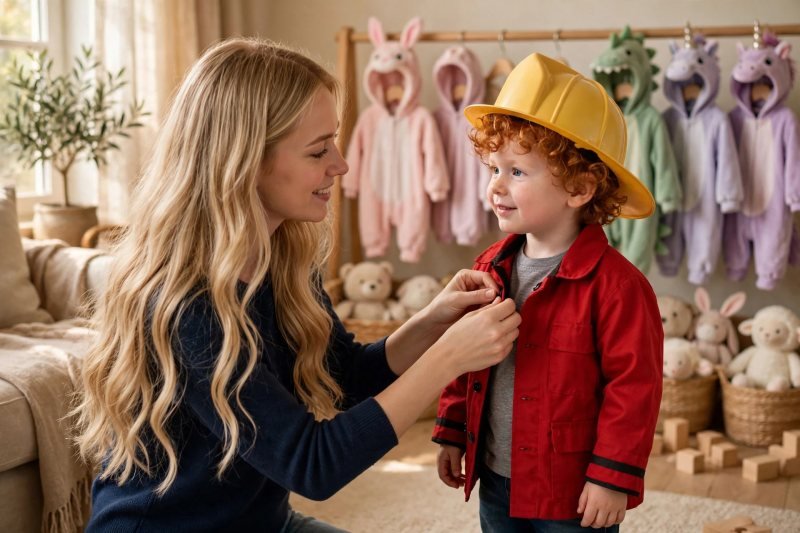
Dress the everyday heroes — firefighter, police officer, doctor. For the preschooler whose love language is sirens, trucks, and helping: (4) firefighter — a red or yellow-striped jacket over anything, a soft helmet, and boots that are actually his rain boots; (5) police officer — a dark blue vest over a light shirt, a soft cap (never a hard hat at face height for anyone), a felt badge he helped place, and no realistic props of any kind — the uniform and the cap carry the whole idea; (6) doctor — a soft white coat or oversized white shirt over clothes, and a toy stethoscope with a short tube that hangs from a pocket, never looped tight around the neck. Prop discipline for this whole guide: props are soft, big enough to never fit in a mouth, and optional at every moment — a costume that needs its prop is a costume with a failure mode. Say, "Heroes wear the uniform; the tools are just visiting." These three also headline the dress-up bin all winter.
-
Rule the royal and magical court — knight, princess, wizard. Three costumes built from an over-layer and a soft headpiece: (7) knight — a silver-gray tunic or tabard over warm layers, a soft helmet-hat or crown, and a foam shield that doubles as a candy tray in a pinch; (8) princess — a dress worn over a long-sleeve tee and leggings, a soft crown on elastic (removable by her or him in one pull), and shoes that are real shoes under the hem; (9) wizard — a deep-blue robe over clothes, a crushable soft cone hat on chin elastic, felt star shapes, and a wand replaced by a soft star on a ribbon loop worn at the wrist. Hat rules across the guide: soft, crushable, elastic-secured, and removable by the child himself — power over his own head is non-negotiable at three and four. Capes, where they appear, are short (above the waist) with breakaway fastenings at the shoulders, never tied at the neck. Say, "Crowns and hats you can rescue yourself from are the only ones we wear." All three layer warm underneath and come apart for the car seat in seconds.

-
Stomp in with dino and creature mania — dinosaur, dragon, friendly monster. The tail-and-hood heavyweights of 2026: (10) dinosaur — a green hooded suit in a T-rex style, with soft spikes down the back, short arms he can still snack through, and a tail that attaches high and short (ground-dragging tails are step-hazards wearing a costume); (11) dragon — the dinosaur's upgrade: wings on a soft harness with no wire edges, belly scales in felt, and a hood with horns too soft to matter; (12) friendly monster — a bright hooded suit or hoodie with soft horns and one big felt eye appliquéd on the belly or hood top, never over his own eyes, in the least frightening colors you can find. Creature rules: spikes, horns, and tails are all soft-stuffed; vision and hearing stay unobstructed (hood details sit on top or at the sides, not over ears); and suit feet are sock-slippery, so real shoes go on for the route. Say, "Stomp practice now — creatures walk like they mean it." If any creature makes your preschooler hide from the mirror, it is retired by acclamation; frightened is never the aesthetic.

-
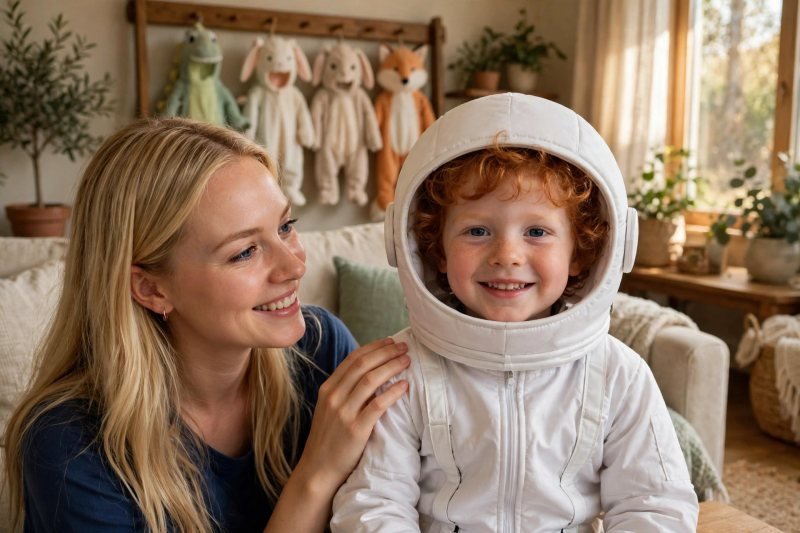
Blast off with space and science — astronaut, alien, mad scientist. For the child who points at the moon and asks questions at full volume: (13) astronaut — white layers or a white one-piece, felt patches he chose the placement for, and a soft open-face helmet-hat (the face stays fully visible — it is a hat shaped like a helmet, never a closed helmet or mask); (14) alien — green layers, an antennae headband with soft bobble tips, and silver felt accents; friendly is the whole brief; (15) mad scientist — a white smock or lab-style coat over clothes, a wild wig worn over a thin cap so it lifts off in one motion, and a soft foam flask or a cardboard beaker as the one optional prop. Science and space rules repeat the guide's spine: open faces, free necks, soft props, and headpieces a preschooler can remove himself. Say, "Scientists and astronauts keep their faces out — they need to see the discovery." Pair the shortlist chat with a week of halloween crafts for toddlers — a paper rocket or planet he made himself settles which of the three he truly wants to be.
-
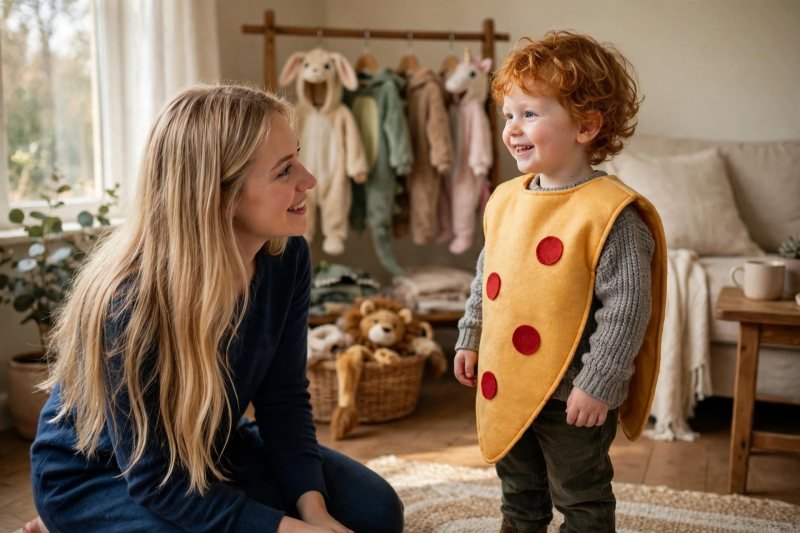
Serve the food fun — pizza slice, donut, strawberry. The sweet-and-savory trio, beloved by grandparents and photographers: (16) pizza slice — a tan-and-red padded triangle tunic over warm layers, felt topping shapes he placed himself, and a pointed hem that stops above the knees for clean walking; (17) donut — a padded ring tunic in frosting colors with felt sprinkles, worn over a tee and leggings, the roundest silhouette in the guide; (18) strawberry — a red padded tunic with seed dots in felt or fabric pen, a green stem hat, worn over green leggings. Food-suit rules: padding must compress for car seats and chairs (or the suit goes on after the drive), fastenings pass a parent's-hand test, sit-down tests are mandatory, and the fruit and food get photographed before the first chocolate, for obvious reasons. Say, "You're good enough to eat — but we'll stick to candy." These three also win the sibling-group prize: a whole snack table, coordinated in one shopping trip, with zero branding anywhere on the tunics.
-
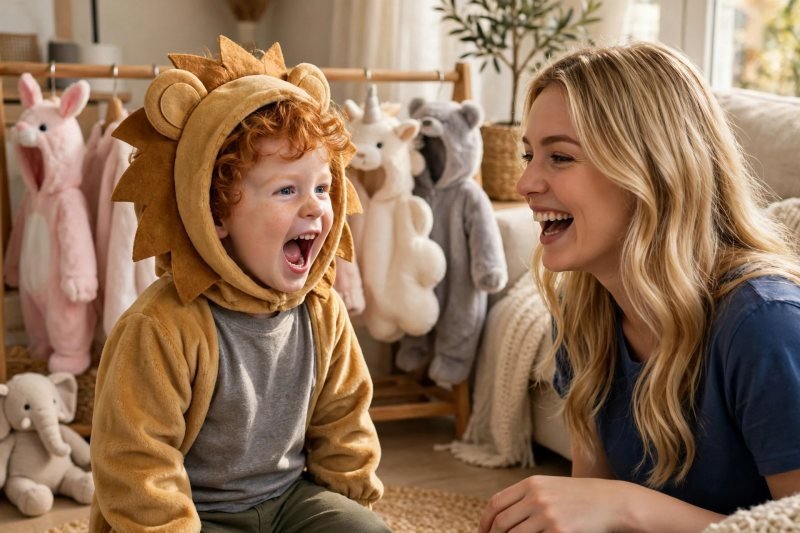
Roam the wild animals — lion, tiger, elephant. Three costumes carried by a hood or headband, the formats that cannot fall off, get lost, or cover the face: (19) lion — a tan hooded suit or hoodie with a felt mane framing the face, roaring practice strongly encouraged; (20) tiger — orange layers with soft black stripes in felt or fabric pen, an ear headband, a tail pinned high enough to sit on, and face-paint whiskers drawn while he watches in the mirror (three strokes per cheek — the fine motor activities crowd will recognize whisker-drawing as stealth steady-hand practice for the parent, art division); (21) elephant — a gray hood with big soft ears and the trunk appliquéd or attached on the HOOD itself, hanging beside the face, never over it — his own nose, mouth, and eyes stay completely clear for breathing, talking, and snacking. Hood rules: ears, eyes, and trunks sit ON the hood, the hood's edge stays behind the hairline, and elastic — never a drawstring — keeps it placed. Say, "The hood does the magic; you just do the roaring." Animal lovers shortlist here; the costume is also next month's dress-up bin royalty.
-
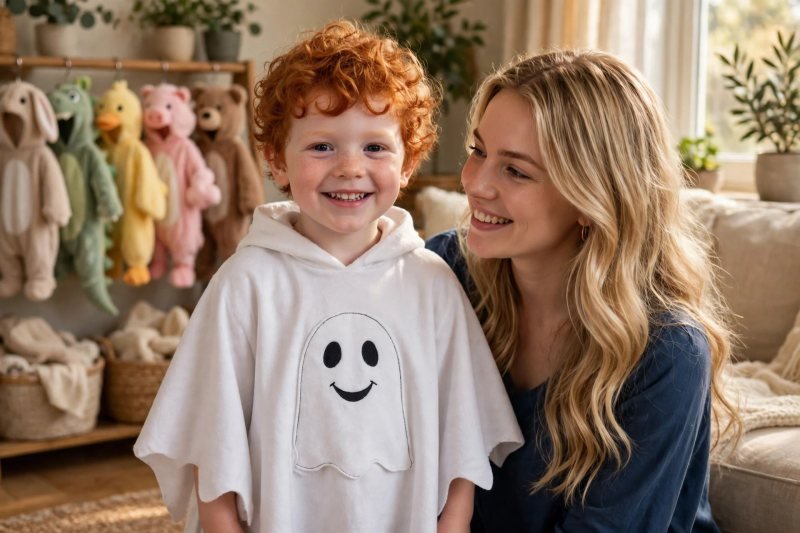
Keep the spookies gentle — friendly ghost, pumpkin, scarecrow. Halloween flavor at preschool strength — spooky silhouettes, zero fright: (22) friendly ghost — a soft white tunic with a smiling face appliquéd at the belly and a white hood or cap, NEVER a sheet over the head (tripping, vision, and breathing all vote no) — the ghost reads by its shape and smile; (23) pumpkin — a padded orange tunic over green or brown layers, a stem hat, zero small parts, and roundness that forgives every layer under it; (24) scarecrow — a flannel shirt and jeans he may already own, a soft hat, and straw-look felt strips sewn at the cuffs (attached, never loose near the face or neck). Say, "Spooky-soft — that's our kind of scary." Dark-evening rule for this trio and the whole guide: light-colored costumes lead, and every tote gets a glow stick or clip-on light, with reflective tape on the back of darker suits — drivers and dusk are a bad mixture. The ghost and pumpkin also photograph beautifully at the porch before dark, which is when preschool Halloween truly happens anyway. If you scoop a pumpkin together first, pumpkin scooping and seed sorting turns the pumpkin costume into a whole-afternoon story, not just an outfit.
-
Turn the storybook pages — caterpillar, red-hooded girl, three-pigs pig. Three costumes borrowed from the read-aloud shelf, all in generic storybook form: (25) hungry caterpillar style — a green segmented tunic (soft hoops or padded bands in two or three greens) over warm layers, a red or green cap with soft antennae, and leaf-green leggings; the segments do all the storytelling, no printed character art anywhere; (26) red-hooded storybook girl — a red hooded cape worn SHORT (above the waist, breakaway fastening at the shoulders, never tied at the neck) over a dress or everyday clothes worn with leggings, plus a small basket carried empty for candy logistics; (27) three-pigs pig — pink layers, an ear-and-snout headband (snout on the band, face clear), and a curly tail, ready to pair with siblings from step 1's pig or step 10's farm set. Storybook rules: capes are short and breakaway, hoods stop at the hairline, and every look is assembled from colors and shapes — the story lives in the reading, not in copied artwork. Say, "We know this story — tonight you get to wear it." A re-read of the favorite book at the try-on cements the choice better than any store display.

-
Gather the group themes — farm set, ocean set, rainbow set — and hold the home try-on. Three coordinated finales for siblings and friends: (28) farm set — one child per barnyard role from this guide (pig from steps 1 or 9, a chick in yellow layers with a felt comb cap, a farmer in overalls and a soft hat), coordinated by color, bought or built in one trip; (29) ocean set — a shark in a gray fin hood, a fish in bright scaled felt over layers, and a sailor in a white soft cap and striped tee, every face open and every fin soft; (30) rainbow set — each child in one bold color from head to toe with a matching soft hat, the group reading as a rainbow only when they stand together, which is the joke and the photo. Then the step that makes all thirty work: the home try-on ceremony, a full week early — costume on over the planned layers (the layering drill from the toddler winter outfits playbook: base layer, costume over, jacket if the night demands), shoes on, tote in hand, a practice march to the mirror and one lap of the house, the sitting test, the snack test, and the parent's checklist (vision clear? neck free? tail sits? layers warm? shoes real?). Costumes are adjusted or swapped NOW, in the calm. Say, "Tonight we practice; on Halloween, we just go be it." A rehearsed preschooler in a simple costume outshines an unrehearsed one in a masterpiece every single year. When the costume is decided, fall leaf crafts for preschoolers keep the autumn creativity going long after Halloween night.


Make it easier
The closet costume: black cat energy without the cat — scarecrow (24), mad scientist (15), and the rainbow set (30) assemble almost entirely from clothes he already owns plus one soft accessory each. The hood shortcut: lion (19), dinosaur (10), and blue heeler puppy (1) are one hooded piece over everyday layers — no separate hat to lose, no prop to carry. The tote matters more than the costume at three and four: spend the saved effort on a bucket he can carry and a glow light he can see by.
Make it harder
Family theme: the farm set (28) plus a farmer parent; the ocean set (29) plus a lighthouse parent in yellow with a flashlight; the food trio (16–18) as a full snack-table cast — group themes are the advanced class. DIY one element together: he glues (with you) the felt sprinkles on the donut or places the astronaut's patches — a made piece makes the costume his in a way shopping can't. The photo plan: pick the parade, porch, or pumpkin-patch shot in advance — costumes photographed in daylight at the weekend event often out-treasure the dark-night documentation.
Other ways to play it
- Cold-night version: every idea here layers — size up, base layers under, hoods swapped for ear headbands under a warm hat when the forecast turns; the costume is the middle layer, not the outer.
- Warm-night version: the vest-and-hat ideas (5, 6, 15) run light: tee underneath, no padding, food suits traded for their tunic-only cousins worn over shorts and tees.
- Solo-to-group version: any single pick becomes a set by color or category — three animals, three foods, three heroes — coordinated in photos without a single matching or branded purchase.
- When a hood slips: if a hood keeps sliding over his eyes at the try-on, retire that hood for the night and use a headband or hat version of the same look instead of adjusting it outdoors — a costume that needs constant fixing is a costume that hides his face.
How it changes by age
- Age 3: Threes get the simplest architectures — one-piece hooded suits, padded tunics, and headbands — tried on twice (the ceremony plus one encore), with the night's route kept to a handful of known doors and a hard stop before tired. Their Halloween is 30 to 45 enchanted minutes, perfectly sized, and the costume they can sit, snack, and toilet in without a full undress wins every time.
- Age 4: Fours can carry a soft prop, choose between finalists with real and loudly held opinions, walk a longer route with planned breaks, and star as the senior cast member in a group theme. The try-on becomes a fashion show with commentary; let them direct it, photograph the finalists, and make the final call between two parent-approved options — ownership is the difference between a costume worn proudly and one negotiated at the door.
What they're learning
- Choice and identity: picking who to be for a night — from loved categories, inside safe bounds — is early self-expression with training wheels. - Body autonomy: hats he can remove, costumes he rehearsed, a veto that retires frightening ideas — his comfort is consulted and obeyed, which outlasts Halloween. - Community ritual: knocking, greeting, thanking, and the tote's growing weight — the neighborhood's kindest civics lesson, in costume. - Counting and categories (sneakily): thirty ideas in ten families of three, spider-free math everywhere — sorting, matching colors to characters, and counting group-set members in felt and foam.
Clearing up
Costumes come off into the dress-up bin (their second career starts tonight), face paint washes off in the regular bath, the tote is emptied into the adult-checked candy bowl, and reflective bits and glow sticks are retired. Photograph the costume flat before storing if it's a keeper — next October's shortlist starts with evidence of what actually got worn happily, versus what merely got bought.
Questions parents ask
What are the most popular preschool Halloween costumes for 2026?
Should preschoolers wear Halloween masks?
How do you keep a preschooler warm in a Halloween costume?
How can I make a trending character costume without buying a branded one?
How long should trick-or-treating last for a 3- or 4-year-old?

save it for later
Pin this for the next rainy afternoon
Keep it on a board so it is there when you need it, rather than when you happened to find it.
Save to Pinterest


