


Pirate Birthday Party Ideas: A Treasure Hunt Adventure
A pirate birthday party for a 6th birthday: map invitations, a cardboard ship, a symbol-clue treasure hunt with a pouch for every child, pirate games, a safe feast, and a cake with exactly six candles — a two-hour adventure for ages 5-6.
A pirate birthday party for ages 5–6 is a two-hour backyard treasure hunt adventure: map invitations with symbols only, a cardboard ship and plain sail, waist-sash dress-up, a flat plank game, a symbol-clue hunt with a pouch for every child, a safe feast, and a cake with exactly six candles lit only by an adult.

The short version
- Plan small and story-shaped: six to eight young pirates, a two-hour arc, shade first, and an indoor fallback ready.
- Maps and clues use symbols only — dotted paths, X marks, and pictograms — with party details sent to parents in a message, not written on the cards.
- Necks stay completely free: sashes at waists or over shoulders, bandanas on heads, soft checked eye patches, and no latex balloons.
- Every game is no-loser by design: a plank laid flat on the ground and a guaranteed treasure pouch per child on the hunt.
- The cake carries exactly six candles for a 6th birthday — an adult lights, guards, and removes them.
- Age
- Ages 5–6
- Prep
- 60 min
- Play time
- 120 min
- Mess
- Some
- Difficulty
- Medium
- Where
- Outdoor
Why kids love this
A pirate birthday party works for five- and six-year-olds because it hands them a story with a job inside it: there is a map, there is a crew, and there is treasure that is genuinely findable. At six, a child can follow a dotted path from clue to clue, carry a beanbag cannonball across a plank without dropping it, and wait — mostly — for his turn to blow out six candles. The birthday child is not an audience member; he is the captain: drawing the invitations, helping raise the sail, leading the hunt, and handing out the treasure at the end. Nothing needs to be frightening or competitive. The games have no losers, the hunt guarantees a pouch for every child, the feast is familiar food with adventurous names, and the whole arc lasts about two hours — long enough to feel like a real voyage, short enough to dock while the crew is still cheerful. For a 6th birthday especially, that mix of dressing up, building, searching, and being trusted with the map is exactly the adventure he has been imagining.
What you'll need
- Plain cardboard boxes and large sheets — for the ship side, the treasure chest box, and the ship target box; all packaging and containers kept blank, with no printing showing
- Parchment-style card stock — for map invitations and symbol clue cards, kept free of readable words in any photo
- Crayons and markers — for dotted paths, X marks, and simple pictogram drawings on maps and clues
- Plain fabric for a sail, plus a simple frame or garden poles an adult secures — the sail stays blank
- Paper for bunting triangles, plus string for hanging bunting high, well out of reach
- Bandanas, waist sashes, and soft eye patches with soft elastic — sashes go over shoulders or at waists only, never tied at necks
- A flat, sturdy board for the plank, a blue blanket for the sea, and soft beanbags as cannonballs
- Small treasure pouches — one per child, counted twice, filled with large age-safe treats
- Feast food checked against the allergy list — fruit with grapes halved lengthways for any under-five siblings, mini sandwiches, and plenty of water
- A birthday cake with room on top for exactly six candles, plus the six candles themselves
- A short pirate picture book with illustrations only for the wind-down, a picnic blanket, sunscreen, and a basic first-aid kit within adult reach
Before you start
A week ahead, confirm the small guest list, ask every parent in writing about food allergies, and agree the two-hour time slot — late morning or mid-afternoon works best for ages 5-6. Two days ahead, build the cardboard ship side and treasure chest box, draw the symbol clue cards, and count out one treasure pouch per child — then count them again. The morning of, hang bunting high, set the dress-up station and plank in shade, hide the hunt pouches at child eye level, and walk the yard once for anything sharp, small, or unsafe at child height.
How to do it
-
Plan the pirate party arc. Keep a 6th birthday small on purpose — six to eight young pirates plus their grown-ups is a full crew — and plan a two-hour arc with a clear running order: arrivals and dress-up; invitations admired and the ship christened; the plank and games; the great treasure hunt; the feast and cake; favors; then a story to bring everyone home. Two hours suits ages 5-6, who can sustain a story this good but still melt down if the cake drifts too late. Pick the shadiest stretch of yard for the feast table, keep a clear lane for the plank, and name your indoor fallback before anyone arrives — the living room flies the same bunting beautifully if rain rolls in. Borrowing the calm, small-is-better logic of a 2nd birthday party keeps the day sized for the child, not the theme. Say, "Today we sail for treasure, and every pirate comes home with a pouch." Post the running order where only adults will glance at it; the crew just needs the next adventure. These 6th birthday party ideas keep the same small crew and two-hour arc.
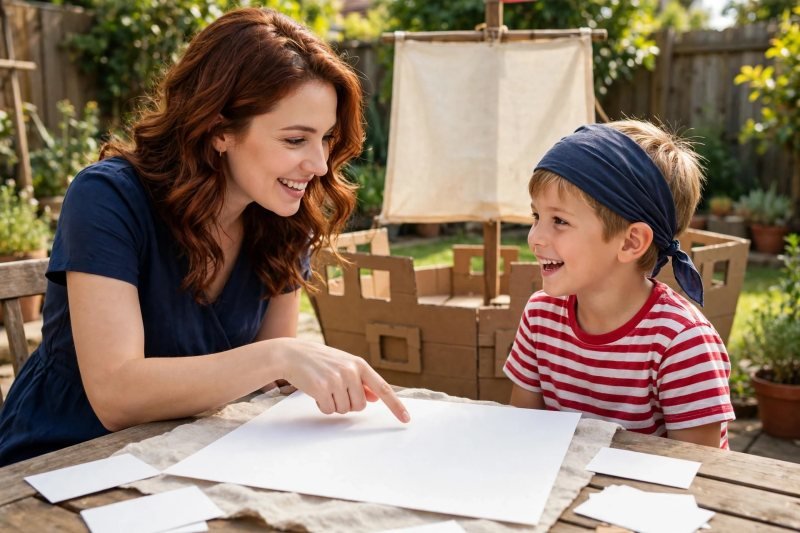
-
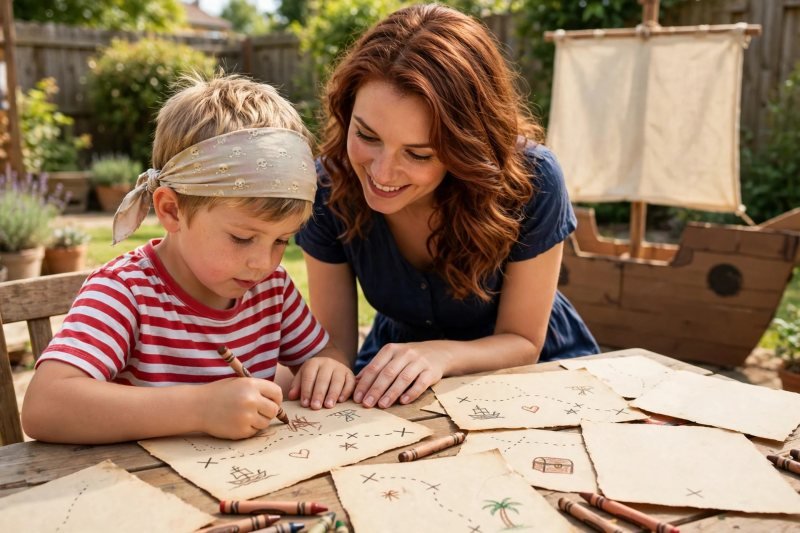
Make map-style invitations together. Give each invitation a parchment-style card and let the birthday captain do the artwork: a dotted path winding across the card; an X where the treasure waits; and simple drawings — a palm tree, a ship, a chest — doing all the talking. Keep every card completely free of readable words in any photograph you share; the party details — time, place, and your allergy question — travel in the message to parents instead, never written across the map itself. This drawing is real pre-party skill practice, the same grip, control, and careful mark-making celebrated in fine motor activities, dressed up as cartography. Hand-deliver to nearby crew or photograph the maps to send, and let him carry the finished stack like the ship's charts. Say, "A map with no words — only pirates can read it, and your friends are pirates." An invitation he charted himself turns the waiting week into part of the voyage.
-
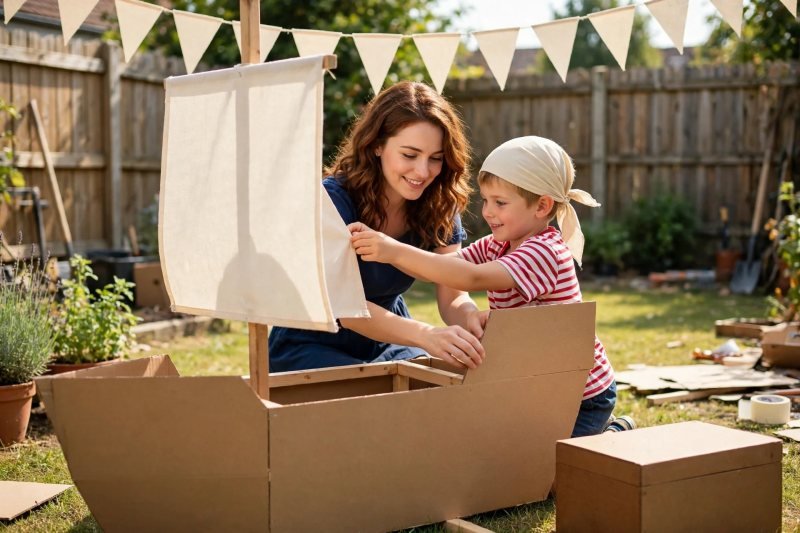
Build the ship-shape decor. Turn plain cardboard into the set: a big ship side propped securely where it cannot topple; a sail of plain fabric raised on a frame an adult has checked for wobbles; paper bunting strung in high swags; and a treasure chest box waiting empty for its moment. Everything strung goes HIGH — bunting at adult head height or above, well out of reach — and nothing is ever strung at child neck height, across doorways at throat level, or low enough to be pulled down and tangled in. Keep the ship against a fence or wall, walkways completely clear, and the chest where small hands can reach it only when the favors step arrives. Say, "We hang the flags where the gulls can see them, and we build our ship strong." Decor that cannot fall on, wrap around, or trip a pirate is decor you never have to police, and a ship the crew helped build is one they will defend all afternoon.
-
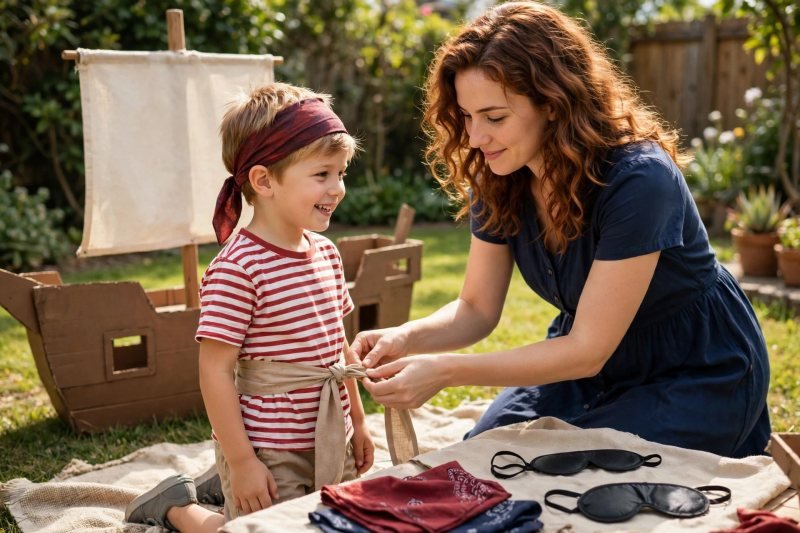
Set the dress-up station. Lay out the transformation corner on a blanket in shade: bandanas that tie at the head or slip on softly; waist sashes that knot at the waist or drape over one shoulder; and soft eye patches with soft elastic you check against each child's head before it goes on. One rule shapes the whole station: nothing is ever tied, looped, or fastened around a child's neck — no exceptions, no clever workarounds. Costumes go over ordinary clothes, shoes stay real and closed-toe for yard ground, patches come off the moment a child wants both eyes back, and any piece a child wants off comes off instantly, no persuasion. Help each pirate in turn, adjust sashes at waists, and let him approve the look in a mirror or shiny tray. Say, "Sashes at our waists, patches soft and comfy — and off whenever you say." Dress-up a child controls completely is confidence he can wear into the hunt. The same dressing-up confidence grows in everyday pretend play.
-
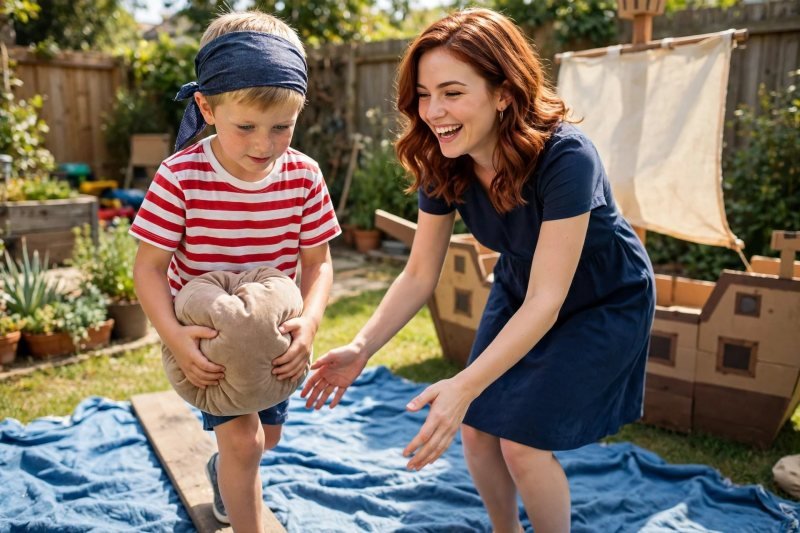
Walk the plank game. Lay a flat, sturdy board directly on the ground over a blue blanket sea — flat on the ground, never raised, never balanced on anything — and give each pirate a soft beanbag cannonball to hold in both hands or carry carefully across. One child walks at a time, an adult walks alongside with hands hovering ready, and stepping off the board just means splashing into a blanket sea that everyone agrees is hilarious. There is no falling, no height, and no elimination: a pirate who wobbles simply steps back aboard and crosses again, cheered louder the second time. Five-year-olds hug the beanbag to their chests; six-year-olds may attempt the crossing holding it on one open palm, captain-style. Say, "Slow feet, steady cargo — the sea is only a blanket, and it tickles." Retire the plank while crossings are still triumphant and the crew is begging for one more.
-
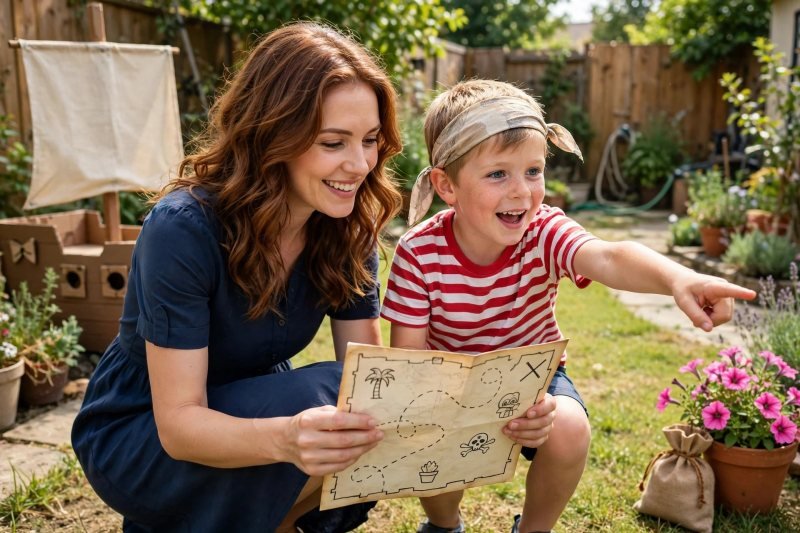
Run the great treasure hunt. Hide one treasure pouch per child — guaranteed, counted twice by an adult before the hunt begins — in yard-safe spots at child eye level: beside a flower pot; under the ship's bow; on the low bench; never anywhere a child must climb, dig near tools, or reach into dense shrubs. Lead the hunt with picture-and-symbol clue cards you have drawn yourself — a dotted path, an X, a palm tree, a chest — keeping every card free of readable words so the symbols do all the talking, which is exactly the symbol-reading and sequencing work celebrated in preschool learning activities. Hunt together as one crew, an adult at the front and one at the back, and let the birthday captain find his pouch neither first nor last. Say, "Follow the dotted path, crew — X marks where a treasure sleeps." When a child finds a pouch that is not his, he becomes its guardian and delivers it to its owner — the kindest mechanic in party games.
-
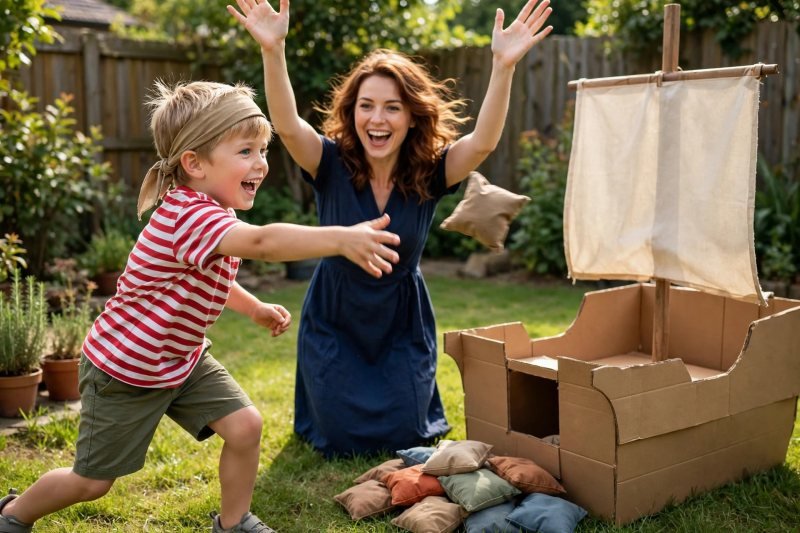
Play pirate games. Set up cannonball toss first: soft beanbags thrown underarm into a big ship box — a wide cardboard target close enough that every pirate scores, with the line stepped back only for children who ask for the challenge. Then play captain says: the captain calls a movement — row the boat; climb the rigging in place; freeze like a statue — and the crew copies only when the captain says so, with an adult captaining first so the listening game stays kind. Nobody is ever out in either game; a missed instruction just earns a giggle and the next call. Keep rounds short, water nearby, and the whole crew moving rather than waiting in line — waiting is where party games leak their joy. Say, "Captain says: row! Captain says: freeze! Sneaky captains make giggling crews." Two ten-minute games here spend the energy that makes the feast peaceful.
-
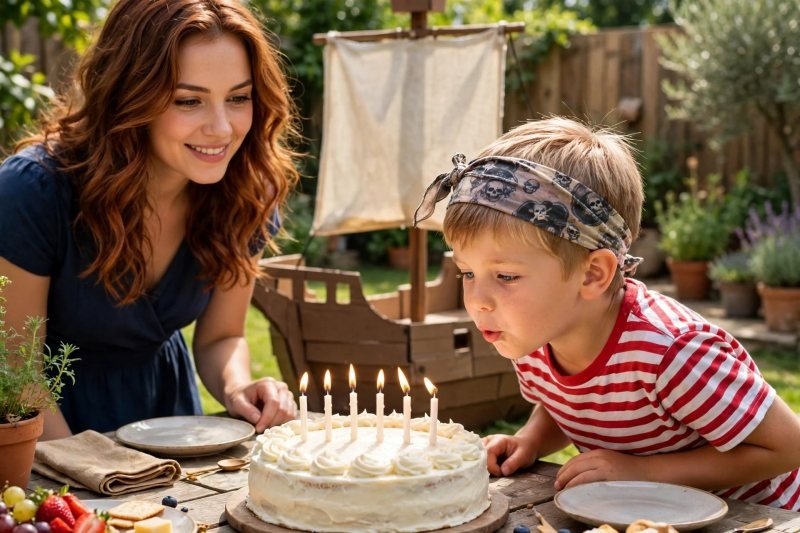
Serve the pirate feast and the cake. Bring the crew to the table for the feast you checked against the allergy list twice: mini sandwiches cut into manageable halves; fruit with every grape halved lengthways by an adult if younger under-five siblings are at the table; cheese and crackers; and water poured often in the yard heat. Eat seated, sashes and patches pushed clear, and let the feast be unhurried — hungry pirates are the only schedule risk left. Then the moment the whole voyage leans toward: the birthday cake, carried in by an adult, with exactly six candles on top. An adult — and only an adult — lights them, the crew sings, the birthday captain blows, and an adult removes the candles and handles anything warm before small slices are served. Say, "Six candles for six wonderful years — make a wish, Captain." Photograph the cake before the song so the six candles are on record; count them in the picture and count them on the cake.
-
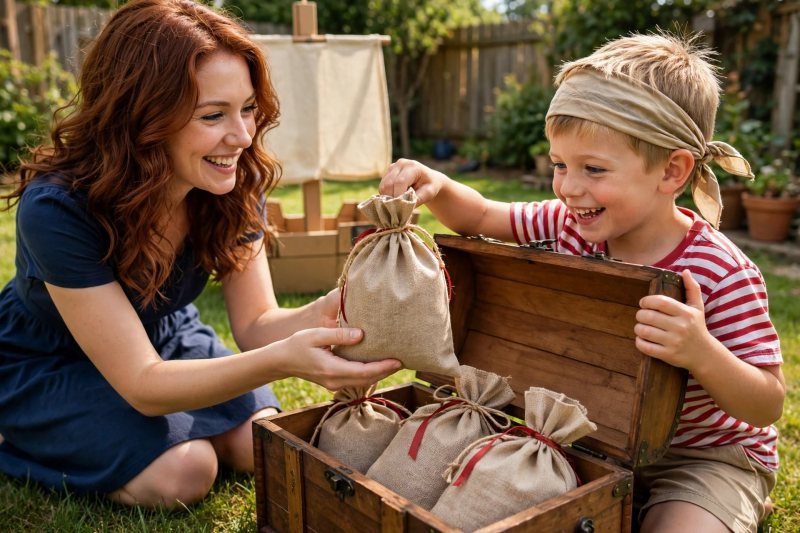
Open the treasure chest favors. Gather the crew around the treasure chest box for the ceremony they have been anticipating since the invitations: the lid lifts, and inside are the favor pouches — one for every pirate, each filled with large, age-safe treats and a keepsake from the day, nothing small enough to be a choking risk and nothing that goes around a neck. The birthday captain hands them out one by one, by name, because giving the treasure away is the captain's honor and the day's last lesson in generosity. Check each pouch against your list as it leaves the chest so no pirate is missed, and keep spares quietly aside for the sibling who materializes at the gate. Say, "Every pirate who sailed today takes treasure home — that is the pirate code." A favor handed over with ceremony is remembered long after its contents are eaten.
-
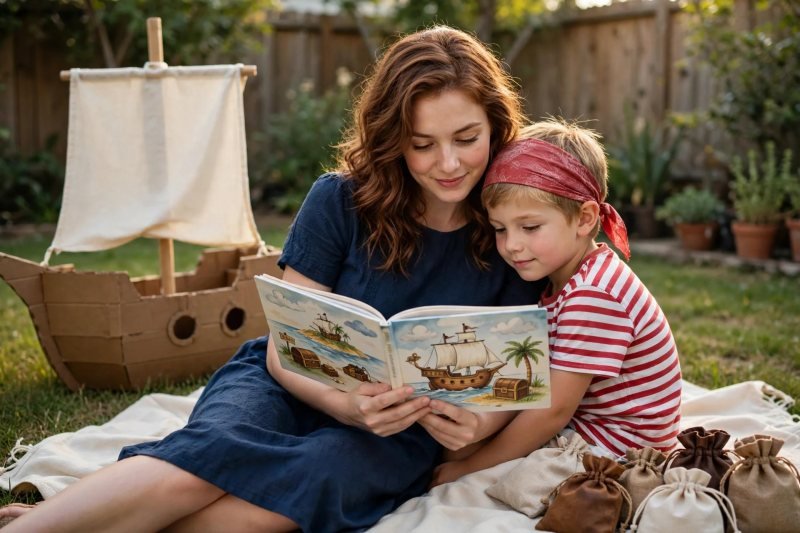
Wind down with a pirate picture-book story and goodbyes. Bring the crew to the blanket for the landing: one short pirate picture book, illustrations only, read slowly by an adult, with voices turned down and the day's best moments named as it ends. Then walk families to the gate with a proper goodbye ritual: bandanas waved, thanks said, one last crew cheer for the captain. As each parent takes over, pass the handover notes that matter: what their child ate, any scrape or wobble and how it was handled, and where their pouch and any dress-up pieces are. Say, "The ship is docked, the treasure is shared, and the crew sails home." A party that ends with a story ends in children's minds as a story — and a calm, narrated goodbye is the souvenir parents thank you for.


Make it easier
Buy plain parchment-style cards and pre-draw the dotted paths yourself the night before; the children's X marks and pictograms are the part that matters. Shrink the arc, not the child: cut the plank game and keep dress-up, the hunt, one game, and the cake — a 90-minute party that ends happy beats a two-hour party that ends in tears. Feast simply: one sandwich filling, one fruit, water, and the cake — a treasure chest box on the table does the theming that a long menu only exhausts you with.
Make it harder
Add a clue chain: link the symbol cards into a five-stop route that ends at the treasure chest itself, opened together for the final pouch reveal. Grow the plank: add a beanbag balance carry — cannonball on one open palm — and a timed crew relay where the whole team crosses before a slow song ends. Invite the grown-ups in: a parents' map-drawing corner and a family photo moment at the ship gives adults a role beyond spectating and photographs beautifully.
Other ways to play it
- Indoor rainy-day version: the same arc in the living room — bunting high on walls, the plank laid flat on a rug sea, the hunt hidden in plain sight on shelves and cushions, and the ship side propped against the sofa.
- Park pavilion version: reserve shade, bring the ship and chest pre-built, weight bunting lines against wind, and run the hunt in a tight, adult-ringed circuit of the pavilion so no pirate wanders toward the wider park.
- Twilight voyage version: for a later family party, keep the same steps but serve the feast first and the cake at dusk — six candles glow beautifully, though an adult still handles every flame and the hunt finishes while light remains.
- Superhero swap: for a different theme with the same arc, superhero birthday party ideas reuse the plank, hunt, and feast structure with capes instead of sashes.
How it changes by age
- Age 5: Five-year-old guests thrive with a steadier hand on the tiller: an adult paired beside them on the plank, symbol clues read together one at a time, and turns that come early while patience is fresh. Keep their feast portions small, their cannonball toss line close, and a quiet corner with a familiar adult available for regrouping. They may not follow every captain-says call — and do not need to; twenty adventurous minutes inside the arc is a complete party at five.
- Age 6: The birthday child's own age runs the full voyage: he can chart the invitations, follow a five-stop symbol clue chain in order, carry a beanbag on one palm across the plank, and wait — mostly — for his moment with six candles. Give sixes jobs: carrying the clue cards, guarding found treasure, handing out the pouches. Responsibility at six feels like being honored, and an honored captain is a gracious one.
What they're learning
Symbol reading and sequencing: following dotted paths, X marks, and pictograms in order and matching a symbol to a real place in the yard — early literacy and logic with no letters required. Balance and body control: crossing a flat plank while carrying cargo, tossing underarm at a target, and freezing on a call — gross motor skills practiced at full pirate speed. Social grace and generosity: guarding and delivering another child's treasure, handing out favors by name, thanking hosts, and saying a ritual goodbye — the party as a gentle civics lesson. Counting with meaning: six candles for six years, one pouch per child counted twice, five stops on a clue chain — numbers attached to things a child cares about stick.
Clearing up
Send treasure pouches and dress-up pieces home the same day — they are favors, not storage — then walk the yard once with a bag for crayons, beanbags, and stray bunting before they become lawn confetti. The cardboard ship folds flat for recycling or one more weekend of voyages, the sail and blanket go to the wash, and the chest box stacks into storage with next year's party supplies. Leftover fruit is refrigerated or composted, sandwich remnants discarded, and the cake, once candles are fully out and removed, covered and stored out of small reach. Photograph the tidy, empty yard — next year's planning starts with proof of how manageable this one was.
Questions parents ask
How long should a pirate birthday party last for a 6-year-old?
How many children should you invite to a pirate birthday party?
How do you make a treasure hunt work for 5- and 6-year-olds?
What food do you serve at a pirate birthday party?
What should the birthday cake look like for a pirate 6th birthday party?

save it for later
Pin this for the next rainy afternoon
Keep it on a board so it is there when you need it, rather than when you happened to find it.
Save to Pinterest


