


Teaching Kids Sun Safety Habits
Teach sun safety habits kids keep for life: spot shade first, build a sunscreen routine, park the hat by the door, drink before thirsty, reapply after water, and pack a go-bag together — ten playful, parent-modeled steps for ages 5–6.
Teach sun safety as a routine, not a warning: make shade a game, apply broad-spectrum sunscreen in the same order before going out, park a wide-brim hat by the door, carry water and drink before thirsty, reapply after swimming or toweling, model every step yourself, and let your child pack the go-bag.

The short version
- Shade first: teach your child to find and use shade as the first sun tool, every time.
- Same sunscreen order, before going out — ears, nose, back of neck, backs of hands — with a parent applying and checking at ages 5–6.
- Hat by the door, water bottle that travels, and drinks taken before thirst, not after.
- Reapply after swimming, toweling, or long sweaty play — a timer your child sets makes the rhythm his.
- Model everything yourself, plan big play for morning and late afternoon, and see a doctor promptly for blistering, fever, dizziness, or a very sore burn.
- Age
- Ages 5–6
- Prep
- 10 min
- Play time
- 45 min
- Mess
- Low
- Difficulty
- Easy
- Where
- Outdoor
Why kids love this
Children this age do not learn sun safety habits kids keep from being told to be careful — they learn by playing, repeating, and copying an adult who does them too. So this guide is built as a routine, not a warning. Shade becomes a hunting game. Sunscreen becomes a song with a set order — ears, nose, neck, hands. The hat gets its own hook by the door, the water bottle travels like a companion, and the timer puts him in charge of reapplying. Every step hands him a small piece of the job while you keep the grown-up parts: applying sunscreen thoroughly, checking skin, deciding when a burn needs a doctor. By the final step he is packing the go-bag himself — not from fear, but because this is simply what his family does before the fun starts.
What you'll need
- Broad-spectrum sunscreen in a plain, blank, unlabelled tube — the routine matters, not a brand
- A wide-brim hat for your child, plus one for you (role-modeling is step 7)
- Child-size sunglasses that stay on comfortably
- A refillable water bottle that is his to carry
- A simple kitchen timer or sand timer he can set himself
- A spare hat for the door hook, and a tote bag for the sun-safety go-bag
- A picnic blanket in a favorite shady spot to anchor the shade game
Before you start
Pick a bright morning and set out the blanket in the shade of your biggest tree or covered spot. Hang a hook by the back door at child height and put the spare hat on it before he sees it. Fill the water bottle, set the sunscreen where the routine will always happen, and put your own hat on first.
How to do it
-
Make shade a game. Start with a hunt, not a lecture. Spread the blanket, then send him on a spot-the-shade mission: find every shady place in the yard before you count slowly to twenty — under the tree, beside the fence, in the doorway's shadow. Each find earns a point, and the blanket goes in the best one. Name it plainly: shade is the first sun tool. While you sit in your winning spot, watch for nature — this is the quiet observation habit behind our butterfly life cycle activities: shade is where you notice wings, ants, and leaf shadows. Say, "First we find our shade — that's where our adventures start and where we come back to rest." Play the hunt first every time; it sets the order for everything that follows.

-
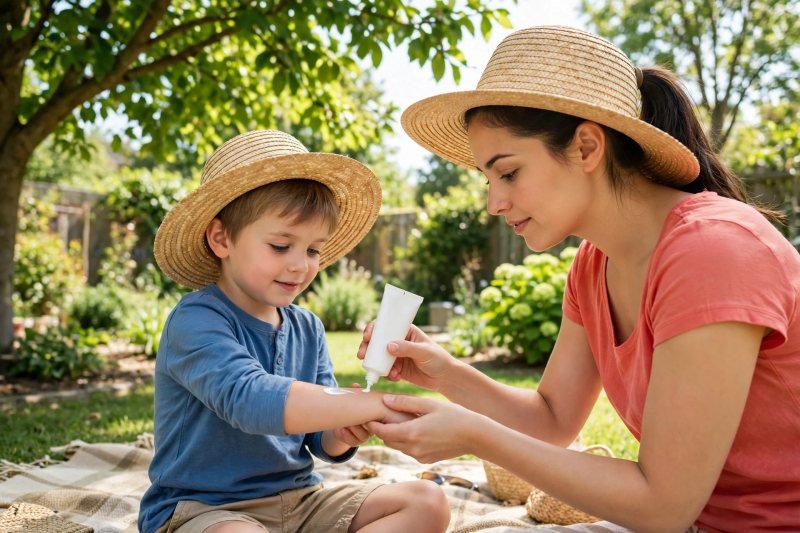
Build the sunscreen routine. Sunscreen sticks when it has an order and a rhythm, so give it both. Apply it before going out, while he is still at the door — never as an afterthought once play has started. Work through the same map every time: face, ears, nose, the back of the neck, arms, and the backs of the hands, the spots most easily missed. A short song or steady count makes the sequence stick; sing it the same way each time. Treat this as part of his wider kids skincare routine — ordinary daily care. At five and six he can help spread it, but a parent still applies and checks: his enthusiasm is real, his coverage is not yet. Say, "Same order every time — ears, nose, neck, hands — so our skin is ready before the fun is." If he resists, shrink the moment, not the standard: song, map, then the door opens.
-
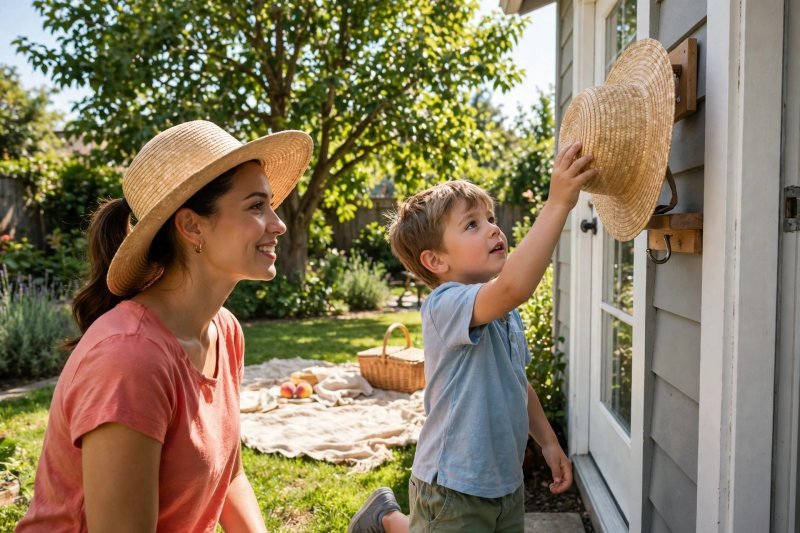
Park the hat by the door. Habits live where the objects live, so give the hat an address: a hook by the back door, at his height, that he can reach without help. The rule is simple and kindly enforced — no hat, no long play. Not as a threat: the hat goes on the way shoes go on. Keep a spare hat on the hook, so the routine never collapses over a lost or soaked one. This is routine-building in its purest form — the same cue, place, and order logic that powers good preschool learning activities: the environment remembers, so the child does not have to be nagged. Let him hang the hat up himself when he comes in; the full loop — hook to head, head to hook — is the habit. Say, "Your hat lives here, so you never have to hunt for it — grab it and we're off."
-
Add sunglasses and cover-up clothing. Once the hat is automatic, add the next tools: sunglasses and clothing itself. Let him practice putting his sunglasses on and tucking them in the go-bag rather than on the grass. Then introduce clothes as sun tools: a long-sleeve top or a rash-guard style cover-up for long sessions, water play, and days when shade will be scarce. The teaching point is empowering — covering skin is protection he can see and control, and it keeps working while he plays, with no timer attached. Lay the cover-up out with the hat the night before. If sunglasses get refused, offer hat-plus-shade and try again next time. Say, "Hats shade your head, sleeves shade your arms, and glasses shade your eyes — your whole kit works together."

-
Make water breaks automatic. Water is the quiet half of sun safety, and the rule that makes it work is timing: drink before you feel thirsty, because thirst is a late signal on a busy play day. Give the bottle a travel rule — it goes everywhere the hat goes — and set it in the shade spot so every return to base includes a drink almost by accident. Build breaks into the play: a drink at every shade visit, when the timer rings, and before a new round of any game. Drink alongside him, every time; a sipping parent teaches better than a reminding one. Watch for flushed cheeks, flagging energy, or unusual crankiness — and stretch the shade stop into a real rest with a snack. Say, "We drink before we're thirsty, so our bodies never have to ask."

-
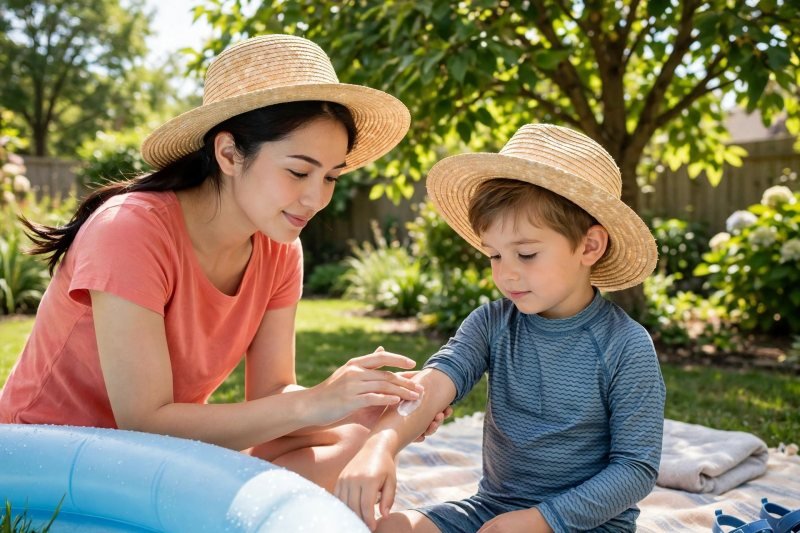
Teach the reapply rhythm. The first application is only half the lesson; the rhythm that completes it is reapplying. Teach the triggers as a short list he can recite: after swimming, after toweling off, and after long, sweaty play. Water and towels remove sunscreen — that is the whole explanation a five-year-old needs. His job is the timer: a simple kitchen timer or sand timer he sets when the first application goes on, kept in the shade spot. When it rings, he announces reapply time — authority children adore — and you apply and check together, same song, same map as step 2. For the full timing picture, our guide on how often to reapply sunscreen explains the rhythm in detail. If it rings mid-game, finish the round, then reapply; the rhythm bends, it does not break. Say, "Swimming, toweling, sweaty play — when one of those happens, the sunscreen goes on again. You're in charge of the timer."
-
Role-model every step. This step is aimed at the adult, because at five and six, habits are caught far more than they are taught. Wear your own wide-brim hat every time his goes on. Apply your sunscreen alongside him, out loud if it helps — ears, nose, neck, hands — and let him catch you doing the map he learned. Drink when he drinks. Move to the shade at shade breaks, rather than calling instructions from the sunny side. A child keeps a precise ledger of what grown-ups actually do, and any step you skip quietly teaches him that step is optional. Align other caregivers on the basics — hat, sunscreen order, water, timer — so the rhythm survives changes of personnel. Say, "See? My hat, my sunscreen, my water — we do this together, every time." Soon you will hear your own scripts repeated back, word for word: the surest sign the habit has moved in.

-
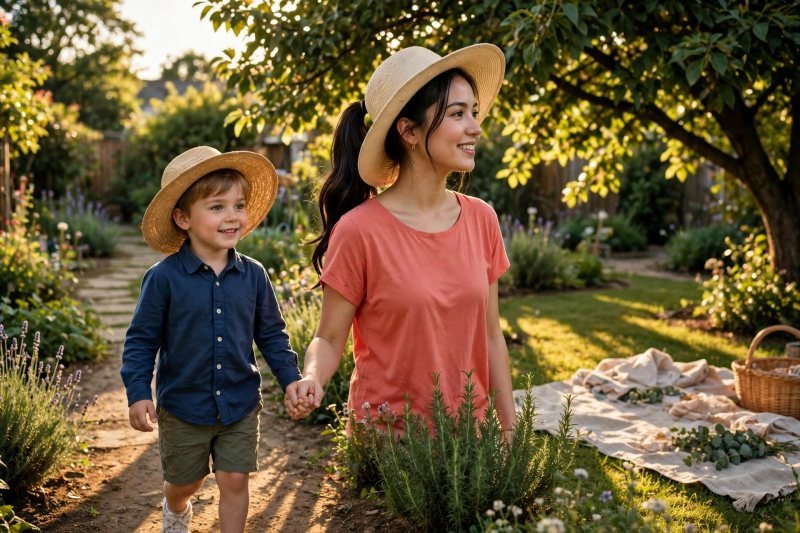
Plan around the strong-sun hours. Timing is the step nobody sees, and it may be the most protective of all. As a general pattern, plan the bigger adventures — the long park trip, the garden project, the paddling-pool session — for the morning and later afternoon, when the sun feels gentler on skin. Let midday become shade play, a porch project, lunch, stories, or an indoor reset, so the daily rhythm does the protecting without negotiation. The wider sun safety beyond sunscreen guide covers shade, clothing, and timing together. Tell him the plan in those words: big play early, shade at midday, out again later. Keep it positive — midday is not banned, it is simply the family's shade-and-rest chapter. When midday play is unavoidable, lean harder on every other step: shade base, cover-up clothing, strict timer, generous water. Say, "We do our biggest adventures in the morning and late afternoon — the middle of the day is for shade, snacks, and recharging."
-
Teach the sunburn check. Even with every habit working, skin sometimes gets more sun than planned, so teach him to be the first reporter of his own body. The check is a sentence he can say: if his skin feels hot or sore, or looks pink, he tells an adult straight away — reporting early is praised. Show him what happens next: cool shade, rest, water, and a grown-up cooling the skin gently with cool water. Then give him — and yourself — the red-flag list that changes the plan from home care to medical care: blistering skin, fever, dizziness, or a burn that is very sore should be seen by a doctor promptly. Knowing where "we handle it" ends and "a doctor helps" begins is itself a safety skill. For gentle next steps after a burn, the sunburn treatment for kids guide walks through cooling and comfort care. Say, "If your skin ever feels hot or sore, tell me right away — telling early is exactly the right thing to do."

-
Pack the sun-safety go-bag together. Finish by giving the routine a home he owns: one tote bag holding the kit — hat, sunscreen, sunglasses, water bottle — packed by him, with a checklist he works through out loud. Packing consolidates the ten steps: he runs the list, notices what is missing, and fixes it before the door opens. Let the bag live beside the hat hook, so steps 3 and 10 meet in one small launch pad. Once a week, do a two-minute habit review together — what went well, what got forgotten — loaded with specific praise: the day he set the timer unprompted, the afternoon he reminded you about water. Refill as you review. Say, "Hat — check. Sunscreen — check. Sunglasses — check. Water — check. You packed us ready." A child who packs the bag has stopped following the routine and started running it.


Make it easier
Start with three steps only — shade game, hat hook, water bottle — and add one new step every few days; a routine adopted in layers sticks better than a ten-step launch. Put the sunscreen where the shoes are: if applying happens at the door as part of leaving, it never competes with play already in progress. Shrink the sunscreen song to one short verse he can sing himself; the child who owns the song owns the sequence.
Make it harder
Hand him the planner role: he checks the day's plan and announces whether it is a morning-adventure or midday-shade day, with reasons. Let him teach the routine to a younger sibling, cousin, or a favorite stuffed audience — teaching a habit is the deepest way to learn it. Add a personal checklist card he reads and ticks off himself at go-bag time, turning the parent's script into his own reading-and-doing practice.
Other ways to play it
- Park version: the shade game becomes finding the park's best base camp; the go-bag rides along so the full kit survives the change of venue.
- Water-play version: lead with cover-up clothing and the reapply triggers — after swimming and after toweling become the day's refrain; the timer lives somewhere dry.
- Vacation version: pack the go-bag the night before each outing and run the same review at the door of wherever you are staying; routines that travel are routines that last.
How it changes by age
- Age 5: Fives thrive on the game layer — the shade hunt, the song, the timer announcement — and on real jobs with clear edges: carry the bottle, hang the hat, call the reapply. Keep scripts short and identical each day, expect enthusiastic but imperfect sunscreen help, and do all applying and skin-checking yourself. Praise the specific behavior whenever he produces it unprompted.
- Age 6: Sixes can hold the whole sequence and start managing it: reading the checklist, setting the timer unasked, planning around the strong-sun hours, noticing a missing go-bag item. Give them the planner and teacher roles from Make it harder, while you keep final responsibility for sunscreen coverage and any sunburn decision. Their pride in running the routine is the mechanism — protect it by checking kindly, not by taking the job back.
What they're learning
Sequencing and routine: a fixed order — shade, sunscreen map, hat, water, timer — rehearsed daily is early executive function in action. Body awareness: drinking before thirst, noticing hot or pink skin, and reporting it early teach him to read and trust his own signals. Cause and effect: water and toweling remove sunscreen, midday sun feels stronger, shade rests a tired body — real-world science, learned on his own skin. Responsibility and care: packing the bag, checking the list, and reminding the family models looking after himself and others.
Clearing up
The routine ends where it began — at the door. The hat goes back on its hook, sunglasses and sunscreen return to the go-bag, the bottle is washed and refilled for tomorrow, and the timer goes back to the shade spot. A thirty-second reset makes the next outing launch in two minutes instead of twenty, and doing it together, out loud, is the day's final repetition: everything in its place, ready for the next adventure.
Questions parents ask
How do I teach my child sun safety without scaring them?
When should kids put sunscreen on — before or after going outside?
How often should children reapply sunscreen?
What should I do if my child gets sunburned?
What belongs in a kids' sun-safety go-bag?

save it for later
Pin this for the next rainy afternoon
Keep it on a board so it is there when you need it, rather than when you happened to find it.
Save to Pinterest


