


Superhero Birthday Party Ideas: A Training Camp Party for Caped 4- and 5-Year-Olds
A superhero birthday party built as a hero training camp: plain capes and masks the kids make themselves, an obstacle course, a power-crystal hunt, hero snacks, and a cake with five candles. Ten steps from first cape to medal ceremony.
A superhero birthday party works best as a hero training camp: guests make plain capes and masks on arrival, conquer a five-station obstacle course, hunt for power crystals, eat hero-named finger food, and graduate with paper medals. Run it in two hours with no competitive games, and finish with a cake holding exactly five candles for the birthday hero.

The short version
- Frame the party as training camp: every guest arrives ordinary and graduates a certified hero.
- Capes and masks are made at the door — the craft solves arrivals and outfits the whole party.
- The obstacle course is beaten by finishing it; the crystal hunt fills every pouch. Nobody loses.
- Food wears costumes: power sandwiches, hero fuel fruit, and a five-candle cake.
- End with a medal ceremony that names each hero's real, observed skill.
- Age
- Ages 4–5
- Mess
- Some
- Difficulty
- Easy
- Where
- Both
Why kids love this
Four- and 5-year-olds do not want to watch a superhero party — they want to be the superheroes, and the training camp format hands them exactly that. Every guest arrives ordinary and leaves certified: a cape they made, a mask they chose, an obstacle course they conquered, crystals they hunted, and a medal at the end to prove it. The genius of the camp structure is that it converts the theme's natural chaos into a program: running, climbing, and shouting are not behavior problems here, they are the curriculum. Nothing is competitive — the course is beaten by finishing it, the crystals are found by everyone, and the freeze game ends in statues and giggles rather than winners and tears. And because every decoration is a plain color, a paper star, or a skyline silhouette, the whole party reads as bold and heroic without a single licensed character in sight.
What you'll need
- Party basics: invitations (paper stars or digital), plates, cups, and napkins in your hero colors
- Cape and mask craft: plain-colored lightweight fabric or large felt sheets (one per hero), self-adhesive hook-and-loop dots or ribbon ties, plain paper or felt eye masks, star stickers and shapes for decorating
- Training course: cushions, a low balance beam or taped line, hula hoops, cones or empty boxes as towers, a tunnel or table to crawl under, soft balls
- Crystal hunt: smooth green or clear "power crystals" (large acrylic gems, painted rocks, or glow sticks) — sized for small hands, enough for every hero to find several
- Decor: black or dark-blue paper for a city skyline, yellow and white paper stars, streamers and balloons in hero colors
- Food: a round cake, sandwich fixings, fruit, veggie sticks, cheese, juice and water
- Finale: paper medals on ribbons or yarn, favor bags, and small favors (a mini cape keyring, stickers, a glow stick)
Before you start
1. Work steps 1–4 across the week before: hero colors, guest list, invitations, and the cape-and-mask craft supplies cut and ready. At this age, preparation is the party. 2. Cut capes ahead (one rectangle per guest, neckline snipped) so party-day craft time is decorating, not measuring. 3. Test the obstacle course yourself at adult height and child logic: every station must be finishable by the smallest guest, because the course is beaten by finishing. 4. The morning of: build the course, hang the skyline, hide nothing yet — crystals get hidden during the cape craft, which is the perfect cover.
How to do it
-
Pick your hero colors and name the mission: training camp. Every decision gets easier once the party has a uniform: choose two bold colors — classic red and blue, or your birthday hero's beloved green and gold — and let them rule the capes, the paper stars, the napkins, and the cake. Then name the day's story out loud: today, ordinary kids report to Hero Training Camp and graduate as certified superheroes. Say: "Nobody arrives a hero. Everybody leaves one." That single sentence is the party's engine — it gives shy guests a role to grow into, gives wild guests a mission to channel the wildness, and explains every game before it starts. One theme, used everywhere, is what makes a party look designed instead of accumulated, and this camp needs no licensed characters at all: plain capes and paper stars carry the whole heroic world.

-
Cap the squad small and fence the party at two hours. For ages 4–5 the guest math is kind: eight to twelve heroes is a full camp, every child under 4 brings their grown-up, and the whole mission fits a two-hour window — say 10:00 to noon, landing food near the end and everyone home before afternoon tiredness decommissions the squad. Write the run sheet now and build the day on it: capes and masks as heroes arrive; training course opens; crystal hunt; hero food and the cake; medal ceremony and goodbye. Say: "Short mission, full arc, every hero graduates." If your family has run this site's toddler parties, you know this rhythm from the 2nd birthday party ideas — the superhero version keeps the same bones and adds a cape allowance.

-
Send star invitations that ask the one question that matters. Paper invitations cut as big stars in your hero colors, or a simple digital card, carry the essentials: date, the two-hour window, address, what to wear for climbing and crawling (play clothes under the cape, shoes that stay on), and the RSVP line with the allergy question printed right on it: "Any food allergies we should plan around?" Ask now, while menus are pencil, not at the door while sandwiches are served. Say: "The invite asks about allergies — always." While replies gather, cut the cape rectangles and mask blanks so party week stays calm; a cape cut in October-quiet conditions beats one cut at midnight before the mission, and your future self is a hero too.

-
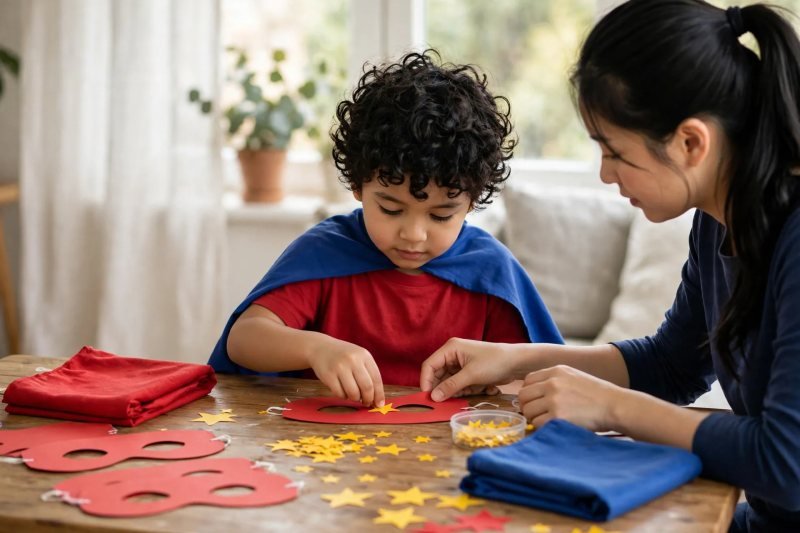
Make the capes and masks — the craft that outfits the whole party. Seat the arriving heroes at the craft table as they come in, because a craft that starts at the door solves the arrivals problem completely: each hero chooses a cape in the party colors, fastens it with hook-and-loop dots or a ribbon tie at the neck (an adult checks every fastening — snug, never tight), picks a plain paper or felt mask, and decorates both with star stickers and paper shapes. Say: "A hero's cape is earned at this table." No names, no letters, no emblems to copy — stars and bold shapes only, which keeps every cape original and every hero equal. Twenty unhurried minutes later the whole squad is transformed, the last guest has arrived, the crystals outside have been secretly hidden by your co-host during the craft, and camp can officially begin.
-
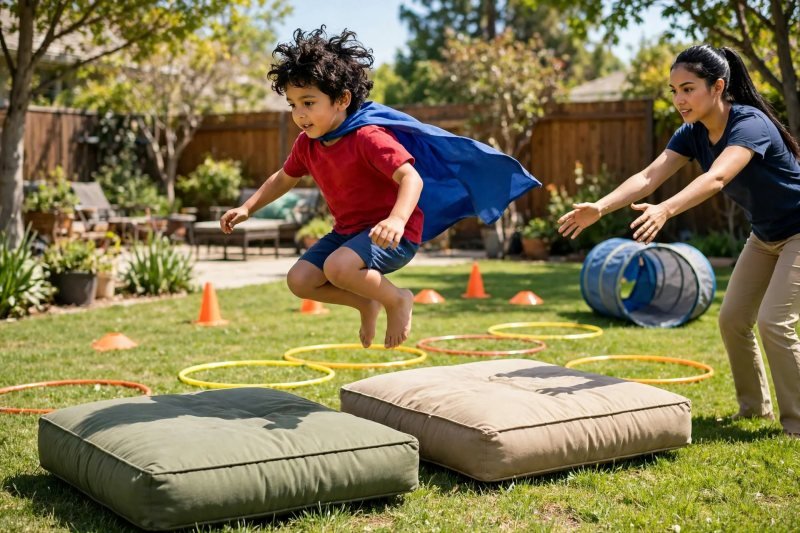
Build the training course out of cushions, hoops, and towers. While capes dry their sticker glue, unveil the course — set it up beforehand and reveal it with ceremony: station one, Leap the Lava (cushions spaced across the floor or lawn to hop between); station two, the Balance Beam Bridge (a low beam or taped line walked heel-to-toe); station three, Hoop Hops (hula hoops laid flat, two feet in each); station four, the Tower Weave (cones or empty boxes zigzagged at a run); station five, the Secret Tunnel (a play tunnel or a table to crawl beneath) that exits at the finish banner. Walk the course yourself at hero speed, narrating each station, then say the camp's golden rule: "The course is beaten by finishing it — heroes help heroes." No timers, no races, no eliminations; a hero who falls off the beam steps back on where they fell, cheered like a champion.
-
Hide the power crystals and run the great crystal hunt. Mid-course, sound the alarm (a whistle, a drum, your best announcer voice): the power crystals that fuel the whole camp have scattered across the yard and must be recovered before cake o'clock. Crystals are large smooth gems, painted rocks, or glow sticks — big enough for small hands, plentiful enough that every hero finds several, hidden at hero height in plain sight: on the beam, inside hoops, under the tunnel's exit, glowing from plant pots. Say: "Every crystal found powers us all — when your pouch is full, help a hero who is still hunting." The hunt runs on the camp's fairness physics: nobody wins, everybody fills their pouch, and the final crystal is always "discovered" by the hero who has found the fewest, because a co-host with eyes can arrange small justice. Recovered crystals get poured into the camp's power bowl with great ceremony — the squad is officially charged.

-
Feed the heroes food with heroic names and familiar flavors. March the charged-up squad to the table, capes still on (a cape at lunch is non-negotiable at five). Hero food succeeds on names and finger-size: Power Sandwiches (ordinary sandwiches, cut in star-ish triangles), Hero Fuel fruit skewers, Super Sticks (carrots, cucumber, and cheese), and Popcorn Power Pouches for grazing between missions. Then the centerpiece waits its turn under a cover: the birthday cake, iced in hero colors with paper stars around the base and exactly five candles standing ready for the chief hero. Say: "The food wears costumes; the food itself stays familiar." Nothing spicy, nothing fragile, nothing a tired hero has to negotiate with — at 4 and 5, the names do the entertaining while the food stays safely inside what small kids actually eat.

-
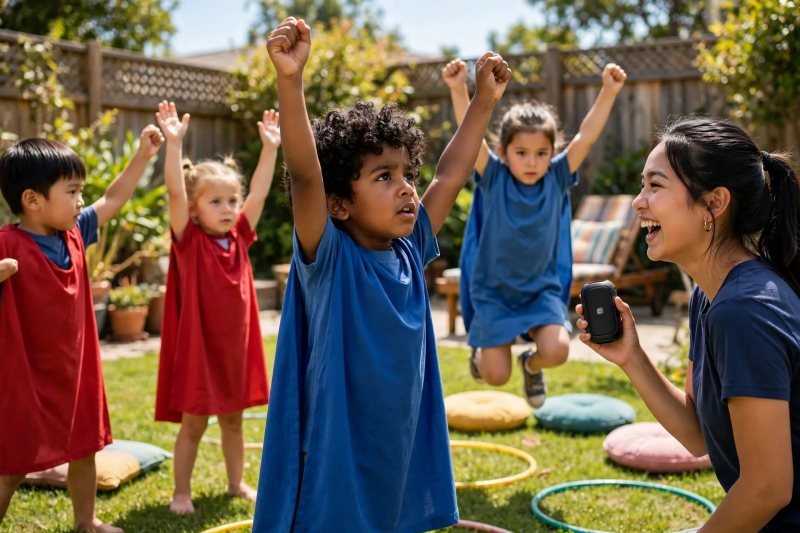
Run hero freeze — the statue game that ends the energy arc. After food, one last mission burns the frosting sugar into glory: hero music plays, the squad flies, leaps, and strikes heroic poses around the course, and when the music stops every hero freezes mid-pose — the beloved freeze-game magic in a cape, where the statues crack the adults up every single round. Say: "When the music stops, heroes turn to statues — even the giggling kind." Play short rounds with pose themes (strongest statue, silliest statue, sleepiest hero) so the game winds down by design: the final round is always the sleepiest statue, played lying down, which lands twelve wired heroes gently on the grass exactly when you need them calm for candles and medals.
-
Light five candles for the chief hero. Gather the squad around the cake in a hero semicircle, capes arranged, and carry in the uncovered cake: hero colors, paper stars, and five candles standing in a row. Say the number out loud as you light them — one, two, three, four, five — because counting the candles is the birthday, in the end: five years, five flames, one chief hero. Sing the song at full squad volume, let the birthday hero blow with help if the flames outlast one breath (assists from the squad are tradition, not failure), and serve small slices with the squad's crystals glinting in their power bowl beside the cake. Say: "Five candles for five years of hero." Then juice, a few quiet minutes of cape-swooshing free play, and the graduation begins.

-
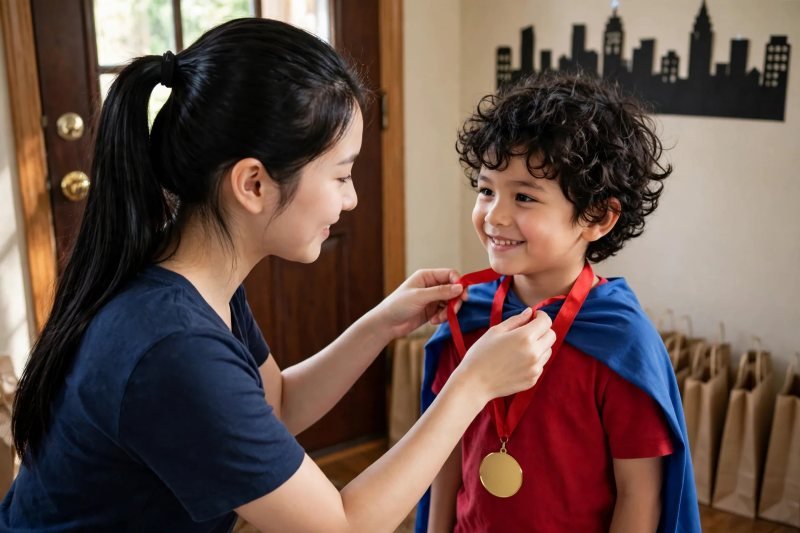
Hold the medal ceremony and send every hero home certified. Line the squad up by the finish banner for the camp's closing ritual: call each hero forward by their chosen hero name, hang a paper medal on a ribbon around their neck — over the cape, always over the cape — and announce their certified skill to the assembled grown-ups: "Hero Zoom, certified in tunnel crawling and crystal finding." Every hero gets a skill that is specifically, observably true, which is why they will wear these medals to dinner. Favor bags wait by the door (a glow stick, stickers, a mini cape for a stuffed animal), coats gather, and each departing hero exits through the skyline arch for one last photograph. Say: "Camp is closed. Heroes are forever." Parents leave with a tired, proud, slightly grass-stained hero and a party that ended at its peak — the only review a training camp needs.


Make it easier
Skip the crystal hunt and run the course twice — heroes adore repetition, and a second lap with variations (backwards beam walk, tunnel with a flashlight) is a full party. Buy plain capes ready-made and let the craft be masks only; the transformation effect is identical. Keep the handmade feel with birthday crafts to make together the squad can finish before the course opens. Move the whole camp indoors: cushions, taped lines, and hoops work in a living room with furniture pushed back, and the tunnel becomes a blanket fort passage.
Make it harder
Add a rescue mission for a confident 5-year-old squad: a stuffed animal "trapped" atop the tower station must be carried back through the whole course, relay-style, hero to hero. Graduate the course: round two adds a soft-ball target toss at the finish ("defeat the meteor shower") with balls thrown into a bucket from a hero-distance line. Let heroes design their own star emblem from paper shapes (stars, bolts, circles — shapes only, no copied characters) and pin it to the cape at the medal ceremony. Masks from paper plates work the same way — see paper plate animal masks for the technique.
Other ways to play it
- Fourth birthday (four-star camp): same ten steps, tilted younger — four candles, a shorter course with bigger cushions, crystals hidden almost visibly, and a 90-minute window with parents staying. For the fifth-birthday build in full, see 5th birthday party ideas and themes.
- Garden heroes: rename the squad for a birthday child who prefers flowers to cities — capes in petal colors, a "garden guardian" course between plant pots, crystals as dew drops, and a petal-strewn cake; the camp's bones do not care what colors they wear.
- Indoor winter camp: the full mission in a hall or big living room — lava cushions on carpet, beam as a taped line, tunnel from a card table and blanket, and glow-stick crystals hunted with the lights low, which 5-year-olds rate as maximum drama. A taped-line course is the indoor fallback — see the masking tape obstacle course.
How it changes by age
- Age 4: Fours join the camp best with the course shrunk kindly: fewer stations, crystals in plain sight, capes pre-fastened by adults, and medals for absolutely everything. Keep the window near 90 minutes and let the birthday four-year-old lead the first lap of every game, because at four, going first is the whole honor system. For a younger squad, the 3rd birthday party ideas and themes keep the same bones at a smaller scale.
- Age 5: Fives run the full academy: they hold the run sheet with you, demonstrate stations for younger guests, count their own five candles, and receive the rescue mission as their graduation exam. Give the chief hero jobs — crystal-counter, medal assistant, line leader — because at five, hosting is the birthday present underneath the presents.
What they're learning
Gross motor development: leaping, balancing, hopping, weaving, and crawling through the course is a full-body workout disguised as a mission — the exact big-muscle practice this age is built for. Cooperation over competition: the fairness rules (the course is beaten by finishing; full pouches help empty ones) let heroes practice generosity at full sprint. Listening and body control: Hero Freeze wires hearing to stillness — the same self-regulation school readiness runs on — under cover of striking poses. Imaginative identity play: choosing a hero name and earning a certified skill lets children try on bravery, kindness, and competence in the safest possible arena.
Clearing up
Training camp strikes in mission order: crystals counted into their pouch for next year, course stations stacked by the heroes themselves (breaking camp is the last game — timed tidying with heroic commentary), capes collected into a laundry basket for a wash before they join the dress-up box permanently. Paper skyline and stars come down once photographs are taken and go to recycling or the birthday hero's bedroom wall. Medals, miraculously, never need clearing — they go home on heroes. Leftover sandwiches travel with departing families, and the run sheet goes into the memory box under one star invitation.
Questions parents ask
What do you do at a superhero birthday party?
How do you make cheap superhero capes for a party?
What games work for a superhero party for 4- and 5-year-olds?
What food do you serve at a superhero birthday party?
How long should a superhero party for a 5-year-old last?

save it for later
Pin this for the next rainy afternoon
Keep it on a board so it is there when you need it, rather than when you happened to find it.
Save to Pinterest


