


Kids' Hair Gel and Styling Products: What's Actually Safe?
Is hair gel for kids actually safe? For most 4- and 5-year-olds, a small amount of a simple, fragrance-free kids' product, used now and then and washed out the same day, is the careful approach. Here is how to choose and use it well.
Hair gel for kids is safest when it is occasional, not daily: choose a simple product made for kids with a short ingredient list and little or no fragrance, patch-test it for 24 hours, use a pea-sized amount on the hair surface only — never loaded onto the scalp — and wash it out the same day. Water and a comb handle most days.

The short version
- Criteria, not brands: made for kids, short ingredient list, fragrance-free or nearly so, clear age guidance.
- Patch-test every new product for 24 hours before the first full use.
- Pea-sized amount, palms first, hair surface only — keep product off the scalp and away from eyes.
- Wash out the same day; never leave styling product in overnight.
- Skip styling products for ages 2–3; water and a soft brush are enough.
- Store closed and out of reach, and stop and rinse if redness, itching, or flaking appears.
- Age
- Ages 4–5
- Prep
- 10 min
- Play time
- 15 min
- Mess
- Low
- Difficulty
- Easy
- Where
- Indoor
Why kids love this
Kids love a style that feels like theirs — a swoop, a spike, a smooth part for picture day. Used sparingly and washed out the same day, styling becomes a short, fun bathroom ritual instead of a battle, and your child gets the grown-up feeling of choosing how they look.
What you'll need
- One simple styling product made for kids, with a short, readable ingredient list and no strong fragrance
- A wide-tooth comb and a soft brush
- A spray bottle of plain water
- A light hand: plan on less product than you think you need, every time
- Gentle kids' shampoo for the wash-out, plus a soft towel
- A small mirror at child height
- Optional: plain hair clips or soft ties with no tight pulling
Before you start
1. Shop by criteria, not claims: made for kids, fragrance-free or very lightly scented, short ingredient list, no adult hold or sculpting formulas. 2. Read the whole label at the store, including warnings and age guidance, and skip anything that stings your own eyes by scent alone. 3. Patch-test first: a tiny dab behind the ear or on the inner forearm, then wait 24 hours before the first full use. 4. Set up the bathroom station: product, comb, spray water, towel, and mirror together, so styling stays short and calm.
How to do it
-
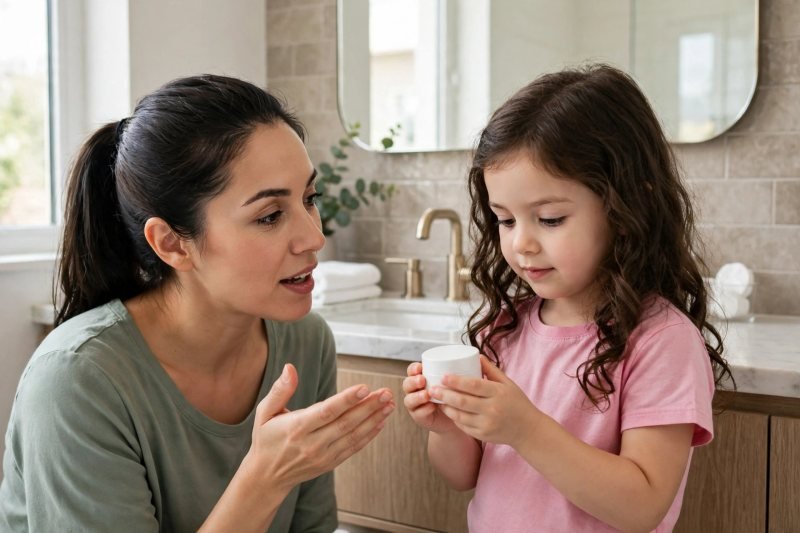
Start with the gentle-is-best talk. Sit your child at the mirror with the single product you chose and keep the talk honest and short. Say: "This helps your hair stay in the style you pick — a tiny bit is plenty, and we always wash it out tonight." Let your child hold the closed container, look at the plain packaging, and choose between two simple styles — smooth or spiky, part or swoop. One product, two choices, no shelf of options — a calm start that leads straight to checking the product together before anything touches hair.
-
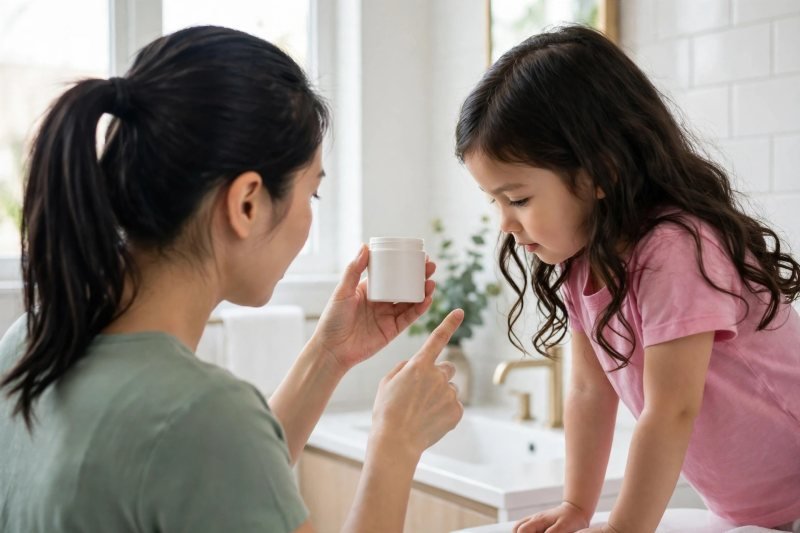
Read the label together. Turn the container over and read the back together — you are checking the words, not the promises on the front. Say: "Grown-ups always read this part first — let's see what it says." Run your finger along the ingredient list and the directions together; you are looking for a product made for kids, clear age guidance, and nothing that reads like an adult sculpting or maximum-hold formula. If the scent is strong even with the lid on, or the list is long and harsh-sounding, that product goes back. A label you both understand earns the next step: the patch test.
-
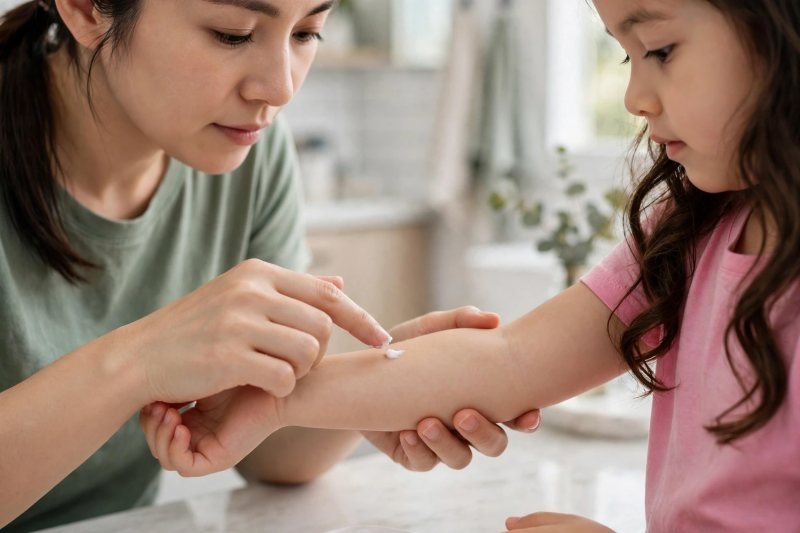
Patch-test before the first style. Dab a tiny amount — half a pea — behind your child's ear or on the inner forearm, and leave it alone. Say: "This tiny test tells us your skin likes it before we use it for real." Wait a full day; check the spot at bath time for redness, itching, or bumps. No reaction means you may style tomorrow; any reaction means wash the spot gently, retire that product, and try a simpler one another week. Never style on the same day as the patch test, and never skip this step for a new product, even one a friend swears by. A calm patch test hands you a green light for detangling.
-
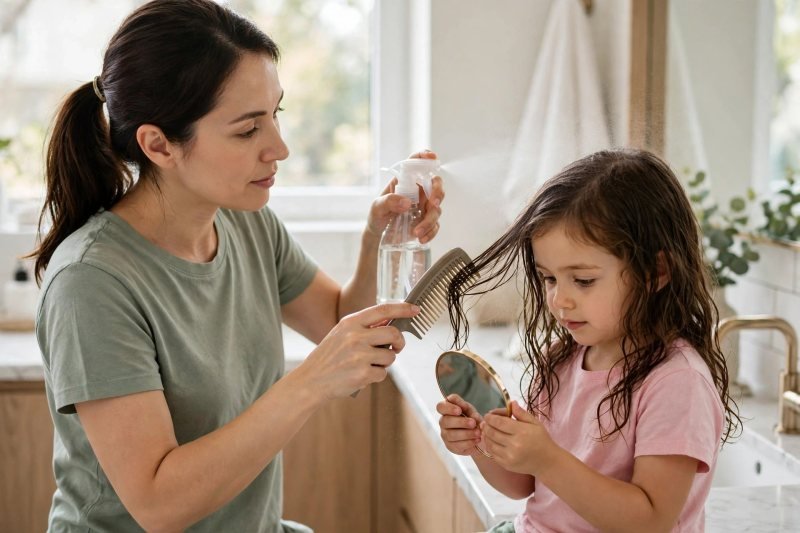
Detangle with water first. Spray plain water through the hair and work the wide-tooth comb from the ends upward, a small section at a time, holding the section above the tangle so it does not pull. Say: "Water does most of the work — the comb just helps it along." Let your child hold the mirror and call out tangles they spot; dry combing pulls, and that pulling is what usually brings the tears — not the styling itself. When the comb glides through, the hair is ready, and damp — not soaking — hair takes a tiny amount of product best. Detangled and damp, you are ready for the smallest useful amount.
-
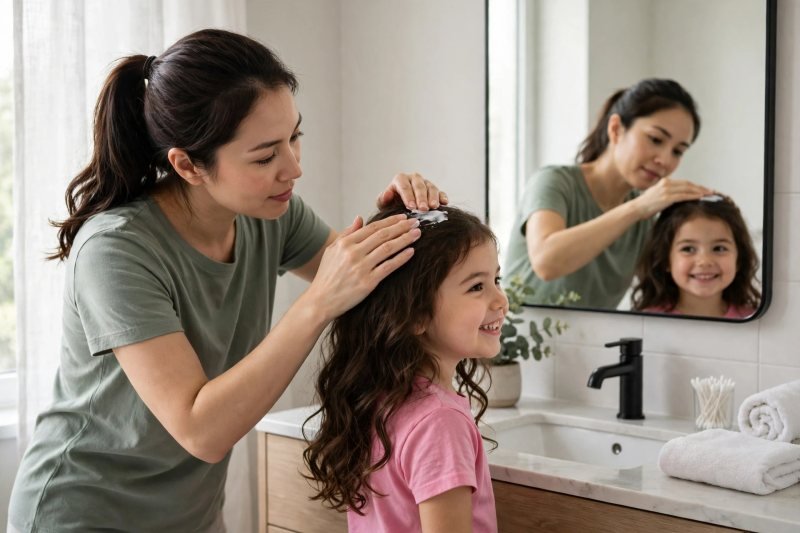
Apply a pea-sized amount, tops only. Rub a pea-sized dab between your own palms first — never scoop straight onto the head — then smooth it only over the top surface of the hair where the style needs hold. Say: "See how little that is? Your hair needs a whisper, not a handful." Keep product off the scalp itself, away from eyes and forehead skin, and let your child do the final pat with their own fingertips so they feel how light it should be. Need more hold? Add half a pea, not another full scoop. The style is set; now shape it together while it is still workable.
-
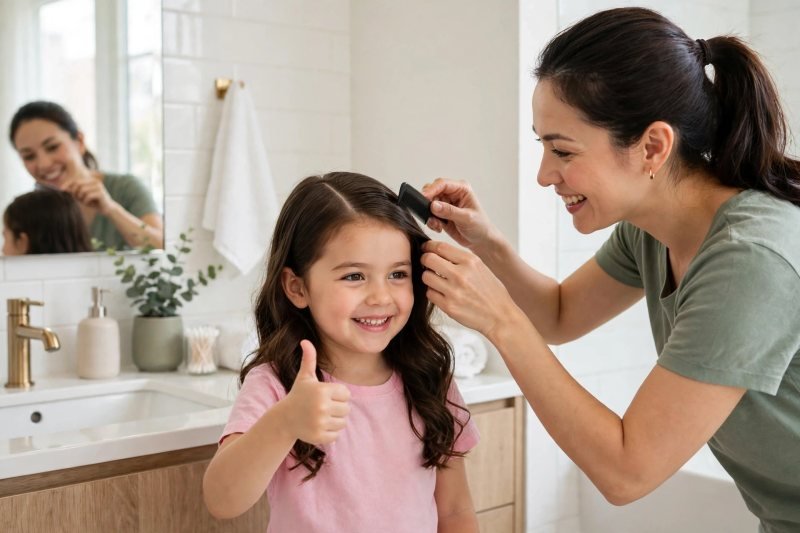
Shape the style and stop. Comb or finger-shape the chosen style in under two minutes — a part smoothed down, a front swoop lifted, short spikes pinched up one by one. Say: "Two tweaks, then we stop — chasing a perfect finish melts the hold and the mood." Chasing perfection melts both the hold and the mood, so declare it done, high-five the mirror, and close the container. Remind your child of the two standing rules while hands get washed: hands off the hair until it sets, and everything washes out tonight. Styled and agreed, the product gets put away safely before the day runs away with you.
-
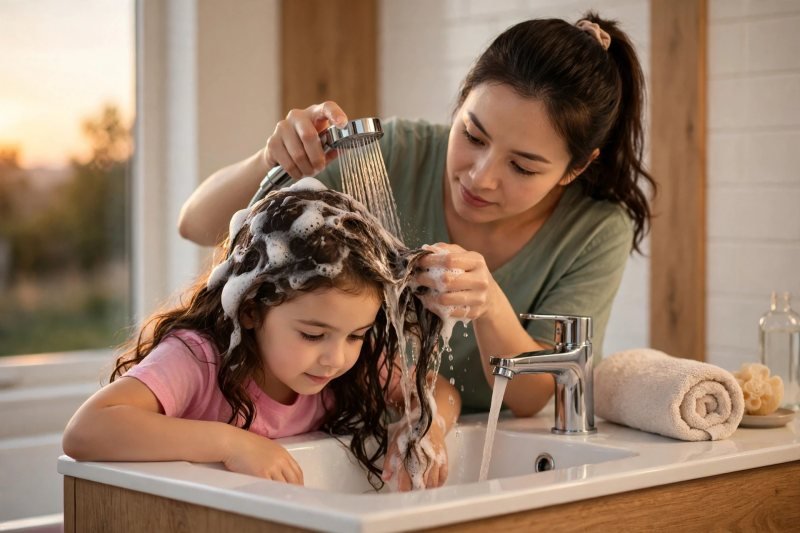
Wash it out the same day. At bath or shower time, rinse the hair well with warm water first — many light kids' products loosen with water alone — then wash once with a gentle kids' shampoo, massaging the scalp lightly with fingertips, never nails. Say: "In today, out tonight — that is our styling rule." Rinse until the hair feels clean rather than slippery, and never send a child to bed with styling product still in; product left overnight can irritate skin, tangle hair into the pillow, and rub onto eyes. Clean hair tonight is what makes the next styling day simple and safe.
-
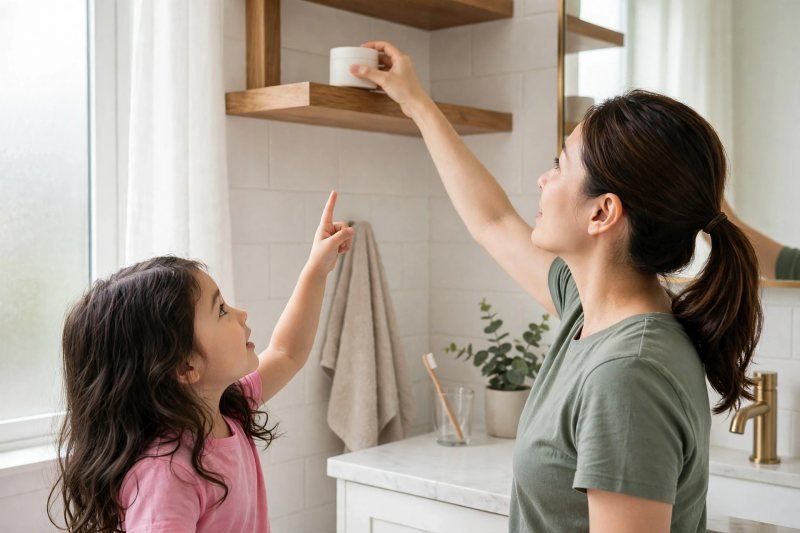
Store it high, closed, and boring. Close the container firmly and put it on a high shelf or in a latched cabinet, alongside your other bathroom products and out of everyday reach. Say: "Styling things live up high, like medicines — they are for grown-up hands to hand out." Wipe sticky drips off the container so little hands do not get a taste or an eye rub later, and check the container monthly; thickened, separated, or strong-smelling product gets replaced, not used up. Stored safely and used rarely — picture days, performances, parties — styling stays a small treat, not a daily habit.


Make it easier
Style with water and a comb alone on most days; save product for photos, performances, and parties. If detangling usually ends in tears, our guide to wash toddler hair without tears shows the same damp-hair, wide-tooth-comb approach step by step. Keep one product only. Fewer products means fewer patch tests, fewer reactions, and faster mornings. Practice the whole routine once on a quiet weekend before picture day, so nothing is new under time pressure. The same calm, one-step-at-a-time approach powers a good first haircut experience — worth reading before salon day.
Make it harder
Let your child be the stylist on a doll or on you: pea-sized amount, tops only, then a full wash-out — teaching the rules cements them. Start label literacy: let your child hunt for the words "fragrance-free" and the age guidance on the container before you buy. Pair styling practice with a simple morning-routine chart, the same sequencing skill behind a gentle kids' skincare routine. Choose the wash-out shampoo together: a gentle kids' formula is what makes the same-day rinse easy, so it helps to know how to pick the best shampoo for kids and toddlers before styling day.
Other ways to play it
- Picture-day smooth style: water, a fine comb part, and the thinnest surface film of product, applied last and washed out that night.
- Costume and performance spikes: a little more shaping with fingertips, still scalp-free, still a same-day wash-out.
- Taming without product: a damp brush, a soft tie or clip, and a hat for the walk — zero product, same tidy result.
- For sensitive scalps and curly hair: dampen well, detangle in small sections, and smooth product over the surface only — curls need water more than hold, and if your child's skin reacts easily, our sensitive-skin care guide for children walks through patch-testing and gentler routines.
How it changes by age
- Ages 4–5: the audience for this guide. Adult applies, child chooses and helps, amounts stay pea-sized, scalp stays product-free, and wash-out is same-day. Occasional use for occasions is the pattern to keep — daily heavy styling is an adult habit, not a preschool one.
- Ages 2–3: skip styling products entirely for most toddlers. Water, a soft brush, and a gentle trim handle every toddler style; young scalps are sensitive and toddlers rub eyes and hair constantly, which spreads product where it does not belong.
- Ages 6–8: most can learn to rub the dab between their own palms and smooth the tops with supervision, but the rules travel with them: made-for-kids product, small amount, no scalp loading, same-day wash-out, and patch-test every new product.
- When to get help: stop the product and rinse well if you see redness, itching, bumps, or flaking where product touched skin or scalp. If irritation spreads, eyes are affected, or things do not settle within a day or two of stopping, call your pediatrician. Bring the container with you — the ingredient list is the most useful thing you can hand over.
What they're learning
Self-care independence: choosing a style, helping apply it, and washing it out builds the same daily-routine confidence as washing and dressing. Following safety rules: patch-test first, small amount, wash out tonight — three rules they can recite and keep. Fine motor control: pinching spikes, smoothing a part, and working a comb build hand control for writing. Reading readiness: hunting real words on a real label — fragrance-free, directions, warnings — shows print doing a job.
Clearing up
"Adult gel diluted is fine for kids." No — adult formulas use stronger fragrances and hold ingredients; use a kids' product sparingly, or water alone. "Natural cannot irritate." Plant ingredients can irritate too — patch-test everything new. "More product lasts longer." Past pea-sized, extra mostly means flakes and a harder wash-out. "Daily styling is harmless." Occasional is the safer pattern; daily layering is how irritation starts. "Unscented means fragrance-free." Not quite — unscented products can still contain masking scents, so fragrance-free is the safer label to look for, and either way, patch-test first.
Questions parents ask
Is hair gel safe for 4-year-olds?
What should I look for in a kids' styling product?
How much gel should I use on my child's hair?
Can my toddler use styling products?
What if a styling product irritates my child's skin?
Keep the habit small: one product, occasional use, same-day wash-out — that is the whole system, and it works for picture days, performances, and parties alike. Wondering how often to wash on styling weeks? Our guide to how often to wash toddler hair covers wash frequency without over-washing, so styling days never turn into daily wash days.

save it for later
Pin this for the next rainy afternoon
Keep it on a board so it is there when you need it, rather than when you happened to find it.
Save to Pinterest


