


Number Tracing Worksheets 1–10: A Preschool Practice Guide
Number tracing worksheets 1–10 give preschoolers a playful path to writing their first numerals. Start at the top of every number, keep sessions short, and bring each sheet to life with rainbow writing, dot markers and counting games.
Number tracing worksheets 1–10 teach preschoolers correct numeral formation through dotted practice. Start with 1–3, teach every number from its top dot, and keep sessions to five or ten minutes. Give extra attention to the curvy 2, 3, 5 and 8, reuse each sheet with rainbow writing and counting games, and move to freehand once the dots are no longer needed.

The short version
- Start with 1–3: a whole pack of ten overwhelms a three-year-old.
- Top dot, every time: every number starts at the top — finding the dot becomes a ritual.
- Watch the curves: 2, 3, 5 and 8 need fingertip practice in sand first.
- Five to ten minutes: short, happy sessions beat long ones.
- Age
- Ages 3–4
- Prep
- 5 min
- Play time
- 10 min
- Mess
- Low
- Difficulty
- Easy
- Where
- Indoor
Why kids love this
Three-year-olds are collectors: pebbles, stickers, and now, numbers. Number tracing worksheets 1–10 hand them a dotted trail to follow, and every number starts at the same top dot. That dependable rhythm — find the dot, start there, travel down — is the seed of every numeral they will write.
What you'll need
- Dotted-number tracing sheets for 1–10 (start with the 1–3 page) — print a dotted-number page, or draw large dotted numerals with a starting dot and arrows, following the guide in Preparation.
- Short chunky crayons — a worn-down stub is ideal
- Dot markers (optional)
- Playdough (optional)
- Large pompoms for counting games
- A shallow tray of sand or salt
Before you start
1. Prepare just the 1–3 page — print a dotted-number sheet or draw three large dotted numerals with starting dots and arrows. A full pack overwhelms a three-year-old. 2. Set the sheet on a low table with one crayon beside it. 3. Put a small pile of large pompoms nearby for the counting game. Look for tall numerals (around 5 cm) with a bold starting dot and arrows showing stroke direction — vital on the twisty 2, 3, 5 and 8. One row of a single number beats a crammed page, and skip sheets whose lines start at the bottom.
How to do it
-
Sit beside your child and set the sheet. Sit beside your child, not opposite, at a low table, and slide the 1–3 sheet into place with one chunky crayon beside it. Say: "We start here, together." Put the small pile of large pompoms nearby for the counting game, and steady the sheet so it cannot slide. This calm setup matters: a sheet that moves and a crayon that rolls away teach frustration, not formation. Once the sheet is steady and your child is settled, warm the fingers up first.

-
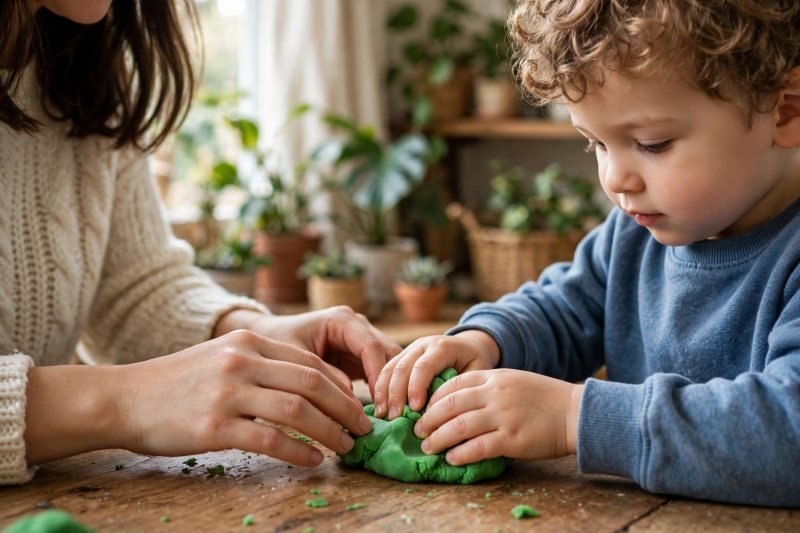
Warm up little fingers. Before any tracing, warm up little fingers: squish a ball of playdough flat, pinch it back into shape, and wiggle every fingertip. Say: "Squish, pinch, wiggle — wake the fingers up!" Two or three rounds are enough; cold, stiff fingers make stiff numbers, and a short play warm-up turns the table into a game. When the fingers feel loose and ready, find the dot that starts every number.
-
Find the starting dot and sweep the stroke in the air. Point to the starting dot on the 1 and sweep the stroke through the air together, big and slow. Say: "Find the dot, start there, travel down." Trace the shape in the air two or three times so the route lives in the arm before the crayon comes out. Air tracing teaches direction without the distraction of holding anything. Once the air sweep feels smooth, put the crayon to the paper.

-
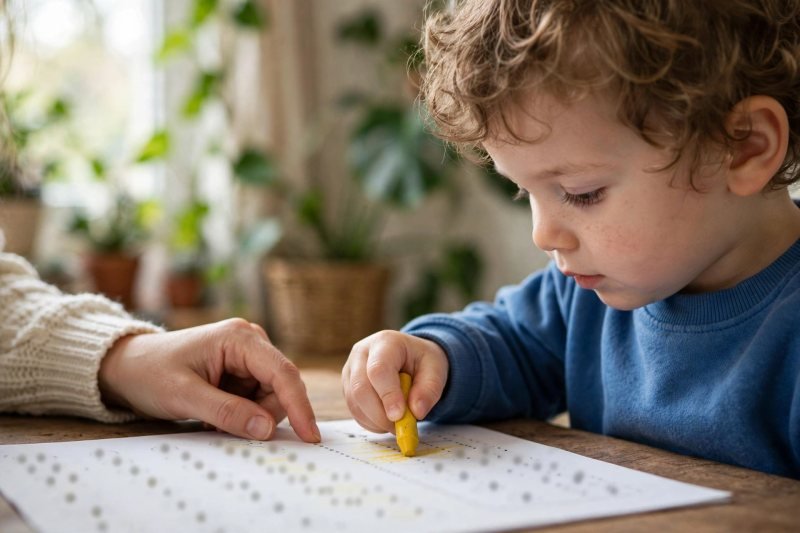
Trace 1, 2 and 3 from the top dot. Trace 1, 2 and 3 with the crayon, starting at the top dot every time. Say: "Top dot first, every single time." Keep the strokes slow and steady, steadying the page with your free hand, and celebrate every top-dot start before moving to the next number. The dependable rhythm — find the dot, start there, travel down — is the seed of every numeral your child will write. When 1, 2 and 3 are traced, the curvy numbers need a different first step.
-
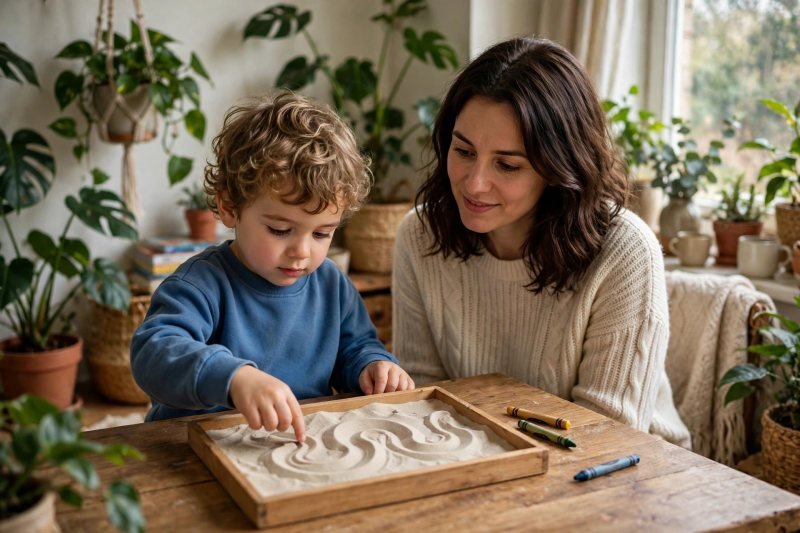
Practise the curvy numbers in sand first. For the curvy numbers (2, 3, 5, 8), trace the shape with a fingertip in the sand tray first, then with the crayon. Say: "Finger first, crayon second." The sand forgives wobbles and lets the finger feel the curve, the loop and the direction change before the crayon has to commit. Do each curvy shape in sand two or three times, then trace it on the sheet with the same slow movement. Once the curves feel familiar, reuse the sheet with color.
-
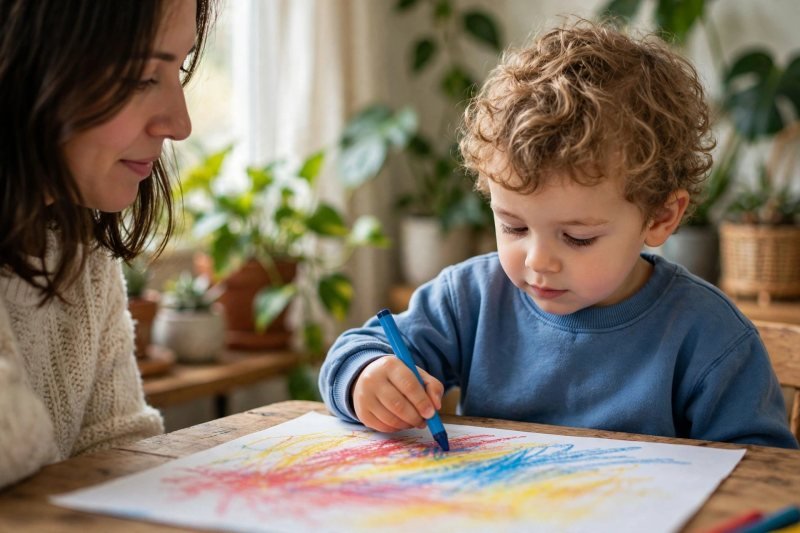
Do a rainbow pass. Do a rainbow pass: trace over the same numbers in two or three fresh colors, right on top of the first tracing. Say: "Red, then blue, then green — say the number every time!" The layered colors show exactly where the path wobbles, and saying each number aloud links the shape to its name. A new color makes an old sheet feel new, which is the whole trick of reusing practice sheets. When the rainbow pass is done, switch tools entirely.
-
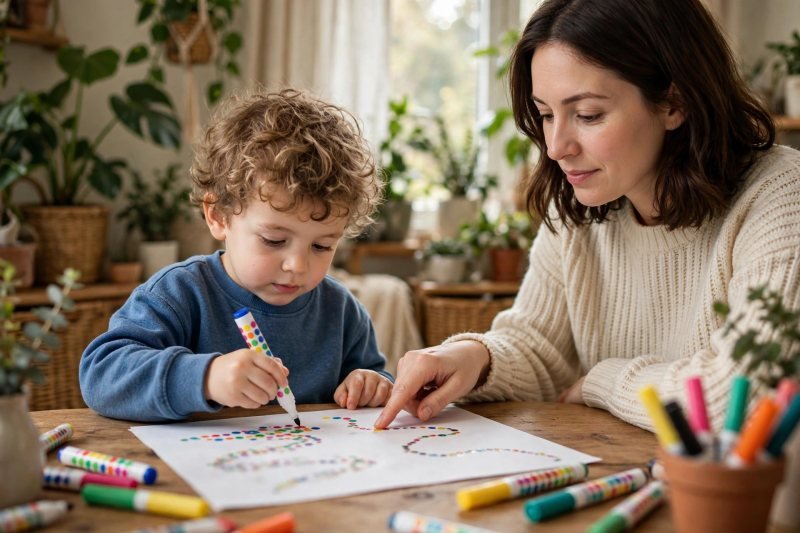
Switch to dot markers. Switch tools: stamp along the dotted paths with dot markers instead of drawing the lines. Say: "Dab, dab, dab — follow the dots!" Slow, deliberate dabbing builds the same hand control as tracing, but it feels like a game, and the bright dots make progress visible at a glance. Keep the dabbing slow; speed is not the skill here. Once the paths are dotted, bring the pompoms in for counting.
-
Count and trace with pompoms. Count and trace: lay a large pompom on each number as you say its name, then trace the row again. Say: "One pompom, one number — say it, then trace it." One object for one number said is the heart of one-to-one counting, and the physical pompom makes the quantity real before the numeral is traced again. Work through the row slowly, naming and placing together. When the row is counted and traced, trace a copy of your own alongside.

-
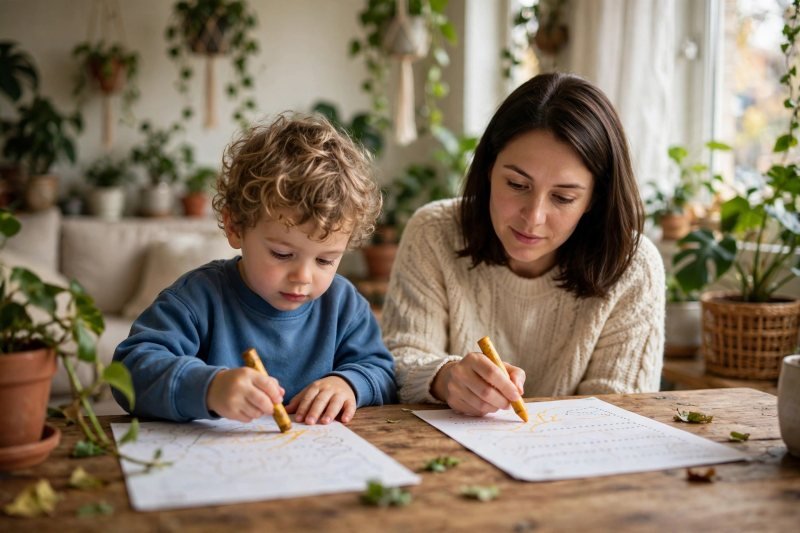
Trace alongside your child. Trace your own copy alongside, moving your hand the same way, and let your child copy you. Say: "Watch my hand — same way, same dot." Children copy movement before they follow instructions, so your slow, top-dot tracing is the lesson. Keep your copy at the same pace, pause at each starting dot, and let your child match you number by number. When both copies are finished, look at the work together and celebrate it.
-
Celebrate the finished sheet and stick a star. Look at the finished sheet together, name one thing that went well, and stick a star on it. Say: "That 2 started at the top dot — star time!" Date the sheet and tuck it into the folder, so the growing number book shows progress over the weeks. Stop while it is still fun, after five to ten minutes; short, happy sessions beat long ones. Once 1–3 are traced confidently, add the next page rather than drilling the same three forever.



Make it easier
Trace with a fingertip in sand or salt before touching a crayon. Cover all but one number with a blank strip of paper. Steady the page and celebrate every top-dot start. Stay on 1–3 for a week or two before adding more.
Make it harder
Add 4–6, then 7–10, until the whole pack feels easy. Trace the number, then try it freehand in the sand tray. Match each traced number to the same number of pompoms. Build finger strength between sessions with fine-motor activities for preschoolers.
Other ways to play it
- Chalk walk: draw giant numbers on the pavement and walk their strokes before tracing indoors.
- Sticker dots: place dot stickers along the dotted path, then join them with a crayon.
- Number hunt: trace a number, then find that many socks, spoons or blocks around the house.
How it changes by age
- Age 3: numbers 1–3, five-minute sessions, finger and crayon mixed. Any comfortable grip is fine.
- Age 4: add 4–10, stretch toward ten minutes, and nudge a three-finger grip. If the grip still feels fisted, build hand strength first with pencil grip activities before pushing tracing further.
- Look for four signs: a wobbly circle, a manageable crayon grip, five minutes of table focus, and spotting numbers on doors or clocks. If most are missing, play with counting songs and sand for a few weeks first.
What they're learning
Number formation: the correct top-down stroke path for 1–10. Number recognition: matching each numeral's shape to its name. Fine motor control: finger strength and control that writing builds on. Hand-eye coordination: steering the crayon along the dotted path. One-to-one counting: one object, one number said — try ten-frame activities next. Build the counting habit first with counting activities for toddlers that use real objects.
Clearing up
Date each finished sheet and tuck it into a folder. A "number book" that fills up over the weeks is powerful proof of progress. Once 1–3 are traced confidently, add the next page rather than drilling the same three forever. When your child traces 1–10 without hunting for the starting dot, bridge to freehand in stages — fingertip in a sand tray first, then crayon on blank paper, big and free. See the FAQ for the full moving-on guidance. Once 1–10 are traced confidently, pair tracing with counting to 10 activities so the numeral, the count and the quantity link together.
Questions parents ask
What order should kids trace numbers 1–10?
Which numbers are hardest for preschoolers to write?
How long should a 3-year-old's tracing session last?
How can I make number tracing worksheets more fun?
When should my child move from tracing to writing numbers?
When numbers feel easy, the same top-dot routine transfers to letter tracing worksheets.

save it for later
Pin this for the next rainy afternoon
Keep it on a board so it is there when you need it, rather than when you happened to find it.
Save to Pinterest

