


Non-Standard Measurement Activities: 10 Hands-On Ideas
Ten non-standard measurement activities for ages 4–5 — measure with blocks, hands, and feet, and discover why one table is 12 blocks but 8 hand spans.
Non-standard measurement activities teach 4–5-year-olds to measure with blocks, hand spans, footsteps, paper clips, and shoes instead of rulers. Three big ideas: units identical, no gaps, and the same object gives a different number with a different unit — a table 12 blocks long is only 8 hand spans.

The short version
- Measure with blocks, hand spans, footsteps, paper clips, or shoes — units kids can see and touch.
- Three rules: units identical in size, laid with no gaps, kept the same throughout.
- A bigger unit always gives a smaller number: 12 blocks long, but only 8 hand spans — spotting that pattern is early number patterns for kids thinking.
- Guess before measuring to build estimating; a results chart cements the learning.
- No-mess, indoor-friendly; keep paper clips away from younger siblings.
- Age
- Ages 4–5
- Prep
- 10 min
- Play time
- 30 min
- Mess
- None
- Difficulty
- Easy
- Where
- Indoor
Why kids love this
One day the table is just "long" — the next it is eight hands long, and your child can prove it. Before rulers mean anything, kids need the ideas underneath: a measurement is a count of identical units with no gaps, and changing the unit changes the number.
What you'll need
- 20+ identical pattern blocks or linking cubes (same size — this matters)
- A picture book; a table or shelf with a straight edge
- Large paper clips in a bowl; a crayon or spoon
- Yarn, child-safe scissors, a couch cushion, a floor mat
- A clear hallway stretch, masking tape (optional), big paper and crayons
Before you start
1. Check all blocks are truly identical — mixed sizes break the lesson. 2. Clear a reachable table edge and a hallway path. 3. Count 20 paper clips into a bowl; cut yarn about as long as your arm span. 4. Tape a start line on the floor.
How to do it
-
Line up blocks with no gaps. Lay blocks along the book's edge, each touching the next. Count: "Six blocks long!" Then leave a finger-width gap on purpose: "Does it still measure the book?" Let them fix it. The golden rule: identical units, touching end to end.

-
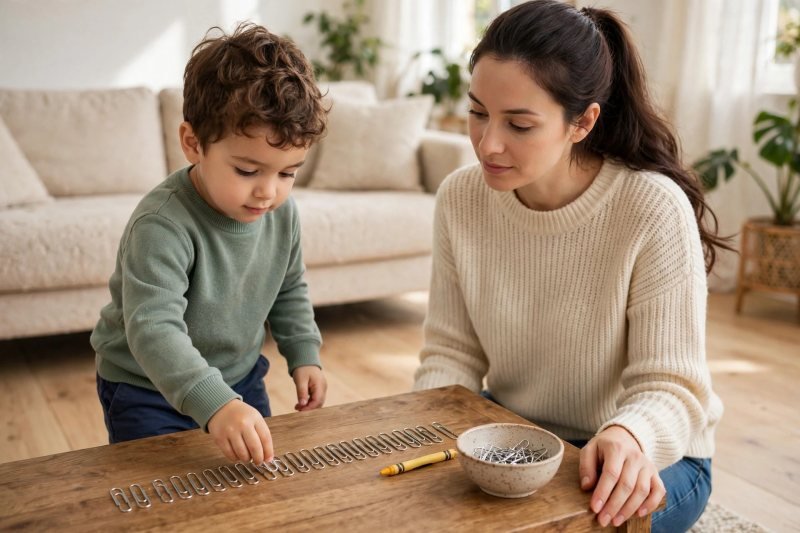
Measure the crayon in paper clips. Lay clips in a touching row beside the crayon: "Five paper clips long!" New unit, same rule. Try a spoon: "Which took more clips?" The unit changed; the game stays the same.
-
Measure the table edge with hand spans. Lay one hand flat, thumb tucked in, and hop it forward so the thumb starts where the pinky stopped — no gaps, like the blocks. Count each span: "Eight hand spans!"
-
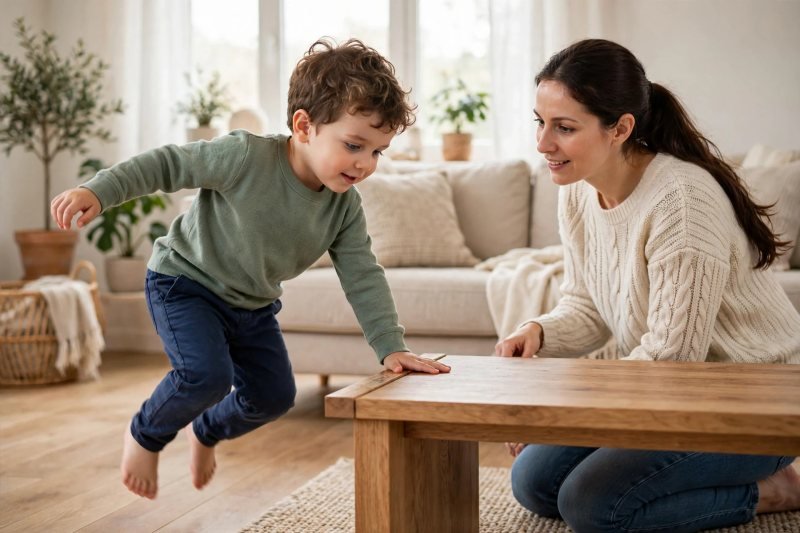
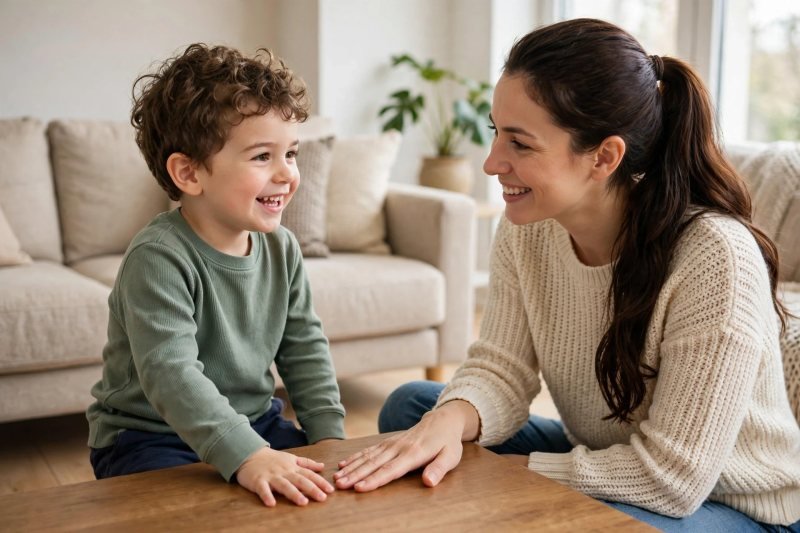
Measure the same table with a grown-up hand. Now use YOUR bigger hand: "Only five of my hand spans!" Same table, different answer. Ask why, and guide them: bigger hands, fewer needed. The key discovery — the unit changes the number.
-
Walk the hallway in footsteps. Walk heel-to-toe from the start line, each step starting where the last toe ended. Count: "Fifteen footsteps!" Try your longer stride — fewer steps, same hallway. Then baby steps and giant steps.

-
How many hands tall are you? Stand your child against a wall; stack flat hand spans upward beside them: "Nine hands tall!" Then the grown-up, a chair, the dog, the doorway.

-
Measure the mat in shoe-lengths. Take off one of your child's shoes — same shoe throughout — and lay it heel-to-toe along the mat: "Six of your shoes long!" Repeat with a grown-up shoe, but ask first: "More shoes or fewer shoes?"

-
Wrap the pillow in yarn, then measure the yarn in blocks. Loop yarn once around the cushion; pinch where it meets — you cut, they hold. Lay it straight and measure with blocks: "Ten blocks around!"

-
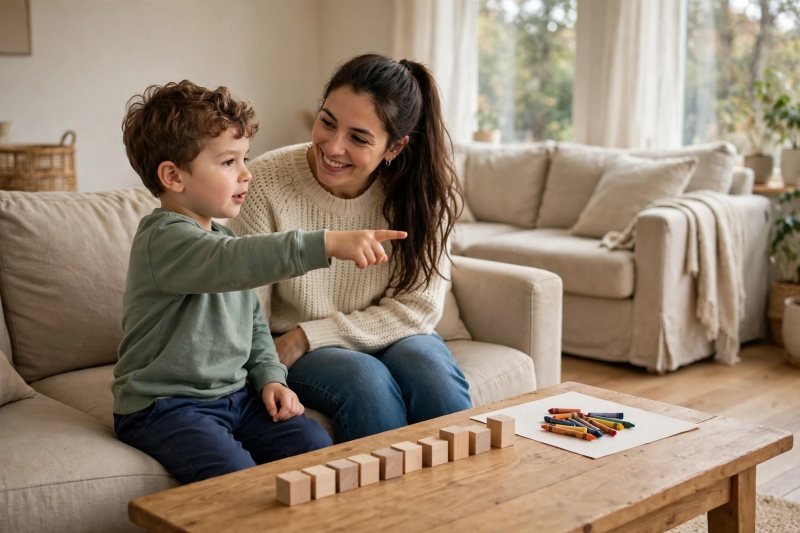
Guess first, then measure. Pick the sofa, bookshelf, rug. Before each: "How many hand spans? How many blocks?" Sketch guesses, measure, compare. Cheer close guesses, laugh at wild ones.
-
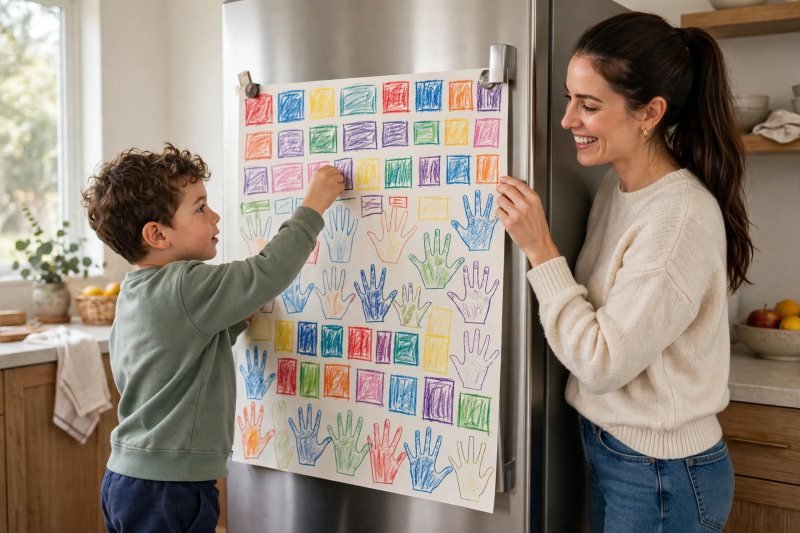
Build the results chart. Draw what you found: 12 block-shapes and 8 hand-shapes for the table, footsteps for the hallway, blocks for the pillow yarn. The picture IS the record — hang it on the fridge.


Make it easier
Do steps 1–3 on day one — "identical units, no gaps" deserves its own session. Keep counts under 10 first: the book (six blocks), the crayon (five clips) — the same early counting as counting activities for toddlers. Count aloud together; let them count while you line things up.
Make it harder
Order three objects by predicted block-count, then measure to check. Measure the table a third way (paper clips); line the three numbers up smallest to largest — more measurement activities for preschoolers use the same compare-and-order play. Run out of blocks mid-measure: mark the spot, shift blocks forward, keep counting.
Other ways to play it
- Outdoor: Footsteps on the path, hand spans on the fence, pinecones along a stick.
- Stuffed-animal clinic: Measure each patient in blocks; order shortest to tallest.
- Sibling: Each child measures the same table with their own hands — step 4, doubled.
How it changes by age
- Four-year-olds are learning the rules: units identical, touching, every one counted. All that re-lining IS the learning. Five-year-olds run the show: they pick the unit, keep it consistent, and explain why a bigger unit gave a smaller number.
What they're learning
Three ideas all later measuring rests on: a measurement is a count of identical units; units must have no gaps or overlaps; the same object gives a different number when the unit changes. Plus counting, comparing, and estimating — counting games for preschoolers build the same skills — and precise words: longer, unit, measure, estimate. Lining up blocks, clips, and hand spans also builds fine motor control — see fine motor activities for preschoolers.
Clearing up
Count the clips back into their bowl. Stack the blocks away; wind up the yarn; scissors out of reach. Hang the results chart on the fridge.
Questions parents ask
What are non-standard measurement activities for kids?
Why measure with blocks and hands before using a ruler?
How do you teach a child that units must be the same size?
What if my child leaves gaps between the blocks?
At what age do kids see that different units give different numbers?
What household objects make good non-standard units?

save it for later
Pin this for the next rainy afternoon
Keep it on a board so it is there when you need it, rather than when you happened to find it.
Save to Pinterest


