


Weather Sensory Bin for Toddlers
A weather sensory bin for toddlers: blue rice rain, cotton-ball clouds, jumbo pom-pom suns, and a toy umbrella. Ten easy steps, four weather words, strict safety for ages 2–3.
A weather sensory bin for toddlers is a shallow bin of blue-dyed rice ("rain") with cotton-ball clouds, jumbo yellow pom-pom suns, a toy umbrella, scoops, and a spray bottle. Toddlers scoop, pour, spray, and squish while you name the weather: rain, sun, cloud, wind. It builds sensory skills, fine motor control, and first science vocabulary for ages 2–3.

The short version
- Blue rice is the "rain"; cotton balls the "clouds"; jumbo pom-poms the "sun."
- Every solid piece must pass the toilet-roll test — no exceptions at 2–3.
- Standard water beads are unsafe; use jumbo beads or skip them.
- Four weather words: rain, sun, cloud, wind — point, name, repeat.
- Adult within arm's reach; the filler is never tasted.
- Age
- Ages 2–3
- Prep
- 5 min
- Play time
- 30 min
- Mess
- Some
- Difficulty
- Easy
- Where
- Indoor
Why kids love this
This bin puts the weather in a box your toddler controls. Blue rice streams, piles, and shushes. Cotton balls beg to be squished. The spray bottle is pure power: squeeze, and it rains. No right way to play — just scoop, pour, spray, and squish.
What you'll need
- Shallow bin with low sides (under-bed box or dish tub)
- 4–6 cups white rice, dyed blue (see Preparation) — the "rain"
- A handful of large cotton balls — the "clouds"
- 3–4 jumbo yellow pom-poms, 1½+ inches across — the "sun"
- A small toy umbrella
- Spray bottle of plain water — for "making it rain"
- Large scoops or measuring cups
- Towel or play mat for underneath
- The toilet-roll rule: every solid piece must be too big to fit through a toilet-paper roll tube — anything smaller is a choking hazard at 2–3.
Before you start
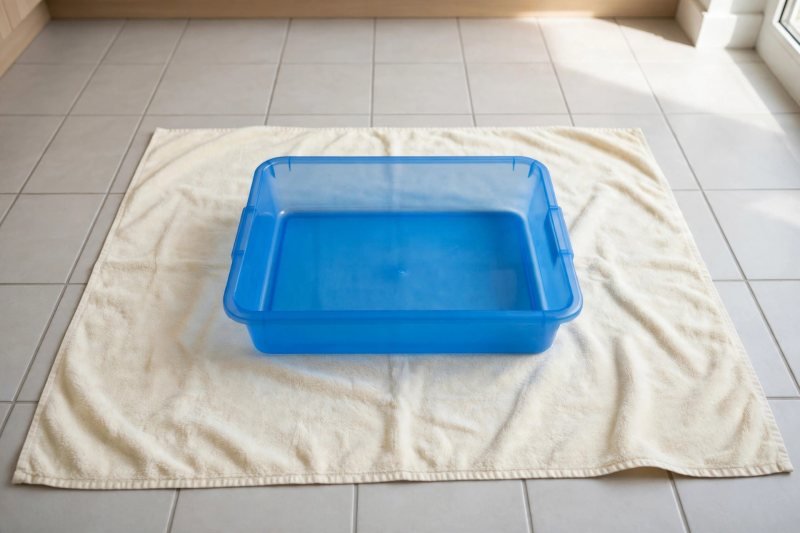
1. Dye the rice (adult job, ahead). Shake rice in a zip-top bag with 1 teaspoon white vinegar and 10–15 drops blue food coloring per 2 cups. Spread on a baking sheet; dry 30 minutes. 2. Toilet-roll test every piece. Anything that fits through the tube stays out. 3. Fill the spray bottle with water; set to mist. 4. Lay the mat; set the empty bin in the middle.
How to do it
-
Set the stage. Put the empty bin in the middle of the mat. Low sides let little arms reach in.
-
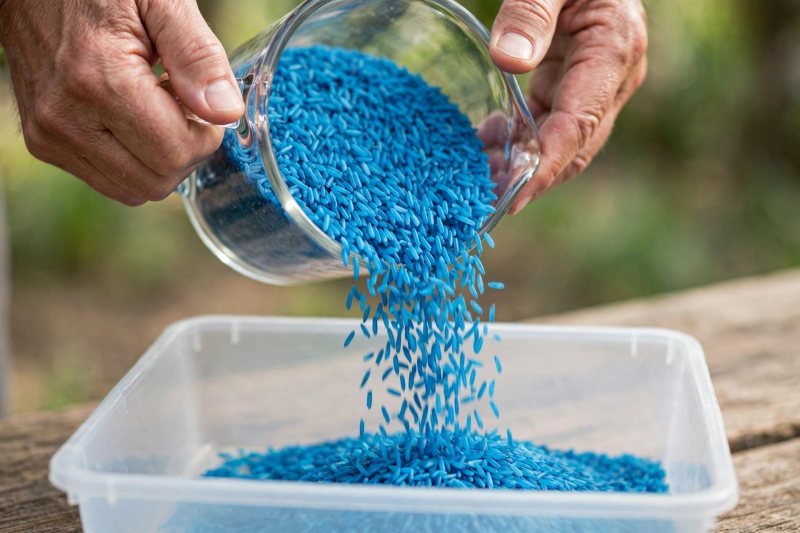
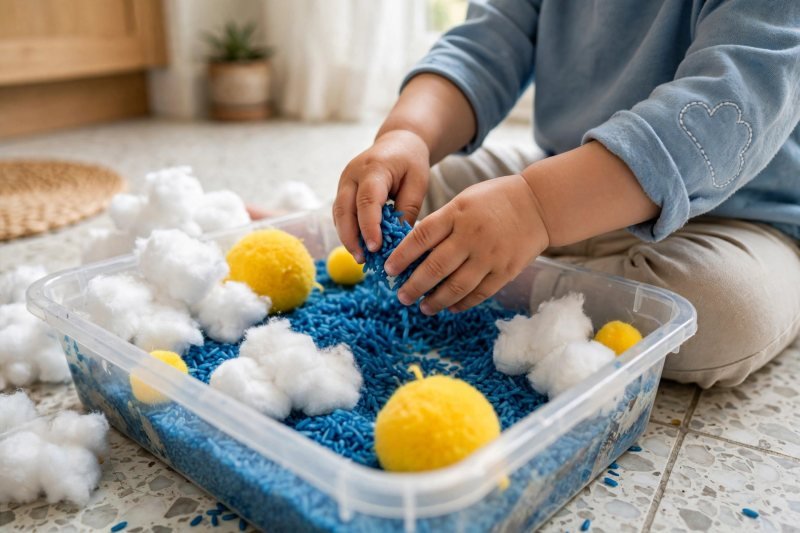
Pour the rain. Tip in the blue rice and spread it out. "This is the rain!"
-
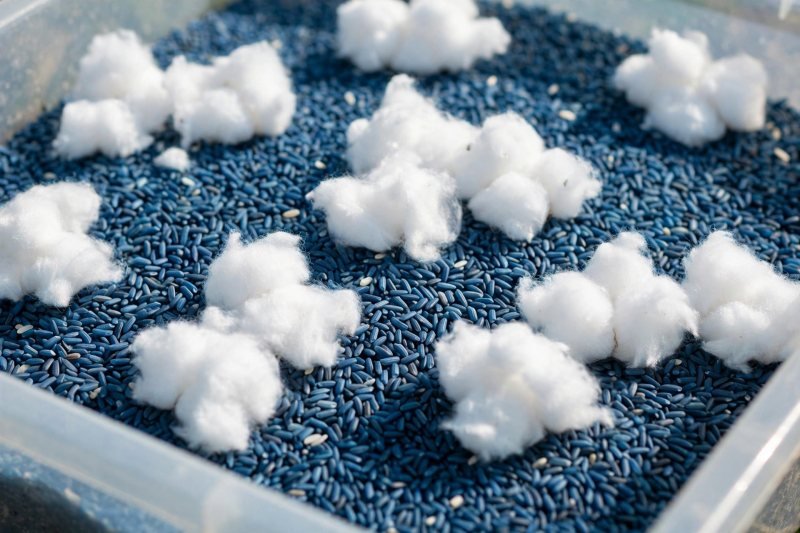
Float the clouds. Scatter the cotton balls on top. "These are the clouds — soft and squishy, just like the sky."
-
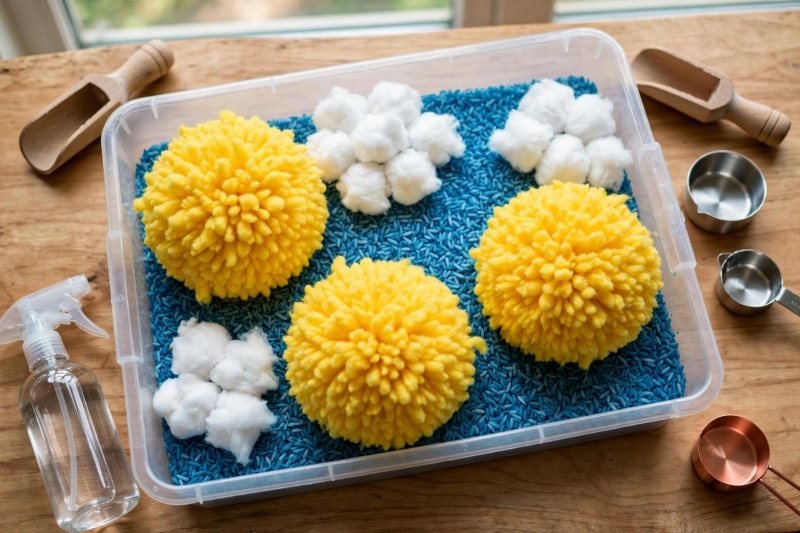
Bring out the sun. Nestle the pom-poms into the rice between the clouds. "Here comes the sun! Can you find the sun?"

-
Stand up the umbrella. Open it and stand it in a corner. "The umbrella keeps us dry when it rains."

-
Add the tools. Tuck scoops, cups, and the spray bottle around the edges, within reach.
-
Invite your toddler in. Sit beside the bin; let them explore hands-first and follow their lead.
-
Make it rain. Guide their hand on the spray bottle and mist the rice together. "Pitter-patter — it's raining!"

-
Name the weather. Point and name each part slowly: rain, sun, cloud, wind. Cheer every attempt.

-
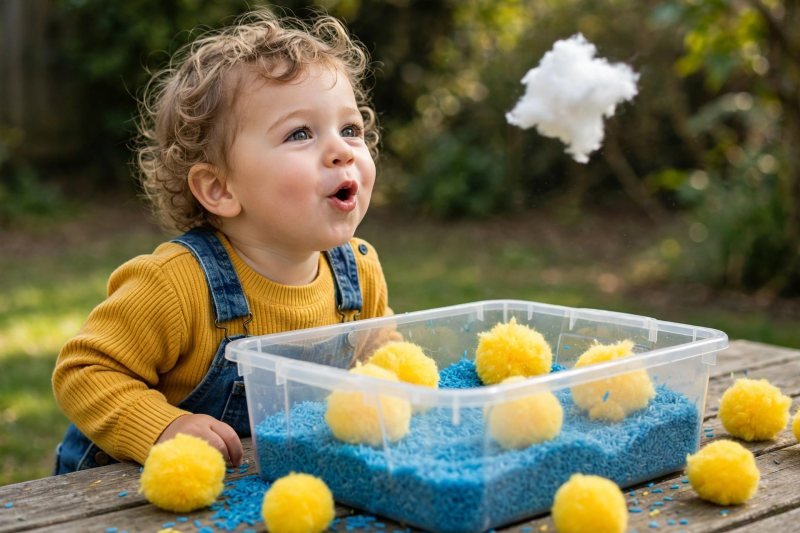
Blow the wind. Blow a cotton-ball cloud across the bin. "Whoooosh!" Then free play.


Make it easier
Use plain white rice — setup drops to two minutes. Just rice, cotton balls, and the umbrella. Teach only "rain" and "sun" — plenty for a just-turned-two. You spray while your toddler points.
Make it harder
Hold up a cloud, sun, or umbrella; your toddler finds the match. Count the suns: "One sun, two suns, three suns!" Hide the pom-poms under the cotton balls — "find the sun." Look out the window: sun day, cloud day, or rain day?
Other ways to play it
- Snowy day: white rice; cotton balls become snow clouds; add a toy shovel.
- Windy day: add crepe-paper streamers and blow them around.
- Puddle play: pour a little water in one corner for a "puddle"; park the umbrella over it.
- Night sky: dark-blue rice and jumbo glow stars (toilet-roll tested).
- Ice day: try ice play science for toddlers for cold, slippery weather play.
How it changes by age
- Built for ages 2–3.
- At 2, expect scooping, pouring, and squishing while you narrate — your voice is the lesson.
- At 3, expect pretend play ("It's raining — get the umbrella!") and real attempts at the words.
- For 18–24 months: closely supervised scooping with the largest tools only.
- Under 18 months, wait.
What they're learning
Science vocabulary: rain, sun, cloud, wind — anchored to touch, how toddler words stick. Cause and effect: squeeze the bottle and it rains; blow and the clouds move. Sensory processing: crunchy rice, soft cotton, cool mist — rich tactile input for growing brains. Fine motor skills: scooping, pouring, and squeezing the trigger strengthen the small muscles writing needs later. Observation: rice darkening under the spray, a cloud drifting — the start of scientific thinking. More sensory play: our five senses activities for toddlers and five senses activities for preschoolers build on the same touch-and-name skills.
Clearing up
Lift out the umbrella, tools, and pom-poms; shake off the rice. Scoop the rice into a sealed bag or jar — it keeps for months. Pick out the cotton balls; toss the worn ones. Shake the mat outside; sweep the strays. Wipe the bin; air-dry before storing.
Questions parents ask
What do you put in a weather sensory bin for toddlers?
How do you dye rice blue for a sensory bin?
Is a sensory bin safe for a 2-year-old?
What is the toilet paper roll rule for toddler toys?

save it for later
Pin this for the next rainy afternoon
Keep it on a board so it is there when you need it, rather than when you happened to find it.
Save to Pinterest


