


Brush for Curly Toddler Hair: How to Choose One and Detangle Without Tears
Brush for curly toddler hair, chosen by feel: what flexible bristles, a cushioned base, and an easy-grip handle should feel like in your hand — plus a calm, section-by-section detangling routine that starts at the ends and ends without tears.
Choose a brush for curly toddler hair by feel: bristles that flex and glide on your inner wrist without scratching, tips smooth and widely spaced, a cushioned base that gives under your thumb, and a handle that grips securely with wet hands. Then detangle wet, conditioned hair from the ends upward in small sections.

The short version
- The wrist test decides: a brush that scratches your inner wrist never touches a toddler's scalp.
- Wide-spaced, flexible, smooth-tipped bristles pass curls through instead of dragging over them.
- Detangling happens on wet hair with conditioner slip — never as a dry routine.
- Ends first, then up: brush the bottom of each section smooth before moving higher.
- Your free hand grips above the tangle so the scalp feels no pull at all.
- The brush sleeps once hair is detangled; dry brushing later only creates frizz.
- Age
- Ages 2–3
- Prep
- 5 min
- Play time
- 15 min
- Mess
- Low
- Difficulty
- Easy
- Where
- Indoor
Why kids love this
Toddlers do not love brushing; they love how it feels when brushing stops hurting. A brush that flexes instead of dragging, hair that is wet and slippery instead of dry and resistant, and a parent who works in tiny sections with a song playing — that combination turns a dreaded routine into close, giggly lap time. When toddlers get their own small role — holding the brush, spraying the water, choosing the song — they start asking for "hair time" instead of fleeing it.
What you'll need
- A candidate detangling brush with flexible bristles and a cushioned base (test it using the checks in steps 2 and 3)
- A wide-tooth comb as a backup for the biggest tangles, if you use one
- A plain spray bottle filled with water (blank and unlabeled)
- A small amount of a rinse-out or leave-in conditioner you already use for your child, in a plain container
- A soft towel for shoulders and drips
- A favorite song, short audio story, or picture book for lap entertainment
- A small hair tie or clips for holding finished sections aside
Before you start
1. Choose the timing first: detangle when hair is wet — after a bath or after a thorough spray-down — never as a dry ambush on a tired toddler. 2. Set up the cozy spot: towel over your lap or the couch, tools within arm's reach, song ready to play. 3. Brush your own palm and inner wrist with the candidate brush (step 2) before it ever touches your child's head. 4. Agree the stop signal: a raised hand or a firm "stop" from your toddler pauses the session — honored instantly, every time.
How to do it
-
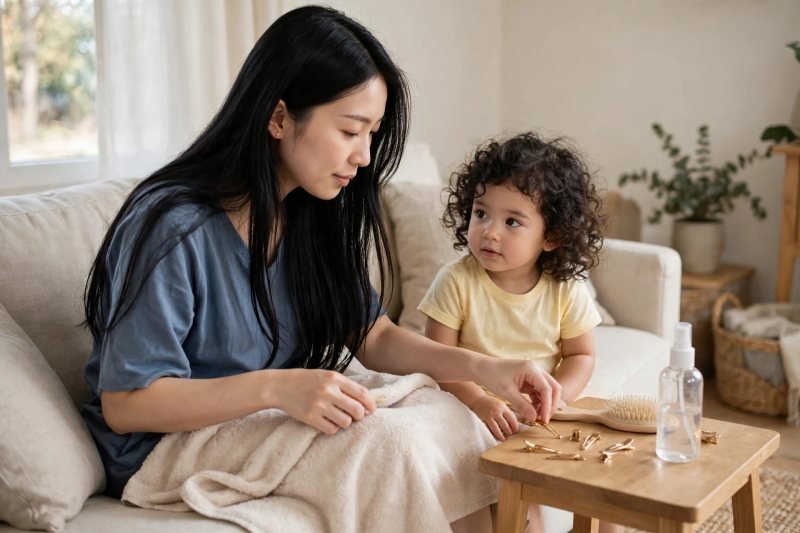
Set up hair time as a cozy ritual, not an ambush. A brush for curly toddler hair only works inside a calm routine, so build the routine first: pick the same cozy spot each time — your lap with a towel across it, or the couch corner with cushions — lay out the brush, spray bottle, conditioner, clips, and towel, and start the song your toddler chose. Say: "Hair time. Song on, snuggles on, then we brush the curls gentle-gentle." Seat your toddler facing outward, back against you, so they can see the book or the room instead of the brush coming at their face. Ritual ready, choose the tool itself by feel.
-
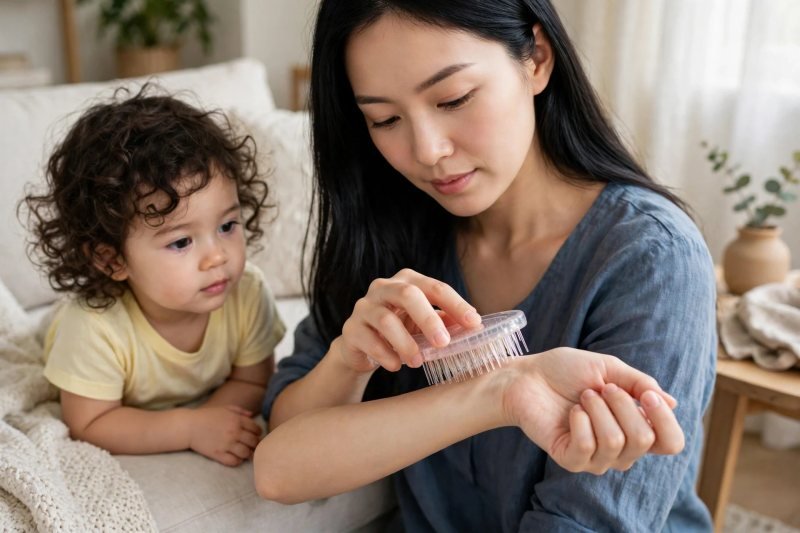
Test the bristles against your own skin before any child's head. The single most useful brush criterion is flex: press the candidate brush into your palm and drag it slowly across your inner wrist — the bristles should bend and glide, springing back without scratching, poking, or catching. Bristles that feel stiff, sharp-tipped, or unyielding on your wrist will feel twice as harsh on a toddler's scalp, and no amount of technique fixes a brush that fights the hair. The same feel-first checks decide the best hair brush for toddlers on any shelf — flex, spacing, and smooth tips, in that order. Look for bristles spaced widely enough that curls can pass between them instead of matting on top, and run a fingertip over the tips: smooth and rounded is the standard. Say, while you test: "If it scratches Mommy, it doesn't touch your curls." Bristles passed, check the base and handle.
-
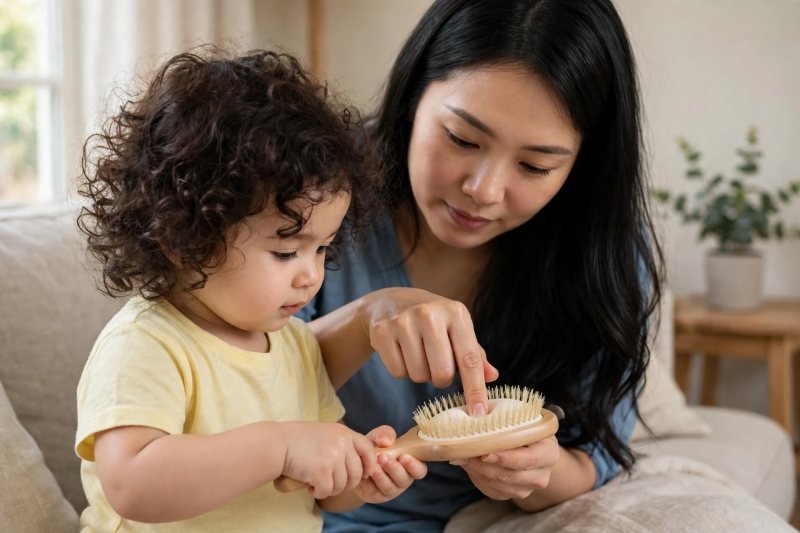
Check the cushion, the handle, and your child's grip. Under the bristles, a cushioned base that gives slightly under your thumb lets the brush absorb tugs instead of transferring them straight to the scalp — press it; it should yield like a firm pillow, not sit rigid like a board. Then judge the handle with wet hands, because that is how you will actually hold it: it should sit securely without squeezing, long enough for your whole grip, and light enough to maneuver in small strokes for fifteen minutes without a tired wrist. Hand the brush to your toddler, too — holding, carrying, and "helping" with the brush builds the same hand skills these fine motor activities for preschoolers develop, and a brush a toddler likes holding is a brush they fear less. Tool approved, wet the hair down properly.
-
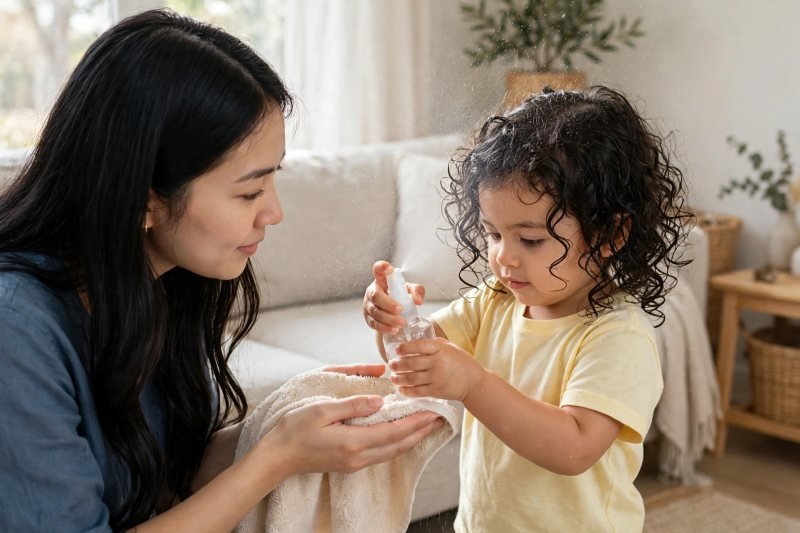
Wet the curls thoroughly — detangling happens on wet hair. Curly hair detangles when it is wet and slippery, and resists — and breaks, and hurts — when it is dry, so this step is non-negotiable: after a bath, keep your toddler wrapped in the towel and start while hair is fully wet; on non-bath days, spray section by section with the water bottle until the curls are damp through, not just misted on top. The full wash routine — how to wash toddler hair without tears — uses the same wet-first rule, so bath nights and spray days feel identical to your toddler. Let your toddler work the spray bottle for a few squeezes — it is the most popular job in the whole routine. Say: "Curls drink water first. Then they let the brush slide." Squeeze out dripping excess with the towel, gently — no rubbing, which creates the very tangles you are about to remove. Hair wet, add the slip that does the real work.
-
Work in a little conditioner with your fingers first. Slip is what turns pulling into gliding: smooth a small amount of conditioner through the wet curls with your fingers, coating the lengths and especially the ends, then finger-detangle for a minute — your fingers are the gentlest tool you own, and they will find and soften the biggest knots before the brush ever arrives. Ease apart any matted tangle you find with your fingertips, adding a touch more water and conditioner rather than more force. Stick to products you already use for your child — if you want a checklist for what counts as safe, hair styling products safe for kids lays out the same rule: familiar, gentle, and kept out of eyes. Say: "Fingers first — they wake the curls up." If your fingers cannot pass through a section yet, that section is not ready for the brush; give it another moment of slip and patience. Fingers gliding, pick up the brush for its first real test.

-
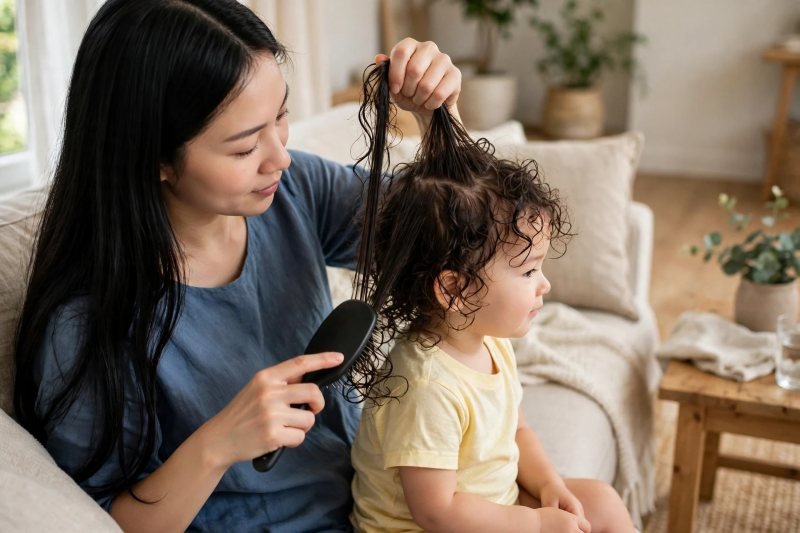
Start every section at the ends, holding the hair above the tangle. Here is the technique that ends the tears: divide the hair into a few sections with clips, take one section, and grip it gently with your free hand a little above the lowest tangle — that hand absorbs the pull so your toddler's scalp never feels it. Brush only the bottom inch or two of the section with short, slow strokes until the ends run free, praising the progress out loud: "Look — the bottom is smooth already!" Only when the ends glide do you move up, which is the next step's job. Start at the top of a tangled section and you drag one big knot down into a worse one; start at the ends and every knot leaves quietly, one at a time.
-
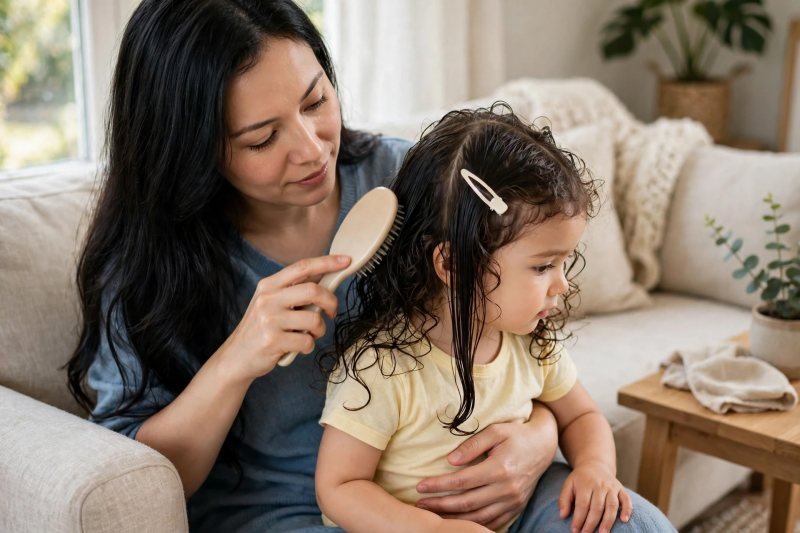
Move up the section in small bites until the brush glides through. Continue up the same section a couple of inches at a time — brush the lower third smooth, then the lower half, then from mid-length down — always brushing downward in short strokes, always with your free hand holding the section so the scalp feels nothing. Work one section fully before unclipping the next, and drop each finished section behind a shoulder where it cannot wander back into trouble. If the brush meets a stubborn knot, stop brushing at it: spray, add slip, finger-ease it apart first, then brush. Say the rhythm your toddler will learn to chant with you: "Ends first, then up, gentle-gentle." Section by section, the head transforms — usually inside two songs. Brushing done, protect the result from rough handling.
-
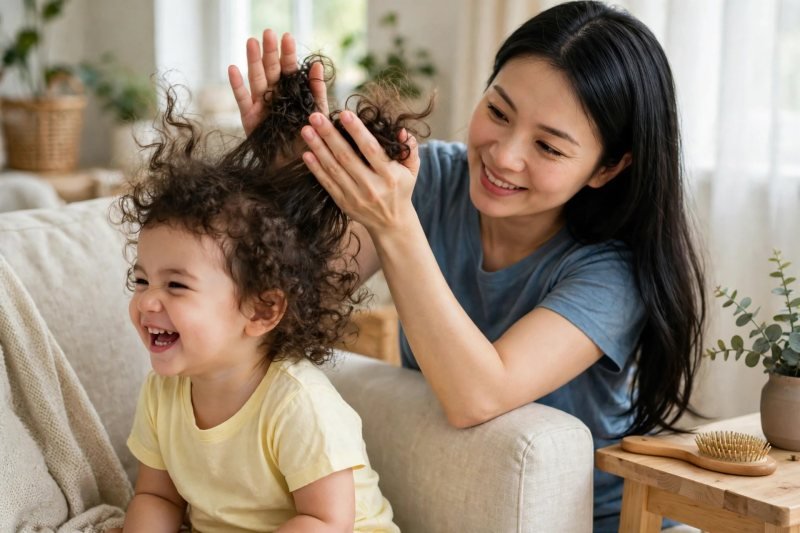
Finish by shaking the curls out — and never brushing them dry. When every section glides, put the brush down for good: scrunch the curls upward gently with your palms, shake the head's curls loose with a little shimmy your toddler will happily join, and let the hair dry as it lies. The rule that preserves all your work: the brush's job is finished once hair is detangled and wet; brushing dry curls later in the day just separates them into frizz and undoes the calm. Say: "Brush sleeps now. Curls bounce!" If a style is needed, fingers and a little water for spot-smoothing are the tools from here. Curls finished, close the ritual the same way every time.
-
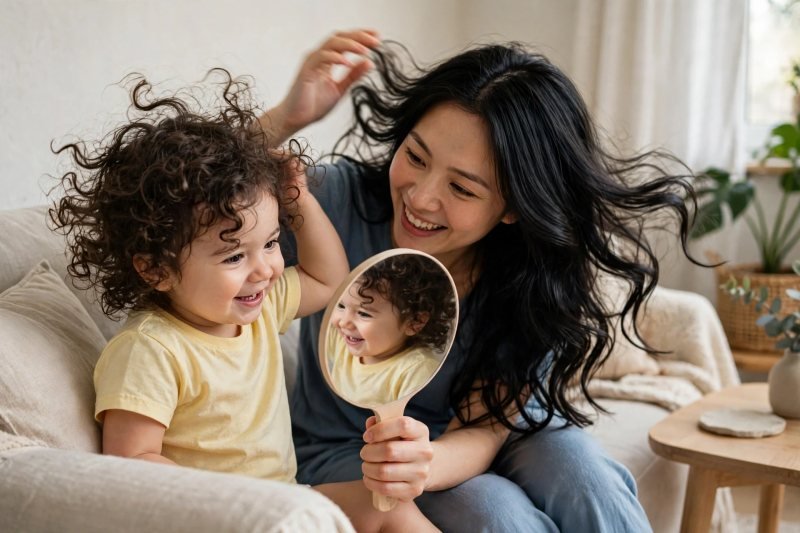
Turn the last minute into the reward and the routine anchor. End hair time with the part your toddler loves most — a mirror moment to admire the bounce, a silly hair-shake dance, or choosing tomorrow's clip — so the final memory of the session is delight, not the middle-minute tangles. Keep the whole ritual at the same point in your day (after bath is the natural anchor) so your toddler predicts it the way they predict a bedtime story; predictable routines draw a fraction of the protest that surprises do. If a first proper haircut is on your horizon, this calm, seated, adult-handles-tools practice is quiet preparation — the readiness signs in this toddler first haircut guide will look familiar. Ritual closed, care for the tool so it stays gentle.
-
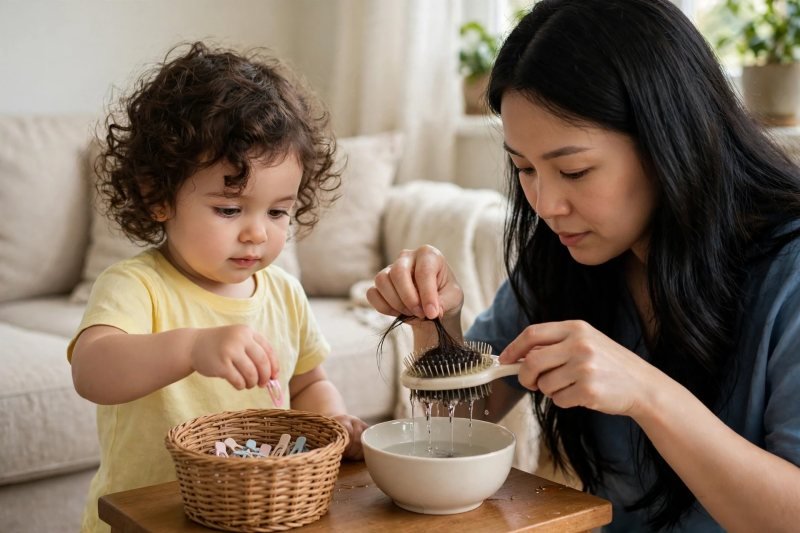
Clean the brush, store the kit together, and note what worked. A brush full of old hair and product stops flexing and starts dragging, so after each session lift the shed hair out with your fingers or the comb's tail, rinse the brush under warm water, shake it off, and let it dry bristles-down on the towel before it rejoins the kit. Store everything — brush, spray bottle, clips, conditioner — in one small basket at the cozy spot, because a kit that lives together makes hair time start in one minute flat. Note briefly what your toddler tolerated best (which song, which spot, ends-first pace) while it is fresh; that note is next session's shortcut to calm. Kit stored, hair time is officially a solved problem.


Make it easier
Very tangle-prone mornings: run a two-minute version — spray, slip, finger-detangle only — and save the full brush routine for bath nights. Brush-shy toddler: let the brush "brush" a doll or your hair first for several days, and let your toddler brush your ponytail before their turn begins. Shorter hair or finer curls: skip the clips and work in two big sections — the ends-up technique matters more than the section count.
Make it harder
Let your toddler own real jobs: holding each finished section, spraying each new section, and counting sections aloud — routine mastery plus counting practice. Teach the chant as a self-care script ("ends first, then up, gentle-gentle") so an older preschooler can start the first section semi-independently with you checking. Keep a simple curl diary together — a drawing after each session of "today's bounce" — to build pride in their hair exactly as it grows.
Other ways to play it
- Bath-time detangling: move the whole routine into the bath's last minutes — hair is wettest, slip is easiest, and rinsing is built in; brush seated in the tub with you kneeling outside.
- Two-parent relay: one adult is the lap and the story voice, the other brushes — ideal for the wiggiest toddlers and the thickest curls.
- Travel kit version: the same brush, a mini spray bottle, and clips in a wash bag keep the ritual identical in hotel rooms and grandparents' houses, which toddlers find deeply reassuring.
How it changes by age
- Ages 2–3: the guide as written — adult brushes, toddler holds, sprays, and chooses songs; sessions stay near fifteen minutes with an honored stop signal.
- Ages 4–5: children can finger-detangle their own ends and brush the front sections with supervision; the ends-up rule and the no-dry-brushing rule stay absolute.
- Ages 6–8: hand over the full wet routine gradually — sectioning, slip, ends-up brushing — checking finished sections and handling true knots as the adult reserve.
- All ages: pain is information, never a price of neat hair — a session that hurts means the tool, the slip, or the technique needs adjusting, not the child.
What they're learning
Sensory trust and body autonomy: an honored stop signal and a predictable ritual teach toddlers that their comfort rules their own body. Sequencing: wet, slip, fingers, ends, up, shake — a six-beat routine a two-year-old can anticipate and eventually recite. Fine motor control: spraying, clip-holding, and brush-carrying build hand strength and bilateral coordination in a real-life context. Hair confidence: praise aimed at bounce and shine — never at "taming" — builds a healthy relationship with natural curls from the start.
Clearing up
Hair time tidies in two minutes: shed hair from the brush goes straight to the bin (before it migrates), the spray bottle and clips return to the kit basket, the damp towel goes to the laundry, and any conditioner drips wipe off the couch or floor before they turn slippery. The basket goes back to its spot — tomorrow's calm session is tonight's tidy basket.
Questions parents ask
What type of brush is best for curly toddler hair?
Should you brush curly toddler hair wet or dry?
How do you detangle toddler curls without pain?
How often should you detangle a toddler's curly hair?
Why does my toddler scream during hair brushing?

save it for later
Pin this for the next rainy afternoon
Keep it on a board so it is there when you need it, rather than when you happened to find it.
Save to Pinterest


