


How to Make a Rain Cloud in a Jar: A Rain-Falls Experiment for Ages 3–4
How to make a rain cloud in a jar — and how to explain how rain falls while you do it. A hands-on weather experiment for ages 3–4 with counting, predicting, and comparing clouds.
To make a rain cloud in a jar: fill a clear jar three-quarters with water, spray a thick layer of white shaving foam on top as the "cloud," and drip blue food coloring onto the foam. Within a couple of minutes the color soaks through, gets heavy, and falls through the water as blue "rain" — just like droplets gathering in a real cloud until gravity pulls them down. A 10-minute setup for ages 3–4, with counting and predicting built in.

The short version
- A clear jar, water, shaving foam, and blue food coloring are all you need — five minutes to set up.
- The foam is the cloud, the colored drops are gathering water droplets, and the falling streaks are the rain — a true, simplified model of precipitation.
- Explain it in preschool terms: droplets join and grow, the cloud gets too heavy, and gravity pulls the rain down.
- Count the drops together and predict how many it takes — predicting and comparing are the science skills at this age.
- Try a thin cloud versus a thick cloud to see which rains first, then make a storm with a big squeeze of color.
- An adult stays nearby: foam and food coloring are not for tasting, and coloring stains — old clothes and a tray are essential.
- Age
- Ages 3–4
- Prep
- 5 min
- Play time
- 20 min
- Mess
- Low
- Difficulty
- Easy
- Where
- Indoor
Why kids love this
Three- and four-year-olds are done with just watching — they want to be the one in charge. This experiment hands them the job: they build the cloud, they squeeze the dropper, and they watch their weather turn rainy right inside a jar on the table. The best part is the prediction game: "How many drops before it rains?" Every child guesses a number, and every child is glued to the jar until the answer appears in falling blue streaks. Then they do it again, bigger. This is the age when "I made rain!" is a genuine achievement, and they will tell everyone about it.
What you'll need
- A clear glass jar or large clear cup (a quart-size mason jar is ideal)
- Water
- Plain white shaving foam (the foamy kind, NOT gel)
- Blue food coloring (liquid, not gel)
- An eye dropper or pipette, plus a teaspoon
- A small clear cup for mixing the "raindrop water"
- A baking sheet, tray, or old towel to work on
- Old clothes or an apron (food coloring stains with enthusiasm)
Before you start
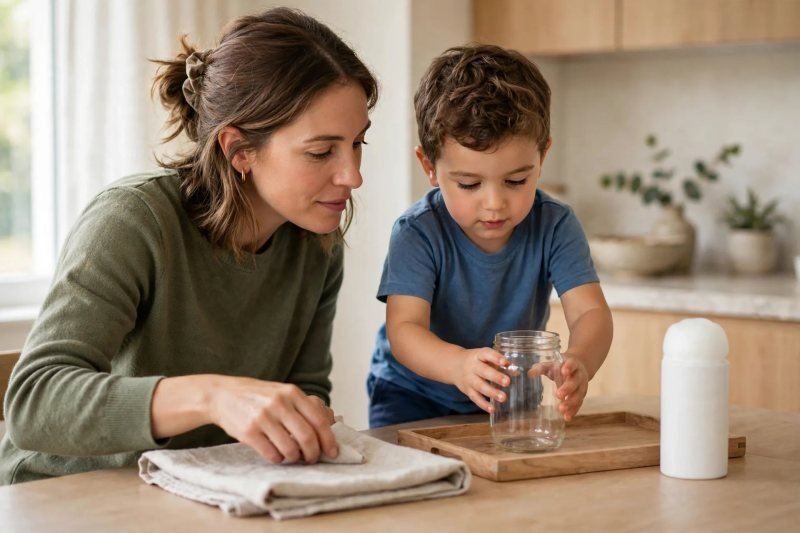
1. Cover your work surface with a tray or old towel, and dress your child in old clothes. 2. Fill the jar about three-quarters full with water, and set it on the tray. 3. Stir a few drops of blue food coloring into a spoonful of water in the small cup — this is your "raindrop water," ready to drop. 4. Have the shaving foam and dropper within your child's reach, and seat them where they can see clearly into the jar.
How to do it
-
Build your weather station. Lay the tray or towel on the table, set the jar on it, and line up your materials. Tell your child: "We are going to make weather today — real rain, inside this jar."
-
Pour the "air." Let your child pour water into the clear jar until it is about three-quarters full. Explain that the water in the jar stands in for the air above our heads — the part rain falls through.

-
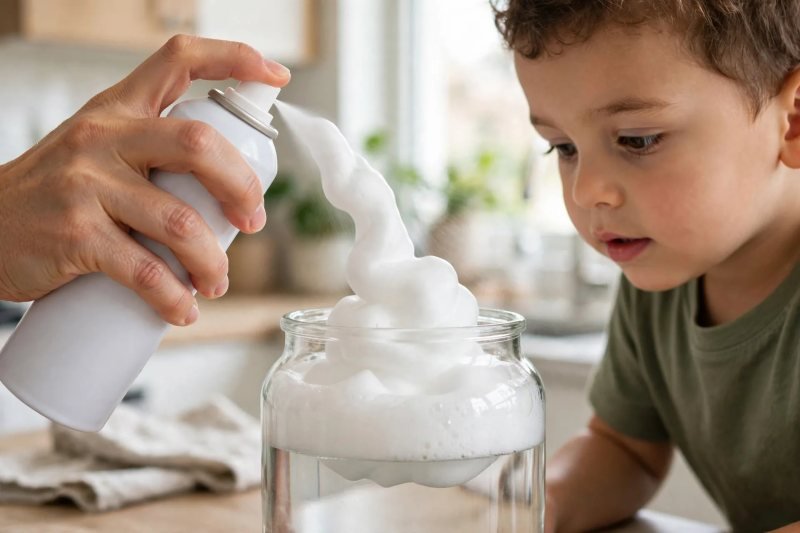
Spray the cloud. Guide your child to spray a thick layer of white shaving foam across the top of the water, about 3–4 cm deep. Announce it: "There's our cloud!" Then tell them the secret: this cloud is going to collect water, just like real clouds do.
-
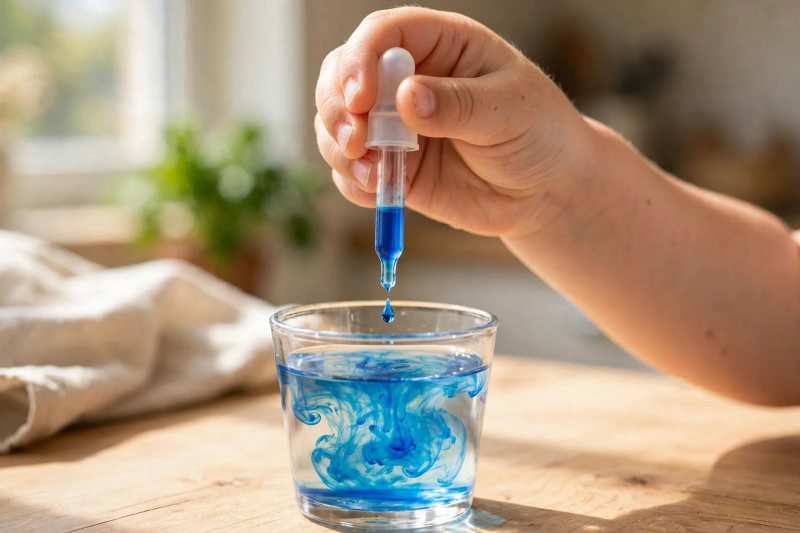
Mix the raindrop water. Drop several drops of blue food coloring into the small cup of water and stir with the teaspoon. Hold it up: "These are our raindrops. Watch what happens when they join the cloud."
-
Load the cloud. Your child drips the blue water onto the top of the foam cloud with the dropper, a few drops at a time, spread around. Explain as they go: "Real clouds are full of tiny water droplets. Every drop you add is another droplet joining the cloud."

-
Predict and count. Before the rain starts, ask: "How many drops do you think the cloud can hold before it rains?" Count the drops together out loud. This is their first prediction — and they will take it very seriously.

-
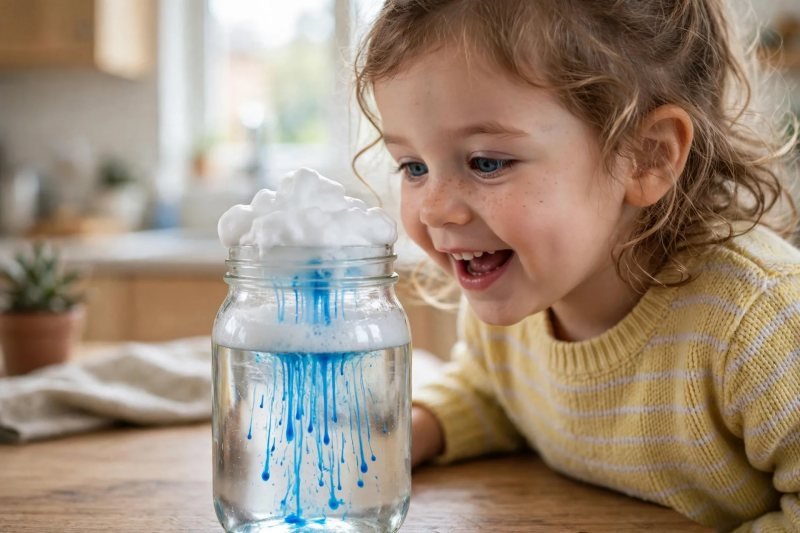
Watch the rain fall. Within a minute or two, blue streaks begin to seep through the foam and fall through the water. Narrate the science simply: "Look — the droplets joined together, the cloud got too heavy to hold them, and gravity pulled them down as rain!"
-
Compare two clouds. Set up a second jar: one with a thin, wispy cloud and one with a thick, heavy cloud. Ask which one will rain first. Drop color on both and find out together. (The thick one usually wins — more droplets, faster rain.)

-
Make a storm. Go back to the first jar and let your child add a big squeeze of color all at once. The cloud turns dark blue and the rain pours — just like a storm cloud on a rainy day. Compare: slow drizzle versus storm.

-
Clean up together. Pour the jars out in the sink, rinse everything, wipe the tray, and wash hands. Show them where the colored water goes — it swirls down the drain, off on its own little journey.


Make it easier
Use a teaspoon instead of a dropper for the color — simpler for small hands and still counts as "loading the cloud." Run the experiment in the kitchen sink or bathtub so spills simply do not matter. Skip the two-cloud comparison the first time. One jar, one cloud, one beautiful rainstorm is plenty for a three-year-old. Keep the explanation to one line at first: "The cloud got too heavy, so the rain fell out." Add the droplet and gravity words on round two.
Make it harder
Turn step 8 into a real experiment: before testing, have your child draw or describe both clouds and write down their prediction. Check it after. Try three cloud thicknesses — thin, medium, thick — and rank them by which rains first. That is genuine fair-test thinking. Time the rain: count out loud from the first drop to the first falling streak. Compare times across rounds. Ask the why-behind-the-why: "Why do you think the thick cloud rained first?" Let them reason it out before you explain.
Other ways to play it
- Rainbow rain: use red, yellow, and green coloring in separate small cups and drop each on a different part of the cloud. Watch the colors fall as separate streaks — then talk about which color "rained" fastest.
- Storm vs. drizzle: one cloud gets drops one at a time (drizzle), the other gets a big squeeze at once (storm). Compare the skies.
- Frozen rain: on a frosty morning, do the experiment and then look outside — if there is snow, explain that snow is just frozen rain, falling when the air is very cold.
- Cloud sketch: while waiting for the rain, draw the jar cloud together on paper — then add blue crayon "rain" falling from it once it starts.
- Real-sky follow-up: the next cloudy day, stand at the window and sort the clouds by color — white, gray, dark gray. Which ones look like they are "getting heavy"?
How it changes by age
- Written for ages 3–4, when children are ready to do more than watch. Threes can spray the foam (with help), squeeze the dropper, and count the drops — the adult handles the setup, the color mixing, and the science words. Fours can run almost the whole experiment, make genuine predictions ("I think ten drops!"), and explain what happened back to you in their own words — that retelling is the real learning. Two-year-olds can join in as watchers and droppers with an adult leading every step; older siblings make excellent "weather scientists" who run the show while the younger one counts.
What they're learning
How rain falls: clouds are collections of tiny water droplets; the droplets join and grow; when the cloud gets too heavy, gravity pulls them down as rain. A genuinely true first model of precipitation. Early science practices: predicting ("how many drops?"), counting to test the prediction, comparing two setups, and describing what happened — the core moves of real experimenting. Number sense: counting drops one by one, comparing "more" and "fewer," and connecting numbers to something happening in real time. New vocabulary: cloud, droplet, rain, heavy, gravity, predict, compare, storm, drizzle — rich, concrete words anchored to something they just caused. Cause and effect, upgraded: this is not just "I did X and Y happened" — it is "I did X, and Y happened because of a reason I can see."
Clearing up
The science is real, simplified — not faked. Clouds genuinely are collections of tiny water droplets, droplets genuinely merge and grow until they are too heavy to float, and gravity genuinely pulls them down as rain. "The cloud got too heavy" is the honest preschool version. The rain takes a minute or two. Nothing happening in the first thirty seconds is normal — the color needs time to soak through the foam. Add a few more drops rather than calling it broken. The cloud is a stand-in. Shaving foam is not what clouds are made of, and it is worth saying so out loud once: "Real clouds are made of water droplets, not foam — the foam is just standing in for them so we can see it." Repeating is learning. Running it again with a new prediction is not "doing it twice for no reason" — testing a new idea against the old result is exactly how science works.
Questions parents ask
How do you make a rain cloud in a jar?
How does a rain cloud in a jar work?
How do you explain how rain falls to a 4-year-old?
Can I make a rain cloud in a jar without shaving cream?
Is the rain cloud in a jar safe for preschoolers?
Why is my rain cloud in a jar not raining?

save it for later
Pin this for the next rainy afternoon
Keep it on a board so it is there when you need it, rather than when you happened to find it.
Save to Pinterest


