


Thick Toddler Hair: How to Manage, Detangle, and Style It
Thick toddler hair needs more moisture, more time, and one simple system: wash gently, condition well, and detangle in small clipped sections from the ends up. This guide gives you a calm wash-day routine, gentle drying, styles that last for days, and a 3-minute morning refresh for ages 3–4.
Manage thick toddler hair with one system: wash gently with lukewarm water, load in conditioner, finger-detangle first, then comb in 4–6 clipped sections from the ends up. Dry by squeezing with a cotton T-shirt, style loose — puffs, a braid, or half-up — and protect it overnight with a satin pillowcase.

The short version
- Sectioning is the whole secret: 4–6 clipped sections, one at a time, never the whole head at once.
- Detangle only when wet and conditioned — fingers first, then a wide-tooth comb from the ends up.
- Texture changes the amount, not the method: less product for thick straight hair, most for thick curly hair.
- Loose styles only, comfort-checked; night braid or satin pillowcase prevents tomorrow's tangles.
- Pain means stop, always; persistent flaking, redness, sores, hair loss, or itching means see a pediatrician.
- Age
- Ages 3–4
- Prep
- 5 min
- Play time
- 20 min
- Mess
- Low
- Difficulty
- Easy
- Where
- Indoor
Why kids love this
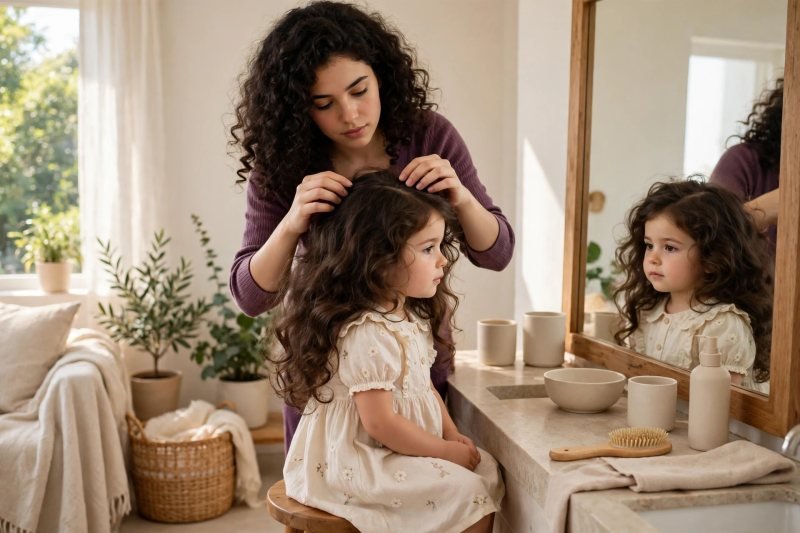
Thick toddler hair can feel like a big job, but children love this routine when it stops hurting and starts feeling like a small, predictable ritual instead of a battle. There is a stool that is hers, a mirror where she can watch, clips she gets to hand you one by one, and a clear stop signal she controls — that sense of agency changes everything. When detangling happens in small, conditioned sections from the ends up, there is no ripping and no tears, and the finished styles — two soft puffs, a loose braid, a half-up twist — stay comfortable through naps, playground runs, and car-seat headrests. The morning refresh takes three minutes with a spray bottle and fingertips, so she starts the day feeling neat without another full wash, and the satin pillowcase and loose night braid mean she wakes up with hair that is still soft and manageable. Most of all, she learns that her natural volume is something to enjoy and care for, not something to fight — and wash day becomes quiet time together rather than something either of you dreads.
What you'll need
- Wide-tooth comb — the only comb you need; wide spacing glides through thick hair without snapping it
- Spray bottle filled with plain water — for morning refresh and for re-wetting sections while you detangle
- Leave-in conditioner in a plain, unlabeled container — for slip during detangling and moisture after washing
- Gentle shampoo and regular conditioner in plain, unlabeled containers — a small amount of each goes a long way
- A little plain hair oil in a plain, unlabeled container — for sealing the ends only, a few drops at a time
- 4–6 section clips — soft, snag-free clips to hold finished sections out of the way
- Cotton T-shirt or microfiber towel — for gentle squeezing dry, never rough rubbing
- Satin pillowcase — or a soft satin bonnet for sleep, to reduce friction and morning tangles
- Small stool and a mirror at her height — so she can sit comfortably and watch what is happening
- Soft, snag-free hair bands — no metal clasps, no tight elastics, for puffs and braids
Before you start
1. Set up your hair station before she sits down: comb, spray bottle, conditioner, clips, and towel all within arm's reach so you never leave her to fetch something mid-detangle. 2. Agree on a stop signal together — a raised hand or the word "pause" — and promise out loud that you will stop the moment she uses it. Trust makes the next step faster. 3. Choose a calm window, not right before bedtime or when she is hungry. A short, unhurried session beats a long, tired one every time, and you can always finish styling after a snack break.
How to do it
-
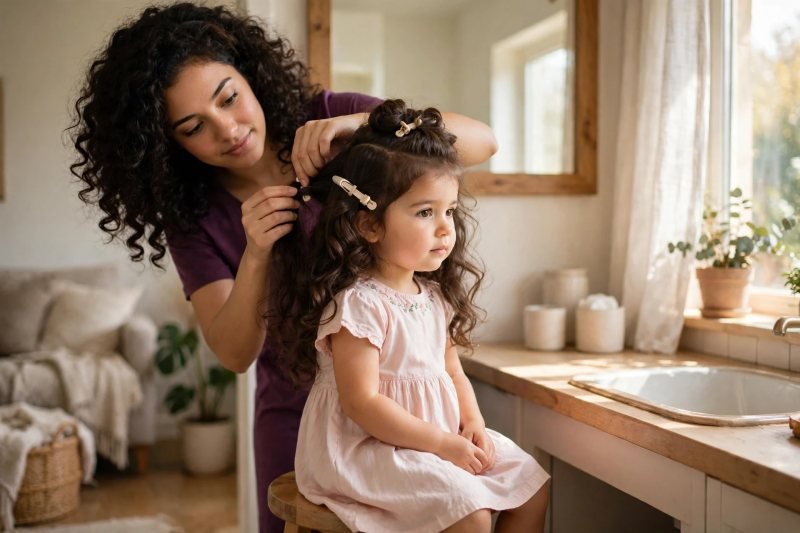
Understand thick hair first. Thick hair means more strands packed onto a small head, and that one fact explains everything else: it needs more moisture because there is simply more hair to coat, it needs more time because product and water take longer to reach every layer, and it tangles more because more strands can wrap around each other. The whole secret of this guide is sectioning — you never tackle the whole head at once, only one small, clipped section at a time. Texture changes the details, not the method: thick straight hair usually needs less conditioner and oil so it does not look flat, thick wavy hair sits in the middle, and thick curly or coily hair usually drinks up the most moisture and needs the gentlest handling when dry. Say, "Your hair is big and beautiful, so we do it in little parts, one at a time." When she understands that the sections are the plan — not a punishment — she settles.
-
Set up wash day for success. Everything goes within reach before she climbs onto the stool: shampoo, conditioner, comb, clips, spray bottle, and towel, laid out in the order you will use them. A small stool and a mirror at her height turn a chore into an event — she can watch the sections appear, count the clips, and see her puffs take shape. Keep sessions short and predictable: wash day is wash, condition, detangle, style, done, in that order every time, so there are no surprises. Reconfirm the stop signal before you start, and keep a small toy or book in her hands for the longer detangling minutes. Say, "You sit here, you can watch in the mirror, and if you say pause, we pause." A toddler who knows the shape of what is coming — and knows she can stop it — cooperates far longer than one who feels ambushed by a comb.

-
Wash gently and rinse twice. Use lukewarm water — never hot — and wet the hair thoroughly, because thick hair can stay dry in the middle layers long after the top looks soaked. Work a small amount of shampoo into the scalp with your fingertips, not your nails, massaging gently in small circles; the lengths mostly need the rinse water running through them, not scrubbing. This scalp-first, gentle approach is the same principle behind a simple kids skincare routine — mild products, gentle hands, no harsh scrubbing on young skin or scalps. Rinse thoroughly and then rinse again: thick hair hides suds deep inside, and leftover shampoo leaves hair dull and the scalp itchy. Keep the whole wash short and calm, talk her through each rinse, and let her hold the cup or tip her head when she is ready. Say, "We wash the scalp, we rinse the bubbles all the way out, and then we are done with water."

-
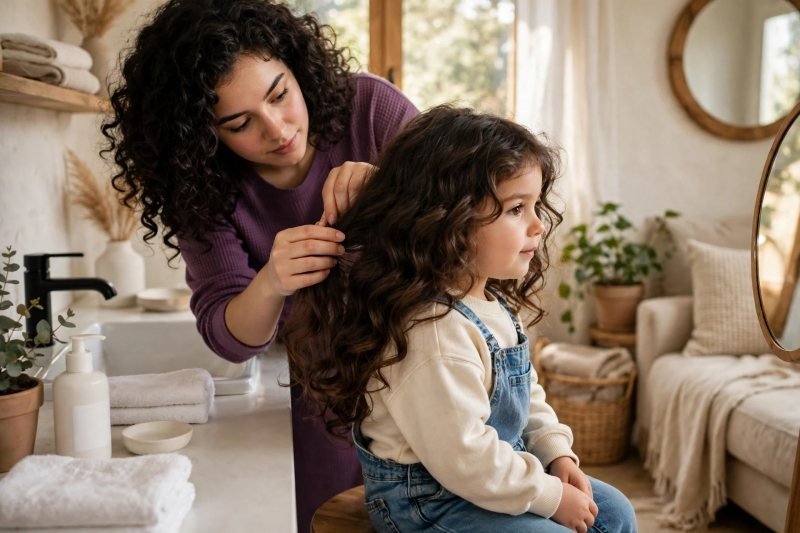
Condition well and finger-detangle first. This is the step that makes or breaks thick hair. Work conditioner from your plain, unlabeled container through the hair generously, coating every layer — slide your hands down in sections so the middle and underneath get their share, not just the top. Then, before any comb touches her head, use your fingers as the first detangling tool: gently separate the hair, find the knots with your fingertips, and tease them apart strand by strand while the conditioner gives the hair slip. Fingers can feel a tangle and stop; a comb cannot. Work through obvious knots and shed hairs now, let the conditioner sit for a few minutes while she plays, and keep the hair dripping wet and slippery throughout. Say, "First my fingers find the tangles softly, then the comb just tidies up." Skipping this step is why detangling hurts — with it, the combing step becomes surprisingly quick.
-
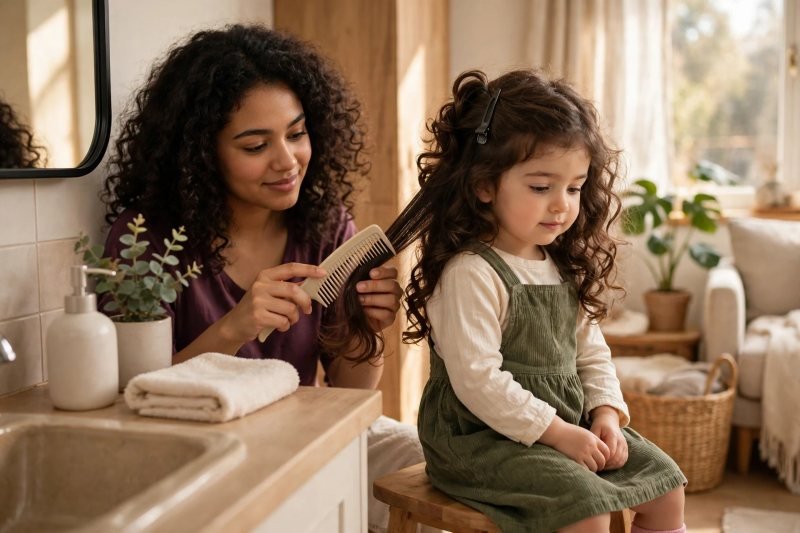
Comb in sections from the ends. Divide the conditioned hair into 4–6 sections and clip each one up with your section clips, then work on one loose section at a time. With your wide-tooth comb, start at the very ends of that section — the last inch or two — and comb those smooth first. Then move up a little and comb from mid-length down, and only when that glides through do you comb from the root to the ends in one smooth pass. Never start at the top and rip downward: that drags every small tangle into one big knot at the ends and breaks hair. If you hit resistance, stop, add a spritz of water or a little more conditioner, and use your fingers first. Let her help by holding the next clip or passing you a soft band — handling clips and bands is real fine motor activities practice, and a helper complains far less than a bystander. Say, "Ends first, then the middle, then the top — little bites, no pulling." Clip each finished section back up so it cannot tangle with the next one.
-
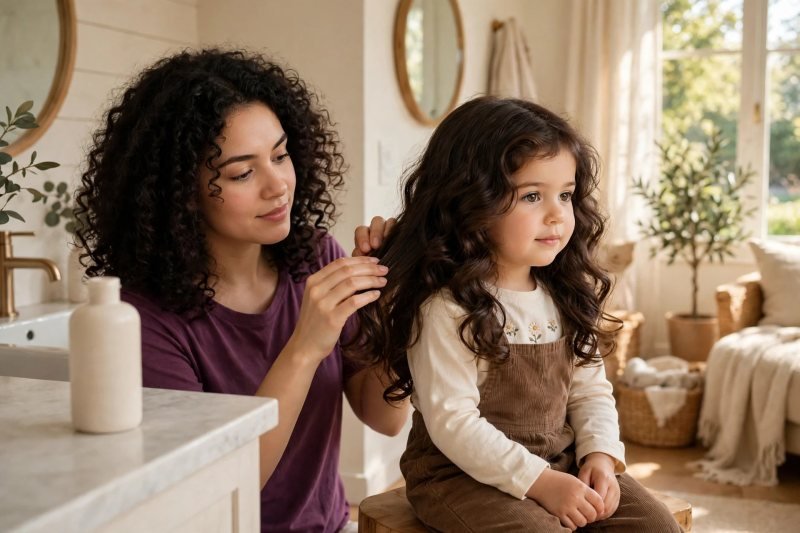
Add moisture and seal the ends. While each section is still damp and freshly detangled, smooth a small amount of leave-in conditioner from your plain, unlabeled container through it with your palms and fingers, coating the lengths evenly. Then take just a few drops of plain oil from its unlabeled container, rub them between your palms, and press them onto the very ends of the hair only — the ends are the oldest, driest part and sealing them helps the whole style last. Dose by texture: thick straight hair usually needs less than you think, or it can look weighed down by afternoon; thick wavy hair takes a moderate amount; thick curly or coily hair usually needs more leave-in through the lengths and benefits from the ends being sealed well. If a section starts to dry while you work, re-wet it with the spray bottle — moisture only soaks in properly on damp hair. Say, "A little drink for your hair, and a tiny bit extra just on the ends." Work section by section until every clip comes out and the hair feels soft all the way through.
-
Dry the gentle way. Put the rough towel-rubbing habit away for good — scrubbing thick hair with a regular towel roughs up the surface, creates frizz, and rebuilds the tangles you just removed. Instead, gather the hair into a soft cotton T-shirt or a microfiber towel and squeeze gently, section by section, pressing the water out without twisting or rubbing. Then let the hair air dry most of the way: loose, down, and left alone while she plays. Hands off during drying matters — the more damp thick hair is touched, scrunched, and flipped, the more it tangles and puffs. Do not use heat styling tools on toddlers: no flat irons, no curling tools, and if you ever use a hair dryer at all, it should be on its coolest, gentlest setting, held well away, and only with an adult in full control — air drying is the default and the safest choice at this age. Say, "We squeeze, we don't rub — then your hair dries all by itself." Once dry, the hair should feel soft and move freely when she shakes her head.

-
Style for the whole week. Choose styles that protect the hair, feel comfortable, and survive naps, hats, and playground time without daily re-doing. Three reliable options cover most weeks: (1) two puffs — part the hair down the middle, gather each side softly, and secure with snag-free bands, not too tight; (2) a loose braid — one or two soft braids that keep lengths together and dramatically cut daily tangles; (3) half-up — the top section gathered softly with a snag-free band, the rest left loose, which keeps hair out of her face while showing off the volume. Check every style with the comfort test: she should be able to shake her head, lie down, and smile without pulling at any spot, and you should be able to slide a fingertip under every band. Styles should never be tight — if the skin looks pulled or she says it hurts, loosen it immediately and redo it softer. Refresh the edges with a spritz of water and your fingertips rather than re-brushing. Say, "Pick your style — puffs, braid, or half-up — and we make it soft and comfy." A style she chose is a style she will leave alone.

-
Prevent tomorrow's tangles tonight. Five minutes in the evening saves twenty minutes in the morning. Before bed, gently gather the hair into one loose braid — loose is the key word, secured with a soft band — or, if she will not keep a braid, let her sleep on a satin pillowcase, or wear a soft satin bonnet if she tolerates it. Satin's smooth surface lets thick hair glide instead of gripping and knotting the way cotton does, so she wakes up with the style mostly intact. In the morning, your refresh is just this: spray the hair lightly with water from your spray bottle, smooth and separate gently with your fingertips — not a dry brush or comb, which creates frizz and breakage in thick hair — re-twist or re-braid any section that needs it, and you are done in about three minutes. Say, "Night braid on, and the morning is easy." If a morning is truly tangled, treat it like a mini wash-day detangle: dampen, add a little leave-in, fingers first, comb from the ends — never dry-force it.

-
Trim, ask for help, and watch the scalp. Blunt, even ends detangle noticeably easier than wispy, split ones, so regular small trims are part of managing thick hair, not just appearance. A kid-friendly stylist who is patient with toddlers is worth finding — or a careful trim at home, by an adult only, with her seated, calm, and watching a show — and our guide to the toddler first haircut walks through making early haircuts calm and positive. Between trims, watch the scalp as part of your routine: a healthy toddler scalp looks calm and comfortable. See a pediatrician or a pediatric dermatologist promptly if you notice any red flags: persistent flaking that does not settle with gentle washing, redness, sores or crusty patches, noticeable hair loss or bald spots, or a very itchy scalp that keeps her scratching and uncomfortable. This guide offers general care information only — it does not diagnose any condition, and a clinician who can actually see her scalp is the right next step for anything persistent or worrying. And the rule that outranks every other rule in this guide: pain means stop, always — stop detangling, stop styling, reassure her, and come back to it later with wetter, better-conditioned hair. Say, "If it hurts, we stop. Your job is to tell me, my job is to listen."


Make it easier
Detangle only on wash day, while the hair is wet and full of conditioner — the rest of the week is spray-and-fingertips refresh only, never dry combing battles. Two puffs are the beginner style: one part, two soft bands, done in five minutes, and they hold through naps better than any loose style. Keep a mini kit by the sofa — spray bottle, one clip, one soft band — so the 3-minute morning refresh happens where mornings actually happen. Protective styles that last: loose braids and puffs keep thick hair tidy for days — see protective hairstyles for toddlers for more ideas that survive naps and playground time. Wash-day rhythm: one thorough wash a week is enough for most thick toddler hair — see how often to wash toddler hair for the full rhythm and when to wash sooner.
Make it harder
Two loose braids instead of one: a center part and a braid each side teaches her the pattern of parting and sectioning, and the style lasts two to three days. Let her do the helper jobs with real responsibility: counting and passing clips in order, holding the mirror, choosing the style from two photos — ownership is the advanced curriculum. Practice a simple flat twist or a three-braid crown on a calm weekend wash day, when there is time to undo and redo without a school-run clock.
Other ways to play it
- Thick straight hair: use less conditioner and leave-in than you think — straight thick hair shows product quickly and can look flat or stringy by afternoon. Detangle in 4 sections, seal the ends with the smallest amount of oil, and favor braids and half-up styles that create shape while keeping the lengths together.
- Thick wavy hair: the middle path — moderate conditioner, detangle in 4–6 sections while soaking wet, and scrunch gently with the cotton T-shirt as it dries to encourage the wave pattern. Puffs and loose braids both hold well; refresh waves with spray and fingertips, never a brush.
- Thick curly or coily hair: the most moisture and the most patience — generous conditioner, 6 smaller sections, fingers first for longer, and more leave-in through the lengths with the ends sealed well. Never detangle it dry. Protective loose braids and puffs worn for several days, plus the satin pillowcase or bonnet, make the biggest difference here. For more on curls, see our curly hair care for toddlers guide.
How it changes by age
- Age 3: Threes are learning to tolerate the routine, so keep wash-day sessions short, predictable, and heavy on her jobs: holding clips, choosing between two styles, watching herself in the mirror. Expect to do all the detangling yourself, with her stop signal honored instantly every time — that trust is what buys you longer, calmer sessions later. Styles stay simplest at three: two puffs or one loose braid, refreshed daily with spray and fingertips.
- Age 4: Fours can take a bigger role: she can hold sections, spray her own hair (with supervision), attempt the first passes with the wide-tooth comb on an easy, well-conditioned section while your hand guides, and manage her own night braid reminder. Sessions can run a little longer and styles a little fancier — two braids, a twist, a braid crown for an occasion — as long as the comfort rules and the pain-means-stop rule stay absolute.
What they're learning
Patience and body care: a calm, step-by-step grooming routine teaches her that caring for her body takes time, has an order, and is worth doing gently. Fine motor control: passing clips in order, holding soft bands, spraying, and (at four) guided first comb passes build hand strength and coordination. Choice and self-image: picking her style, watching it take shape in the mirror, and hearing her natural volume described positively builds early confidence in how she looks. Cause and effect: night braid in, easy morning out — she can see and feel how an evening action changes the next day, which is early planning in its most tangible form.
Clearing up
Rinse the comb and clips under warm water and let them air dry on the towel, empty and refill the spray bottle with fresh water for the morning, and fold the cotton T-shirt or microfiber towel into the kit so everything lives in one place for next time. The satin pillowcase goes back on the pillow, soft bands go into a small pot she can reach, and wash day is fully reset in about two minutes — a kit that is always ready is what makes the routine feel easy instead of like an event you have to gear up for.
Questions parents ask
How do you detangle thick toddler hair without it hurting?
How often should you wash thick toddler hair?
What is the best way to dry thick toddler hair?
How do you stop thick toddler hair tangling overnight?
When should a toddler with scalp problems see a doctor?
Internal link targets for publisher: kids-skincare-routine-simple-steps (step 3, gentle wash); fine-motor-activities-for-preschoolers (step 5, child helping with clips/bands); toddler-first-haircut-guide (step 10, trim); curly-hair-care-for-toddlers (Variations, thick curly hair); protective-hairstyles-for-toddlers (Make it easier, protective styles); how-often-wash-toddler-hair (Make it easier, wash-day rhythm). Full URLs: https://brightplaydays.com/activities/kids-skincare-routine-simple-steps/ ; https://brightplaydays.com/activities/fine-motor-activities-for-preschoolers/ ; https://brightplaydays.com/activities/toddler-first-haircut-guide/ ; https://brightplaydays.com/activities/curly-hair-care-for-toddlers/ ; https://brightplaydays.com/activities/protective-hairstyles-for-toddlers/ ; https://brightplaydays.com/activities/how-often-wash-toddler-hair/ . Care discipline: general guidance only — no diagnosis, no cure promises, no invented statistics. Zero brands, zero prices; all containers described as plain and unlabeled throughout. US spelling throughout.

save it for later
Pin this for the next rainy afternoon
Keep it on a board so it is there when you need it, rather than when you happened to find it.
Save to Pinterest


