


Pattern Worksheets for Kindergarten: Complete, Copy and Create
A complete guide to pattern worksheets for kindergarten: the three worksheet types that actually teach patterning (copy, complete, create), how to use each one at home, a 10-minute daily routine, and what to do when your child gets stuck — ages 5–6.
Pattern worksheets for kindergarten work best as a three-step routine: copy-the-pattern pages first, where your child reproduces a finished row; complete-the-pattern pages next, where they fill in the missing pieces; and create-your-own pages last, where they invent their own pattern. Do one or two pages a day, read every finished row aloud together, and color-code the parts — color all the As one color and all the Bs another — so the rule becomes visible.

The short version
- The three worksheet types teach three skills: copying builds careful observation, completing builds rule-finding, creating builds real understanding.
- Start with copy-the-pattern pages — the easiest kind, and the warm-up for the harder fill-in pages.
- Read every finished row aloud together, pointing at each piece; hearing the rhythm is how rules click.
- One or two pages a day for 10–15 minutes beats a big weekend packet.
- Stuck? Cover the right half of a row, read the left half aloud, and the missing piece reveals itself.
- Age
- Ages 5–6
- Prep
- 5 min
- Play time
- 15 min
- Mess
- None
- Difficulty
- Easy
- Where
- Indoor
Why kids love this
Because it's a puzzle with a beat, and because copy pages hand them a win in the first three minutes. The color-coding trick turns a finished page into something that looks like art, and create-your-own pages are the real hook — their pattern, their rule, their name at the top. Keep the portfolio folder where they can reach it; kindergartners pull out old pages to show grandparents, and nothing sells practice like an audience.
What kinds of pattern worksheets help kindergartners most? — Three kinds, and each teaches something different. Copy-the-pattern pages show a finished row with empty boxes underneath; your child reproduces it piece by piece, training the careful looking later math needs. Complete-the-pattern pages show a row with the last pieces missing; your child finds the rule first, then fills the blanks. Create-your-own pages give blank rows and one instruction: invent a pattern. That's the mastery check — a child who builds their own correct pattern and reads it back owns the concept. This guide uses all three, in that order.
Which worksheet type should my kindergartner start with? — Start with copy. Copying is the warm-up lap: no rule-hunting, no pressure, just look and match. A child new to worksheets can succeed at a copy page in minutes, and that early win teaches them worksheets are a game, not a test. Have them point at the model's first piece, say its name, then draw it in the box below — one piece at a time, left to right. If a piece lands wrong, read both rows back and let them hear the mismatch. Once copying feels easy, move to complete-the-pattern — starting with fill-in pages is what makes kids guess instead of read.
How do I use complete-the-pattern worksheets? — Sit with them for the first row and make your thinking audible. Point at each shape and read aloud: "Circle, square, circle, square…" Then stop at the empty box and ask, "What's the rule?" If they hesitate, cover the blank half and read just the finished part — the missing piece often pops out. For the first few weeks, color the finished row together afterward: all the circles one color, all the squares another. Try not to rush a fill-in page in silence — the reading-aloud step is the whole lesson.
How many worksheets should a kindergartner do in one sitting? — One or two pages, ten to fifteen minutes, and done. Pattern work is brain work, and a tired five-year-old's accuracy often falls off around the fifteen-minute mark — the errors stop being about patterns and start being about stamina. A short daily session beats a thick weekend packet; the spacing moves the skill into long-term memory. Build it into an existing routine: breakfast, one worksheet, then the day starts. End on a win — if a page went badly, finish with a quick copy page.
What do I do when my child gets stuck on a worksheet? — Don't reach for the answer — reach for the row. First, read it aloud together with your finger under each piece; many stuck moments dissolve the instant the rhythm is heard. Second, cover the blank half: "Just listen to this part — what's the beat?" Third, do the first blank yourself, thinking aloud, then hand the pencil back. If none of that works, the page is too hard — swap it for a copy page with zero comment. A child who leaves a hard page and returns two days later usually sails through.
Which pattern types will my kindergartner meet on these pages? — Five, in this order: AB (circle, square, circle, square), AAB (circle, circle, square), ABB (circle, square, square), AABB (circle, circle, square, square), and ABC (circle, square, triangle). AB first because the rule has one move — switch. AAB and ABB stretch the rule just a little. AABB bridges into three-part thinking, and ABC is the graduation exam: three pieces cycling in order. Each type appears in all three worksheet styles before the next is introduced. If ABC still wobbles, that's normal — it's the hardest pattern in the kindergarten range.
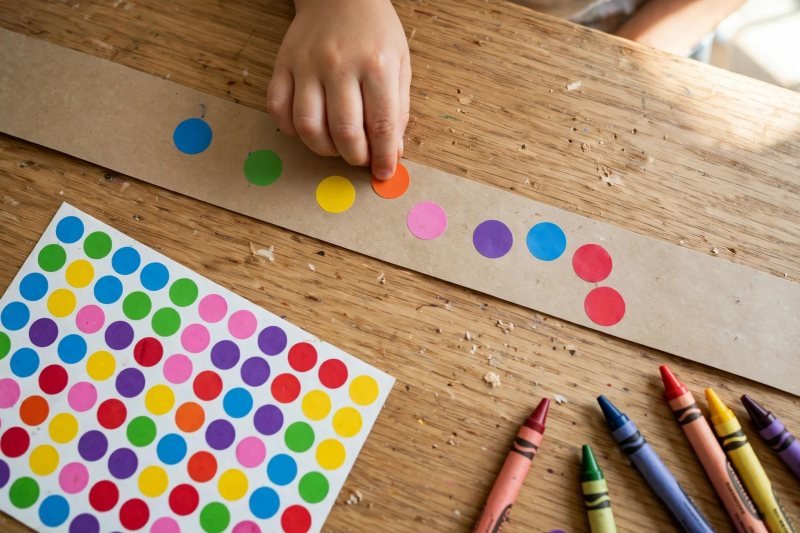
How can I make worksheets more hands-on? — Crayons are the baseline, but variety keeps a kindergartner coming back to the table. Swap the crayon for dot stickers on one page — peeling and placing them builds fine motor control while the rule gets practiced. Cut-and-glue pages work beautifully for complete-the-pattern rows: cut the missing pieces from a strip and glue them in, turning "fill in the blank" into a small craft. For create pages, try stamping — a bottle cap in washable paint makes chunky pattern pieces. The rule stays the same; only the medium changes.
What you'll need
- - The 9-page printable pack (PDF, publish-time item — attached via the CMS Downloads repeater at publish)
- - Printed pages, one or two per session, single-sided
- - Crayons or colored pencils (thick, easy-grip ones for younger fives)
- - Dot stickers and a glue stick (for the hands-on pages)
- - Child-safe scissors (for cut-and-glue pages)
- - A folder or binder — the "pattern portfolio"
Before you start
Print one or two pages the night before — not the whole pack at once, or the pile itself becomes the pressure. Single-sided printing keeps crayon from ghosting through. Set out crayons, stickers if today's page needs them, and the portfolio folder. Five minutes, once, and tomorrow's session is ready before breakfast.
How to do it
-
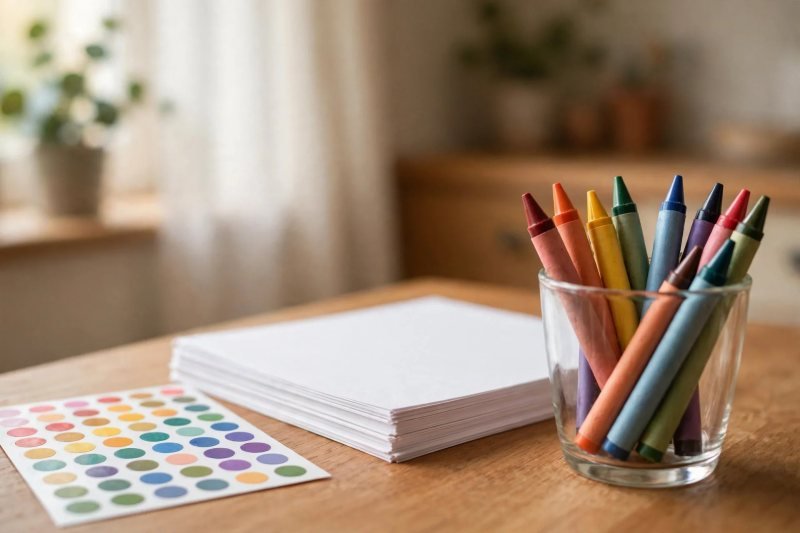
Set up a little worksheet station. Clear one end of the table and lay out today's page (just one), crayons, and the portfolio folder. Keep the printed stack out of sight — one page at a time keeps the task feeling small. Sit side by side with your child, not across from them.
-
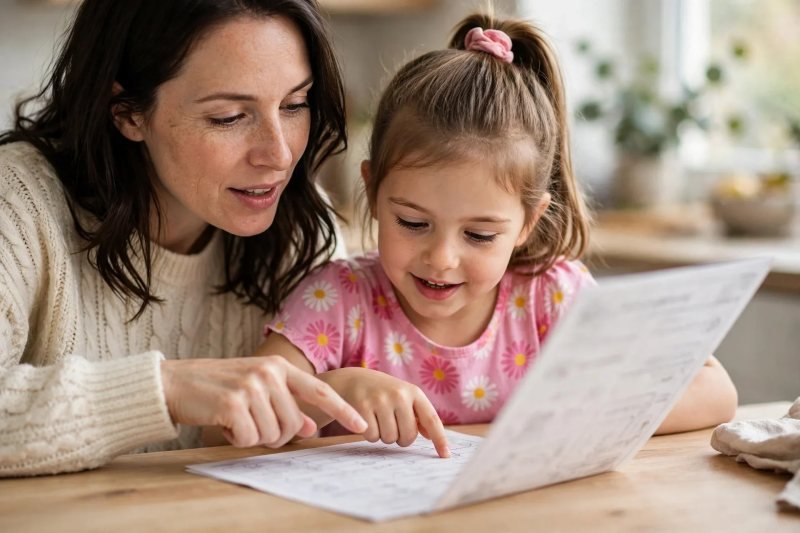
Warm up by reading a row together. Before anyone picks up a crayon, run your finger under a finished row and read it aloud: "Star, heart, star, heart." Have your child read it back, pointing at each piece — a two-minute warm-up that switches the brain into pattern mode.
-
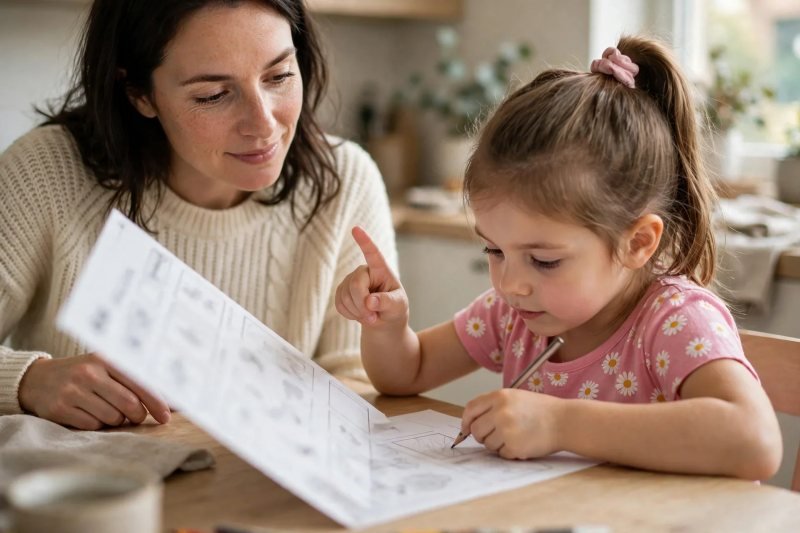
Do a copy-the-pattern page first. Start with page type one: a finished row on top, empty boxes below. Your child points at the model's first piece, says its name, then draws it underneath — one piece at a time, left to right.
-
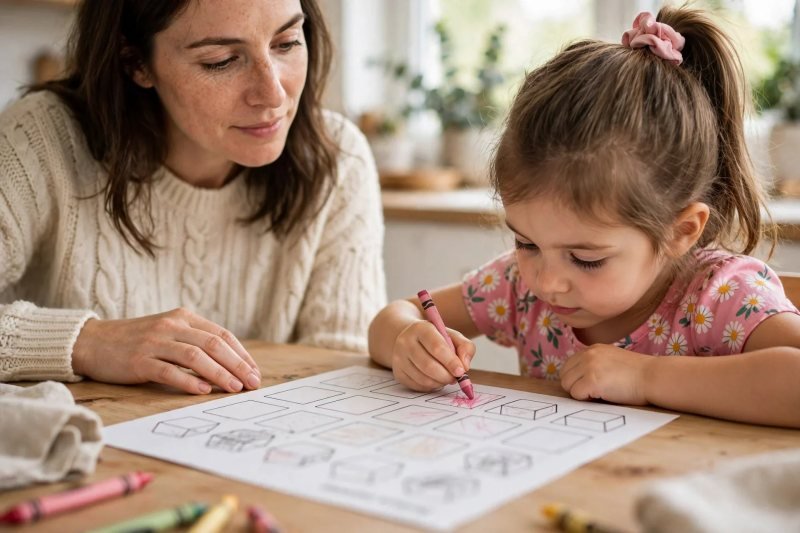
Move to a complete-the-pattern page. Read the started row aloud together, name the rule ("What's repeating?"), and let your child fill the empty boxes. If they stall, cover the blanks and read just the finished part — the missing piece usually announces itself.
-
Read every finished row back together. Every completed page gets read aloud, finger under each piece, both of you chanting. Then check it against the rule: "Does it go back and forth like we said?" Kids who read their work catch their own mistakes — and catching your own mistake beats never making one.

-
Try a create-your-own page. Hand over a blank-row page: "Invent a pattern. Any rule you want." When they're done, they must read it back to you, pointing at each piece. If the row wobbles, read it together and ask whether it matches the rule they picked. Creations are keepers: straight into the portfolio.
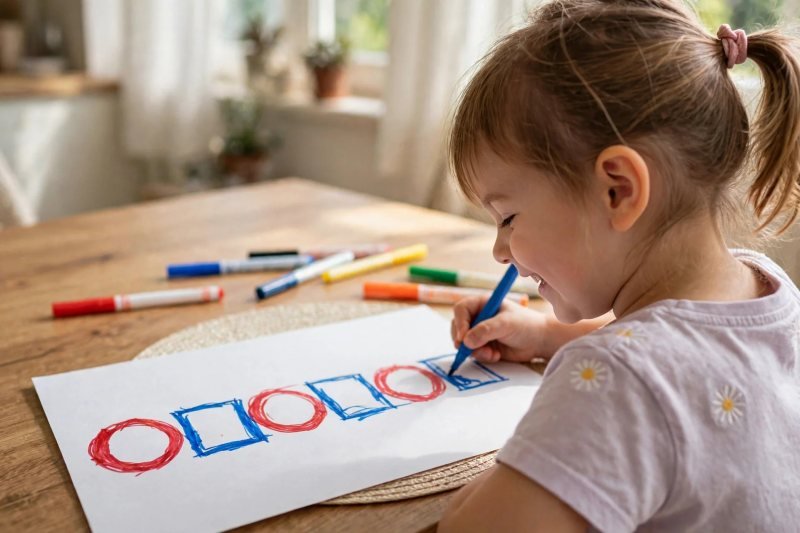
-
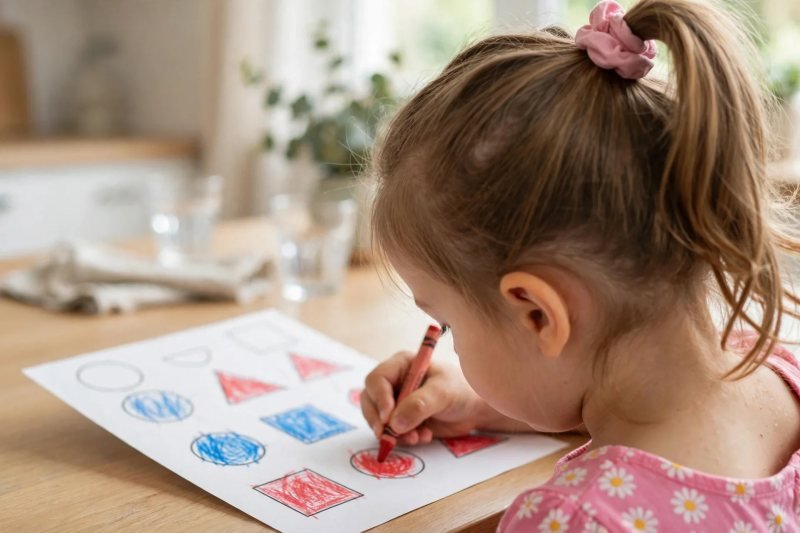
Color-code the parts. Go back over a finished page and color all the A pieces one color and all the B pieces another — every circle red, every square blue. The repetition becomes a visible picture, and the abstract "rule" suddenly has a shape. Do this on at least one page a week.
-
Make one page hands-on this week. Swap the crayon for dot stickers, or turn a complete-the-pattern page into cut-and-glue: your child cuts the missing pieces from a strip and glues them into the row. The rule is identical — only the medium changes — but the novelty resets a bored kindergartner's attention.
-
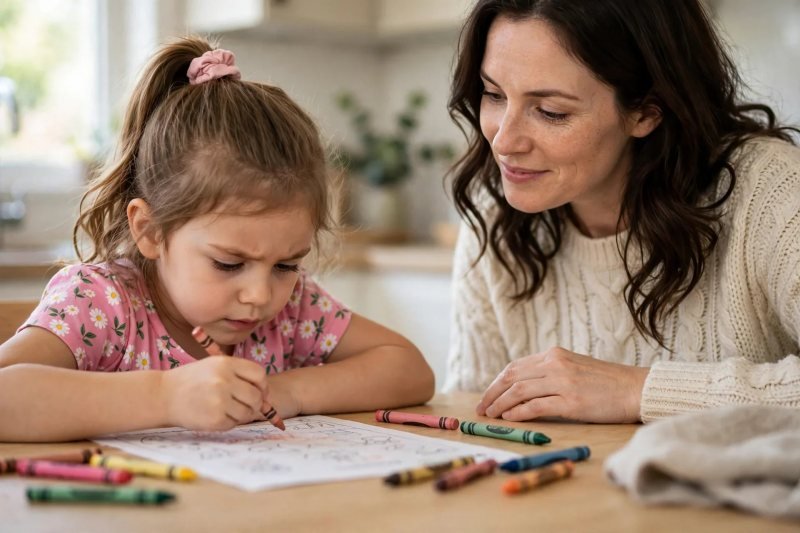
Try the trickiest pattern type. When AB feels automatic, pull out an ABC page (circle, square, triangle) or an AAB page. Read the row together first — three-part rhythms need the chant even more. Don't be surprised if ABC takes weeks.
-
File the page in the pattern portfolio. Slide every finished page into the folder, dated if you like. Once a month, flip through the old pages together — "I used to do those easy ones!" Visible progress is the best motivation there is, and it costs nothing.


Print it out
Make it easier
- Stay on copy pages as long as they need — days or weeks. Copying is real learning.
- Use only AB rows at first: circle, square, circle, square, with big pieces.
- Read the row aloud yourself while your child just points; let them join the chanting when ready.
- Cover the blank half of any fill-in row so there's less to process at once.
Make it harder
- Move from AB to AAB, then ABB, then ABC — one new pattern type at a time.
- Try a growing row on a create page: one dot, two dots, three dots — "What comes next?"
- Build the pattern silently: no reading aloud, just eyes and pencil. Genuinely hard.
- Swap a page with a sibling and check each other's work — teaching the rule is the deepest learning of all.
- Take the rule off the page with pattern games for kindergarten — same skills, no pencil.
- Take it outside: a shape hunt game turns pattern-spotting into a walk.
Other ways to play it
- - Sticker pattern page: use dot stickers instead of crayons for a whole page — peeling is fine-motor gold.
- - Cut-and-glue page: cut missing pieces from a strip and glue them into a complete-the-pattern row.
- - Partner pages: you fill in every other blank, your child fills the rest — great for wobbly days.
- - Sidewalk pattern: take a create-your-own page outside and draw the row huge with sidewalk chalk.
- - Pattern mail: your child invents a pattern page for grandma and reads it to her over video call.
- - For the shape side of patterning, shapes worksheets for kindergarten pair well with these pages.
How it changes by age
- Ages 5–6. Younger fives should live in the copy pages with AB rows and big pieces, reading aloud every time; older sixes usually move through complete pages faster and can reach ABC and the create pages within a few weeks. The 5-year-old who needs a month of copy pages is not behind — careful matching is the foundation everything else sits on. Follow their accuracy: if fill-in pages come back with guesses instead of read rows, drop back to copy with zero fuss. Digit wobble? Number recognition games build the symbol fluency these pages assume.
What they're learning
- Pattern recognition: identifying a repeating rule — the foundation of sequencing, skip counting, and multiplication later. - Rule-finding: analyzing a partial row to predict what comes next — genuine problem-solving, not just recall. - Careful observation: matching pieces exactly on copy pages — the attention later math requires. - Math vocabulary: pattern, repeat, rule, next, sequence — naming the ideas while using them, which deepens the AB patterns for preschoolers work many kids did at 3–4. - Fine motor skills come free with every page — coloring, cutting, sticking, gluing — and pencil control is its own kindergarten goal. - The daily 10-minute routine builds work habits too: sit down, focus, finish, file — a school skill hiding inside a math one.
Clearing up
Ninety seconds: crayons back in the cup, sticker sheets and scissors in the drawer, scraps in the recycling. Let your child slide the finished page into the portfolio folder — "filing" is part of the routine, and doing it themselves closes the session with a sense of done.
Questions parents ask
Are worksheets good for teaching patterns to kindergartners?
What pattern skills do kindergartners practice over the year?
My child just guesses on complete-the-pattern pages instead of reading the row. What helps?
Should I use crayons, stickers, or cut-and-glue on pattern worksheets?
How long should a pattern worksheet session last for a kindergartner?
And the golden rule of worksheet season: the day your child asks "Can I do another one?" — say yes, hand them a copy page, and let the good streak roll. Worksheet fans who want movement breaks should try counting games for preschoolers. For the counting side of patterning, see counting worksheets for kindergarten.

save it for later
Pin this for the next rainy afternoon
Keep it on a board so it is there when you need it, rather than when you happened to find it.
Save to Pinterest


