


Protect Kids' Hair From Chlorine: The Swimmer's Hair Routine
Chlorine hair in kids is preventable: soak hair with clean water before swimming, smooth in leave-in conditioner, braid or cap it, then rinse, wash gently, and detangle after — a simple routine that keeps swimmer's hair soft all summer.
To protect kids' hair from chlorine, soak it with clean water before swimming so it can't absorb as much pool water, smooth in leave-in conditioner, braid it or add a cap, then rinse right after swimming, wash gently, and detangle with conditioner and a wide-tooth comb.

The short version
- The pre-swim soak is the star: hair filled with clean water drinks far less pool water.
- Leave-in conditioner is the barrier; a braid or bun stops the tangles; a cap is a bonus, not a must.
- Rinse the moment they're out — that rinse alone removes most of the pool water.
- Wash gently with everyday shampoo; a clarifying wash is an occasional reset, never a daily habit.
- Detangle only when wet and conditioned, from the ends up, with a wide-tooth comb.
- Age
- Ages 4–5
- Prep
- 5 min
- Play time
- 15 min
- Mess
- Some
- Difficulty
- Easy
- Where
- Both
Why kids love this
Kids don't love hair routines; they love swimming. This one is built to disappear: the soak is a game of "hair drinks first," the braid is a mermaid braid, the cap is swim gear like the big kids wear, and the after-swim detangle happens with a towel cape and a story. Nothing in the routine hurts, pulls, or takes more than a few minutes — so the pool stays the fun part.
What you'll need
- A handheld shower head, jug, or pool-side shower for the pre-swim soak and after-swim rinse
- A leave-in conditioner your child tolerates (any plain bottle — you'll smooth it through the lengths)
- A gentle everyday shampoo for after swimming, and a gentle clarifying shampoo for occasional use only
- A regular rinse-out conditioner for the after-swim detangle
- A wide-tooth comb (never a fine brush on wet hair)
- Soft hair ties that don't snag, plus a swim cap if your swimmer will wear one
- A towel for the pool deck and one for the bathroom
- A small kit bag that lives by the pool bag, so the routine travels
Before you start
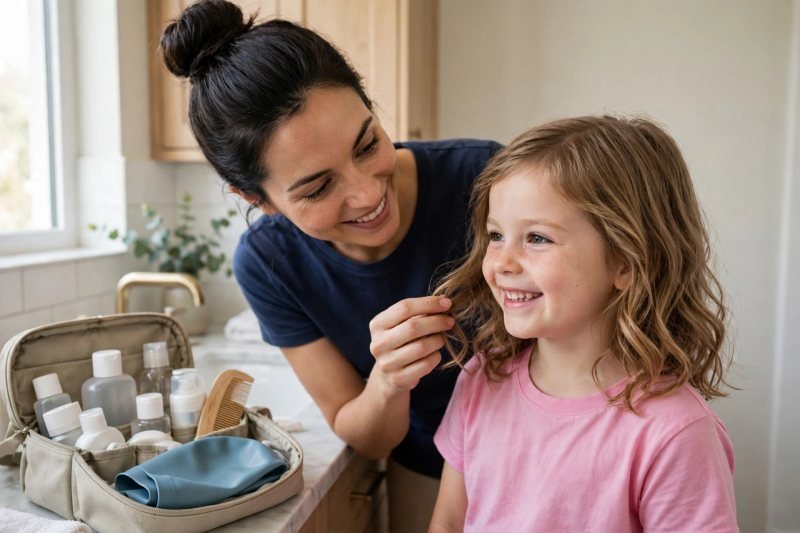
Build the kit once: leave-in conditioner, wide-tooth comb, soft ties, and cap in a small bag that stays with the towels. Do a first practice run at home bath time — soak, smooth, braid — so pool day is a rerun, not a premiere. Patch-test any new hair product on a small area of skin a day ahead, following its label directions, and stop using anything that seems to irritate your child's skin or scalp. Agree the order with other caregivers: soak, smooth, braid or cap before the water; rinse, wash, detangle after. Same order, every swim.
How to do it
-
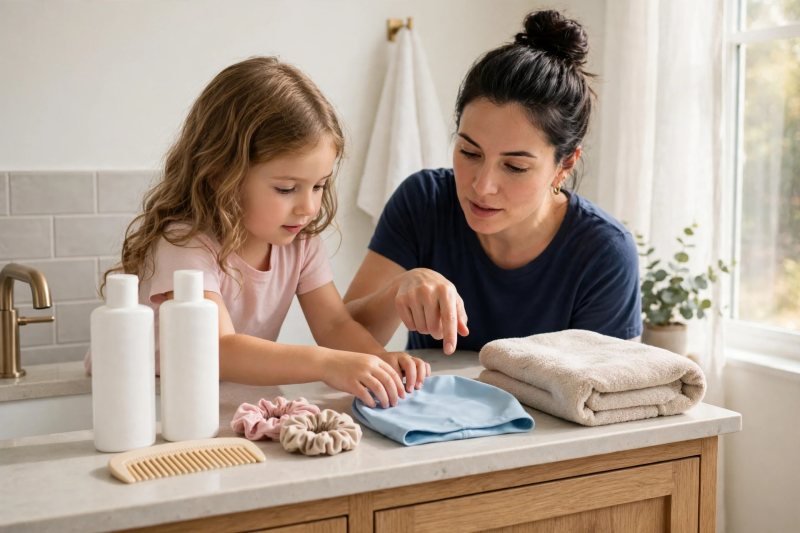
Gather the swim-hair kit and name the enemy honestly. Start by laying the kit out where your child can see it — leave-in conditioner, wide-tooth comb, soft ties, cap, towel — and say what you're actually fighting: "Pool water keeps the pool clean, but it's rough on hair. It washes away the natural oils that keep hair soft, so hair can come out dry and straw-like." That's the whole story for kids' hair and chlorine: the damage is dryness and tangles, and it's preventable with a barrier and a rinse. One honest note for blond swimmers: the green tinge light hair sometimes picks up over a summer is linked to metals like copper in pool water, not the chlorine itself — the same routine below helps either way, because it all comes down to how much pool water the hair drinks. Kit ready: the hair drinks first, before it ever meets the pool.
-
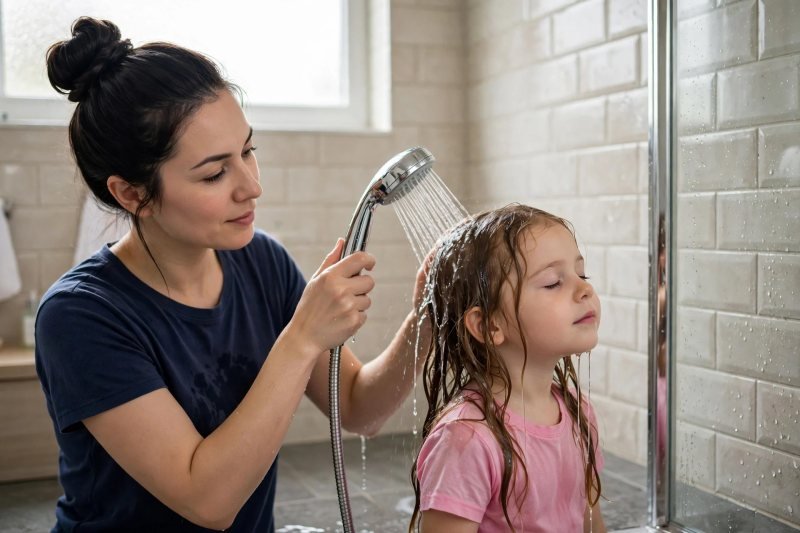
Soak the hair with clean water before a single toe gets wet. This is the step that does most of the work, and it takes ninety seconds: at the pool-side shower, under the garden hose, or in the bathroom before you leave, wet your child's hair completely with clean water until it's dripping. Hair behaves like a sponge — hair that is already full of clean water has far less room to soak up pool water. Say the line that makes it a game: "Hair drinks first! Fill it up with the good water so there's no room for the pool water." Do it even for a quick dip; a half-done soak on a short swim beats a skipped soak every time. If your routine includes sunscreen, skin and hair both get done in the same pre-swim stop — the same door-station logic as a simple kids' skincare routine keeps the whole family system in one place, and how to get your toddler to wear sunscreen has the no-battle approach for getting it on before the pool. Hair soaked and dripping: lock the water in.
-
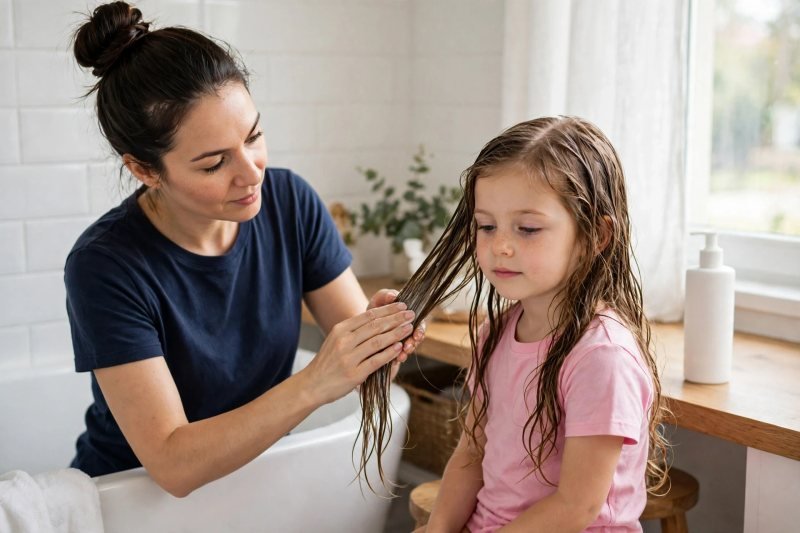
Smooth leave-in conditioner through the lengths as a barrier. With the hair soaking wet, warm a small amount of leave-in conditioner between your palms and smooth it down the lengths and ends — the oldest, driest part of the hair — keeping it off the scalp itself. Think of it as a raincoat over a full sponge: the hair is saturated with clean water, and the conditioner helps that water stay put while adding slip that prevents tangles later. Your child can hold the bottle (what matters is that it is a conditioner your child's skin tolerates, not the brand on it). Work it through with fingers, not a brush. Barrier on: now give the hair a shape the water can't wreck.
-
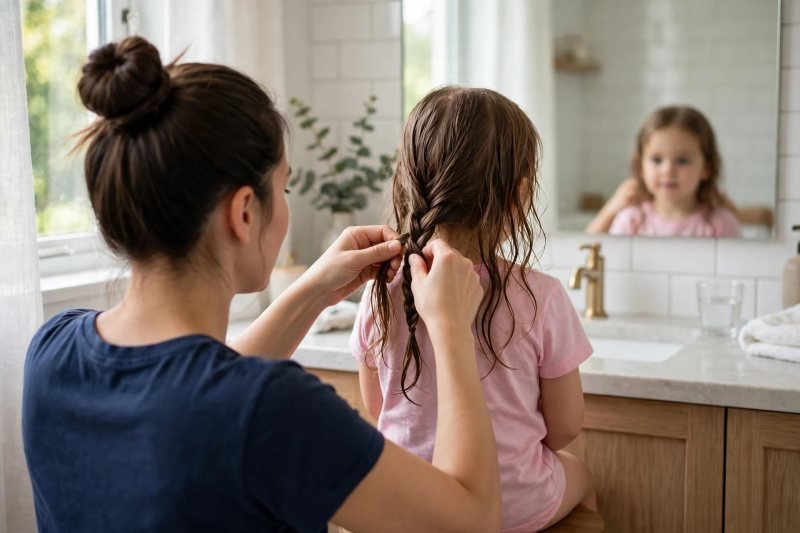
Braid or bun the hair so the water can't tangle it. Loose hair in a pool is a tangle factory — it swirls, knots, and rubs against itself for an hour. A single braid down the back (the "mermaid braid" in our house) or a simple bun keeps the lengths together, cuts the exposed surface, and makes the after-swim detangle a two-minute job instead of a twenty-minute ordeal. Use soft ties that slide out without snagging, and let your swimmer choose: braid, bun, or two braids are all correct answers — the only wrong answer is loose. Say, as you finish: "Mermaid braid, locked and loaded." For short hair, this step shrinks to a good smooth-back with the leave-in — the soak and barrier still do the heavy lifting. Hair contained: decide on the cap.
-
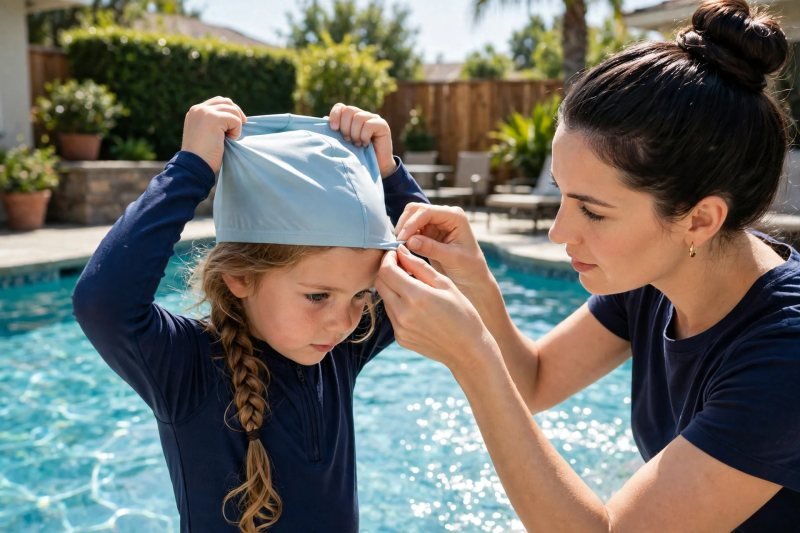
Cap it for long swims — gently, and only if they'll wear it. For swims longer than a splash, a swim cap adds a real second barrier: it keeps most pool water off the hair entirely and holds the braid in place. Put it on without the fight: gather the braid into a low coil, stretch the cap over the forehead first, then roll it back over the hair, and let your child do the final pull-down themselves — ownership ends most cap battles. Be honest about the limits, though: caps are not watertight, hair at the edges still gets wet, and a child who truly hates the cap is better off with steps 2–4 done well than with a cap that ruins swimming. The cap is the bonus round, not the main event. Cap on (or happily skipped): into the water you go.
-
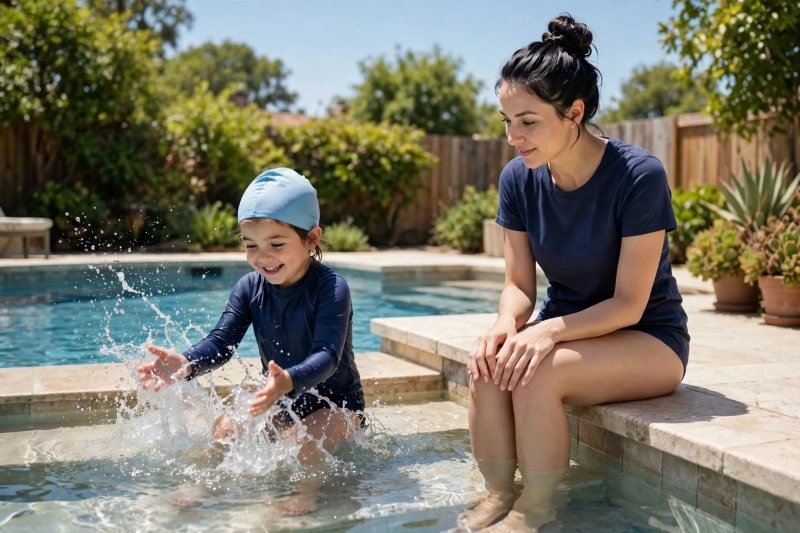
Swim, play, and rewet at every break. During the swim itself the routine goes invisible — your only jobs are the ones that matter at any pool: an adult watching the water constantly, and one small habit at snack or sunscreen breaks, a quick rewet of the hairline and braid with clean water from a jug or shower if the hair has dried out between dips. Dried-out hair at the break is a sponge emptying itself, ready to drink pool water again on the next dive; a thirty-second rewet tops it back up with the good stuff. Keep it breezy — this is a sip of water and a splash, not a ceremony. When the swimming is done, move straight to the rinse while the hair is still wet: wet hair is halfway to clean already, and the next step is where the pool actually leaves the hair.
-
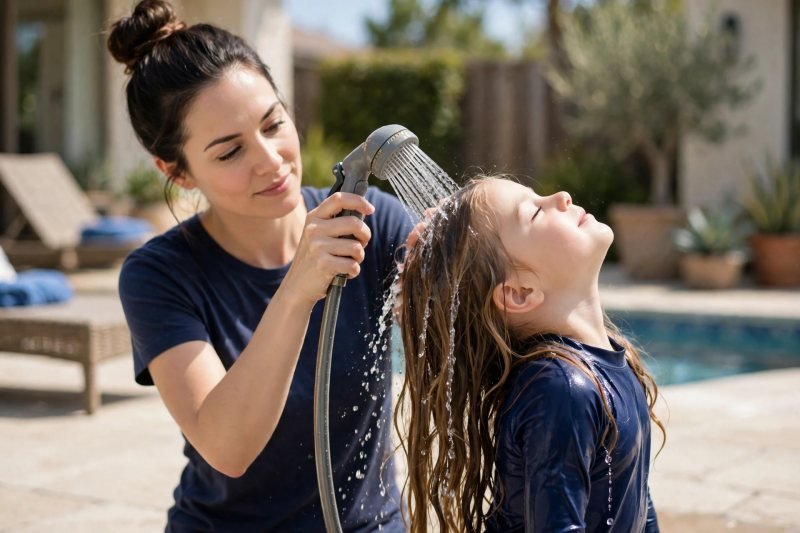
Rinse with clean water the moment they're out. Before the towel, before the snack, before the car: rinse the hair thoroughly with clean water — pool-side shower, hose, or straight into the home shower — working your fingers through the lengths while the water runs. This single rinse removes most of the pool water sitting on and in the hair, and it costs two minutes. Take the braid out first so the rinse reaches everything, and squeeze the lengths gently rather than scrubbing — wet hair is fragile hair, and rough handling now is breakage later. If a full wash has to wait (a beach shower with no shampoo, a long drive home), this rinse is the routine's insurance policy: it holds the line until the real wash. Hair rinsed and dripping clean: now wash, gently.
-
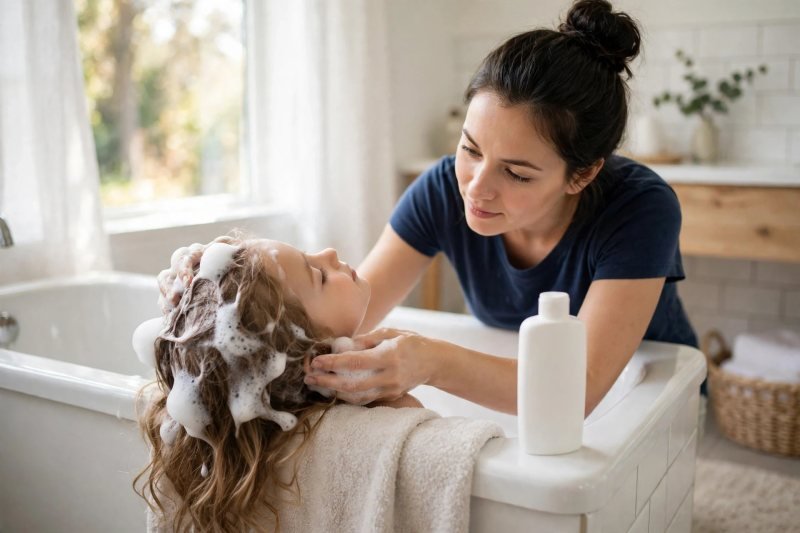
Wash gently — and save the deep clean for when it's needed. In the shower or bath, shampoo once with a gentle everyday shampoo, massaging the scalp with fingertips (never nails) and letting the suds rinse down the lengths rather than scrubbing the ends, which are the oldest and driest part. Most swims need nothing stronger. If, over a heavy swim week, the hair starts feeling coated or straw-like even after washing, that's the occasion for a single wash with a gentle clarifying shampoo — occasional, not daily; clarifying every day would strip the hair you're trying to protect, so think of it as an occasional reset, not the routine. If you are unsure how often to wash at all, how often to wash toddler hair sets a simple baseline for swim weeks and quiet weeks alike. Rinse until the water runs clean and the hair feels clean-but-soft, not squeaky. Washed: now put back what the pool took out.
-
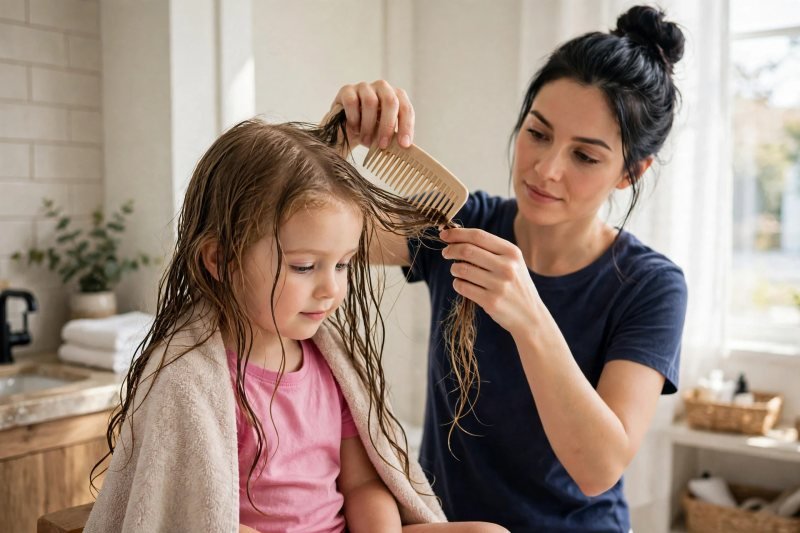
Condition and detangle slowly, from the ends up. Smooth rinse-out conditioner through the lengths, then detangle with a wide-tooth comb while the conditioner is still in — this is the gentlest detangle there is, because the conditioner gives the hair slip and the wide teeth don't tear. Start at the very ends, combing the last inch free first, then work upward in small sections; never drag a comb from root to tip through a knot, and never brush dry swimmer's hair with a fine brush, which snaps the ends you're growing. If curls are in the mix, the best brush for curly toddler hair guide covers which tools glide without snagging. Let your child hold the mirror or tell the story while you work — a detangle with entertainment is a detangle that gets finished. Rinse lightly, leaving the hair feeling silky, not coated. Hair smooth: finish the routine the way you'd finish any good system — with a check.
-
Dry kindly, check the ends, and reset once a week. Pat and squeeze the hair dry with a towel — no rough rubbing — and let it air-dry loose or in a soft braid. Then run the two-second check this whole routine exists for: fingers down the lengths. Hair that feels soft and bends easily is winning; hair that feels straw-like, looks faded at the ends, or tangles faster than it used to is asking for the weekly version of care — a longer conditioner soak at bath time — and, every few months, a small trim of the dry ends, the same tidy-up logic as a toddler's first haircut: a little off the ends keeps the rest healthy. For overnight protection between swim days, a satin pillowcase and bonnet for kids keeps the ends smooth while they sleep. If the scalp itself is ever red, itchy, or sore, that's not a hair-care question — check in with your pediatrician. Routine done: soft swimmer's hair, all summer long.


Make it easier
Short on time? Do steps 2 and 7 only — the pre-swim soak and the after-swim rinse. They carry most of the protection on their own. Cap refuser? Double down on the braid and the rewet-at-breaks habit instead; the routine works without a cap. Bath-time swimmer: run the whole after-swim sequence as the evening bath — wash, condition, detangle — so pool day adds no extra stop.
Make it harder
Teach independence: ages 5+ can learn to do their own soak and their own rinse while you supervise the wash — the routine becomes theirs before swim lessons make it essential. Add a swim-log: a simple calendar tick for every swim and wash teaches older kids how frequency drives the routine (heavy swim weeks get the clarifying reset). Braid school: practice the braid on dry hair at home until your swimmer can do a simple one themselves.
Other ways to play it
- Beach version: salt water is gentler than pool water but sun and wind are not — keep the soak, barrier, and braid, and add a hat at every break.
- Swim-lesson version: for weekly lessons, the full routine every time; the clarifying reset only when the straw feeling actually shows up.
- Curly-hair version: same order, more conditioner at every stage, and detangle only when wet and conditioned — curls snap when dry-combed.
How it changes by age
- Ages 2–3: the adult does everything; keep it to the soak, a smooth of leave-in, a tiny bun if hair allows, and the rinse — two minutes at each end of the swim.
- Ages 4–5: the guide as written — full routine with the child holding bottles, choosing the braid, and pulling the cap down themselves.
- Ages 6–8: hand over the soak and rinse, supervise the wash, and teach the ends-up detangle — swimmers this age can own most of their hair care.
- All ages: if a product stings, itches, or leaves the scalp red, stop using it and check with your pediatrician — no routine outranks comfortable skin.
What they're learning
Cause and effect: hair as a sponge — fill it with clean water and it can't drink pool water — is real, testable science at sink level. Habit building: the same order before and after every swim teaches that routines are how we take care of things we love. Body care independence: holding bottles, choosing braids, and pulling on caps are the first rungs of self-care. Honest observation: checking how hair feels and naming the change (soft, dry, straw-like) is the beginning of all practical problem-solving.
Clearing up
The kit makes its own cleanup easy: bottles and comb go back in the kit bag, ties live on the bag's strap, the cap gets a shake and air-dries on a hook, and towels go straight to the wash or the line. Rinse the comb if it carried conditioner. Two minutes — and the bag is ready by the pool bag for the next swim, which is the entire secret of a routine that survives the summer.
Questions parents ask
How do I protect my child's hair from chlorine?
Why does my child's hair feel like straw after swimming?
Does chlorine turn kids' hair green?
Should kids wear a swim cap in the pool?
How do you get chlorine out of a child's hair after swimming?

save it for later
Pin this for the next rainy afternoon
Keep it on a board so it is there when you need it, rather than when you happened to find it.
Save to Pinterest
