


Preschool Winter Coat Guide: What to Look For
Choosing a preschool winter coat is about fit, not bulk. This guide shows what to look for — mid-thigh length, room for layers, an easy zipper, a safe hood and cuffs, plus the movement checks and car-seat rule that keep preschoolers warm and safe.
The right preschool winter coat reaches mid-thigh, feels light but warm, fits over a base layer and sweater, and zips up with a big pull and chin guard. Check that cuffs cover wrists, the hood stays clear of eyes with no drawstrings, and your child can hug, reach, and bend freely. Never buckle it into a car seat.

The short version
- Length sweet spot: around mid-thigh — covers the bottom when sitting, clears the knees for climbing.
- Always fit the coat over a base layer plus a sweater, never over a thin shirt alone.
- Look for a large zipper pull your child can grip and a chin guard at the top.
- The preschool flip trick makes getting the coat on an independent job.
- Hood must stay up without covering eyes; no drawstrings or dangling cords anywhere.
- Car-seat rule: coat off, harness snug over layers, blanket over the top.
- Age
- Ages 3–4
- Prep
- 10 min
- Mess
- None
- Where
- Indoor
Why kids love this
Preschoolers love a coat they can manage themselves. The flip trick feels like magic, zipping up solo feels grown-up, and the movement test turns fitting into a game. When a preschool winter coat passes these checks at home, getting ready becomes a job your child is proud to own.
What you'll need
- The coat you are checking, in your child's current size range
- A thin base layer, like a long-sleeve top
- A warm middle layer, like a fleece or sweater
- Everyday winter pants, plus mittens or gloves
- A low hook, chair, or bench your child can reach
- Your child's car seat, fitted in the car as usual
- A soft blanket kept in the car for over-the-harness warmth
Before you start
1. Pick a calm moment at home, not the rushed minute before preschool, so your child can try and retry. 2. Lay the coat, base layer, and sweater out in dressing order in the entryway. 3. Check the coat yourself first: run the zipper, find the chin guard, test the snaps, and confirm there are no drawstrings or dangling cords. 4. Save the car-seat check for last, blanket ready.
How to do it
-
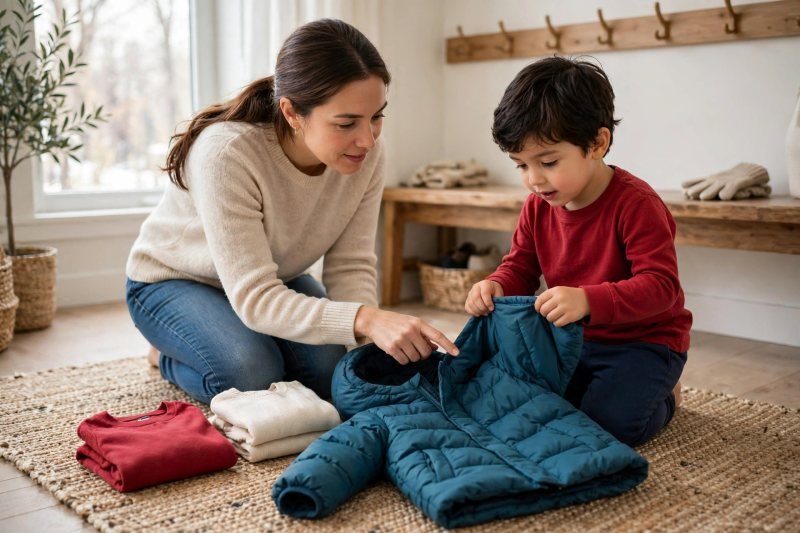
Lay out the coat and layers. Spread the coat flat on the rug with the base layer and sweater beside it, and look at the whole outfit before anyone dresses. Say: "First we check the coat itself — it should reach the middle of your thighs, feel light to carry, and still have room for warm clothes underneath." Let your child lift the coat; a good coat feels light for its warmth, because heavy coats tire small shoulders. Mid-thigh covers the bottom when sitting yet clears the knees for climbing, and a coat that only fits over a thin shirt will fail on cold days. Layers looking right, put them on first.
-
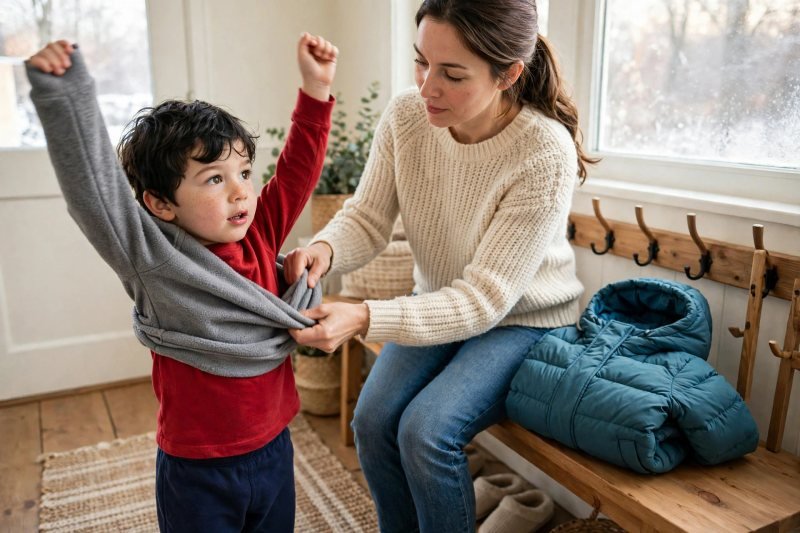
Dress in layers first. Dress in the order winter mornings demand: pants on; a thin base layer tucked in; then a warm sweater or fleece over the top. Say: "Layers go on first, coat goes on last — the coat is the roof, and these are the walls." Let your child pull on each layer independently, smoothing sleeves to the wrists so nothing bunches under the coat sleeves, and talk through the system: the base layer sits soft on the skin; the middle layer does much of the warming; the coat blocks wind and weather. Never judge a coat over a thin top alone — that check lies. Fully layered, your child is ready for the flip trick.
-
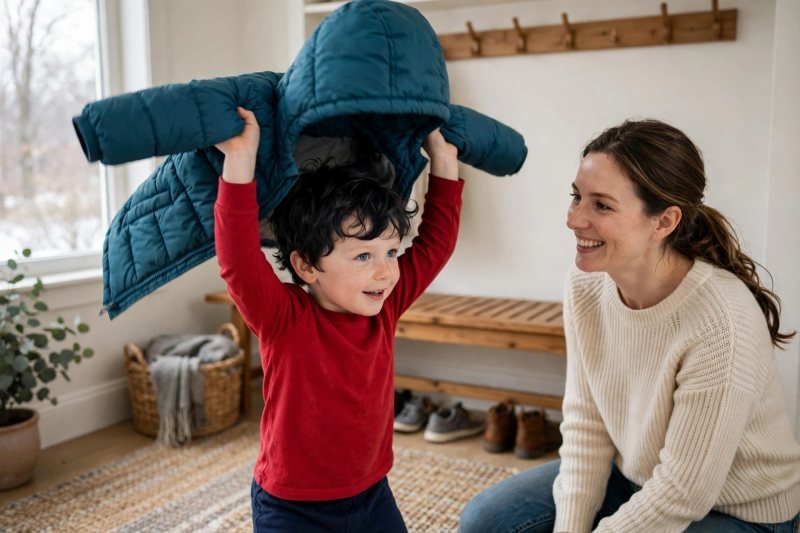
Flip the coat on. Lay the coat face-down on the floor, open and wide, hood edge nearest your child's toes and sleeves stretched out to the sides. Say: "Stand at the top of your coat, slide your arms into the sleeves, and flip it right over your head." Your child bends down, pushes both arms into the sleeves while the coat is still on the floor, then lifts up and over so the coat flips over the head and lands on the shoulders in one delighted motion. Two or three tries before sleeves stop twisting is normal — this trick brings independence long before reaching behind the back works. Coat on, the next job is closing it solo.
-
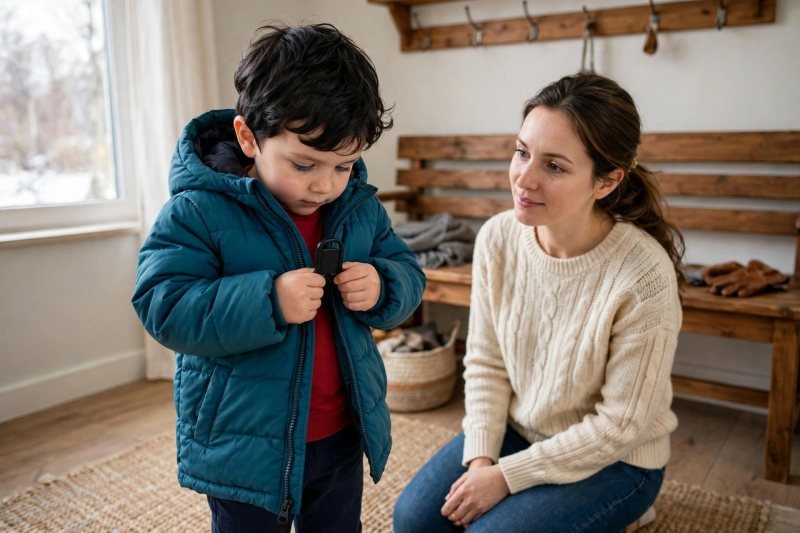
Zip it up solo. Bring the zipper sides together at the hem and show how the pin slides fully into the box at the bottom before anything pulls up — a half-seated zipper splits and jams. Say: "Pin all the way in, hold the bottom tight, then pull the big tab up slowly — all the way to your chin." Look for what small hands need: a large, easy-grip pull; a smooth run that never catches on fabric; and a chin guard, a small fabric flap at the top keeping skin away from the zipper's teeth. Let your child zip, unzip, and zip again, fixing mistakes while you narrate. Next, test sleeves and length.
-
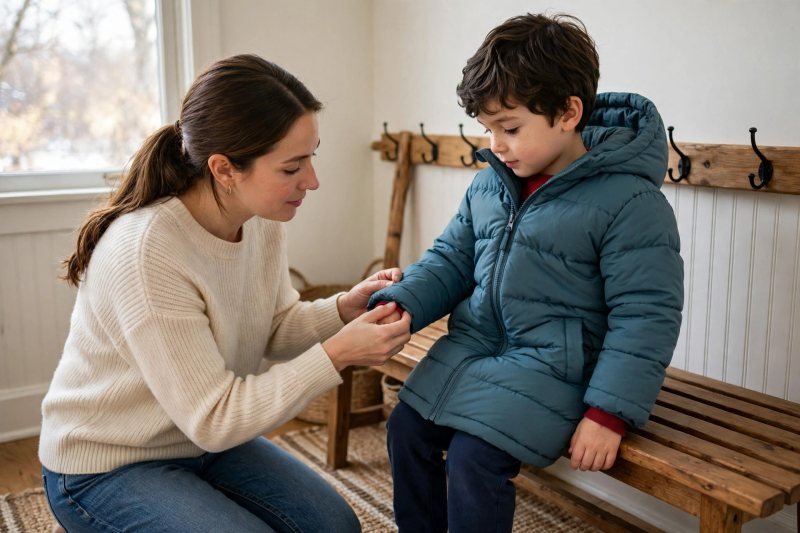
Check sleeves and length. With the coat zipped up, run the three-position check: arms hanging down; arms stretched out in front; then sitting on the bench. Say: "Arms down — cuffs cover your wrists; arms up — sleeves should not climb halfway to your elbows; sit down — the coat still covers your bottom." Arms down, cuffs should cover the wrist bone so no cold gap opens before the mitten; arms raised, a small shift is fine, but a big bare gap means short sleeves or a pulling body; sitting tests mid-thigh length, because a riding-up coat exposes the seat of the pants on cold benches. Passing? Time to move.
-
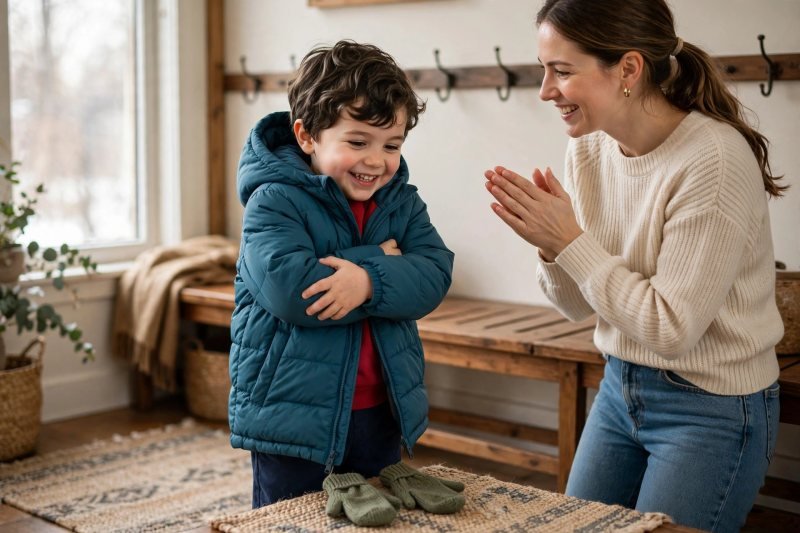
Do the movement test. Turn fitting into three playground moves, in the coat, in full layers, at full energy: hug yourself tight, arms crossed; reach both arms high for the sky; then bend down and scoop up a mitten from the floor. Say: "If you can hug, reach, and bend, you can play — if the coat pulls, pinches, or stops you, it fails the test." Your child should hug without the back straining, reach without the hem lifting clear of the waistband, and scoop without the zipper digging in or knees tangling in the hem. A coat that passes play at home passes play outside. Next, the hood, cuffs, and closures.
-
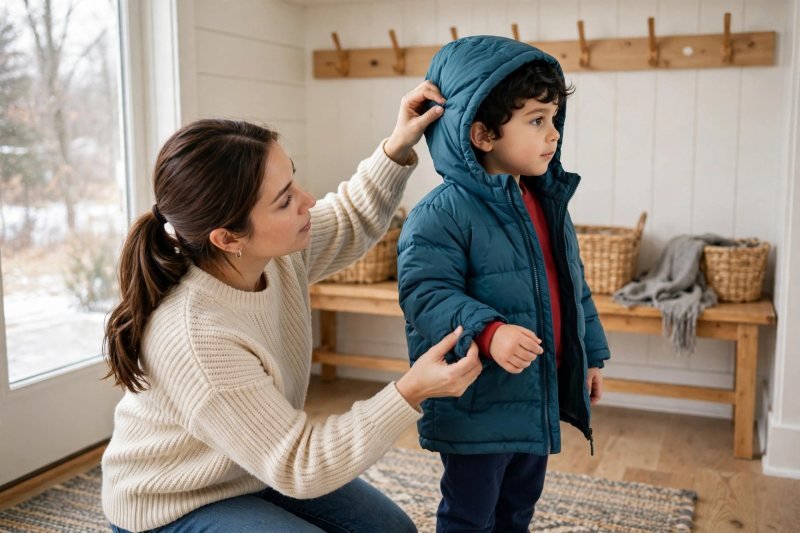
Check the hood, cuffs and closures. Pull the hood up and check front and side: it should sit around the head without sliding over the eyes, stay put when your child turns left and right, and come down with one push when clear sight matters, like crossing a street. Say: "Your hood is a warm hat that lives on your coat — never over your eyes, and never hanging by strings." A safe coat has no drawstrings at hood or hem and no dangling cords or long toggles anywhere, because cords catch on playground equipment and doors. Cuffs should sit snug, ideally over mitten tops, and snaps should open with a firm child-sized tug. On dark winter mornings, reflective trim or a bright hat helps drivers and other adults spot a small child sooner — treat it as a visibility extra, not a substitute for holding hands and staying where adults can see your child. One rule remains — at the car.
-
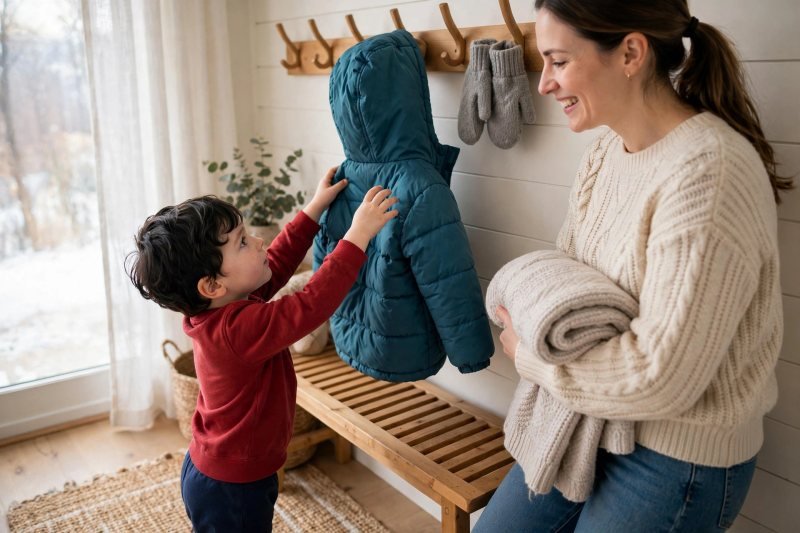
Finish with the car-seat rule and the hook. At the car, teach the rule as cold mornings will run it: the bulky coat comes off before buckling, every time. Say: "Puffy coats stay off in the car seat — straps hug your sweater, and the blanket keeps you warm on top." Seat your child in layers without the coat, buckle up, and tighten the harness until no slack can be pinched at the shoulder, because puffy padding hides space that compresses in a crash and leaves straps too loose. Tuck the blanket over the buckled harness for warmth. Back inside, your child hangs the coat on their low hook, mittens in a pocket, ready for tomorrow.


Make it easier
Practice the flip trick and zipper on a calm weekend first, with no need to go anywhere. For a just-turned 3-year-old, make the movement test pure play and seat the zipper yourself while they pull. Check one thing per day if a full fitting overwhelms: length on Monday, zipper on Tuesday, hood on Wednesday.
Make it harder
Hand over the whole morning sequence — layers, flip, zip, hook — with you watching silently from the doorway. Teach the self-check chant — wrists covered, bottom covered, hood clear of eyes — and let your child inspect a stuffed friend's coat. Build a complete cold-morning outfit using these preschool winter outfits ideas, and let your child choose the layers each day. Then test the finished outfit on a real outing with our kids' winter layering guide.
Other ways to play it
- Shopping version: run the same checks in the store — bring the usual sweater, do the flip and zip there, and never buy on a thin-shirt fit. Compare how the coat sits with the whole outfit in our toddler boy winter outfits.
- Hand-me-down version: a sibling's coat works if it passes every check; inspect worn cuffs, a sticky zipper, and a loose hood, and follow the care label on that coat before you wash or treat it — this guide's drying advice does not replace it.
- Deep-winter version: on the coldest days keep the coat and grow the system — warmer middle layer, hat, mittens, snow pants — instead of a bulkier coat. See our winter hub for the season's wider cold-weather ideas.
How it changes by age
- Ages 3–4: this is the fitting sweet spot. Most 3- and 4-year-olds can learn the flip trick, work a large zipper pull with practice, and play the movement test like a game, while you stay in charge of the safety checks — sizing, hood and drawstring screening, and the car-seat rule. Buy for the child in front of you, not the chart: fit over layers matters more than the label. Dressing a younger sibling too? See these toddler winter outfits ideas for ages 2–3, where adults do every closure.
- When to get help: if the harness will not tighten snugly over layers, check the car seat manual and the maker's guidance, or visit a certified child passenger safety technician.
What they're learning
Reading The Button Who Wanted a Coat together turns the coat into part of a story, which can make the flip trick feel like play rather than practice. Independence: the flip trick, solo zipping, and hanging the coat on a hook turn dressing into a job preschoolers own. Sequencing: layers first, coat last, coat off in the car, blanket on top — a winter routine with an order they can recite. Body awareness: noticing pinches, gaps, bare wrists, and a hood over the eyes builds the language of fit and comfort. Safety habits: no cords, chin protected, harness snug against the body — simple rules learned early and repeated daily.
Clearing up
"The puffier the coat, the warmer the child." Not necessarily — warmth comes from the whole system: a good coat over sensible layers beats a huge coat over a thin shirt, and bulk fails in the car seat anyway. "Buy two sizes up so it lasts." A coat that swallows hands, hangs past knees, and gaps at cuffs lets cold air in and trips small legs; growing room is smart, a swamp is not. "A hood replaces a hat." A hood helps, but it must never cover the eyes, and a snug hat still wins on very cold days. "Coats are fine in car seats if the straps feel tight." Feeling tight over padding is the trap — the padding compresses in a crash. Coat off, straps snug on the body, warmth on top.
Questions parents ask
What size winter coat should I buy for a preschooler?
How warm should a preschool winter coat be, and what goes under it?
Can preschoolers wear winter coats in car seats?
How long should a preschool winter coat be?
When should I size up a preschool winter coat?

save it for later
Pin this for the next rainy afternoon
Keep it on a board so it is there when you need it, rather than when you happened to find it.
Save to Pinterest

