


AB Patterns for Preschoolers: The First Pattern to Master
A step-by-step guide for parents on teaching AB patterns — the first pattern every preschooler should master. How to demonstrate, name, copy, extend, fix, and create repeating patterns with objects you already own, for ages 3–4.
Build a simple two-part row yourself — red, blue, red, blue — saying each piece out loud as you place it. Let your child copy your row, then leave a gap in one you started and ask them to finish it. Once they can extend your pattern, spot a wrong piece, and build their own, they've mastered the AB pattern. Ten minutes a day with toys you already own is plenty.

The short version
- An AB pattern is a repeating two-part sequence — red, blue, red, blue — where A and B alternate over and over.
- Always model first: build the pattern yourself while saying each piece out loud before asking your child to copy.
- Follow the sequence: copy your pattern, extend a pattern you started, fix a deliberate mistake, then create their own.
- Keep pieces big, keep rows short (4–6 pieces at first), and keep sessions to 10–15 minutes.
- Signs of mastery: they extend your pattern correctly, spot a wrong piece, name the rule in their own words, and invent their own patterns unprompted.
- If they slip into AABB instead of AB, that's progress — they sense the repetition; help them tighten it back to AB.
- Age
- Ages 3–4
- Prep
- 2 min
- Mess
- None
- Difficulty
- Easy
- Where
- Indoor
Why kids love this
Because patterns have a beat, and 3-year-olds feel the beat. The chanting — "red, blue, red, blue!" — turns into a game all by itself, and catching YOUR mistake (step 5) is the high point of the whole week. There's no wrong answer lurking here, just a rhythm to ride, and kids come back to it the way they come back to a favorite song.
What you'll need
- Two kinds of anything, 8–10 of each: wooden blocks in two colors, big beads in two colors, red and blue cups, apples and oranges, socks in two patterns.
- A tray, rug, or clear stretch of floor to build on.
- A length of yarn or string (for threading patterns).
- Optional: a sticker sheet and a strip of paper (for sticker patterns).
- Optional: a basket for the pattern hunt.
Before you start
None, really. Grab two kinds of something from around the house — blocks, beads, socks, snacks — and clear a patch of floor or table. That's the whole kit. The outdoor step needs nothing but a yard or a walk; the movement step needs nothing at all.
How to do it
-
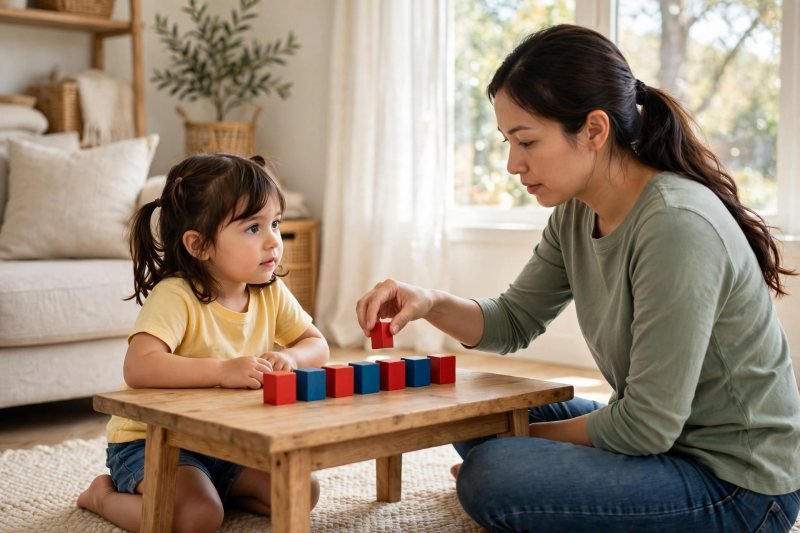
**Build the first pattern yourself.** Sit side by side with your child — not across from them — and line up 4 to 6 pieces, alternating two colors or objects. Say each piece out loud as you place it: "Red. Blue. Red. Blue." Don't ask them to do anything yet. This is the demonstration, and it's the most important step of all: they need to see the rule before they can use it.
-
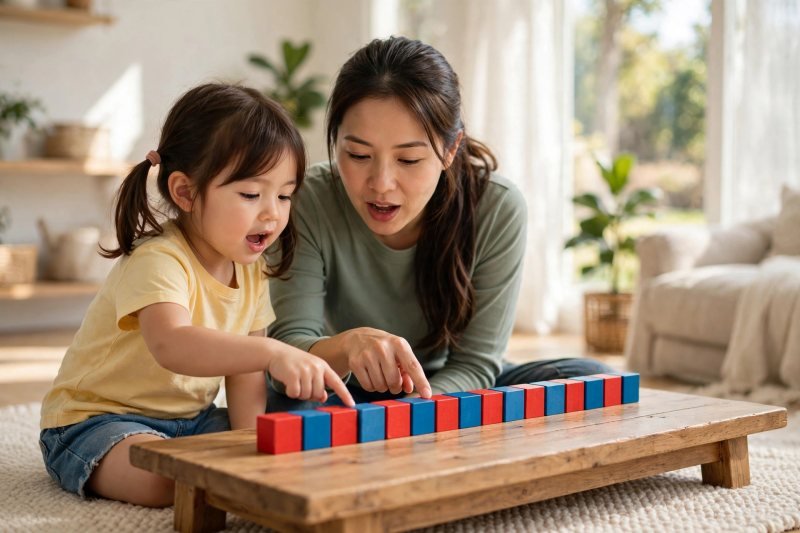
**Read the pattern back together.** Run your finger slowly along the finished row and read each piece aloud: "Red, blue, red, blue." Invite your child to say it with you. Then read it again a little faster, like a chant. Hearing the alternation — the back-and-forth rhythm — is what makes the rule click. Linger here as long as they enjoy it.
-
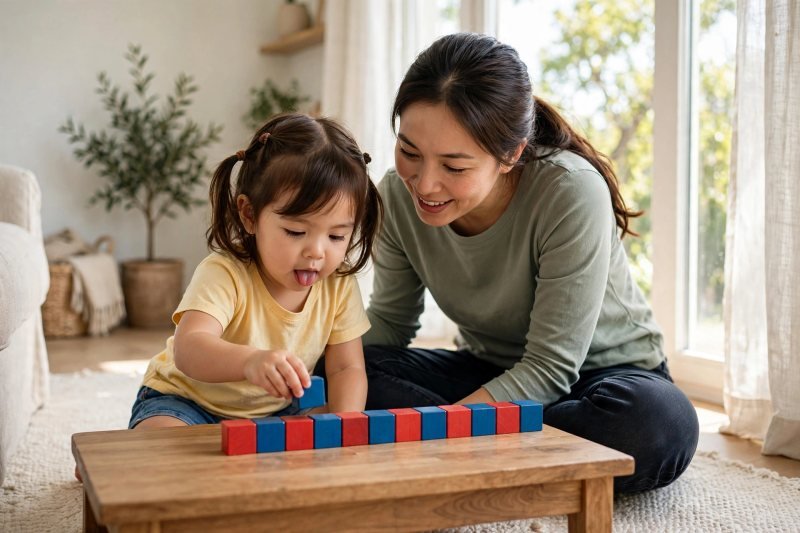
**Copy my row.** Build a fresh AB row and ask your child to make one "just like mine," piece for piece, side by side. This is the copy level: the true entry point of pattern learning. Let them take their time, and read their row back together when it's done. If a piece lands in the wrong spot, read the row aloud — they'll usually hear the hiccup and fix it themselves.
-
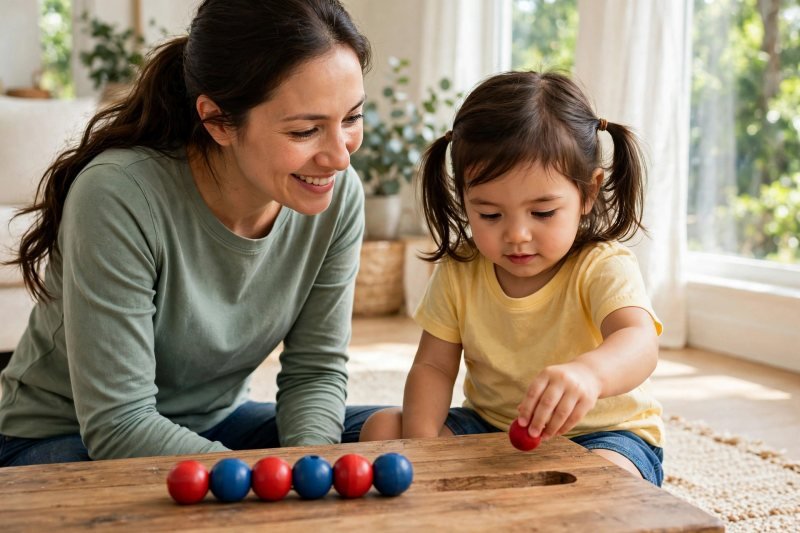
**You start it, they finish it.** Begin a row with three or four pieces and stop, leaving an empty gap. "What comes next?" Let them place the missing pieces to extend your pattern. This is the extend level, and it's the first real test of whether the rule is sinking in. Celebrate every correct piece — and if they hesitate, read the row aloud together as a hint.
-
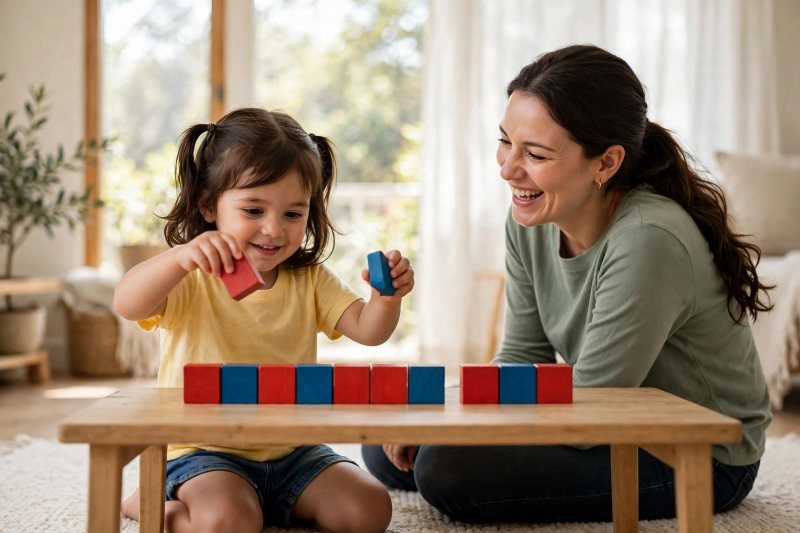
**Spot my mistake.** Build a row with one wrong piece — red, blue, red, red, blue — and read it aloud slowly: "Did I mess up?" Let them find the wrong piece and swap it for the right one. Mistake-hunting teaches them to check the rule, not just follow it, and nothing delights a 3-year-old like catching a grown-up's error. Take turns: now let them build a row with a mistake for you to find.
-
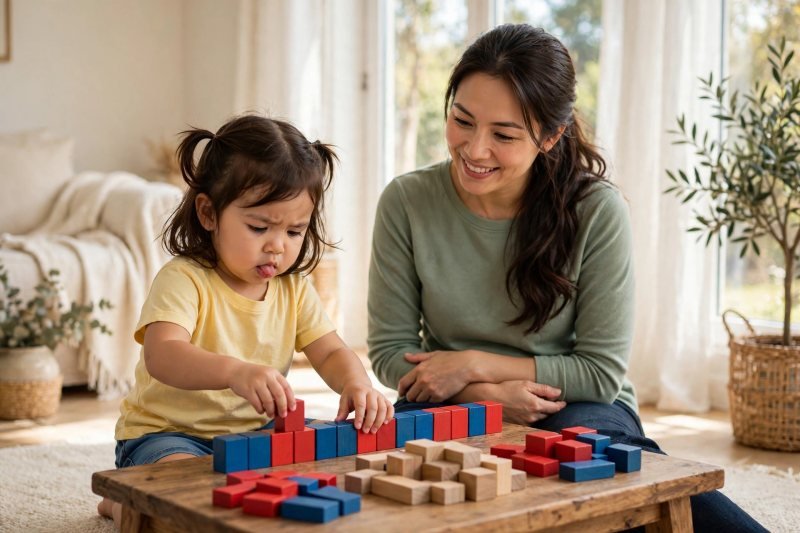
**Let them create one.** Hand over a mixed pile of the two materials and say: "Make your own pattern." No template, no model to copy — just their rule, their way. This is the create level, and it shows whether the pattern is really theirs. If the row comes out AABB or random, that's fine; read it back together and let them hear what they built. Own creations are where the learning locks in.
-
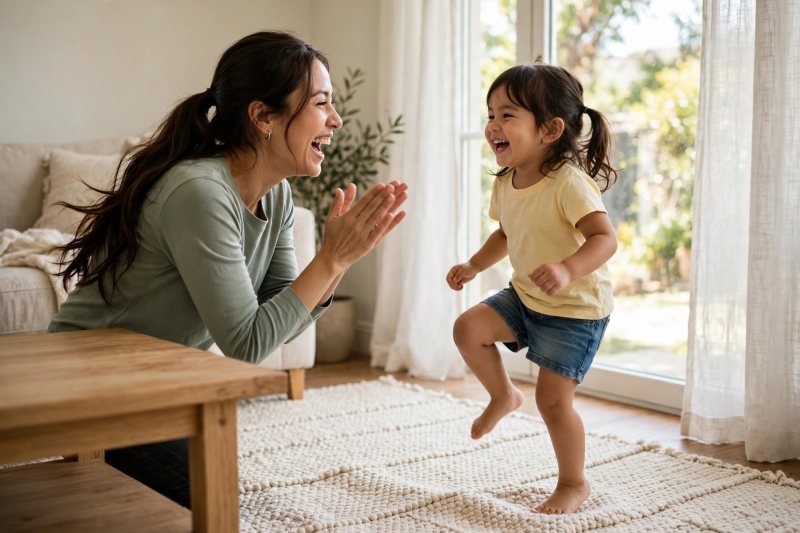
**Move the pattern.** Turn the rule into movement: clap-stomp-clap-stomp, jump-twirl-jump-twirl, loud-quiet-loud-quiet. Take turns leading — you build a movement pattern and they copy it, then they lead and you follow. Body patterns cement the rule for kids who wiggle more than they sit, and they're a perfect reset when table play runs out of steam.
-
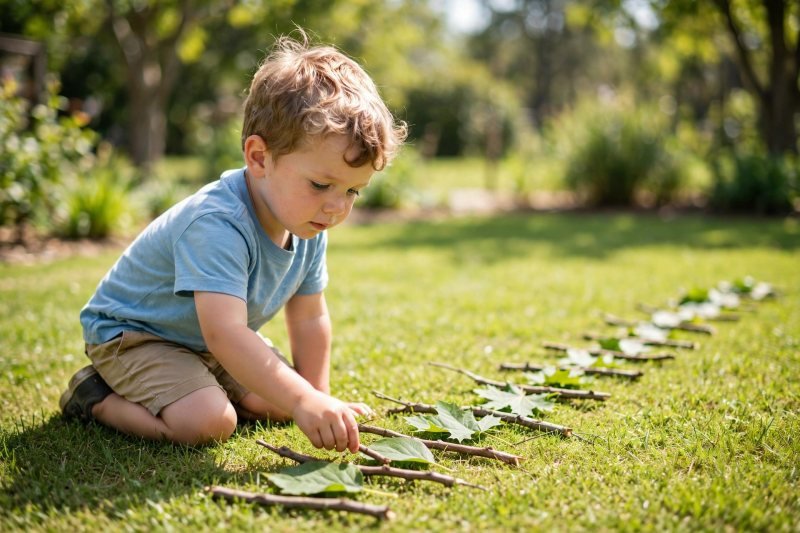
**Take it outside.** Line up sticks and leaves, pebbles and flowers, in an alternating row along the grass or the sidewalk. Nature gives you endless free materials and a much bigger canvas — rows can stretch as far as a preschooler's patience allows. Photograph the longest one; children love seeing their pattern from above.
-
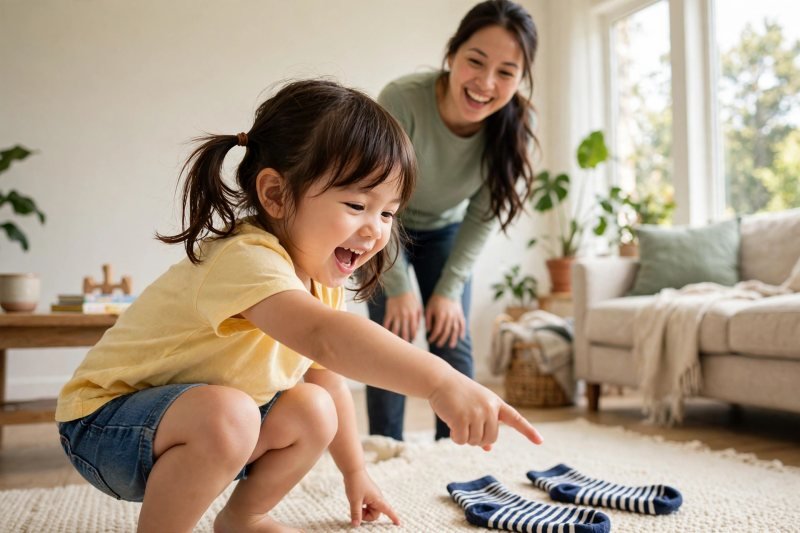
**Hunt for patterns in the house.** Walk around together finding real AB patterns in the wild: striped socks, floor tiles, a polka-dot curtain, the slats of a fence, your own striped shirt. Spotting patterns outside the game is the payoff — it's the sign the rule has moved from the table into their thinking. Let them lead the hunt; you be the amazed audience.
-
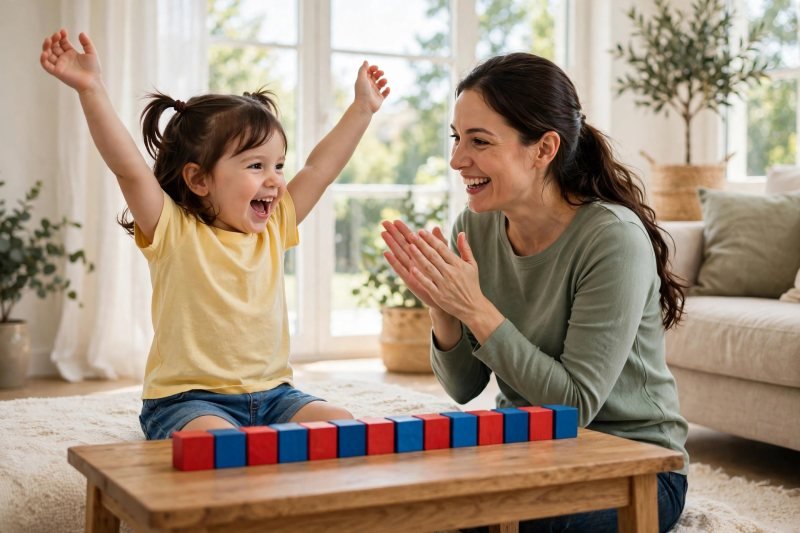
**Ask for the rule in their own words.** "So what's the rule?" Cheer whatever they say — "Red, blue, red, blue!" or "It goes back and forth!" When a child can say the rule, extend your row, and invent their own pattern, the AB pattern is mastered. Mark the moment: they just learned their first piece of real math, the grown-up kind.


Make it easier
Use big, high-contrast pairs: red and blue blocks, apples and oranges, big and small cups. Keep rows to 4 pieces at first — a short row they can read is better than a long one they can't. Stay at the copy step as long as they need — days or weeks. Copying IS learning. Say each piece aloud yourself; let them place pieces in silence if chanting feels like too much. If pieces get mixed up, sort them back into two piles together before rebuilding.
Make it harder
Stretch rows to 8–10 pieces once 6 feels easy. Introduce AAB and ABB: "This time it's two As then a B — red, red, blue, red, red, blue." Model it first, exactly like you modeled AB. Try shape patterns: circle, square, circle, square — using pieces from our shapes activities for preschoolers. Build silently: make a row with no talking, then have your child read it back and name the rule. Combine materials: a block pattern AND a movement pattern at the same time — clap for red, stomp for blue.
Other ways to play it
- Snack patterns: cracker-blueberry-cracker-blueberry on a plate (eating the mistakes is allowed).
- Sticker patterns: alternate two sticker designs down a strip of paper — a keepsake pattern.
- Sound patterns: clap-stomp, loud-quiet, tap-shake — no materials needed, perfect for the car.
- Water patterns: drip-drop rhythms in the bath — one splash, one pour, one splash, one pour.
- Sibling version: older kids build ABB or ABC patterns; little ones copy; everyone hunts for mistakes in each other's rows.
How it changes by age
- Ages 3–4.
- Younger threes should live at the copy and extend steps with big, chunky materials and rows of 4; older fours usually move faster through the sequence and can reach the create step within a few sessions.
- Follow their ease, not their birthday — if copying feels effortless, hand them the extend step; if extending stalls, drop back to copying with zero fuss.
What they're learning
Pattern recognition: identifying a repeating rule in a sequence — the foundation of all later pattern work. Extending sequences: predicting what comes next, the seed of pre-algebra thinking. Attention to order: noticing when a sequence breaks — careful looking as a thinking skill. Math vocabulary: pattern, repeat, next, rule — naming the math words while they play. Counting and sequencing grow out of this too — the touch-and-say rhythm they use here is the same one in our counting games for preschoolers. Fine motor skills come free with the placing, threading, and stacking — our fine motor activities for preschoolers has more for little fingers. For more early-math play, browse the math activity hub; the preschool activity hub gathers activities matched to ages 3–4.
Clearing up
Two minutes: scoop both kinds of pieces back into their own piles or a bin. Let your child do the sorting — "all the reds here, all the blues there" is one last sneaky round of sorting play. Outdoor rows just get scattered back into nature.
Questions parents ask
What is an AB pattern in preschool math?
At what age should my child learn AB patterns?
What is the difference between AB, ABB, and ABC patterns?
My child keeps making AABB instead of AB. Should I correct them?
Can I teach patterns without buying anything special?
How long does it take a preschooler to learn AB patterns?
Zero pressure, zero guilt. If your child would rather line the blocks up in a parade than alternate them, that's fine — the copy step will still be there tomorrow. And if they want to do the "spot my mistake" game five days in a row, the pattern sense is working exactly as it should. Play first; the math follows.

save it for later
Pin this for the next rainy afternoon
Keep it on a board so it is there when you need it, rather than when you happened to find it.
Save to Pinterest