


Pattern Activities for Preschoolers: AB, ABC and Beyond
Ten pattern activities for preschoolers that grow from simple AB to ABC and beyond — body-movement patterns, sound games, snack sequences, sticker strips, and nature finds, all for ages 3–4 with things you already own.
The best pattern activities for preschoolers start with simple AB repetition — clap, stomp, clap, stomp — then grow to ABC and beyond. Use body movements, sounds, snacks, and stickers so children copy, continue, and eventually invent their own patterns. Keep each round short and playful; spotting, continuing, and fixing patterns is early algebraic thinking hiding inside play.

The short version
- The first pattern to teach is AB: two alternating things — clap, stomp, clap, stomp. Master it before adding anything else.
- Children learn patterns in four stages: copy yours, continue one you started, fix your deliberate mistake, then invent their own.
- Body and sound patterns come before tabletop ones — movement makes the repetition click.
- Say the pattern aloud together ("apple, cracker, apple, cracker") — hearing the rhythm teaches the rule.
- Stop at AB for younger threes; stretch older fours toward ABC, AAB, and ABB.
- Point out patterns in real life — floor tiles, fences, crosswalks — so the skill leaves the table.
- Age
- Ages 3–4
- Play time
- 15 min
- Mess
- Low
- Difficulty
- Easy
- Where
- Both
Why kids love this
Because the patterns are made of clapping, drumming, snacks, stickers, and things they find outside — not paper and pencils. Your child gets to boss YOU around with the rhythm, catch you making mistakes on purpose, eat the evidence, and invent rules only they know. Every activity ends with a giggle or a crunch, and the math hides completely.
The best pattern activities for preschoolers start with the child's own body. Before a 3-year-old can arrange stickers in a row on paper, they can clap and stomp — and that alternating rhythm, clap, stomp, clap, stomp, is the AB pattern, the very first pattern most children learn. So this collection begins with movement and sound, then moves to hands-on sequences — snacks, stickers, blocks, nature finds — and finishes with children inventing their own patterns. Each of the ten activities below starts with the simplest AB and shows you how to stretch it to ABC and beyond when your child is ready.
You go in this order: copy, continue, fix, invent. First your child copies your pattern — you clap, stomp, clap, stomp, and they join in. Then they continue one you start — you lay out red, blue, red, blue, and they place the next piece. Then you make a deliberate mistake — red, blue, blue — and let them catch it and fix it. Finally they invent a pattern and you copy theirs. Don't skip a stage, and don't rush: some children need a week of joyful AB copying before ABC makes any sense, and that week is exactly right.
Patterns are pre-algebra wearing a disguise. When a child notices that clap, stomp repeats, they are finding a rule in a sequence — the same mental move they will later use for counting by 2s, multiplication tables, and number patterns in school. Patterns also train left-to-right order (the same direction reading flows), careful attention to what changes and what stays the same, and prediction: "what comes next?" These ten activities build all of that with claps, snacks, and stickers, years before it ever looks like math class.
If pattern play is clicking and you'd like to fold numbers into the mix, our counting games for preschoolers grow the same way — small playful rounds with real objects.
What you'll need
- - Two bowls and a snack: banana slices and blueberries, or crackers and apple slices (nothing smaller than a large grape)
- - Two colors of dot stickers or foam stickers, plus long paper strips
- - Wooden blocks or large linking bricks in two or three colors
- - A pot, a wooden spoon, and a simple shaker (a sealed jar of dry rice works)
- - Long paper strips, washable paint, and three kitchen-sponge shapes (star, circle, square)
- - Dry penne or rigatoni and food coloring for tinting, plus yarn or a shoelace
- - A basket for nature finds: leaves, pebbles, pinecones
- - Toy animals or cars in two or three types for a parade
Before you start
Two minutes for most of these: put stickers and a paper strip on the table, pile blocks nearby, set out the snack bowls. The sponge stamping needs the sponge shapes cut and a shallow tray of paint; the pasta necklace needs dry tinted pasta (tint the night before if you like colors — see the step). Nothing else requires prep — Clap-Stomp and the Sound Band start the second someone says "go."
How to do it
-
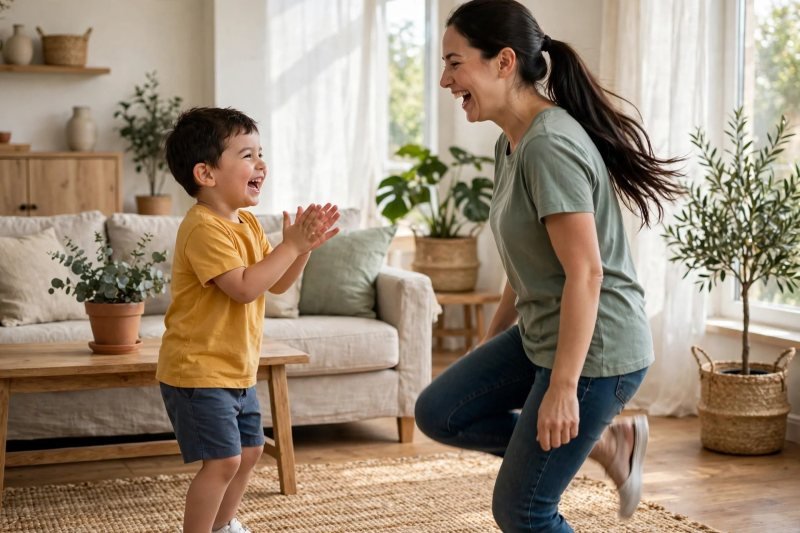
Clap-Stomp AB. Stand facing each other with clear floor space. You start the pattern and say it aloud as you do it: "clap, stomp, clap, stomp." Your child joins in and copies. Once the rhythm is steady, drop the words and just move together — the pattern lives in the body now. Swap roles: your child leads with clap-stomp, and you follow. For a stretching step, sneak in one mistake ("clap, clap") and let them catch it and correct you — catching your error proves they own the rule.
-
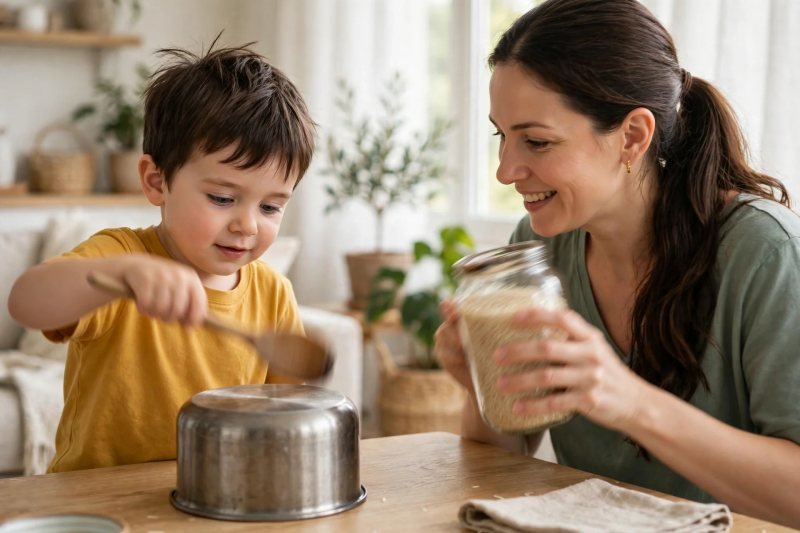
Sound Pattern Band. You need a pot, a wooden spoon, and a shaker. Start an AB sound pattern: tap the pot, shake the shaker — "tap, shake, tap, shake." Your child joins, playing one instrument while you play the other, so the pattern is a duet. Now let them lead: they choose the two sounds and the order. Try louder and softer rounds — "tap, SHAKE, tap, SHAKE" — because changing the volume teaches that the pattern is the ORDER, not the loudness. End with a wild freestyle minute so the instruments stay fun, not formal.
-
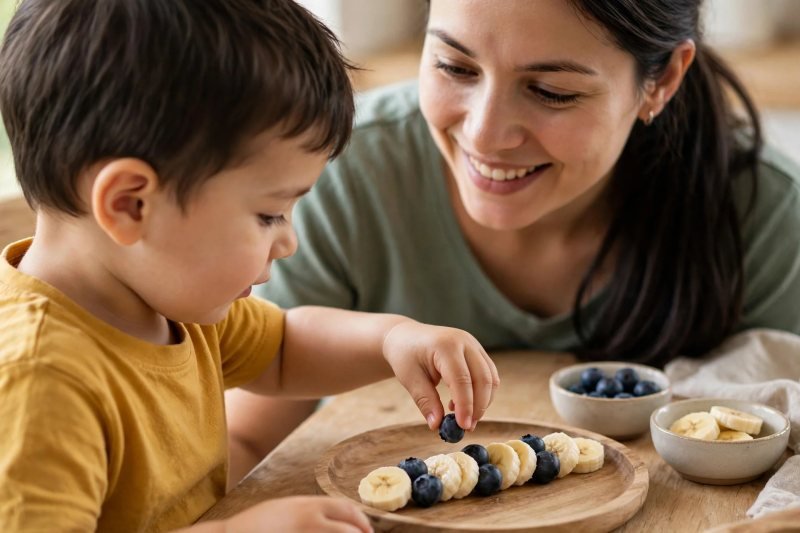
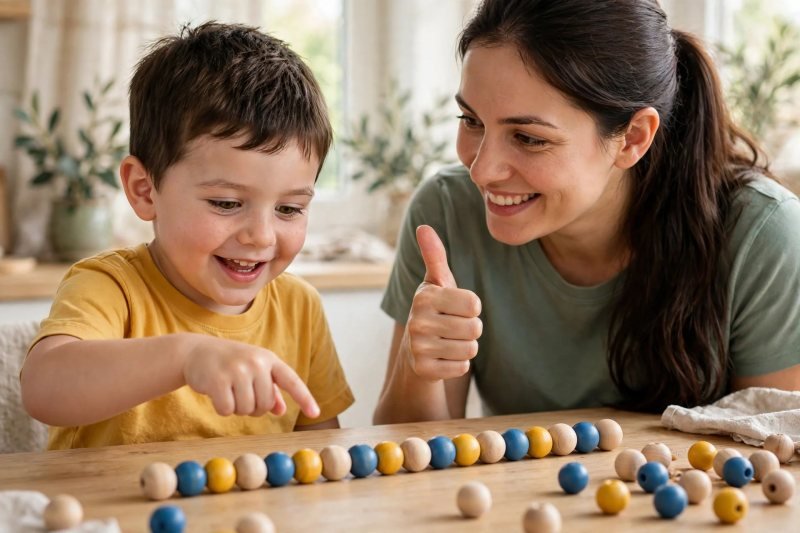
Snack Line-Up. You need two small bowls of two snacks — banana slices and blueberries are perfect: big, safe, and different shapes. Line up an AB row on the table: banana, blueberry, banana, blueberry, saying each one aloud. Your child continues the row by placing the next pieces. Then start a row with a gap in the middle — banana, blueberry, banana, [space] — and ask "what goes here?" Eating the pattern at the end is mandatory, and naming each piece aloud is what glues the pattern rule into memory.
-
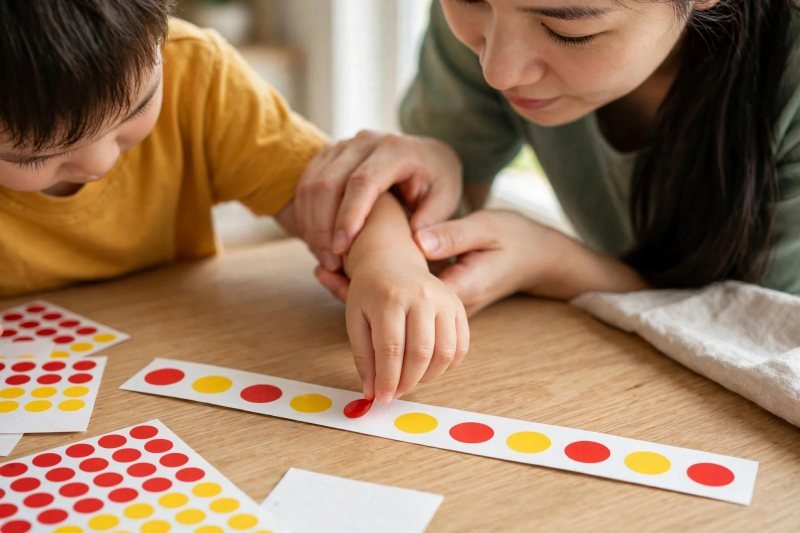
Sticker Strip. You need two colors of stickers and a long paper strip. Stick the first few yourself — red, yellow, red, yellow — narrating as you go: "red, yellow, red, yellow." Now hand your child the stickers and let them finish the strip. The peel-and-place action slows speedy fingers down, which is exactly what young pattern-makers need. When the strip is done, tape it up somewhere visible; admiring it later is a free second round of "read the pattern to me."
-
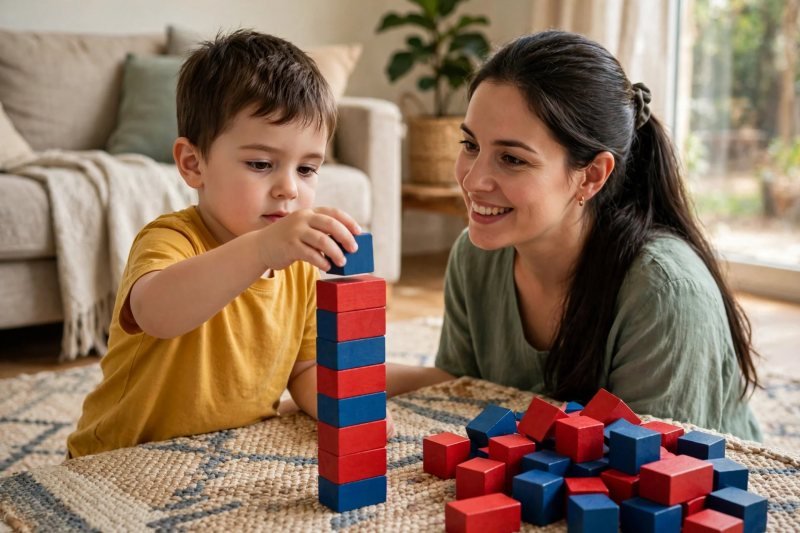
Tower in Two Colors. You need blocks in two colors. Build the first few layers together, alternating: red block, blue block, red block, blue block, saying the color of each as it lands. Now your child builds the rest of the tower alone, continuing the AB. When it wobbles — it will — rebuild it with an ABC: red, blue, yellow, red, blue, yellow. Towers make patterns three-dimensional and forgiving: a wrong-colored block is easy to spot and swap, and rebuilding is half the fun. Count the layers as you build — ten red-blue pairs is a counting win, and our number recognition activities for preschoolers grow the same skill with real objects.
-
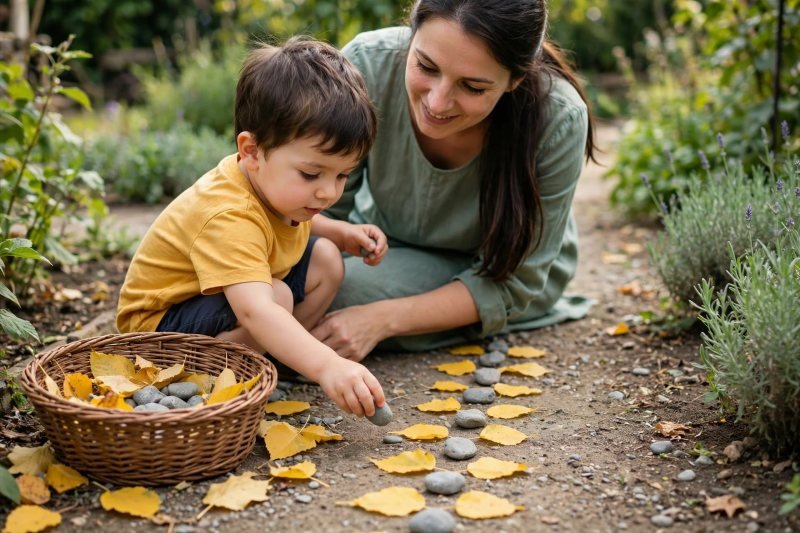
Nature Pattern Walk. You need a basket and a walk — garden, park, or sidewalk. Collect two kinds of finds: yellow leaves and red leaves, or pebbles and sticks, or pinecones and acorns. Back on the path, lay an AB line on the ground: leaf, pebble, leaf, pebble, narrating each one. Your child extends the line with the collected finds. If a find breaks the pattern, ask "does this one fit, or does it start a new pattern?" — deciding what belongs is the thinking work. Photograph the finished line, then leave it for someone else to find.
-
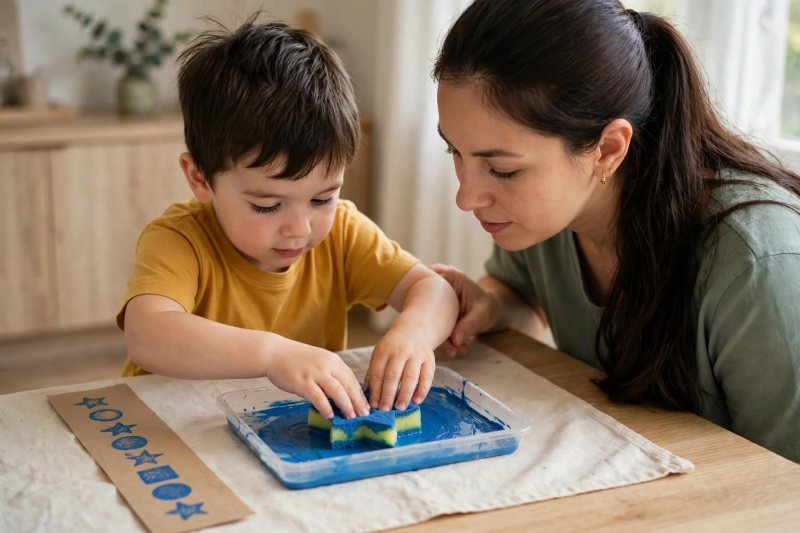
ABC Stamp Row. You need three sponge shapes and washable paint in three colors. Press the shapes into a row: star, circle, square — that's your ABC. Stamp the first cycle yourself, saying the names aloud: "star, circle, square, star, circle, square." Now your child stamps the next cycles, continuing the ABC. When it clicks, switch to AAB — star, star, circle — and watch them work a little harder. Washable paint and a covered table keep this joyful; the three-shape cycle is many children's first real ABC. If the three shapes are still new, our shapes activities for preschoolers introduce them gently first — and if mixing the paint colors is part of the fun, our color mixing activities for preschoolers show how to blend them.
-
Pattern Pasta Necklace. You need dry penne or rigatoni tinted with food coloring (a spoonful of pasta, a few drops of color, and a splash of rubbing alcohol in a bag; shake and dry overnight). Thread an AB onto a shoelace: red pasta, blue pasta, red pasta, blue pasta, naming each as it slides on. Your child continues the string. Ready for more? Try ABC with yellow added, or ABB — red, blue, blue. Stringing builds fine-motor control for free, and the necklace gets worn to dinner with enormous pride. For more stringing ideas, our fine motor activities for preschoolers has a whole shelf of them.

-
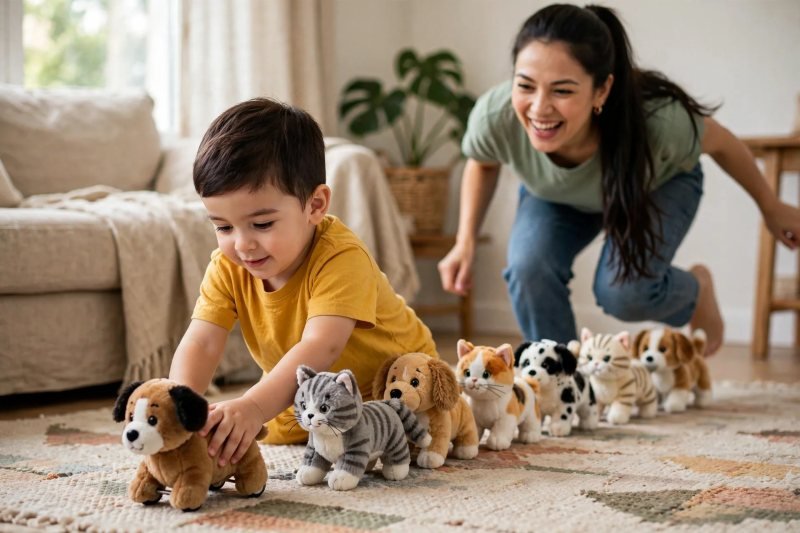
Animal Parade. You need toy animals or cars in two types — cats and dogs, or red cars and blue cars. Line up the parade: cat, dog, cat, dog, narrating as each toy marches in. Your child continues the parade line. Then flip the roles: they line up the parade and YOU get to be the marcher, stomping your toys along behind theirs. Try an ABC parade — cat, dog, bird — once AB is easy. The marching finale (every toy parades across the rug to a silly drumbeat) is what makes this one get requested again tomorrow.
-
Fix It and Invent It. This is the graduation round — do it after your child knows AB well. Lay a row with one deliberate mistake: red, blue, blue, red. Say "I think I made a mistake — can you find it?" Let them point to the wrong piece and fix it. Do two or three "find my mistake" rows, then hand over the materials entirely: "Now YOU make a pattern, and I'll copy yours." Whatever they invent — even a glorious chaotic AABBC — name it back to them ("red, red, blue, blue, circle!") so they hear the rule they invented. Photograph their creation; inventing is the deepest level of pattern thinking there is.


Make it easier
- Stay at AB only: clap-stomp, two snacks, two sticker colors. ABC can wait weeks.
- Shorten every row: three or four units is plenty ("red, blue, red — your turn").
- Let your child only COPY for a while — copying is a complete, real stage, not a failure to continue.
- Use big chunky items: large blocks, banana slices, big stickers. Small pieces frustrate small fingers.
- Do the pattern together, side by side, with you narrating — your steady rhythm is their scaffolding.
Make it harder
- Move to ABC: three sounds, three snacks, three stamp shapes cycling in order.
- Try AAB and ABB rows ("star, star, circle" then "star, circle, circle") — the doubled unit is the first real challenge.
- Play "find my mistake": you build a row with one wrong piece and they diagnose and fix it.
- Ask them to describe the rule aloud: "tell me the pattern so I can copy it." Saying the rule is a level up from following it.
- Let them invent a pattern family and teach it to you — then to a grandparent on a video call. Teaching cements mastery.
- Count the repeats: "how many red-blue pairs fit on your strip?" That's pattern thinking meeting counting — our counting to 10 activities pairs well here.
Other ways to play it
- - Bath version: squeeze-and-drip with a sponge — squeeze, drip, squeeze, drip — or alternate two bath toys in a floating row.
- - Car version: spot patterns out the window — red car, blue car; or count lamp posts in an AB of lit and unlit.
- - Sidewalk chalk version: draw AB or ABC rows of shapes on the driveway; hop along reading the pattern aloud.
- - Sibling version: older kids design the patterns, younger ones copy them — both get the right level of challenge.
- - Quiet version: sticker strips and the snack line-up make perfect calm-down or waiting-room activities.
How it changes by age
- Ages 3–4. Younger threes should live at AB for a long while — copying your clap-stomp, continuing a two-snack row. That's the whole curriculum, and it's enough. Older fours who do AB in their sleep are ready for ABC, AAB, ABB, "find my mistake," and inventing their own. Follow the ease, never the birthday: if ABC confuses, cheerfully drop back to AB for another week.
What they're learning
- Pattern recognition: spotting the repeating rule in a sequence — the foundation of algebraic thinking (all 10 activities). - Copying, continuing, and inventing sequences: the four-stage ladder from copying to inventing (Steps 1–10). - Left-to-right sequencing: patterns read the same direction reading flows, quietly preparing reading readiness. - Attention to sameness and difference: deciding what fits and what breaks the rule (Steps 6, 10). - Fine-motor skills: peeling stickers, threading pasta, stamping, and stacking — sorting and matching games build the same sorting-by-attribute muscle in a different game. - Math vocabulary: "first, next, then, repeat, pattern" — words that will come back in school math for years.
Clearing up
Two minutes: stickers back in their sheet or in the finished strip's proud spot on the wall, blocks back in the bin, nature finds released back to the garden (or lined up on the windowsill), snack bowls in the sink. Let your child sort the pasta back by color — one last pattern before the activity ends. (NOTE: this field contains cleanup instructions, not misconceptions — paste as-is.)
Questions parents ask
What is the first pattern kids learn?
Why are pattern activities important for preschoolers?
My child can't copy a pattern. Is that normal?
When should kids move from AB to ABC patterns?
Can you do pattern activities without buying anything?
How long should a pattern activity last?

save it for later
Pin this for the next rainy afternoon
Keep it on a board so it is there when you need it, rather than when you happened to find it.
Save to Pinterest


