


Learning Shapes: Circle, Square, Triangle — The First Three
A three-week plan for learning shapes: circle in week one, square in week two, triangle in week three — taught by naming, touching, tracing, and real-life spotting.
Teach shapes one at a time: circle week one, square week two, triangle week three. Name the shape while your toddler touches and traces it — a circle is round with no corners, a square has four equal sides and four corners, a triangle has three sides and three corners. Then spot shapes on real objects. Ten to fifteen minutes a day beats one long lesson.

The short version
- Circle, then square, then triangle — one new shape per week.
- Circle: round, no corners. Square: 4 equal sides, 4 corners. Triangle: 3 sides, 3 corners.
- Name each shape while your toddler touches and traces it.
- Spot shapes on real objects: plates, crackers, sandwich halves.
- 10–15 minutes a day beats one long session.
- Calling every shape "circle" at first is normal — categories narrow within weeks.
- Age
- Ages 2–3
- Prep
- 10 min
- Play time
- 15 min
- Mess
- None
- Difficulty
- Easy
- Where
- Indoor
Why kids love this
Two-year-olds learn with their hands, not by sitting and listening. Each week brings one big shape to pat, trace, and carry around — and one new word to own: circle, square, triangle.
What you'll need
- 3 large cutouts (circle, square, triangle), 8+ inches across, from colored paper or felt
- A basket or tray; painter's tape for floor outlines (optional)
- Banana slices, square crackers, triangle tortilla halves for snack week (optional)
Before you start
1. Cut one big circle, one big square, and one big triangle — each at least 8 inches across, too big to swallow. 2. Put only the circle out for week one; store the others until their week. 3. Clear a small patch of floor or table. 4. Pick a calm moment — after breakfast or before bathtime.
How to do it
-
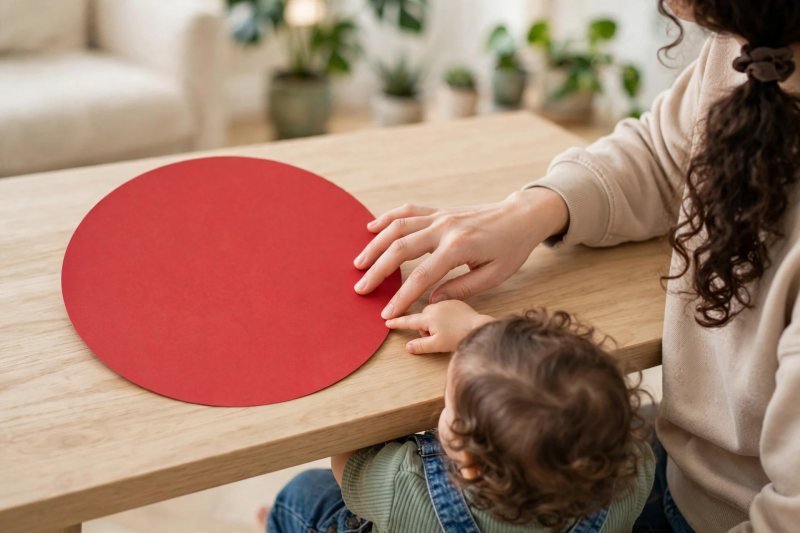
Present the circle. Hold up the big circle: "This is a circle." Hand it over to grab and pat. One shape, one week — no rush.

-
Trace it together. Trace the edge with their finger: "Round and round — no corners." Say circle each lap.
-
Spot circles. Walk around holding the circle. Touch it to a plate, a clock, a cushion: "Same shape — circle!" Let your toddler point.

-
Welcome the square. Bring out the square with the circle still in play. "This is a square." Trace one side, stop at the corner, go again. Count the four corners together: "One, two, three, four."

-
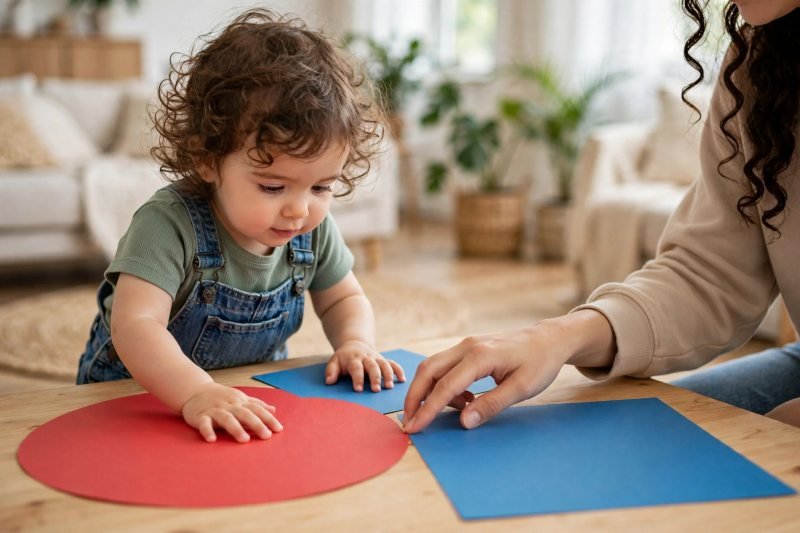
Feel the difference. Lay them side by side. Trace the circle ("no corners — round and round"), then the square ("corners — stop, stop, stop").
-
Hunt for squares. Hunt only squares: a napkin, a cracker, a cushion, a windowpane. Hold the paper square to each find: "Same shape — square!"

-
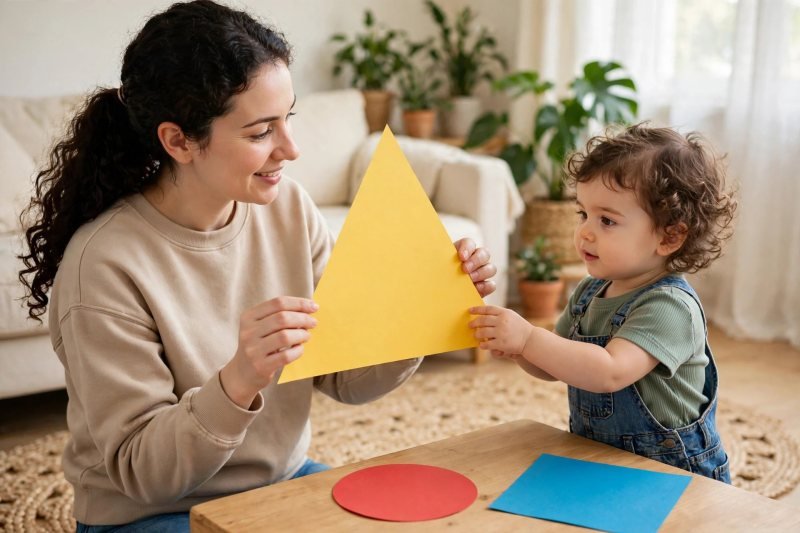
Introduce the triangle. Bring out the triangle with the other two familiar. "This is a triangle." Trace its three sides: "One, two, three corners."
-
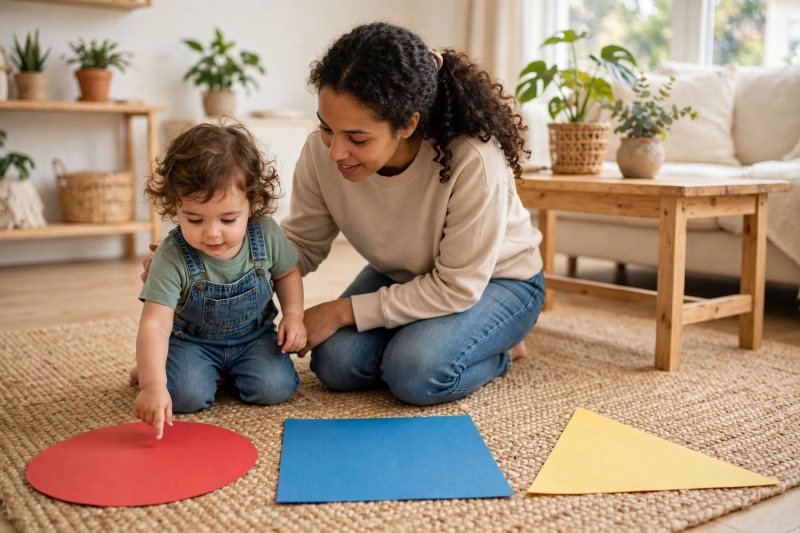
Compare all three. Lay all three in a row and trace each: "Circle — no corners. Square — four corners. Triangle — three corners." Ask "Which is the circle?"
-
Find triangles in real life. Triangles hide everywhere: half a sandwich, a pizza slice, a folded napkin. Ask "Triangle, square, or circle?" and name it together.

-
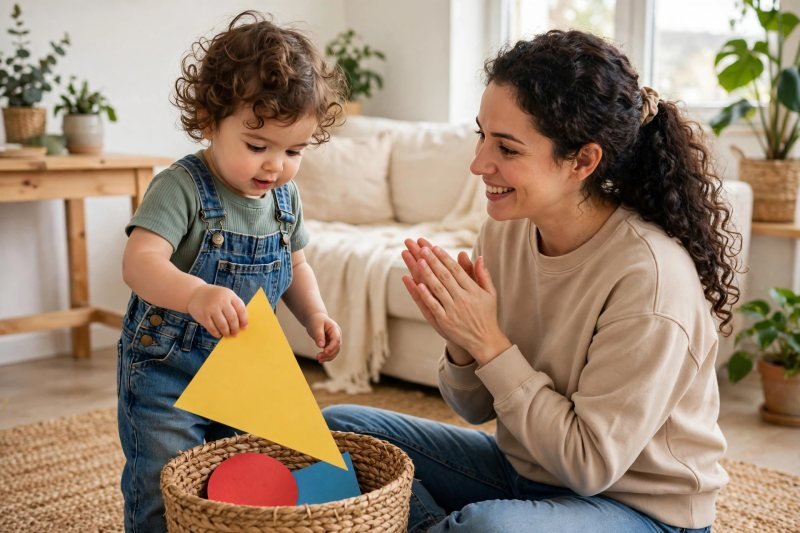
Name them into the basket. Pick up each shape, name it, and drop it in the basket: "Circle! Square! Triangle!" Cleanup naming doubles as a final review.


Make it easier
Stay on the circle for two weeks — no deadline. Go bigger: dinner-plate cutouts are easier to grab and trace. Skip naming; touching and tracing are real learning first.
Make it harder
Ask "How many corners?" before you count. Mix the shapes and ask for "all the triangles." Hunt shapes in books and outside — a wheel, a door, a yield sign. When all three feel solid, shapes activities for preschoolers offer the next level of hands-on geometry play.
Other ways to play it
- Shape snack week. One snack per shape week: banana slices, square crackers, triangle tortilla halves.
- Body tracing. Lay each cutout on the floor — run the circle, march the square, tiptoe the triangle.
- Bath-time spotting. Lids are circles, a folded washcloth is a square, a folded corner is a triangle.
How it changes by age
- At 2, keep it to the circle: touching, tracing, hearing the word. At 2.5, most toddlers hold two shapes, so circle plus square works with the side-by-side tracing game. At 3, add the triangle and the corner chant — three sides, three corners. If square and triangle blur, spend a few days on those two. Once the first three feel familiar, 2D shapes activities extend the same tracing games to new shapes.
What they're learning
The names of the first three shapes: circle, square, triangle Circle: round, no corners. Square: 4 equal sides, 4 corners. Triangle: 3 sides, 3 corners. Describing words: round, straight, corner, same, different Early sorting — what matches and what doesn't Fine motor control from tracing edges and pointing — the same small-hand work behind fine motor activities for preschoolers
Clearing up
When your toddler calls every shape a circle, that's learning, not failure. Children learn categories by overusing the first word they know, then narrowing it down — like "doggie" for every animal. Keep modeling the right names calmly ("That's a square!") without quizzing. Shapes don't need to look like school. Toddlers learn through their bodies — tracing edges, walking outlines, spotting shapes in the kitchen — and play-based learning tends to stick.
Questions parents ask
When should toddlers learn shapes?
What are the first shapes toddlers should learn?
How do you teach the difference between a square and a triangle?
Why does my toddler call every shape a circle?
How long should shape activities last for toddlers?
One shape per week fits most two-year-olds, but follow your child — a child who names the circle on day two is ready for the square. Drop the words into daily moments: "round plate," "square cracker." For more ideas in the same age band, see toddler learning activities at home. The same touch-and-name rhythm works for letters too — alphabet activities for toddlers.
Keep reading: shape sorting activities and shape activities for toddlers.

save it for later
Pin this for the next rainy afternoon
Keep it on a board so it is there when you need it, rather than when you happened to find it.
Save to Pinterest


