


2D Shapes Activities: Names, Sides and Corners
These 2D shapes activities help kids ages 5–6 name shapes like pentagons and hexagons — and count every side and corner to prove it. Ten hands-on ideas, zero worksheets, all the geometry vocabulary a kindergartener needs.
The best 2D shapes activities for ages 5–6 teach shape names by counting sides and corners: build shapes from spaghetti and playdough, stretch them on a geoboard, sort them by number of sides, hunt for them outdoors, and play clue-based guessing games. A pentagon has 5 sides and 5 corners, a hexagon 6 and 6 — when kids count it themselves, the name sticks.

The short version
- Teach 2D shape names by counting sides and corners
- Core set for ages 5–6: triangle 3/3, square 4/4, rectangle 4/4, pentagon 5/5, hexagon 6/6, circle 0/0, oval 0/0; octagon 8/8 as challenge
- Build shapes before quizzing
- Sort by number of sides to fix square–rectangle confusion
- Age
- Ages 5–6
- Prep
- 10 min
- Mess
- Low
- Difficulty
- Easy
- Where
- Both
Why kids love this
Five- and six-year-olds love being experts. A child who can look at a pentagon, announce its name, and prove it by counting five sides and five corners feels like she cracked a code — and she did. These ten 2D shapes activities turn shape vocabulary into games, builds and hunts, so names like hexagon and octagon stick because her hands learned them, not just her eyes.
What you'll need
- Paper, crayons or markers, index cards, wooden or foam 2D shapes (triangle, square, rectangle, pentagon, hexagon, circle, oval — add an octagon when your child is ready), playdough, dry spaghetti, rubber bands, a wooden geoboard with pegs, three baskets, sidewalk chalk, pipe cleaners, child-safe scissors, a glue stick.
Before you start
1. Pick one or two activities per session — a five-year-old learns more from one game repeated twice than from five games rushed once. 2. Gather one set of the eight target shapes ahead of time: triangle, square, rectangle, pentagon, hexagon, circle, oval. 3. Keep a cheat sheet for yourself: triangle 3 sides and 3 corners, square 4 and 4, rectangle 4 and 4, pentagon 5 and 5, hexagon 6 and 6, circle 0 and 0, oval 0 and 0, octagon 8 and 8.
How to do it
-
**Step 1 — Make shape fact cards.** Start with names, then prove each name with a count — a shape's name stops being a memorized word the moment your child counts its sides and corners and sees the name fits. Give your child an index card per shape. She draws the shape, then counts and writes its sides and corners. Tape the cards to the fridge as a reference gallery she built herself — kids consult their own work far more willingly than any store-bought poster.

-
**Step 2 — Trace and count.** Your child runs one finger slowly around each shape, counting sides out loud, then taps each corner and counts those too. The slow trace matters: rushing children sweep a square in one motion and count "one side." Insist on a stop at every corner. Slow, deliberate counting like this builds the same one-at-a-time habit as our [counting activities for toddlers](/activities/counting-activities-for-toddlers/).
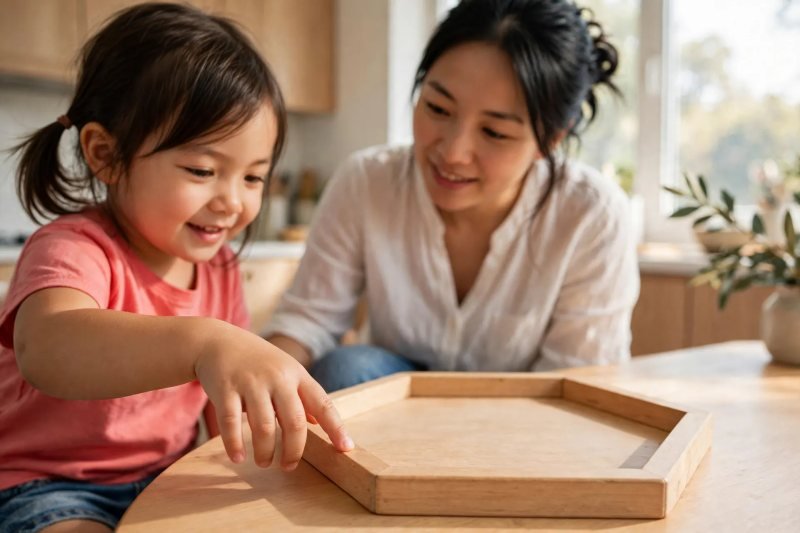
-
**Step 3 — Build with spaghetti and playdough.** Roll tiny playdough balls for corners; break dry spaghetti into sticks for sides. Build a pentagon (five balls, five sticks), then a hexagon (six and six). If a build will not close, count the corners — a "pentagon" that will not close usually has six.

-
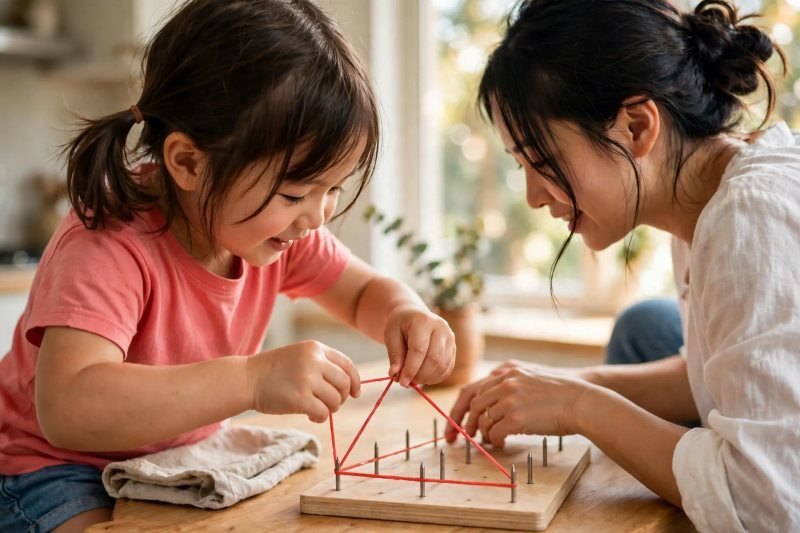
**Step 4 — Rubber-band geoboard.** Once the names are familiar, make counting sides and corners the game itself. Stretch rubber bands around geoboard pegs to build each shape, then count sides and corners together. Every turn around a peg is a corner your child can feel. Ask: "Can you stretch a shape with exactly five corners?"
-
**Step 5 — Sort by sides.** Set out the mixed shapes and three baskets: 3 sides, 4 sides, 5 or more. Mix in tricky ones — a skinny tall triangle, a tilted square, a long rectangle. Children discover a triangle stays a triangle when stretched or tipped, and that squares and rectangles are different shapes despite both having four sides.

-
**Step 6 — Sidewalk chalk shapes.** Draw giant shapes on the driveway. Call out clues — "Hop to the shape with six sides!" — and your child jumps to the answer, then counts the sides aloud to check. Big chalk shapes teach scale too: a triangle is a triangle whether it fits in a hand or fills a driveway.

-
**Step 7 — Shape guessing game.** Games give vocabulary the repetition it needs without ever feeling like drill. Hold a shape behind your back and give clues: "I have four equal sides and four corners." Your child names it, then you swap roles. Letting the child invent the clues is the real win — a good clue proves she understands the properties, not just the name.

-
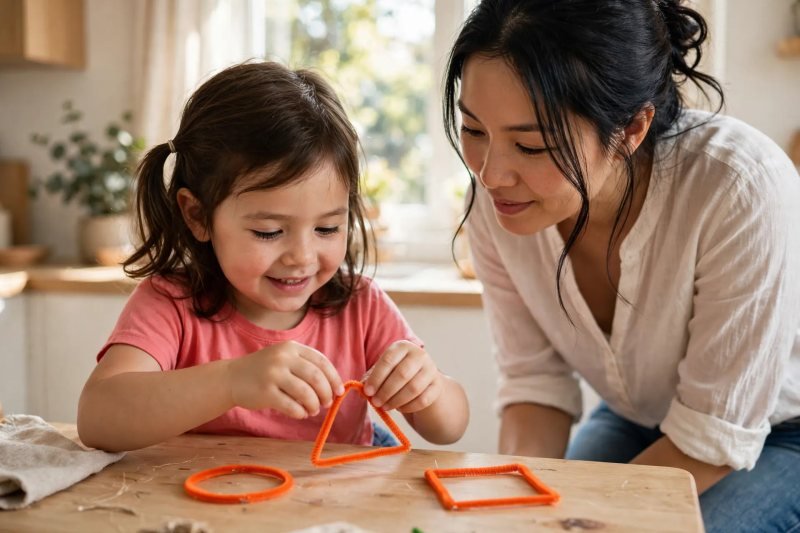
**Step 8 — Pipe-cleaner shapes.** Bend pipe cleaners into each shape, counting sides as you bend. The ends must meet: a "circle" with a gap is just a curved line. Twist the ends together, then hunt for corners — zero, because nothing pokes out. Bending, twisting, and hunting makes this one of the most satisfying [fine motor activities for preschoolers](/activities/fine-motor-activities-for-preschoolers/).
-
**Step 9 — Nature shape hunt.** Take blank paper outside. Each time your child spots a shape — a round manhole cover, a rectangular sign — she names it, says its sides and corners, and makes a tally mark. Back home, count the tallies: which shape won the day?

-
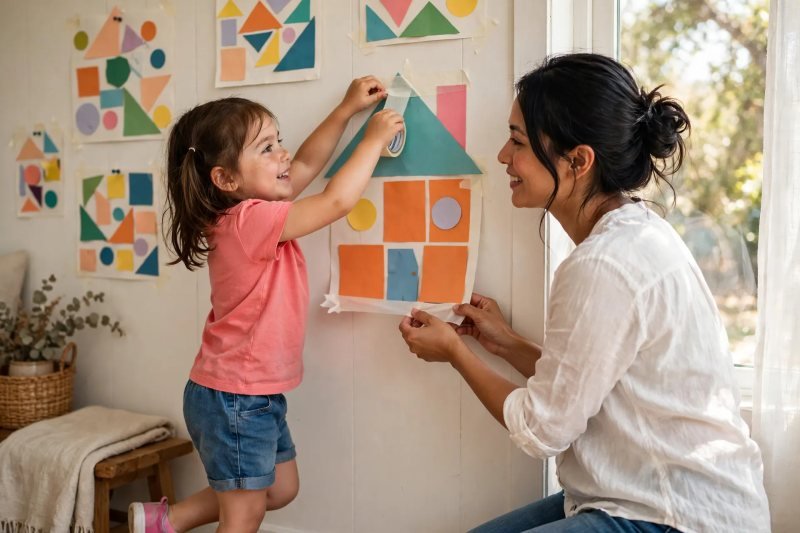
**Step 10 — Shape art gallery.** Your child builds pictures from paper shapes — a house from a square and triangle roof — glues them down, then gives a "museum tour," naming every shape and counting its sides and corners. Hang the art at her eye level.


Make it easier
Start with four shapes — circle, triangle, square, rectangle — and add pentagon, hexagon and oval once those are solid. Use only the building activities (steps 3, 4 and 8) at first — constructing a shape teaches its properties more gently than naming games.
Make it harder
Add the octagon as a challenge shape, then ask: "What would a 9-sided shape be called?" (A nonagon — let her look it up and feel like a researcher.) Ask "always, sometimes, never" questions: "Is a square always a rectangle?" A square is a special rectangle — a genuine "wow" moment for a six-year-old.
Other ways to play it
- Rainy day — run steps 1, 2, 4 and 7 as an indoor shape afternoon. Car ride — play the guessing game (step 7) with words only. Art week — stretch step 10 across several days, one shape-art picture per day.
How it changes by age
- Ages 3–4 — this set of eight shape names is a stretch at three or four; start instead with our [shape hunt around the house](/activities/shape-hunt-around-the-house/), which trades side-and-corner counting for simple shape spotting around the home. Age 5 — most fives can name the circle, square, triangle and rectangle and are ready to add pentagon, hexagon and oval. Age 6 — most sixes can learn all eight shapes including the octagon.
What they're learning
2D shape vocabulary (triangle, square, rectangle, pentagon, hexagon, circle, oval, octagon); shape properties (counting sides and corners to identify shapes); zero as a property (circles and ovals have none); shape constancy (name stays across sizes/tilts); sorting by properties; fine motor control.
Clearing up
A common mix-up: children assume every shape must have countable sides, so "zero sides" for circles feels wrong — the pipe-cleaner test in step 8 settles it. Another: calling every four-sided shape a square — sorting squares and rectangles side by side (step 5) fixes it.


