


Shape Activities for Toddlers: First Circles, Squares and Triangles
A playful collection of first shape activities for toddlers: touch, stomp, trace, and hunt for circles, squares, and triangles through sensory play — no worksheets.
The best shape activities for toddlers are hands-on: trace big paper circles, squares, and triangles, squish them from playdough, stomp on taped floor shapes, and hunt for real circles, squares, and triangles around the house. Keep sessions to 15 minutes, use pieces at least 4 inches wide, and narrate the shape names while your child touches them. One shape a week is plenty for a two-year-old.

The short version
- Toddlers learn shapes best by touching, moving, and playing — not flashcards or worksheets.
- Start with just three shapes: circle (round, no corners), square (4 equal sides, 4 corners), triangle (3 sides, 3 corners).
- Keep every shape piece at least 4 inches across to avoid choking hazards.
- Say the shape name while your child is touching the shape — hearing plus feeling wires the memory.
- Fifteen joyful minutes beats a long forced session; follow your toddler's lead.
- Hunt for real shapes in the kitchen and bedroom so shapes become part of everyday life.
- Age
- Ages 2–3
- Prep
- 5 min
- Play time
- 15 min
- Mess
- None
- Difficulty
- Easy
- Where
- Indoor
Why kids love this
At two, the world is something to grab, pat, and climb over — and these shape activities for toddlers turn the very first math concept into exactly that. Your child squishes playdough shapes, stomps on floor shapes, and hunts for circles in the kitchen while you narrate the words that stick: round, corner, same-all-around. No worksheet, no sitting still — that's how the names tend to stick, without a single flashcard.
What you'll need
- 9 large shape cutouts (3 circles, 3 squares, 3 triangles) from construction paper or felt, each at least 4 inches across
- Soft playdough, store-bought or homemade
- Painter's tape or masking tape, plus a small basket or tray
- Crayons and plain paper, for rubbings (optional)
- Dry rice and a shallow tray, for the sensory dig (optional)
Before you start
1. Cut 9 large shape cutouts — circles, squares, triangles — each at least 4 inches across, too big to swallow. 2. Lay one of each shape on the floor or low table where your toddler plays most. 3. Put the remaining six in a basket nearby with the playdough and tape. 4. Tidy the play area so the shapes are the only new thing competing for attention.
How to do it
-
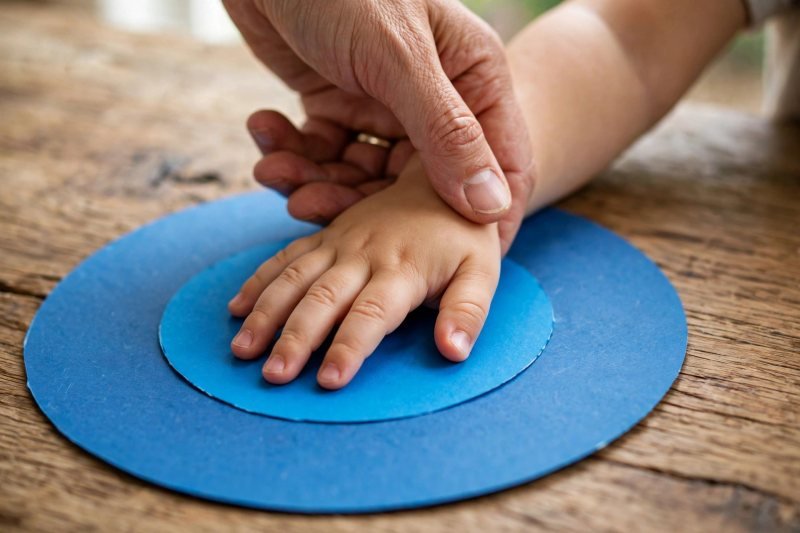
Start with the circle and trace it together. Hand your toddler the paper circle and say, "This is a circle," then trace its edge together with one finger, going round and round with no corners to stop at; the smooth, endless edge is the whole lesson, so let your toddler feel it twice — once with your hand guiding theirs, once on their own — while you repeat the word "circle" each time their finger travels the curve. Keep the other shapes out of sight for now: one shape at a time keeps a two-year-old's attention where it belongs, and the circle's friendly roundness makes it the easiest first win.
-
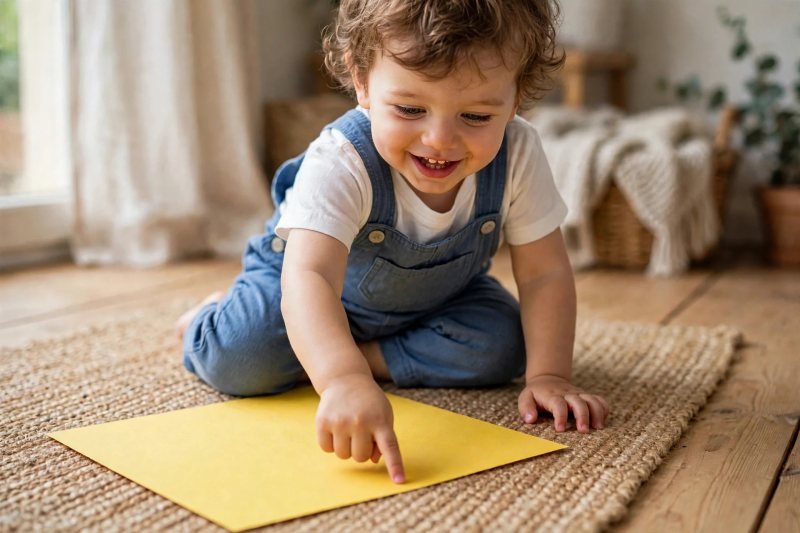
Touch the square and count its four corners. Hand over the paper square and say, "This is a square," then trace each straight side slowly, stopping at every corner to count out loud together — "one, two, three, four" — tapping each corner as you name it; counting the corners out loud turns the shape into a first counting game, and the stop-start rhythm of side-corner-side is what makes "square" feel different from "circle" in small hands. If your toddler rushes past the corners, slow the trace down yourself and let them catch up — the pause at each corner is the teaching.
-
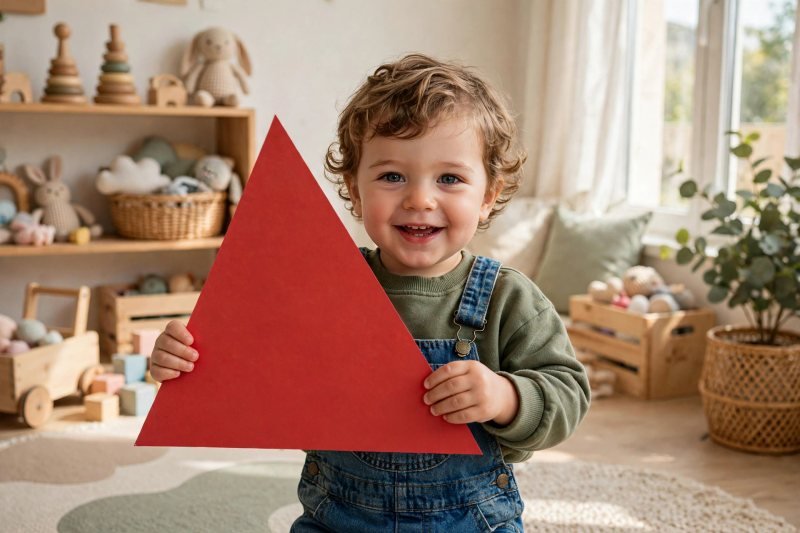
Meet the triangle and count its three sides. Hand over the paper triangle and say, "This is a triangle," then trace its three sides together, counting three corners the same way — "one, two, three" — and point out the difference your toddler can feel: the triangle has fewer corners than the square, and one of its corners points up like a roof. Hold the paper triangle next to the square for a side-by-side look so the contrast lands, then let your toddler hold the triangle up proudly — naming a shape they are holding beats naming one they are only looking at.
-
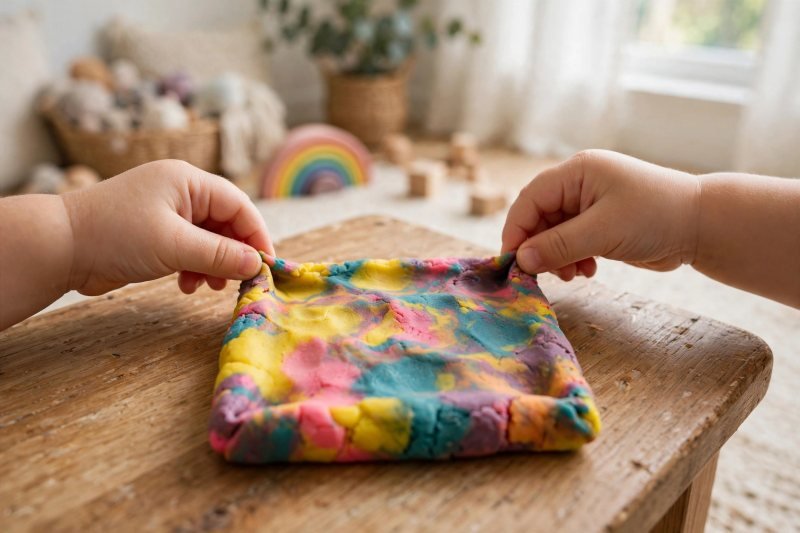
Squish the shapes from playdough. Set out soft playdough and make the three shapes together with your hands: squash a ball flat into a circle, pinch four corners onto a second ball for a square, and three onto a third for a triangle, narrating each move — "squash, pinch, pinch" — as you go; pinching corners is small-hand work, so it doubles as fine-motor practice, and the same pinching and rolling shows up in fine motor activities for preschoolers as your child grows. Make each shape from a different color of playdough so color and shape get learned together — color-mixing play pairs naturally with shape play — and let your toddler squash a finished shape flat and start again, because remaking is the fun.
-
Stomp the shapes on the floor. Tape the three shapes to the floor a few feet apart, press the tape flat so little feet cannot catch an edge, then call out, "Find the circle!" and let your toddler run, crawl, or hop to it and stomp; celebrate the arrival more than the accuracy, and play it again with the square and the triangle. The whole-body movement is the point — toddlers remember with their feet as much as their eyes — and if you want more movement games for the same age, toddler learning activities at home has plenty that need nothing but floor space.

-
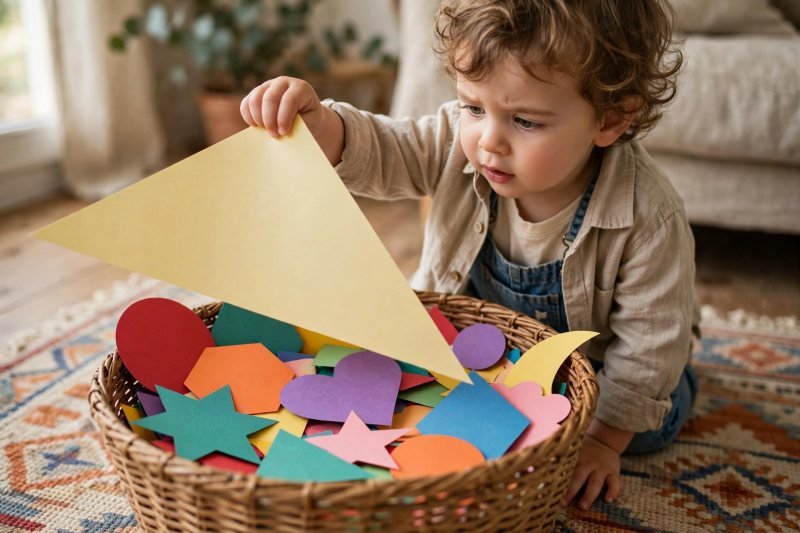
Pull shapes from the basket and name them. Drop all nine cutouts in the basket and mix them up, then let your toddler pull them out one at a time while you name each one as it appears — "circle!", "square!", "triangle!" — turning the pull into a little surprise each time; if they name one wrong, model the right word cheerfully — "That's a triangle!" — without correcting, because hearing the right word in a happy moment teaches faster than any correction. If your toddler pulls the same shape three times running, cheer it anyway — repetition is the learning — and the naming game works like a simple memory and matching game once they start remembering which shapes are still in the basket.
-
Hunt for circles in the kitchen. Walk to the kitchen together and look for real circles: a plate, a lid, the bottom of a cup, the face of a clock; hold the paper circle next to each find and say, "Same shape!" so your toddler sees the paper shape and the real thing match. Let your toddler do the pointing once they catch on, and follow their lead to the next room if they are on a roll — a circle hunt that wanders into the hallway is still a circle hunt, and finding shapes in the real world is what turns a paper game into lasting knowledge.

-
Hunt for squares and triangles around the home. Repeat the hunt for the other two shapes: a square napkin or cracker, a triangle from a folded sandwich half, a square cushion, the triangular corner of a folded blanket; let your toddler do the spotting now, and name each find together as you go. Keep the hunts short — two or three finds per shape is plenty — and stop while your toddler is still excited rather than pushing for one more, because ending on a win is what makes them ask to hunt again tomorrow.

-
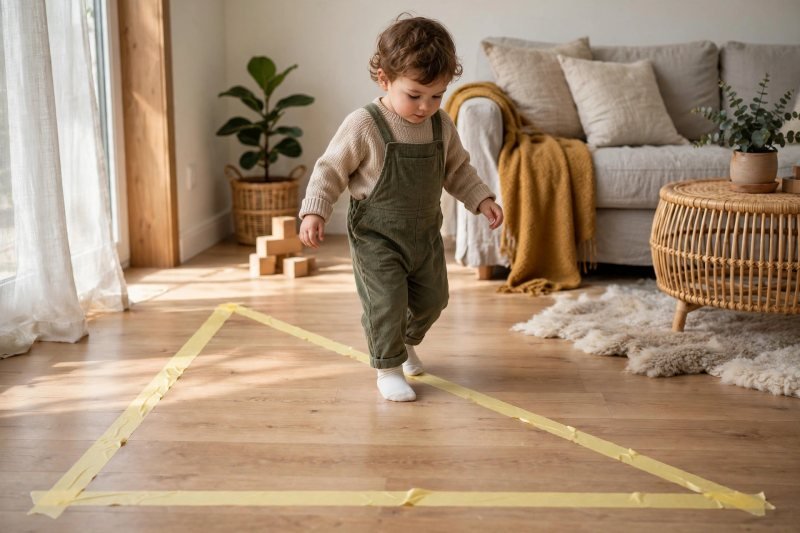
Tape a giant triangle on the floor and walk it. Outline a big triangle in painter's tape, large enough for your toddler to stand inside, then add a circle and a square beside it, pressing every strip flat so little feet do not catch an edge; your toddler walks the outlines, stepping right on the tape, feeling the straight sides and sharp corners under their feet. Walk it with them the first time, narrating as you go — "straight, corner, straight, corner" — then let them walk it alone, and try walking it backward or hopping from corner to corner once the shape feels familiar.
-
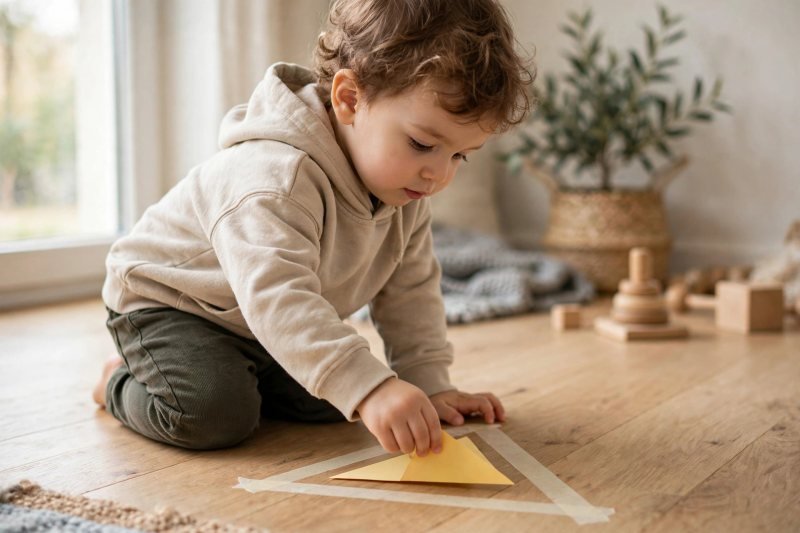
Match the cutouts to the tape shapes, then wind down with shape talk. Hand over the paper cutouts one at a time and let your toddler drop each onto the matching tape outline, celebrating every match and gently guiding the misses — "the triangle goes on the triangle lines, see?" — until all three shapes sit on their outlines; then sit down with the basket, pick up a shape, name it, and let your toddler name it back as each one goes away, turning cleanup into one more round of the game. If your toddler names all three without a pause, they are ready for the next level — the shape activities for preschoolers build on exactly these three shapes, adding sorting and new shapes to meet.


Make it easier
Work with just the circle for a whole week before adding the square. Use the biggest cutouts you can manage (dinner-plate size) for easy grabbing. Skip naming entirely — just touch, stomp, and squish; the words come later.
Make it harder
Hold up two circles and a square: "which one is different?" Ask "can you find the shape with NO corners?" and let them hunt. Count the sides of a triangle or the corners of a square together.
Other ways to play it
- Shape stomp dance party. Put on your toddler's favorite song and scatter the cutouts on the floor. Each time the music pauses, call a shape and everyone stomps on it. Freeze-dance energy meets shape names — toddlers ask for this one on repeat.
- Sensory shape tray. Bury the cutouts in a tray of dry rice. Your toddler digs through, pulls out a shape, and names it — the surprise of each find holds short attention spans.
- Shape rubbings. Tape the cutouts to the table, lay paper over them, and rub a crayon across so the shape appears. The arm movement builds pre-writing muscles.
- Bedtime shape spotting. During the bedtime routine, spot shapes around the bedroom: the round clock, the square pillow, a folded blanket corner. Two minutes a night, zero setup.
How it changes by age
- Age 2: Focus on touching and naming. Your two-year-old learns the three words mostly by hearing you say them while their hands are on the shape. Matching is hit-or-miss and that's developmentally perfect — celebrate attempts, not accuracy.
- Age 2.5: Expect your child to point to the right shape when you name it, even if they can't say the word yet. Receptive language runs ahead of speech at this age — trust it and keep narrating.
- Age 3: Many three-year-olds can name all three shapes, sort cutouts into piles, and spot them around the house unprompted. If yours is ready, introduce one new shape — rectangle or oval — but there's no rush.
What they're learning
Shape names and recognition: identifying circles, squares, and triangles by sight and touch Geometric attributes: circle — round, no corners; square — 4 equal sides, 4 corners; triangle — 3 sides, 3 corners Fine motor skills: tracing edges, pinching playdough corners, picking up cutouts Gross motor skills: walking tape outlines, stomping, moving between shapes Language development: hearing and repeating shape words in meaningful context Early math thinking: noticing sameness and difference, beginning to sort
Clearing up
A common worry is that a toddler "should" name shapes by age two — but milestones treat shape naming as an emerging skill between ages 2 and 3, not a deadline. A child who stomps on a circle without saying the word is still building the recognition that naming grows out of. Another misconception: that shape learning needs flashcards or apps. Young children grasp concepts best through their bodies — tracing, walking, squishing — because movement helps the learning stick better than just looking at a picture.
Questions parents ask
What shapes should a 2-year-old know?
How do I teach my toddler shapes without flashcards?
My toddler calls every shape a circle. Is that normal?
What is a good first shape activity for a 2-year-old?
Are shape sorters good for toddlers learning shapes?
When should I introduce more shapes beyond circle, square, and triangle?

save it for later
Pin this for the next rainy afternoon
Keep it on a board so it is there when you need it, rather than when you happened to find it.
Save to Pinterest


