


Kids' Hair Type Chart: Identify Your Child's Texture (1A to 4C)
A gentle, text-only guide to kids hair types for ages 3-4: look at dry hair, test one strand, check wet hair, and walk 1A to 4C to find your child's texture and care clues.
Kids hair types use a common 1A to 4C guide: straight is Type 1, wavy Type 2, curly Type 3 and coily Type 4, with A to C moving finer to fuller within each family. Identify your child by looking at dry hair, laying one shed strand flat, and checking wet hair, then match care to the most delicate pattern present.

The short version
- Start dry, test one shed strand on a towel, then check wet hair — those three clues together beat any single photo or guess.
- The chart runs 1A to 1C straight, 2A to 2C wavy, 3A to 3C curly and 4A to 4C coily, as a common guide, not a scientific label.
- Mixed textures on one head are normal, and type can change as baby hair grows out — re-check every few months.
- Add porosity and frizz clues to the type headline: how fast hair wets, dries and lifts in humidity predicts care better than a letter alone.
- Match care to type with a light touch for straight, balance for wavy, moisture and wet-only detangling for curly and coily, and always follow the most delicate pattern.
- Age
- Ages 3–4
- Mess
- Low
Why kids love this
Three- and four-year-olds love this because it feels like a looking game in front of the mirror, not a test. There is no pulling, no product piled on and no right or wrong answer; a child watches their own hair spring, wave, swirl or fall smooth, feels one soft strand between their fingers, and hears their texture described with warm, admiring words. Spotting that one head can be smooth on top and curly underneath, or that wet hair tells a different story than dry hair, lands as a small discovery rather than a label. When you name what you see positively — bouncy, silky, swirly, springy — your child hears that their hair, exactly as it grows, is interesting and worth caring for gently.
What you'll need
- A wide mirror in good natural light — a bright bathroom or a salon corner at home where you can see shine, wave and curl shape clearly without shadows
- A spray bottle filled with plain clean water — for the wet-hair clue only; containers should be plain and unlabeled in your play space
- A soft, light-colored towel — to catch loose strands, to dab hair dry, and to give a plain background that makes a single strand easier to see
- A wide-tooth comb and a soft brush — for gentle detangling only if hair is already loose and comfortable; never to force hair flat for the test
- A few loose, shed strands collected gently from a brush or pillow — for the strand-pattern test; never pull a strand out for this
- A notebook or phone notes page for your own private notes — what you saw dry, what you saw wet, and where different patterns appear on the head
- Patience and a calm five minutes after play or before bath time — observation works best when your child is rested, not rushed, hungry or already upset about hair care
Before you start
1. Choose a calm moment when hair is clean, fully dry, loose and free of heavy styling — ideally the day after a wash, with no tight braids, ponytails or hats flattening the pattern just before you look. 2. Set up your mirror corner: lay the soft towel over the stool or counter, fill the spray bottle with plain water, and place the comb and brush nearby but out of the way until you need them. 3. Invite your child as a partner, not a subject — explain that you are going to play a looking game to learn how their hair likes to be cared for, and let them hold the towel or the spray bottle if they want a job. 4. Agree your language before you start: every pattern you might see — straight, wavy, curly and coily — gets a positive word, and there is no best type in this chart, only useful information for gentler care.
How to do it
-
Step 1: Look at dry hair first. Start with hair exactly as it wakes up and lives its day — clean, completely dry, loose, unbrushed if it is curly or coily, and lightly brushed only if it is straight or wavy and that is its normal state — dry hair shows the true everyday pattern you care for; stand your child in front of the wide mirror in bright, even light and simply look together from the front, the sides and, with a second small mirror or a gentle turn, the back; notice whether strands fall mostly straight with no bend at all; whether they form a loose, flowing S shape that comes and goes; whether they loop into clear spirals or ringlets you could slip a finger through; or whether they grow in tight, small coils and zigzags that sit close and spring back when stretched — and notice that different areas may disagree — smoother at the crown, waves at the sides, tighter curls at the nape — which is completely normal. Say, "Let us just look first — your hair is telling us its story today." Write down in your private notes what you see in plain words — smooth, swaying, spiraling, springy — before you reach for any letter or number, because that honest dry-hair picture is the anchor every later step checks back against.

-
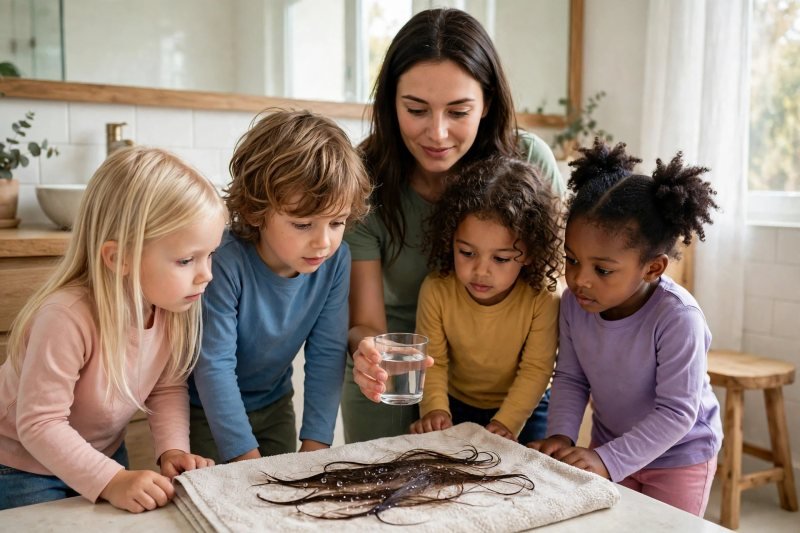
Step 2: Try the single-strand pattern test. Next, take one loose strand only — a shed strand lifted gently from a brush, a pillow or the towel, never a strand pulled from the head — and lay it flat on the light-colored towel where you can see its natural shape without stretching it; let it rest for a few seconds and watch what it chooses to do on its own — a strand that lies almost completely straight with no curve is telling you about straight hair; a strand that relaxes into a gentle, elongated S is telling you about wavy hair; a strand that curls back into a clear loop or spiral is telling you about curly hair; and a strand that forms a very small, tight coil or a tiny zigzag is telling you about coily hair — then, if your child is curious, hold the strand very lightly at one end, let it hang, and notice how much it springs back when you release it, without ever tugging. Say, "One tiny strand, no pulling — let us watch what shape it makes all by itself." Repeat with two or three shed strands from different parts of the head — crown, above an ear and nape — and do not worry if they do not all match, because mixed patterns are the rule for many children, and the most common pattern is simply your headline.

-
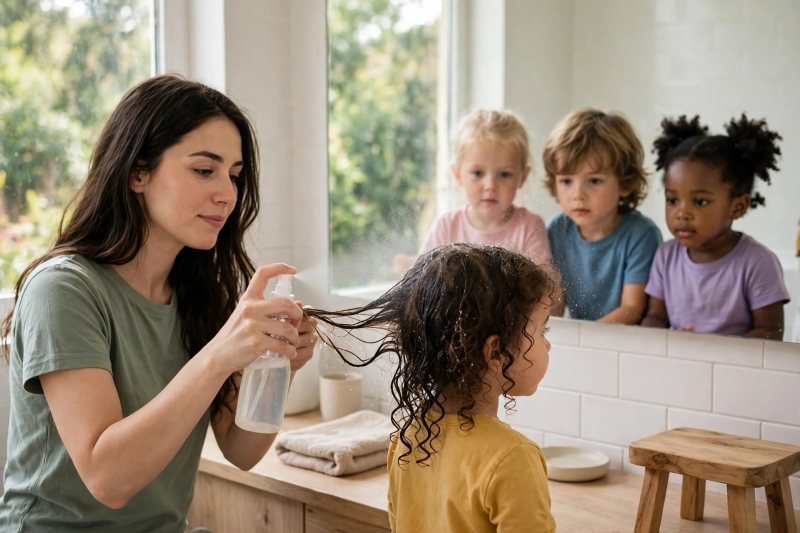
Step 3: Check the wet-hair clue. Now add water, because wet hair reveals the pattern underneath everyday fluff, product and sleep — lightly mist a small section with the spray bottle until it is damp, or do this step at the start of bath time when hair is wet through, and watch closely what changes; straight hair usually stays straight when wet, perhaps looking a little sleeker and heavier; wavy hair often shows its S shape more clearly when wet, then softens again as it dries; curly hair may stretch longer when wet and spring back up as it dries, sometimes looking surprisingly different at the two stages; and coily hair often shows noticeable shrinkage when it dries, looking shorter dry than it did wet, which is a healthy, expected quality of tight coils rather than anything to correct — compare the same section dry and damp, and note whether curls form more clearly, whether waves disappear, and how much length changes, because those wet-to-dry shifts are among the most useful clues in the chart. Say, "Water shows us a secret — let us see what your hair does wet, then watch it spring back dry." If your child dislikes spraying, stop and use bath time instead; the clue is helpful, never worth a battle, and a toddler first haircut appointment is another calm moment when a stylist sees hair both wet and dry and can share what they notice.
-
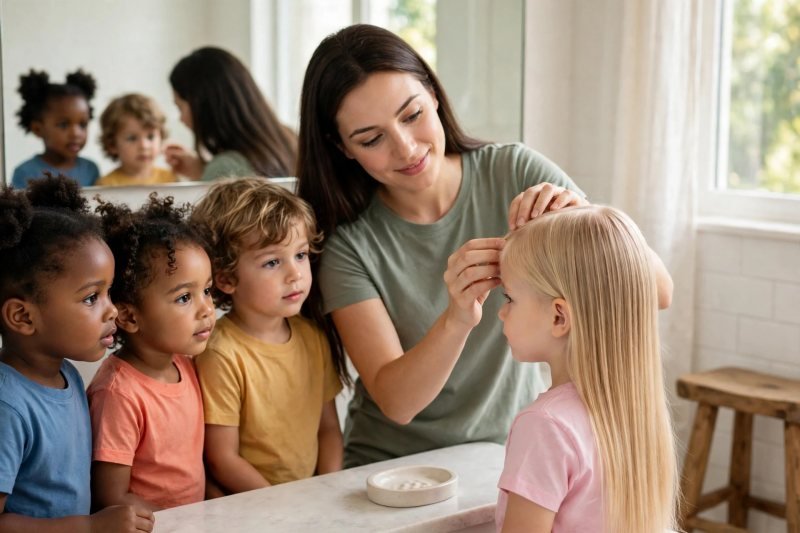
Step 4: Walk the straight types, 1A to 1C. With your dry, strand and wet clues in hand, walk the chart slowly in words, starting with straight hair, which the common Andre Walker-style typing guide groups as Type 1 — describe it as a helpful shared language, not scientific fact or a fixed identity, because children's hair is still developing; Type 1A is the straightest and finest — strands fall flat, feel silky and light, show almost no bend even at the ends, and tend to look shiny because the smooth surface reflects light easily; Type 1B is straight with a touch more body — strands still fall straight overall but feel a little fuller, may hold a very slight bend at the ends, and do not lie quite as flat against the head; Type 1C is straight and coarsest in this group — strands are thicker-feeling, mostly straight with occasional soft bends or flicks, especially around humidity or after sleep, and the hair can look fuller and less silky-flat than 1A — and across all three, straight hair shows scalp oil more quickly along the smooth strand, so let how often to wash toddler hair guide wash timing by oiliness rather than a fixed schedule; tangles ease out more readily, and heavy products weigh fine hair down fast, so light handling is the theme. Say, "Straight can be silky-flat, a little fuller, or thick and swishy — all straight, all lovely." If your child's dry strand lay flat and stayed flat wet, you are likely in this family, even if bedhead or a hat briefly suggests a wave that disappears on its own.
-
Step 5: Walk the wavy types, 2A to 2C. Continue the walk into Type 2, the wavy family, where strands form a stretched S pattern rather than a loop — Type 2A is fine and gentle — a loose, barely-there wave that appears most after air-drying, can be smoothed out easily with brushing, and often looks straight at the roots with soft movement through the lengths; Type 2B is a clearer, more defined S — waves start a little higher, hold their shape through the day, sit a bit flatter at the crown and show more texture through the middle and ends, with a greater tendency to fluff or frizz in humid weather; Type 2C is the fullest wave — thick-feeling S shapes that begin near the roots, border on loose curls in places, resist being brushed flat, and frizz most readily of the wavy group because the bends give humid air more to lift — and the key distinction to teach yourself here is wave versus curl: a wave stretches out into an S when you lay the strand down, while a curl loops back on itself into a circle or spiral, so return to your towel test whenever you are unsure between 2C and the curly family that follows. Say, "Waves make a long, lazy S — like a gentle hill, over and over." Wavy hair is often mixed with straighter roots and wavier ends, especially while baby hair grows out, so name the dominant wave rather than hunting for a perfect single letter.

-
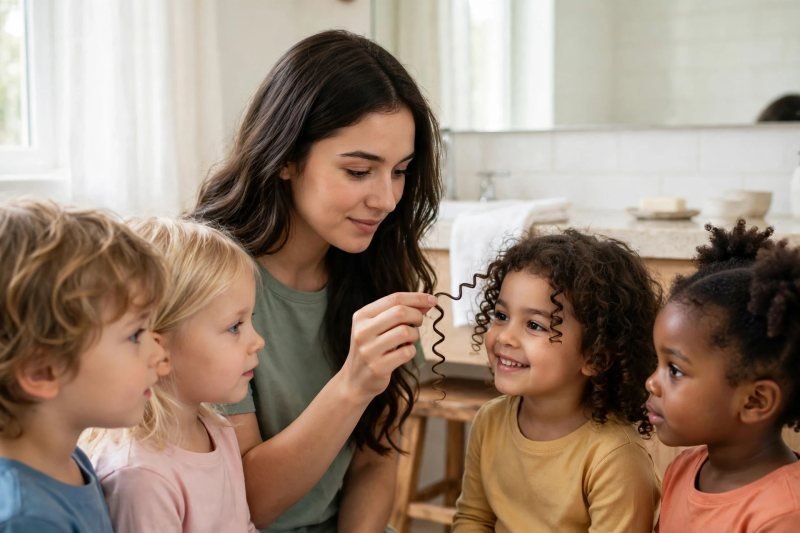
Step 6: Walk the curly types, 3A to 3C. Move next to Type 3, the curly family, where strands form real loops and spirals you can see from across the mirror — Type 3A forms large, loose, shiny loops — curls about as wide as a chunky sidewalk-chalk stick in everyday comparisons parents use, with a soft S at the root that gives way to clear spirals through the lengths, and hair that stretches noticeably when wet and springs back as it dries; Type 3B forms tighter, bouncier spirals — curls roughly the width of a marker or a small finger, with more volume, more spring and a stronger tendency to tangle where spirals wrap around each other, especially at the nape and after sleep; Type 3C forms the tightest curls in this family — dense, corkscrew spirals about the width of a pencil or a drinking straw, packed closely together, with the most volume and shrinkage of the curly group and a delicate feel that asks for especially gentle handling — and across Type 3, curls feel drier by nature because scalp oil travels slowly around bends, and curls should be judged by their dry, rested shape, not by how long they stretch when wet, because spring-back is part of their health. Say, "Curls make circles and springs — let us count how bouncy yours are today." If your child's towel strand looped into a spiral and the wet clue showed clear stretch and spring, you are in curly territory, and the exact step — A, B or C — matters far less than handling all curls slowly, wet or well-moisturized, and never dry-brushing them into fluff.
-
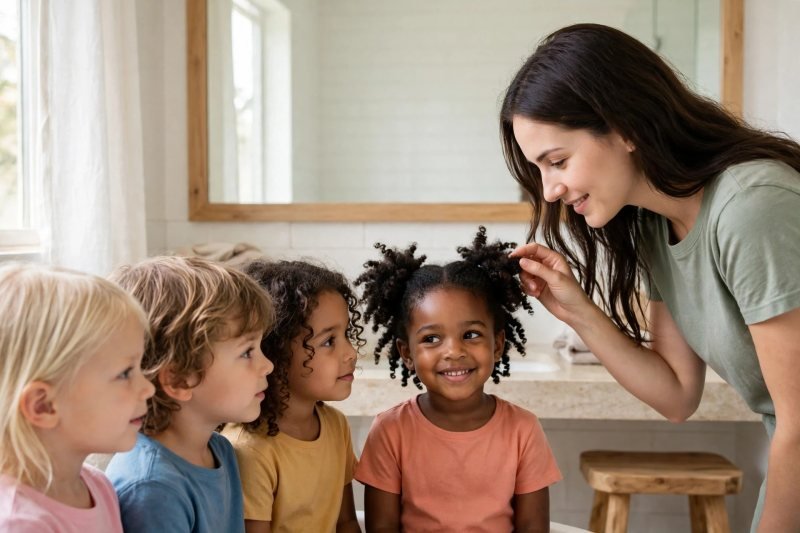
Step 7: Walk the coily types, 4A to 4C. Finish the main walk with Type 4, the coily family, where strands form the smallest, tightest patterns and the most beautiful shrinkage and density in the chart — Type 4A forms soft, defined small coils — tiny spirals with a visible curl pattern about the width of a crochet needle in common parent comparisons, springy and relatively easy to see strand by strand when hair is moisturized and rested; Type 4B forms a sharper, less defined pattern — strands bend in tight Z-like angles rather than round spirals, feel cottony-soft, pack densely, and show strong shrinkage so hair looks much shorter dry than its true stretched length; Type 4C forms the tightest, densest pattern — very small coils and zigzags that may not show a defined pattern without close looking, with the greatest shrinkage of any type in the chart, a fragile, delicate feel along each fine strand, and a need for the gentlest, most patient handling of all — and hear this clearly: coily hair is not difficult or problematic by nature; it is fine-stranded and bend-rich, so moisture, patience and protective, low-manipulation handling help it thrive, and natural hair care for Black toddlers offers gentle routines built around coily textures — neutral facts with care answers, not flaws. Say, "Coils are tiny springs packed with power — small, strong and amazing." Judge coily type dry and rested, expect and celebrate shrinkage as a sign of springy health, and remember that a 4C headline with 4A patches at the nape or crown is a completely ordinary mixed picture, not a contradiction.
-
Step 8: Read porosity and frizz clues. A type letter alone does not finish the picture, because two children with the same curl pattern can need different care depending on how their hair takes in and holds water — that quality is often called porosity, and you can read a simple, home version of it from clues you have already gathered; watch how quickly hair gets wet in the bath — hair that wets through instantly and dries very fast afterward behaves as if it drinks water quickly and lets it go quickly (often called high porosity); hair that takes a while for water to soak in, with droplets beading on the surface at first, behaves as if it takes in moisture more slowly but may hold it longer once it is in (often called low porosity); and watch frizz with the same neutral curiosity — frizz is simply strands lifting and separating in humidity or after friction from hats, pillows and dry brushing, and it appears across wavy, curly and coily types as useful information about moisture and handling, not as a failure or a problem to fix — note how hair feels a day after washing — light and fluffy, soft and settled, or dry-feeling at the ends, the oldest, most fragile part of the hair. Say, "Let us be detectives — how fast does your hair drink its water, and how long does it stay happy?" Keep these notes beside your type headline — for example, curly with slow-to-wet, fast-to-frizz clues — because together they predict far more about what will work than the letter alone, much as a simple kids' skincare routine works best when you notice how skin behaves, not just what it is called.
-
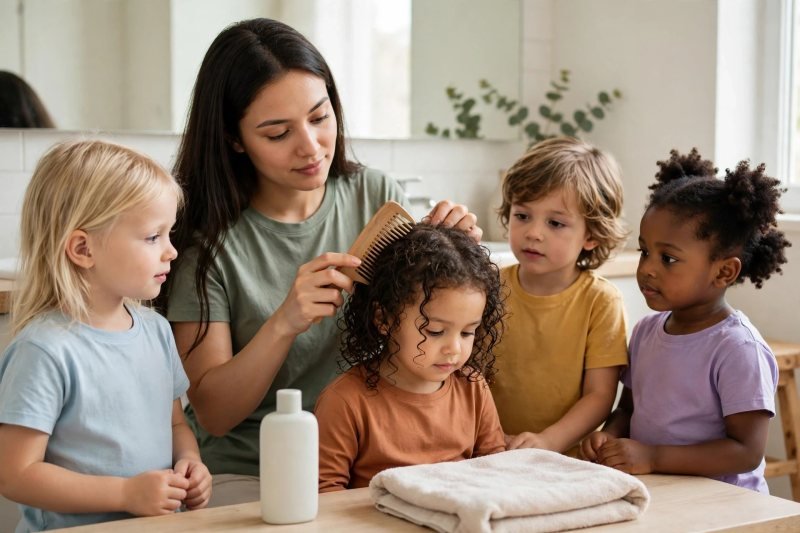
Step 9: Match the type to gentler care. Now turn identification into kindness, because the whole point of the chart is not the label but the handful of care choices the label helps you make more gently; for straight hair, think light — wash when roots look flat or feel oily, use only small amounts of light products, and detangle easily with fingers or a best hair brush for toddlers on dry hair; for wavy hair, think balance — avoid weighing waves down with heavy layers of product, scrunch gently as hair air-dries if your child enjoys it, and brush mainly before washing rather than repeatedly through dry waves; for curly hair, think moisture and minimal disturbance — detangle slowly only when hair is wet and slippery with a gentle, criteria-chosen conditioner, use a wide-tooth comb from ends upward, and avoid dry brushing that pulls spirals apart into frizz; for coily hair, think moisture, patience and protection — detangle in small sections when wet and well-conditioned, handle each fine strand as delicately as thread, favor low-manipulation styles that do not pull edges, and give drying plenty of unhurried time — and across every type, choose any product you use by criteria only, such as a best shampoo for kids and toddlers that is fragrance-free if your child is sensitive, easy to rinse, and suited to fine children's hair, rather than by promises, because no product changes a child's type and none needs to. Say, "Now we know a little more about how to be gentle — that is what the chart is really for." If a care choice causes tears, pulling pain or scalp discomfort, stop and simplify; comfort is a better guide than any chart, and type should make hair care calmer, never stricter.
-
Step 10: Re-check as hair grows and changes. Finish by putting a gentle expiry date on today's answer, because a three- or four-year-old's hair is a moving picture — baby hair sheds and is replaced, toddler curls sometimes relax as hair grows longer and heavier, straight baby hair sometimes gains wave, and coily patterns can become clearer as fine baby fluff gives way to a child's true texture through the preschool years — so re-run this same calm routine every few months, after any big change you notice in length, thickness or pattern, and whenever your current care suddenly stops working as well as it did; redo the dry look first, lay a fresh shed strand on the towel, check the wet clue again, and walk the four families in words until one headline fits the hair in front of you now, not the hair you remember from last year; update your notes with the date, celebrate any change as growth, and if patterns shift unevenly, name the mix out loud so care follows the most delicate pattern present. Say, "Hair grows and changes, just like you — we will look again and learn again." A child who hears that change is normal and interesting grows up trusting their hair's story, and that trust — far more than whether you landed on 2B or 3A today — is the lasting gift of learning kids hair types together.



Make it easier
Skip the letters entirely for a first pass: sort only into the four families — straight, wavy, curly or coily — using the dry look and the towel strand test, and add the A, B or C detail weeks later if you still want it. Do the whole routine inside bath night: dry look before the bath, wet clue in the bath, and towel strand test from the brush afterward, so no separate session is needed. Use photos as memory: take one dry-hair photo and one damp-hair photo in the same mirror light and compare them side by side later, when your child is asleep and you can think in peace.
Make it harder
Map the whole head: note the pattern separately at the crown, sides, front and nape, name the dominant type and the runner-up, and choose care that protects whichever pattern is most delicate. Add a two-day diary: record how hair looks and feels on wash day and on day two — shine, softness, tangles, frizz and how fast it dried — and use that diary, not the chart alone, to adjust washing frequency. Compare siblings or family members kindly: run the same looking game with an older sibling's shed strands on separate towels and talk about how every head in the family has its own mix, with no ranking.
Other ways to play it
- Bath-time version: move every observation into one bath — dry look at the mirror beforehand, wet clue and strand behavior in the water, and a first care match as you detangle gently afterward; best for children who dislike sitting still at a mirror.
- Salon-corner version: set up a pretend salon with the stool, mirror and towel, let your child type a doll's or stuffed animal's yarn or fabric hair first, then do their own looking game — rehearsal makes the real routine feel familiar and fun.
- Two-caregiver version: have two adults observe independently on different days and compare private notes before discussing a headline type; agreement builds confidence, and disagreement usually means a genuinely mixed pattern worth naming as a mix.
How it changes by age
- Age 3: Three-year-olds do best with the shortest, most playful version: the dry mirror look, one strand on the towel, and a quick wet clue at bath time, all wrapped in admiring language. Expect a wiggly session of five good minutes rather than a perfect assessment, accept a family-level answer — curly, for example — without pressing for a letter, and remember that a three-year-old's hair may still carry fine baby texture that will change noticeably over the next year, so hold every conclusion lightly and revisit it.
- Age 4: Four-year-olds can partner more fully: they can hold the towel steady, place the shed strand themselves, describe shapes in their own words — straight like a slide, wavy like the sea, curly like a spring, coily like tiny springs — and help notice differences between the front and the back of their head. Offer the full walk through the families in simple words, let them guess their family before you share yours, and start connecting type to one care choice they can own, such as holding the comb while you detangle only wet, slippery curls.
What they're learning
Observation and sorting: looking carefully before naming, comparing dry and wet, and sorting strands by shape — straight, S-shaped, spiral or tight coil — is real early science: classify by what you can actually see. Body knowledge and self-appreciation: learning the words for their own hair's pattern, hearing every texture described positively, and discovering that mixed patterns and change over time are normal builds a healthy, factual relationship with their own body. Cause and effect in care: noticing that dry brushing changes curls, that water reveals a truer pattern, and that gentler handling follows from what you observed teaches children that care choices have reasons they can understand. Patience and gentle touch: waiting for a strand to settle, handling a single hair without pulling, and sitting for a calm mirror game practice fine motor control, stillness and respect for delicate things — including their own hair.
Clearing up
Rinse the spray bottle and leave it to air-dry, shake the towel outside to release loose strands, and wipe the mirror and stool. Wash the comb and brush with warm soapy water, let them dry fully, and file your dated notes — dry pattern, strand shape, wet clue, porosity notes and headline family — where you will find them at re-check time. Throw away shed strands, and finish by telling your child one specific, true thing you loved learning about their hair today.
Questions parents ask
How do I identify my child's hair type at home?
What is the difference between 2C wavy and 3A curly kids hair?
Can a child have two hair types at once?
Does kids hair type change as they grow?
What does hair porosity mean for kids?
How should care change for curly and coily kids hair?
Internal link targets: toddler-first-haircut-guide (step 3, anchor "toddler first haircut"); how-often-wash-toddler-hair (step 4, anchor "how often to wash toddler hair"); natural-hair-care-black-toddlers (step 7, anchor "natural hair care for Black toddlers"); kids-skincare-routine-simple-steps (step 8, anchor "kids' skincare routine"); best-hair-brush-for-toddlers (step 9, anchor "best hair brush for toddlers"); best-shampoo-for-kids-toddlers (step 9, anchor "best shampoo for kids and toddlers").


