


4C Hair Care for Kids: A Wash-Day Routine for Tight Coils
A gentle wash-day routine for 4C hair kids ages 3-4: pre-poo, a soft cleanse, conditioning, detangling in small sections, moisturizing, and loose twists — low-tension, pain-free, and led by your child throughout.
For 4C hair kids ages 3-4, section dry hair, add pre-poo for slip, cleanse gently section by section, condition generously, and detangle only when wet and slippery, from the ends up. Rinse, moisturize and seal on damp hair, twist loosely, and refresh lightly the next day.

The short version
- Section first and work one piece at a time: pre-poo, cleanse, condition, detangle, rinse, then move on.
- Detangle only on wet, conditioned hair, from the ends up, holding above the comb so nothing tugs her scalp.
- Pain and tightness are stop signals — add slip, use fingers, or undo and redo looser, never push through.
- Moisturize and seal on damp hair, finish with loose twists, and let her pace, pauses, and choices lead the day.
- Celebrate tight coils exactly as they are — no brands, no pressure, and no promises to change her hair.
- Age
- Ages 3–4
- Mess
- Some
Why kids love this
Wash day feels good when it never hurts, never rushes, and never treats her hair as a problem to fix. For a 3- or 4-year-old with tight 4C coils, the magic is in the pacing: she chooses a song, she holds the cup, she tells you when to pause, and each small section is finished before the next one begins, so she can feel progress instead of overwhelm. The water play at the sink, the slippery conditioner, the gentle twists she can count and pat, and the soft wrap at the end turn care into a familiar rhythm she helped lead. Nothing pulls tight, nothing promises to change her coils, and every step says the same true thing in a different way — your hair is beautiful as it grows, and caring for it can be tender, unhurried time together.
What you'll need
- A wide-tooth comb with smooth, rounded teeth — for detangling only on wet, conditioned hair, never on dry coils
- Four to six large, smooth clips or soft bands — for holding finished sections apart without pulling, all plain and unlabeled
- A gentle cleanser and a generous amount of conditioner — in blank, unlabeled containers, chosen for your own child's hair and comfort
- A leave-in moisturizer and a light oil or butter for sealing — also in blank, unlabeled containers, used in small amounts
- A soft cotton t-shirt or microfiber towel — gentler on coils than a rough bath towel for blotting, never rubbing
- A small cup for pouring water, a basin or a sink with warm water, and a hand mirror so she can watch if she wants to
- A satin or silk-feel bonnet, scarf, or pillowcase for sleeping — smooth fabric that lets twists rest overnight
- A favorite song, a waterproof toy, and a snack and drink for break time — patience supplies matter as much as hair supplies
Before you start
1. Set out everything within arm's reach of the sink or basin — comb, clips, blank and unlabeled containers, soft t-shirt towel, cup, and mirror — so you never leave your child to fetch something mid-wash. 2. Agree the pace together before any water: she can ask for a pause, a song change, or a break at any point, and a pause always means hands stop straight away. 3. Dress her in a swimsuit or an old t-shirt for sink or basin washing, lay a towel underfoot for drips, and warm the room so wet shoulders do not get chilly between steps.
How to do it
-
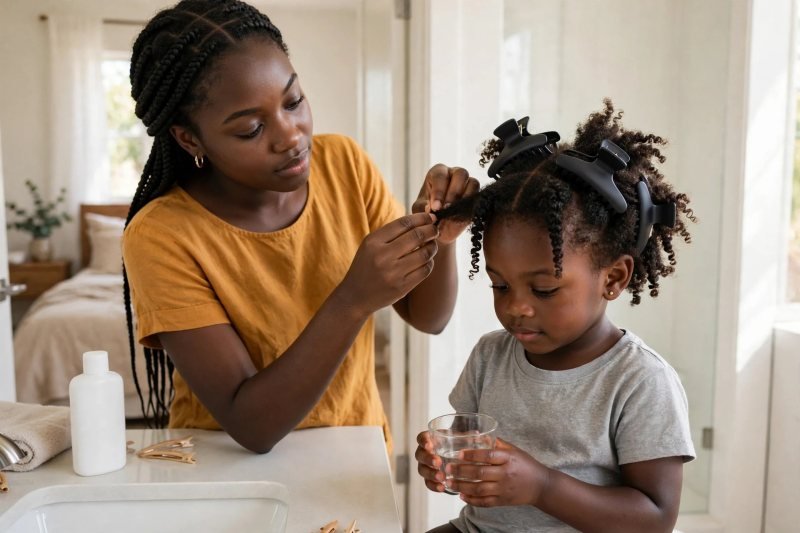
Section and pre-poo first. Start on dry hair, before any water, because tight coils are easier to part gently before they shrink up in the sink — use your fingers, never a fine comb, to divide her hair into four to six loose sections; clip each section up and out of the way; and work on one section at a time while the others rest. Smooth a little conditioner or oil from your blank, unlabeled container through the first section with your fingertips, loosening shed hair and large tangles with patient fingers only — the pre-poo adds slip, softens the section, and gives the later cleanse less work to do. If first hair experiences are still new in your house, the calm, no-surprises pacing in this toddler first haircut guide uses the same child-led logic — explain, show, then begin. Say, "We start with small sections and soft hands — you tell me if you need a pause." A child who trusts the first five minutes will usually trust the whole wash day.
-
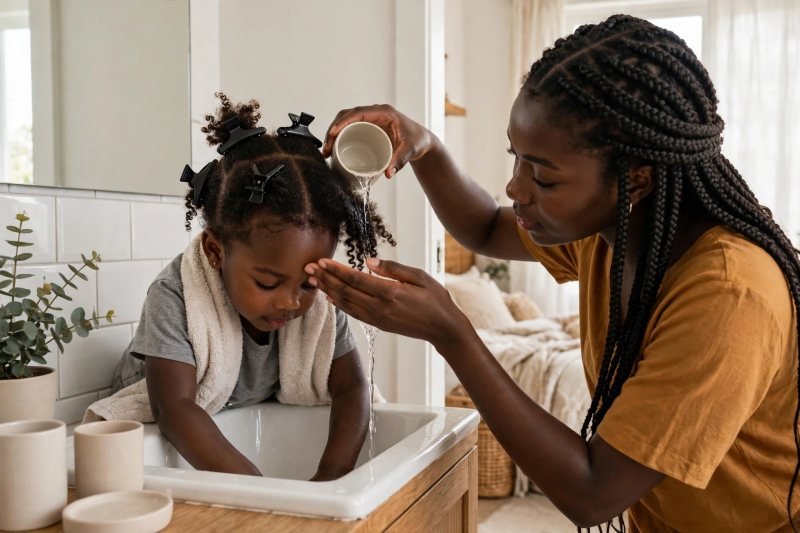
Cleanse gently, section by section. Move to the sink or basin with warm — never hot — water, keep her in her swimsuit or t-shirt with a towel around her shoulders, and wet one section at a time while the clipped sections stay mostly dry and out of the way. Smooth a small amount of gentle cleanser from its blank, unlabeled container onto her scalp with your fingertips — fingertips only, never nails — massage in small, slow circles, and let the lather rinse down the length of the section rather than scrubbing the coils themselves into a tangled pile. Keep her head at an angle she chooses, shield her eyes with your hand or a folded cloth, and pour with the small cup so water never rushes over her face without warning. Say, "Warm water, gentle circles, and I will always tell you before I pour." Cleansing the scalp kindly, section by section, is what keeps wash day calm enough to repeat.
-
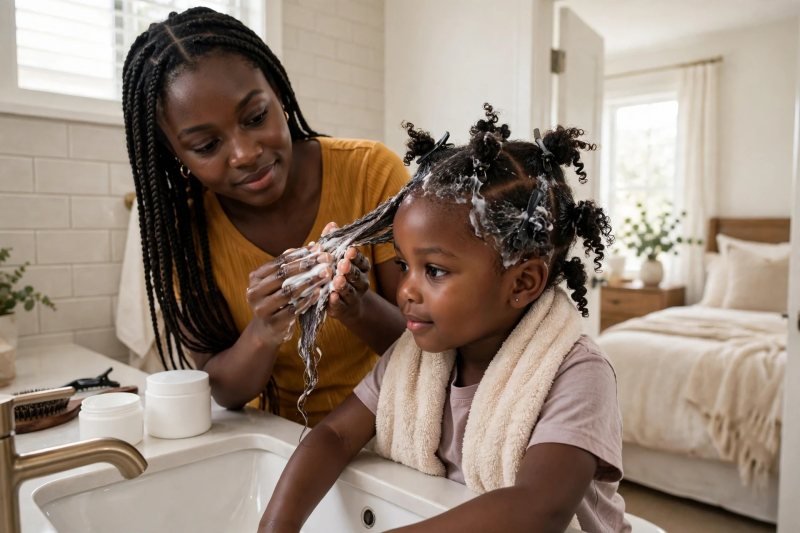
Condition generously and let it rest. While the section is still wet, coat it generously with conditioner from its blank, unlabeled container — tight coils detangle best when they are wet and slippery, and this is not the step to use a tiny amount. Smooth the conditioner from roots to ends with your palms, squeeze it gently through the coils so every strand feels coated, and then clip the section back up and move on to cleanse and condition the next one in exactly the same way. Letting conditioned sections rest while you work gives the hair time to soften, gives her a rhythm she can predict — wash, condition, clip, next — and gives you both natural pause points for a sip of water or a song. Say, "The conditioner is resting and making your coils soft and slippery — can you feel how smooth this section is?" Predictable repetition is comfort at this age, especially when each step feels kind.
-
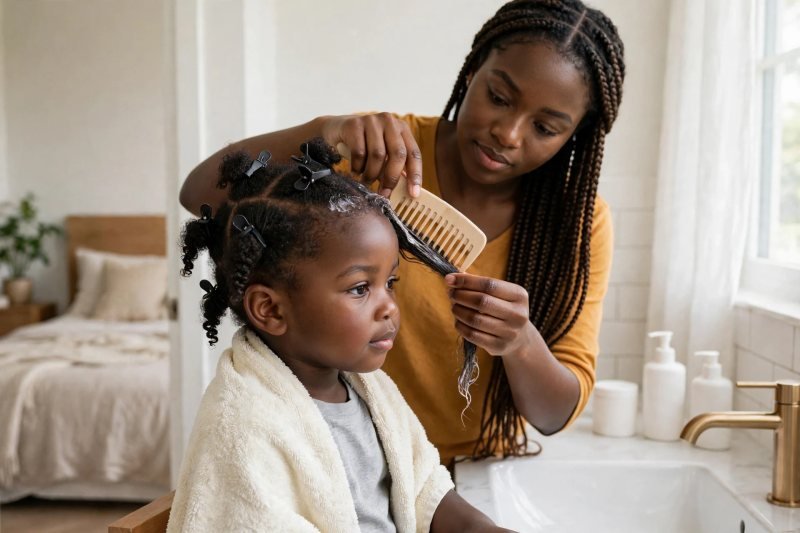
Detangle in sections, from the ends up. Take down one conditioned section — and only one — keep it wet and full of conditioner, and start with your fingers, gently separating what gives easily and leaving anything resistant for the comb. Then use the wide-tooth comb in the only order that stays pain-free: begin at the very ends, hold the hair above where you are combing so nothing tugs at her scalp, comb a short distance, move up a little, and repeat until you reach the roots — if the comb meets resistance, stop, add water and conditioner, and use your fingers first rather than pushing through. A snag is information, not a battle; pain is always a stop signal, never something to push past quickly to get it over with. Say, "We start at the ends and go slowly, and if anything pulls, we stop and add more slip." Detangling this way, section by section, is the heart of a low-tension wash day. The same ends-up, fingers-first approach is at the heart of our curly hair care for toddlers guide too.
-
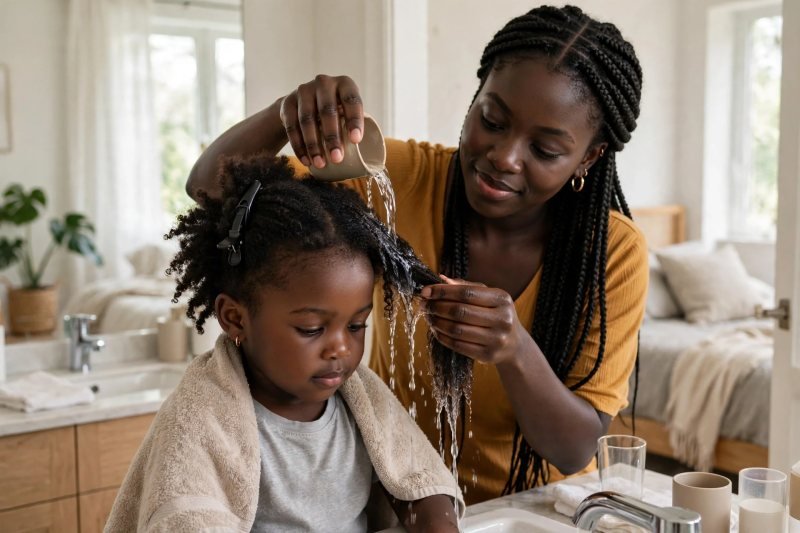
Rinse each detangled section clean. Once a section is detangled, rinse it with warm water from your cup or a gentle sink flow, pouring in the direction the hair falls and smoothing with your free hand so the coils stay elongated and separated rather than bunching back together. Squeeze the water out gently, blot — never rub — with the soft t-shirt towel, loosely twist or clip that finished section up, and only then move to the next conditioned section to detangle and rinse it in turn. Working in this finished-section rhythm means no part of her hair sits wet, loose, and re-tangling while you work elsewhere, and she can count the finished twists building up, which makes the end of wash day visible and near. Say, "One section washed, detangled, and rinsed — let's count how many are done and how many are left." Counting finished sections together turns a long routine into a story with chapters she can follow. If rinsing ever brings tears, the gentle pouring tricks in washing toddler hair without tears help here too.
-
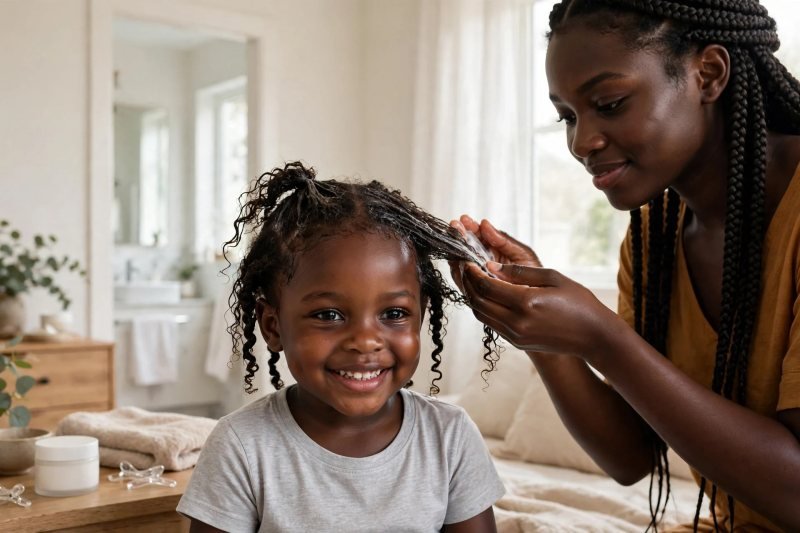
Moisturize and seal while hair is damp. With all sections rinsed, work again one section at a time while her hair is still damp — not dripping, not dry — because moisturizer spreads and absorbs most evenly on damp coils. Smooth a small amount of leave-in moisturizer from its blank, unlabeled container through the section with your palms and fingers, coating the length and especially the ends, which are the oldest and driest part of every strand; then smooth a very light layer of oil or butter over the top to seal that moisture in, using far less than you used for the moisturizer itself. The same gentle, damp-skin logic behind a simple kids skincare routine applies here too — small amounts, gentle hands, and a routine short enough to repeat without dread. Say, "Damp hair, soft moisturizer, a little seal on top — your coils are drinking it up." If a section starts to dry while you wait, mist or pat it with a little warm water and carry on.
-
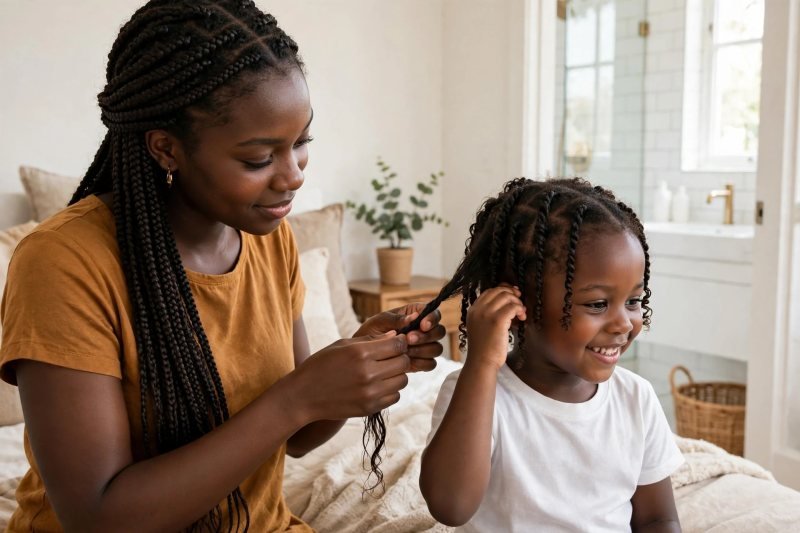
Twist each section gently and loose. Finish each moisturized section with two or three loose two-strand twists — divide the section, cross one part over the other all the way down with relaxed hands, and coil the very end around your fingertip so it holds without any tight pulling at the root. Loose is the whole point: twists should lie softly, never feel tight, never lift the skin at the hairline, and never hurt, throb, or leave her tender — if she says a twist feels tight, undo it and redo it looser without debate. Let her pat each finished twist, count them with you, and choose which side you start on next time, because small choices are how a 3- or 4-year-old stays a partner in her own care rather than a passenger. Say, "Gentle twists, nice and loose — they should feel like nothing at all." Twists keep detangled, moisturized coils separated and resting happily until they dry. Loose twists are one of the gentlest protective styles — see more low-tension ideas in our protective hairstyles for toddlers guide.
-
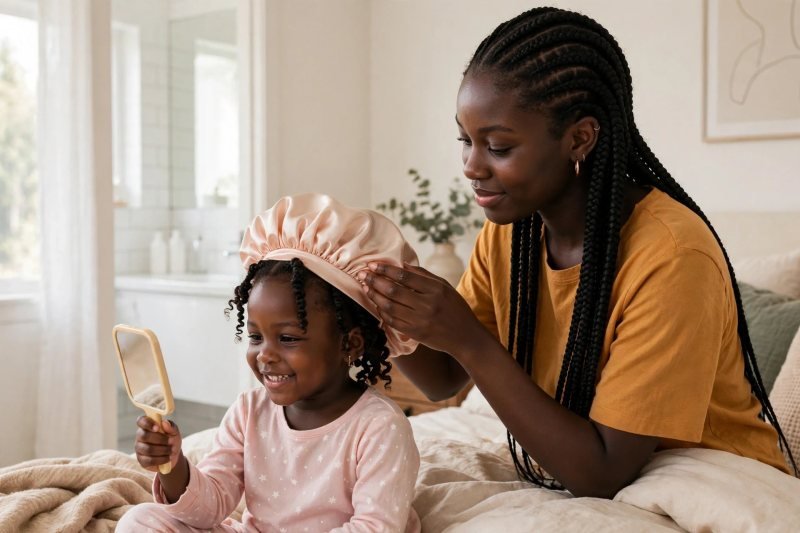
Dry softly and wrap for rest. Leave the twists in and let them air-dry as she plays, eats her snack, or listens to a story — no rubbing with a rough towel, no tight styling while the hair is wet, and no rushing the drying with anything hot against her scalp or skin. If you are heading toward bedtime, wait until the twists feel dry to the touch, then cover them with her smooth bonnet or scarf tied by an adult — snug enough to stay on, loose enough to slip off freely, and never tight around her neck or hairline — or let her sleep on the smooth pillowcase instead. Show her the finished twists in the hand mirror, name what is lovely about them out loud, and let her decide whether tomorrow is a twist-out day or a keep-the-twists day. Say, "Your twists are resting now, soft and neat — you were so patient and so helpful." Ending with admiration, not inspection, is what she will remember about wash day.
-
Refresh gently the next day. The next morning, decide together: keep the twists in for another day of easy care, or undo them one by one with lightly moisturized fingertips for a soft twist-out, unraveling from the ends and separating only where the hair parts easily on its own. For hair staying in twists or worn loose, refresh with the lightest touch — pat or mist a little water onto any dry-feeling areas, smooth a pea-sized amount of moisturizer from its blank, unlabeled container over the top with your palms, and leave the roots and scalp completely alone. Never re-detangle dry hair with a comb, never chase perfect definition, and never restyle from scratch on a non-wash day; a two-minute refresh that respects yesterday's work is the routine that survives busy family life. Say, "A little water, a little softness, and your hair is ready — we do not need to start all over again." Next-day ease is the reward that makes the whole wash-day system worth it. For more on caring for Black toddlers' natural hair between wash days, see our natural hair care for Black toddlers guide.

-
Wrap up with praise and a promise. Finish wherever you are — bathroom or bedroom — by putting every blank, unlabeled container back together in one place with the comb and clips, letting her drop the clips into their spot herself, and reviewing the day in the mirror together for no more than a happy minute. Name specific things she did — she held the cup, she asked for a pause clearly, she counted the twists — because specific praise teaches her that her voice and patience shaped the routine, not just her stillness. Agree together, out loud, roughly when the next wash day will be, and let it be a flexible plan rather than a deadline, so the routine stays associated with care and togetherness instead of dread or surprise. Say, "We took care of your beautiful coils together, slowly and gently, just like they deserve." A wash day that ends with pride is a wash day she will walk into willingly next time.



Make it easier
Wash in two sittings: pre-poo, cleanse, and condition in the morning, then detangle and twist after a meal or nap — a rested child and a rested parent detangle far more gently. Use four sections instead of six, accept slightly imperfect partings, and detangle with fingers only on weeks when time or patience is short. Shorten the routine, not the kindness: skip the pre-poo on an easy week, keep the cleanse kind and the conditioned detangle slow, and you still have a complete, gentle wash day.
Make it harder
Invite her to lead more: she holds the mirror, counts sections and twists out loud, chooses the order of sections, and helps smooth moisturizer through the ends with her own hands. Add a simple pattern to the twists: she picks whether each section becomes two twists or three, then counts and compares the finished sides — early math inside real care. Build a picture routine chart together with drawings — sections, sink, conditioner, comb, twists, bonnet — so she can follow and point to each step herself next wash day.
Other ways to play it
- Sink or basin version: the full routine at a kitchen or bathroom sink with a basin of warm water and the pouring cup — ideal for small bathrooms, quick rinses, and children who prefer standing or kneeling on a sturdy stool with an adult right beside them.
- Bath-time version: cleanse and condition during an ordinary bath, detangle the conditioned sections while she plays with a waterproof toy, then moisturize and twist in the bedroom afterwards so no step feels rushed by cooling bathwater.
- Two-caregiver version: one adult washes and detangles while the other reads, sings, holds the mirror, and manages breaks and snacks — especially helpful for a first wash day in this routine or a particularly tender-headed week.
How it changes by age
- Age 3: Keep everything shorter and closer: four sections, a briefer cleanse, fingers-first detangling with the comb used only briefly and only on slippery, conditioned hair, and breaks whenever she asks — including a full stop and a return later. Sit her where she feels secure, narrate every pour before it happens, and expect her participation to be choosing songs, holding the cup with help, and patting finished twists. A fifteen-minute gentle version done kindly teaches her more than a long version endured.
- Age 4: A 4-year-old can follow the full sequence, hold a section while you comb the ends, count sections and twists, choose twist or twist-out for the next day, and tell you clearly what feels tight, cold, or uncomfortable — believe her every time and adjust. Give her real jobs, real choices, and the mirror, and let her pride in her coils be part of the conversation: naming her hair as beautiful, strong, and worthy of gentle time is the lesson underneath the routine.
What they're learning
Body autonomy and voice: asking for a pause and being heard instantly, reporting what feels tight or uncomfortable, and making choices about her own hair — early lessons that her body and her words both matter. Counting and sequencing: four to six sections, steps in a fixed kind order, twists counted as they build — math and logic lived through a real routine rather than a worksheet. Patience and cause and effect: conditioner plus water plus slow hands makes detangling comfortable; rushing makes it pull — a gentle, memorable lesson in why process matters. Self-care and identity: her tight coils are celebrated exactly as they are, cared for without any attempt to change them, and worthy of unhurried, tender time — a foundation for confidence that reaches far beyond hair.
Clearing up
Rinse the comb and clips in warm water, remove any shed hair to the bin, and wipe the sink or basin so conditioner does not dry into a slippery film for the next person. Cap and put away every blank, unlabeled container in one basket with the comb, clips, and soft towel, so the whole kit is findable next wash day without a search. Shake the t-shirt towel and any dripped-on towels straight into the laundry, mop the floor dry, and put the bonnet or smooth pillowcase back in its bedroom spot ready for tonight.
Questions parents ask
How do you wash 4C hair for kids without tears or pulling?
How often should you wash a 3- or 4-year-old's 4C hair?
What is pre-poo for kids with tight coils?
How do you detangle 4C hair for kids gently?
How do you keep tight coils moisturized between wash days?
The routine is presented throughout as low-tension, pain-free, and child-led — pauses are honored instantly, tightness is always undone, and her coils are celebrated exactly as they are with no attempt or promise to change texture. Zero brands and zero prices in text or images; every container described as blank and unlabeled; no medical claims, no growth claims, and no texture-changing claims or promises anywhere.


