


Family Halloween Costumes: 15 Matching Themes for 2026
Fifteen matching family Halloween costumes you can build from clothes at home: pumpkin patch, zoo animals, chefs, dinosaurs, space explorers and more — each with what every family member wears and toddler-safe try-on tips for ages 3-4.
Matching family Halloween costumes for ages 3–4 are fifteen generic, no-sew themes — pumpkin patch, zoo animals, chefs, garden vegetables, dinosaurs, space explorers and more — each built from clothes at home with paper hats and face paint, so parents and toddler match safely with nothing tied at any neck.

The short version
- All 15 themes are generic and closet-built: solid-color clothes plus paper hats, ears, and badges — no bought costumes, no licensed characters.
- Toddlers never wear masks or eye patches; face paint, painted noses, and loose hats do the character work instead.
- Necks stay free on every theme: wings and packs use shoulder straps, sashes tie at waists, hats lift straight off.
- Dress in daylight, layer real warmth underneath, take the porch photograph early, and remove anything your child wants off instantly.
- Age
- Ages 3–4
- Mess
- Low
Why kids love this
Matching family costumes turn Halloween from a costume a child wears alone into a story the whole family steps inside together — and for a three- or four-year-old, that togetherness is the entire thrill. She is not just a pumpkin; her parents are pumpkins too, and the porch has become a pumpkin patch. She is not just wearing spots; she is the dinosaur in a family of dinosaurs, roaring on cue while her grown-ups stomp in a friendly, non-scary line. Every theme in this guide is deliberately gentle — no frightening faces, no masks covering a toddler's face, no licensed characters to disappoint her when the store version looks different — and every look can be put on over ordinary warm clothes, taken off in seconds, and rebuilt from what is already in drawers and wardrobes. The choosing, the trying on, the porch parade, and the photograph become the celebration, long before any doorbell rings.
What you'll need
- Everyday clothes in solid colors — orange, green, brown, black, white, red, blue, and yellow tops, leggings, and pants form the base of almost every theme
- Plain cardboard and sturdy paper — for hats, ears, tails, badges, and signs; all boxes and packaging kept blank, with no printing showing
- Soft fabric scraps, old T-shirts, and tea towels — for aprons, capes that fasten at the shoulders, sashes worn at the waist, and simple tails tucked into waistbands
- Paper hats, headbands, and soft crowns that sit on the head and lift straight off — never anything tied, looped, or elasticated around a neck
- Face paints suitable for young children's skin, plus a mirror — for noses, whiskers, freckles, and spots instead of masks
- Scissors and tape for adult use only, plus safety pins used only by adults and placed where small hands cannot reach them
- Warm layers to wear under costumes — vests, long-sleeved tops, and leggings, because October evenings are cold even under a dinosaur hood
- Comfortable closed-toe shoes for everyone — costumes go over real shoes; no costume footwear for walking outdoors
- A phone or camera for the porch photograph, a small basket or tote for any treats, and a flashlight carried by an adult for after-dark visibility
Before you start
1. A week ahead, let your child look at picture descriptions of the themes, pick a family favorite together, and write down the closet clothes each theme needs so nothing is a last-minute surprise. 2. Two days ahead, cut any cardboard ears, hats, and badges, try every adult fastening yourself first, and check that nothing ties at a neck, covers a toddler's face, or trails where small feet will trip. 3. On the day, lay out the full family set on a bed, dress in daylight, do face paint last at a calm moment, and take the porch photograph before anyone gets tired, hungry, or cold.
How to do it
-
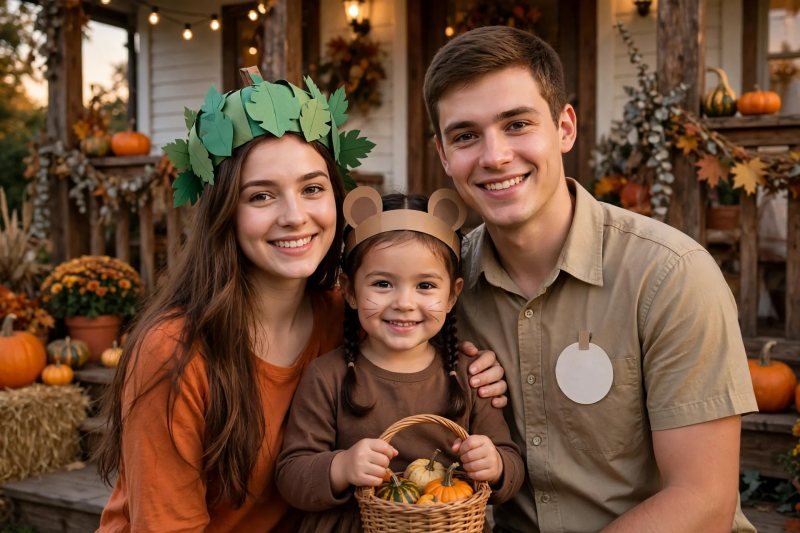
Start with the coziest classics. Begin where Halloween feels friendliest with (1) Pumpkin Patch Family — grown-ups wear orange tops with a green paper leaf hat and brown pants as stems and vines; your toddler wears an orange top over warm layers with a soft green leaf headband; add simple face-paint stem freckles and carry a small basket — and (2) Zoo Animals — grown-ups wear brown or tan clothes with paper ears on headbands as the friendly zookeepers in plain shirts with a paper badge pinned by an adult; your toddler chooses one animal with ears and a tail tucked into her waistband — a bear, a bunny, or a big cat with painted whiskers. Build both from closet clothes plus cardboard ears, keep tails short so nobody trips, and pair the choosing with simple Halloween crafts for toddlers earlier in the week so the ears feel familiar before the big night. Say, "We match, we belong together — which cozy family shall we be first?"
-
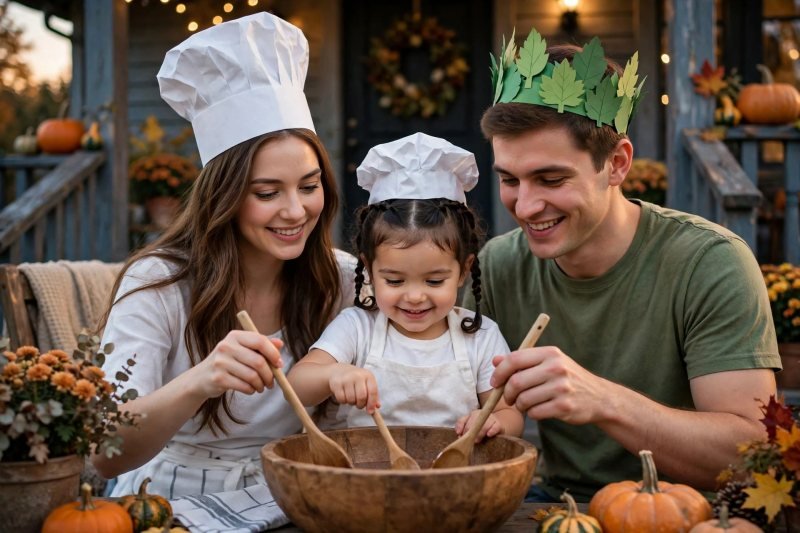
Cook up kitchen and garden fun. Move to the make-believe work themes with (3) Chefs and Bakers — grown-ups wear white tops with a tea towel apron tied at the waist and a tall paper chef hat; your toddler wears a white top with a smaller apron and a soft paper hat that lifts straight off; carry a wooden spoon each and paint on gentle flour-dust freckles — and (4) Garden Vegetables — grown-ups wear green tops as leafy stalks with a red or orange top for one tomato or carrot parent wearing a green paper leaf crown; your toddler is the sweet pea or baby carrot in green or orange with a leaf headband; use face-paint dots for seeds and hold a watering can for the photograph. Everything fastens at waists and shoulders only; aprons never loop at a neck. Say, "Chefs stir, gardeners grow — show me your best pretend sprinkle and your tallest stretch." Paper hats and aprons in this step are simple builds, and Halloween crafts for kids offers more of the same paper-and-glue toolkit for a rainy afternoon before the night.
-
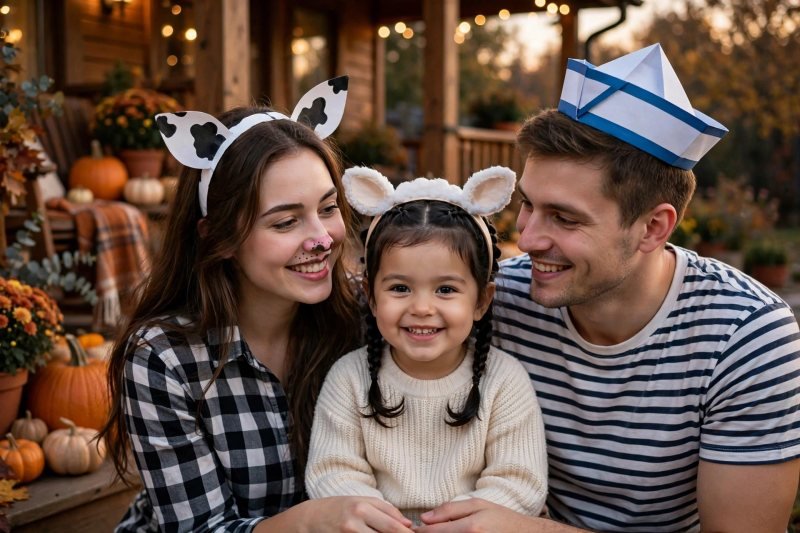
Head to the farm and the sea. Continue the story with (5) Farm Animals — grown-ups wear checked or plain shirts with paper ears as a cow, a pig, or a horse, with painted noses and a tail tucked into a waistband; your toddler is the lamb in a cream top with cotton-soft paper ears or the chick in yellow with a tiny paper beak hat that sits on top of her head — and (6) Ocean Creatures — grown-ups wear blue and teal as waves and sailors in striped tops with a paper sailor hat; your toddler is a friendly fish, turtle, or octopus in bright colors with paper fins taped to sleeves — never gloves that cover her hands — and painted bubble dots on her cheeks. Keep every fin and tail soft and short; if a piece flaps into her face, trim it or leave it off. Say, "Farm in the morning, sea in the afternoon — can you moo, then swim, without stopping?"
-
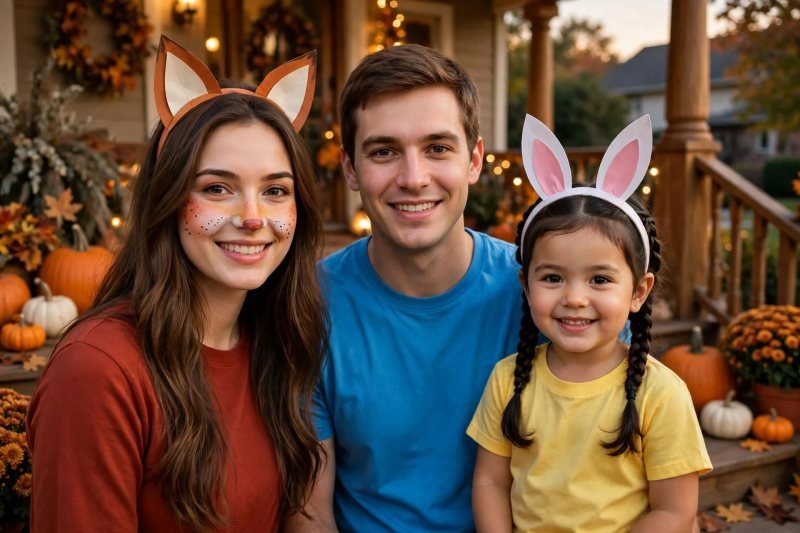
Wander the woods in every color. Take the family outside in your imagination with (7) Woodland Animals — grown-ups wear browns and rust reds as a fox, an owl, or a deer, with paper ears or a feather-free paper owl brow on a headband and painted noses; your toddler is the hedgehog or bunny in soft neutrals with ears that sit on a headband and lift off freely — and (8) Rainbow Family — each person wears one solid rainbow color from head to toe — red, orange, yellow, green, blue, and purple shared across the family; your toddler picks her color first and wears it over warm layers with a paper sun or cloud hat. The rainbow needs no making at all beyond sorting clothes, which makes it the kindest backup for tired evenings and for borrowing layering sense from toddler winter outfits so the colors go over real warmth. Say, "Woodland quiet or rainbow bright — walk softly like a fox, then shine like your color."
-
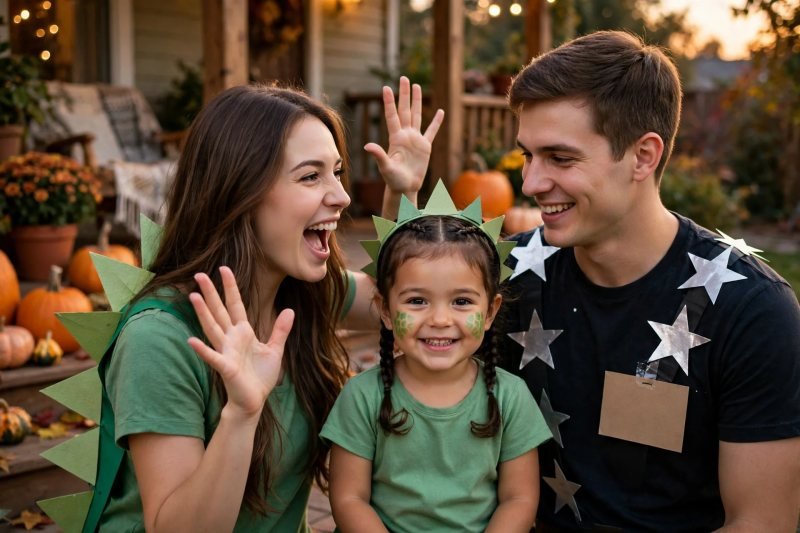
Roar gently, then blast off. Raise the energy carefully with (9) Dinosaurs — grown-ups wear green or brown with a row of soft paper triangles taped down the back of a top and a tail tucked into a waistband; your toddler wears the same in miniature with a soft hood or headband spikes and painted cheek scales; practice a friendly roar with hands up like tiny arms and keep stomping slow so nobody falls — and (10) Space Explorers — grown-ups wear dark tops with silver paper stars taped on and a plain cardboard badge pinned by an adult; your toddler is the littlest astronaut in a light top with paper stars, a soft paper moon hat, and a small cardboard jet pack worn with shoulder straps — never anything heavy, hot, or covering her face. Stars and spikes are paper only; nothing rigid sits at face height. Say, "Dinosaurs stomp softly, astronauts float slowly — show me both, one after the other."
-
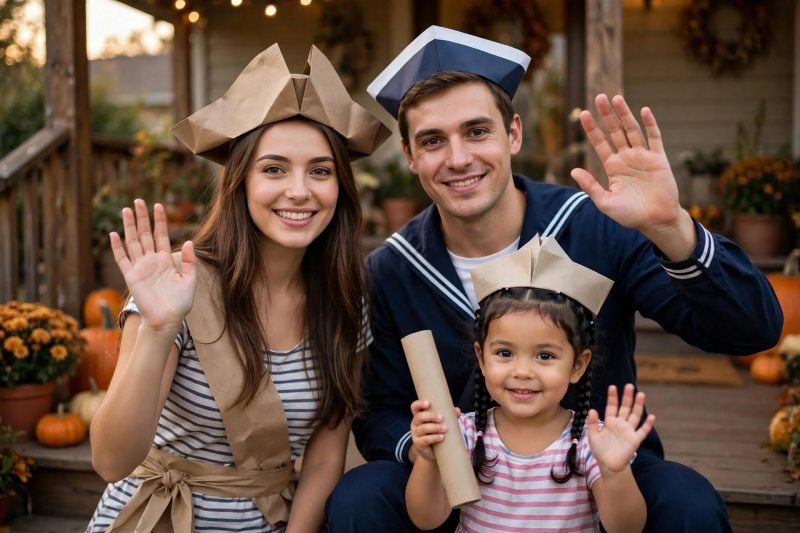
Sail away as pirates and sailors. Settle into swashbuckling without a single scary edge in (11) Pirates and Sailors — grown-ups wear striped tops with a waist sash, a paper pirate hat or sailor cap, and painted friendly freckles; one grown-up can be the sailor in white and navy with a paper collar laid over the shoulders; your toddler wears stripes with a soft paper hat, a waist sash tied by an adult at her side, and a cardboard spyglass she can drop freely. There are no eye patches for toddlers — they block vision on dark paths — no swords, and no neckerchief tied at any neck; collars and sashes sit at shoulders and waists only. Build the hats from plain cardboard the day before so the evening itself stays calm. Say, "Ahoy, small sailor — hats on, eyes clear, and we sail only where the grown-ups can see."
-
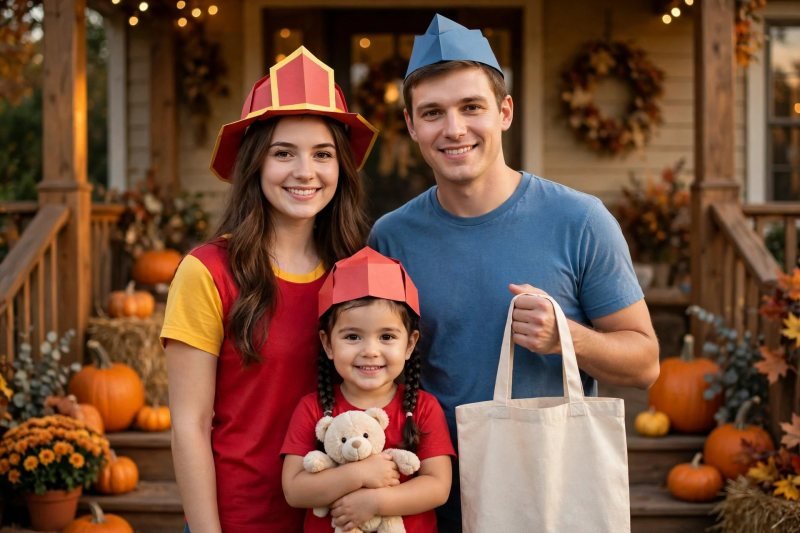
Help the neighborhood together. Choose the everyday heroes in (12) Community Helpers — grown-ups wear the helper bases — a postal worker in blue with a plain paper cap and an empty tote, a firefighter in red and yellow with a soft paper helmet, or a doctor in a white top with a paper badge; your toddler picks one helper to match a parent exactly — same colors, same paper hat, same badge shape — and carries one safe prop such as an empty envelope, a toy flashlight, or a plush patient. Matching one parent precisely delights this age more than a brand-new character, and borrowing the small-group, everyone-has-a-role logic of a 2nd birthday party keeps the helper parade feeling celebratory rather than overwhelming. Badges are pinned or taped by adults only. Say, "Helpers help — who are we helping today, and what is your very important job?"
-
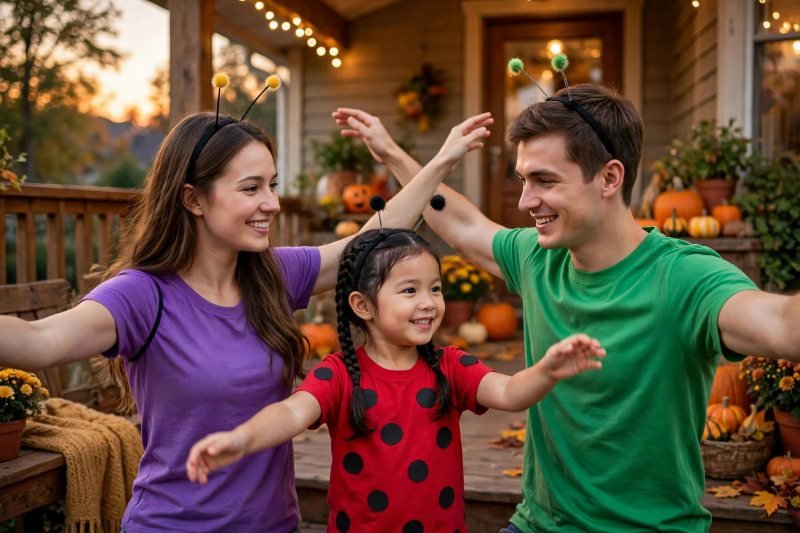
Flutter and buzz in the garden. Shrink the family down to garden size in (13) Bugs and Butterflies — grown-ups wear bright solid colors with paper wings fastened with shoulder harness straps over their tops and antennae on headbands with soft paper balls on the ends; your toddler is the butterfly or ladybird in her brightest top with small soft wings on shoulder straps — never elastic around her neck — a red top with painted or paper dots for a ladybird, and antennae that lift straight off. Wings come off the moment she asks, doors and car seats mean wings off for everyone, and no wing edge sits at another child's eye height in a crowd. Test the harness straps at home in daylight so Halloween itself holds no fastening surprises. Say, "Wings on our shoulders, feet on the ground — flutter to the porch and back, then rest." Wings and antennae only work if a child can wear them and still play, so rehearse the garden set in pretend play first — fluttering to the porch and back in daylight, with no audience, tells you what will survive the evening.
-
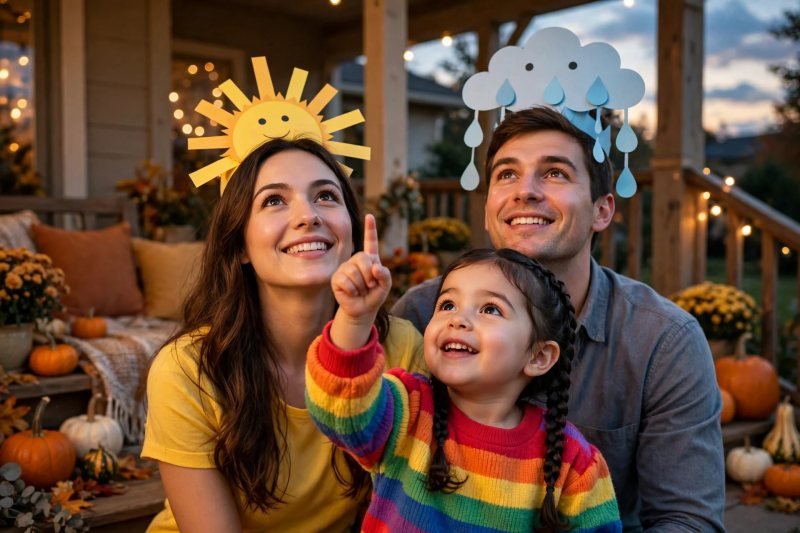
Become the weather itself. Dress as the sky in (14) Weather Wonders — grown-ups split the forecast — one in yellow with a paper sun crown as sunshine, one in gray-blue with paper raindrops taped to a top as a friendly rain cloud, each crown and hat sitting loose and lifting off freely; your toddler is the rainbow after the rain in mixed bright colors, or the snowflake in white and pale blue with a soft paper snowflake hat if the evening is truly cold. Layer real warm clothes underneath every weather look, because pretend sunshine keeps nobody warm, and keep paper raindrops and stars taped flat so nothing dangles near faces or necks. This theme photographs beautifully on the porch at dusk with everyone pointing at the real sky. Say, "Sun, rain, rainbow — point to yours, then look up: what is the real sky doing tonight?"
-
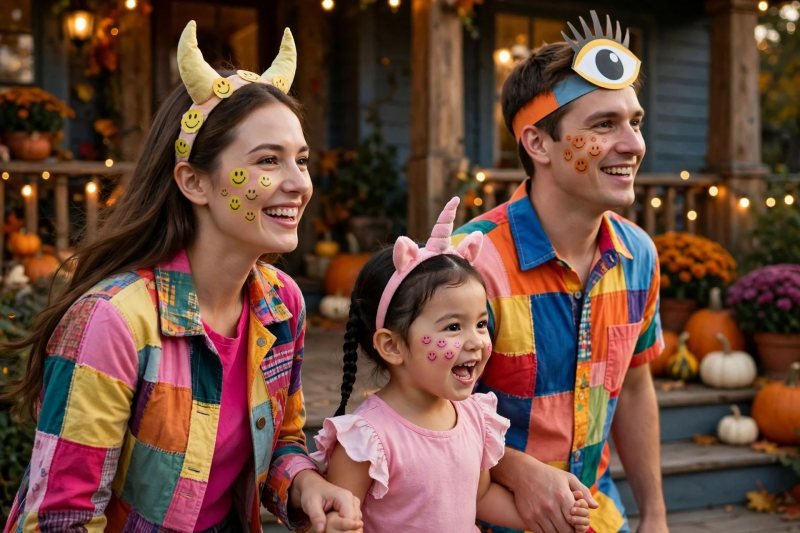
Finish with friendly monsters and a parade. End the choosing with the silliest gentle option in (15) Friendly Monsters — grown-ups wear mismatched bright colors with one big paper eye or two soft paper horns on a headband, painted smiley spots, and a tail tucked into a waistband; your toddler is the tiniest monster in her favorite color with one soft horn headband, painted cheek spots, and a happy growl she controls completely. Nothing here is scary by design — smiles only, no fangs, no masks, and no face covering of any kind — and the final ritual is the same for every theme: dress in daylight, check each other in a mirror, walk a slow porch parade so your child can be admired, take the family photograph, and remove anything she wants off before you step out. Say, "My favorite monsters are the friendly ones — big smile, soft growl, parade time." The friendly monsters get one more outing before the parade: monster footprint painting lets younger children meet the monster theme as paint and paper, so the costume itself holds no surprises.


Make it easier
Pick the rainbow or pumpkin theme: both are pure closet sorting with one paper hat each — no cutting beyond a single leaf or sun shape, and a tired parent can still pull them off in fifteen minutes. Dress only the toddler fully and let grown-ups match with one shared signal — the same paper hat, the same color top, or the same painted nose — matching reads clearly in photographs even when adults keep it simple. Do the try-on as the activity itself on a weekend afternoon: porch parade, photograph, hot drink, done — a complete celebration with no evening outing required at all.
Make it harder
Build a two-theme evening: start as one theme for the porch photograph and swap paper hats, ears, and badges at a planned pit stop to become a second theme — older preschoolers love the transformation moment. Add a made backdrop: hang a plain sheet or large paper scene — pumpkins, waves, stars, or a rainbow — high and secure on the porch wall for a family photo booth every visitor uses. Invite grandparents or close neighbors to join the same theme by color and hat, expanding the set while keeping every fastening, face-paint, and supervision rule identical.
Other ways to play it
- Stay-home porch party version: skip the outing entirely — costumes, porch parade, a treasure basket hidden at home, and photographs — ideal for the youngest threes, bad weather, or a child who finds doorbells overwhelming. Daytime fall festival version: wear the same themes to a daytime event; swap face paint for hats alone in bright sun, carry water, and choose the farm, garden vegetable, or rainbow themes that read best in daylight. Sibling and cousin expansion version: assign each extra child one role inside the chosen theme — another vegetable, another dinosaur, another helper — keeping one shared color or hat shape so the whole group reads as one family set. When the toddler opts out: if your toddler refuses the family theme on the night, dress her in the plain base color of the set with one hat or headband and let the adults carry the theme — a toddler in the family colors still photographs as part of the set, and forcing the full look ends the evening early.
How it changes by age
- Age 3: Three-year-olds do best with one-step costumes — a color, a hat, painted whiskers — worn over familiar clothes and removed the instant they ask. Let them choose between two themes only, keep try-ons to ten happy minutes, expect the hat to come off for the photograph and put it back on only if they offer, and treat the porch parade at home as a full and successful Halloween. Age 4: Four-year-olds can hold a whole theme in mind: they pick the family set, hold a prop, practice the walk and the sound, and stay dressed longer if they stay warm, fed, and admired. Give fours a job — carrying the basket, knocking first with a grown-up beside them, checking that everyone's hat matches — because being the theme expert is the part they will retell.
What they're learning
Imaginative play and storytelling: becoming a chef, a dinosaur, or the weather gives a child a role, a voice, and a tiny plot — the building blocks of narrative thinking and confident pretend play. Color, sorting, and matching: rainbow dressing, vegetable colors, and matching a parent's helper uniform are real classification work — grouping by color, kind, and feature while getting dressed. Body awareness and self-care: choosing layers, noticing hot and cold, asking for a hat off or a layer on, and walking carefully in a tail or wings builds the language of listening to their own body. Family belonging and social confidence: matching the people they love most, being admired in a porch parade, and greeting neighbors with a grown-up beside them practices brave, kind social moments at exactly their size.
Clearing up
Halloween clearing up is mercifully simple: paper hats, ears, badges, and wings go into one labeled box as next year's starter kit, face paint comes off faces before pajamas, and closet clothes go straight back to drawers and laundry so nothing costume-y lingers to be mourned in the morning. Cardboard that survived stays flat in the box; soggy or torn paper goes to recycling. Check porch steps and the path for dropped paper stars and tails while an adult still has the flashlight out, store the photograph where you will find it next October, and note which theme your child loved most — that one note is next year's entire head start.
Questions parents ask
What are the easiest matching family Halloween costumes to make at home?
How do you make a Halloween costume safe for a 3-year-old?
What can a family dress as together for Halloween without buying costumes?
Should toddlers wear masks for Halloween?
How long will a toddler actually keep a Halloween costume on?
Full 15-theme enumeration: (1) Pumpkin Patch Family; (2) Zoo Animals; (3) Chefs and Bakers; (4) Garden Vegetables; (5) Farm Animals; (6) Ocean Creatures; (7) Woodland Animals; (8) Rainbow Family; (9) Dinosaurs; (10) Space Explorers; (11) Pirates and Sailors; (12) Community Helpers; (13) Bugs and Butterflies; (14) Weather Wonders; (15) Friendly Monsters.


