


Circus Birthday Party Ideas: The Greatest Party on Earth
A circus birthday party for a 5th birthday: big-top decor, carnival game booths with ring toss and duck pond, circus snacks, and a cake with exactly five candles — a joyful two-hour plan for ages 4-5.
A circus birthday party for ages 4–5 is a joyful two-hour big-top celebration: paper big-top decor, cardboard game booths with ring toss and a duck pond, a ticket booth, circus snacks checked for allergies, and a cake with exactly five candles lit only by an adult.

The short version
- Plan joyful and structured: eight to ten young guests, a two-hour arc, flat booth lane first, and an indoor fallback ready.
- Decor goes high and necks stay free — paper bunting above reach, loose paper hats, no ties, cords, or latex balloons.
- Every game is no-loser by design: tickets for every completed turn, every duck a winner, and every ticket roll traded for the same prize bag.
- Snack safely: allergies checked in writing, grapes halved lengthways, children seated, booths paused while eating.
- The cake carries exactly five candles for a 5th birthday — an adult lights, guards, and removes them.
- Age
- Ages 4–5
- Mess
- Some
- Difficulty
- Medium
- Where
- Both
Why kids love this
A circus birthday party works for four- and five-year-olds because it gives every child a role in the show instead of a seat in front of it — and at this age, being in the show is everything. The birthday child is starring in it: stamping his own ticket invitations, collecting tickets at his own booth, tossing soft rings until one lands, fishing a winning duck from the pond, and leading a parade lap while everyone cheers. Nothing needs animals, nothing needs to be scary, and nothing needs a loser. The booths reward trying rather than winning, every ticket earns a prize, the snacks are food he already loves made festive by paper cones, and the whole arc lasts about two hours — long enough to feel like the greatest party on Earth, short enough to end while everyone is still beaming. For a 5th birthday, that combination of performing, playing, snacking, and blowing out exactly five candles is a milestone done at exactly his size.
What you'll need
- Plain cardboard boxes and sheets — for the game booths, the ticket booth front, and big paper stars; all packaging and containers kept blank, with no printing showing
- Red and white paper and card stock — for striped big-top bunting triangles, booth trims, and star decorations, plus string for hanging them high
- Blank ticket-style cards in bright colors — for invitations and play tickets, with no words or numbers printed or written where a photograph would show them
- Soft rings and stable, weighted cones or bottles — for the ring toss booth; rings soft and oversized for small hands, targets weighted so they stand without wobbling
- A wide, shallow basin or tray, water, and floating plastic toy ducks — for the duck pond booth; ducks are simple plastic toys only, with a plain mark hidden underneath each one by an adult
- Paper hats that sit loosely on the head and lift straight off, plus simple costume touches worn over ordinary clothes — nothing tied, looped, or fastened at any neck
- Popcorn or puffed corn snacks in paper cones, mini sandwich supplies, and fruit cups — every filling and snack checked against the allergy list, with grapes halved lengthways by an adult for every child under five
- A birthday cake with room on top for exactly five candles, plus the five candles themselves
- Bubble wands and parent-made bubble solution in a shallow, stable container
- Plain prize bags — one per child, filled with large, age-safe prizes and tickets they earned at the booths
- A short picture book about performing or celebrating for the wind-down, a large striped blanket for snacks and story, sunscreen, water for everyone, and a basic first-aid kit within adult reach
Before you start
1. A week ahead, confirm the guest list, ask every parent in writing about food allergies, and agree the two-hour time slot — late morning or mid-afternoon, with energy high and no meal expected to carry the whole day. 2. Two days ahead, build and paint the cardboard booths, cut the bunting and paper stars, hide a plain mark under each duck, and count prizes so there is one full prize bag per child plus spares — food is prepped fresh on the day by an adult. 3. The morning of, hang bunting high, set the booth lane on flat ground with clear walkways, fill the duck pond basin to a shallow level only, lay the snack blanket in shade, and walk the yard once for anything sharp, small, or unsafe at child height.
How to do it
-
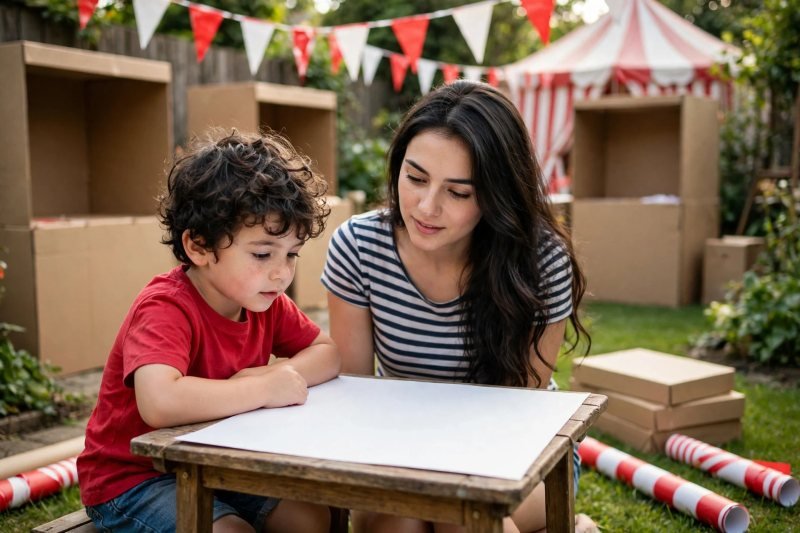
Plan the big top. Keep a 5th birthday joyful on purpose — eight to ten young guests plus their grown-ups is a full and happy ring — and plan a two-hour arc in a clear order: arrivals and tickets; a ringmaster welcome; two game booths; circus snacks; the cake; a parade with bubbles; then prizes and a story. Choose the flattest part of the yard for the booth lane, keep a wide, clear parade path around it, and name your indoor fallback before anyone arrives — the living room with the same bunting and booths works beautifully if rain appears. Borrowing the calm, small-is-better logic of a 2nd birthday party keeps the day sized for the child, not the spectacle. Say, "Step right up — this backyard is about to become the greatest party on Earth."
-
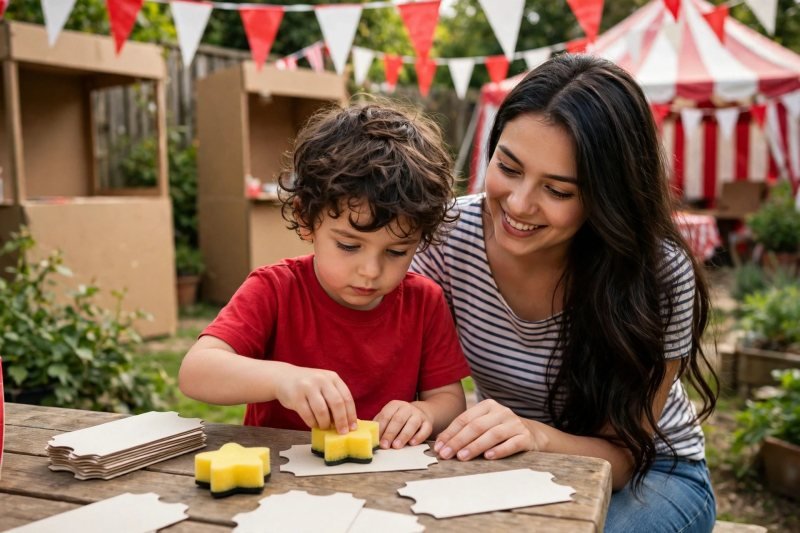
Make the ticket invitations together. Cut bright card stock into simple ticket shapes — a long rectangle with notched corners is plenty — and keep every card completely blank in any photo you take of them, with names and details added by hand only for hand-delivery or shared in the message itself. The birthday child's jobs are the joyful ones: stamping a star or stripes with a sponge; pressing one paper star onto each ticket; and carrying the finished stack like real box-office treasure. Hand-deliver to nearby friends or photograph the blank tickets to send to parents, with the time, place, costume note, and your allergy question in writing in the message itself rather than on the card. Say, "You made the tickets — now everyone knows this is your big show." An invitation he helped make turns waiting for the party into part of the party, and every guest arriving with a ticket in hand already feels like a performer.
-
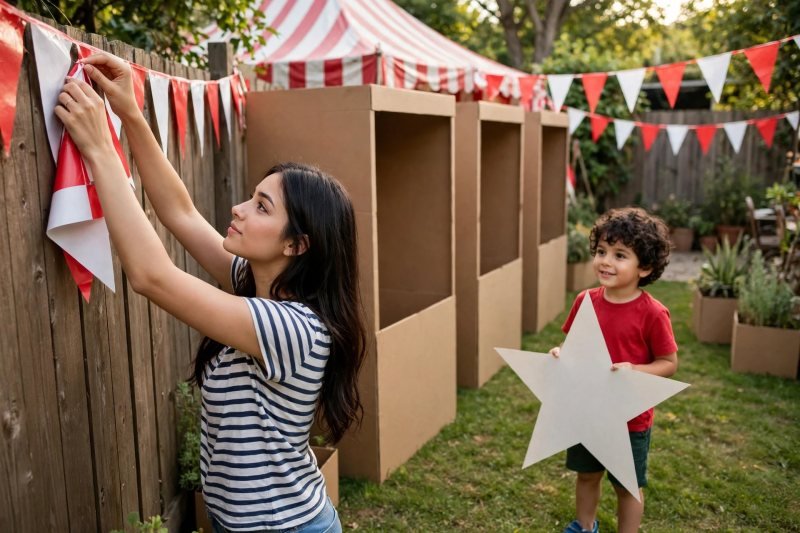
Raise the big-top decor. Turn plain cardboard and paper into the set: a striped booth lane from box fronts trimmed with red-and-white paper; a ticket booth with a wide, low counter an adult stands behind; paper bunting strung in bold swags overhead; and oversized paper stars taped high on fences and walls. This party uses paper decor only — no latex balloons anywhere, because popped or uninflated latex is a serious choking risk and paper gives you the same color without it. The safety rule shapes the whole look: everything strung goes HIGH — bunting hangs at adult head height or above, well out of reach, and nothing is ever strung at child neck height, across doorways at throat level, or low enough to be pulled down. Booths stand weighted and wobble-tested by an adult, walkways stay clear for the parade lap, and the duck pond basin sits stable on flat ground. Say, "We hang the bright things high where everyone can see them and no one can pull them down."
-
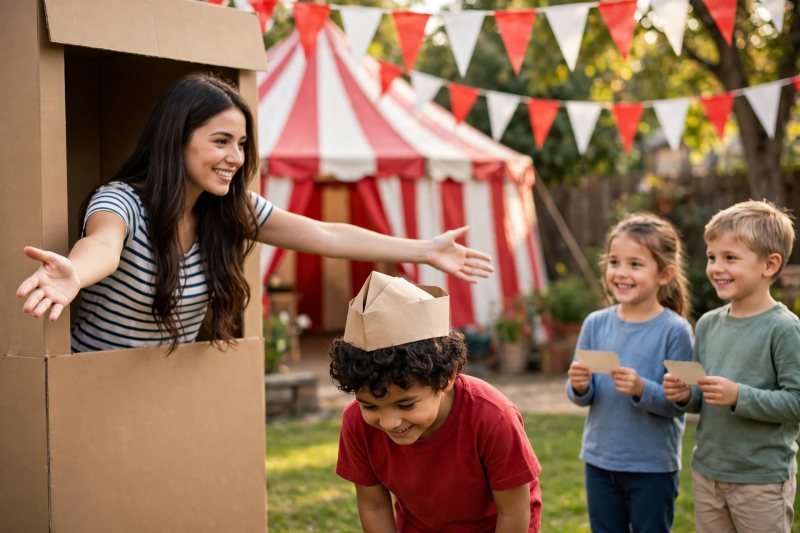
Welcome everyone like a ringmaster. Gather the performers just inside the ticket booth for the opening moment: an adult host — warm, loud enough to be fun, never frightening — welcomes the crowd, introduces the birthday star by name, and explains the one rule that runs the whole show: everyone gets a turn and everyone gets cheered. Costume touches follow one test: paper hats sit loosely on the head and lift straight off; capes are not worn during games; and nothing — no tie, cord, ribbon, or costume strap — is ever tied or looped around a child's neck. Each child hands over a play ticket at the booth, gets a star stamp on the hand from an adult, and joins the ring for a practice bow — hands wide, big smile, applause from everyone. Shoes stay real and closed-toe, and any costume piece a child wants off comes off instantly. Say, "Welcome, welcome — the greatest fifth birthday on Earth is about to begin."
-
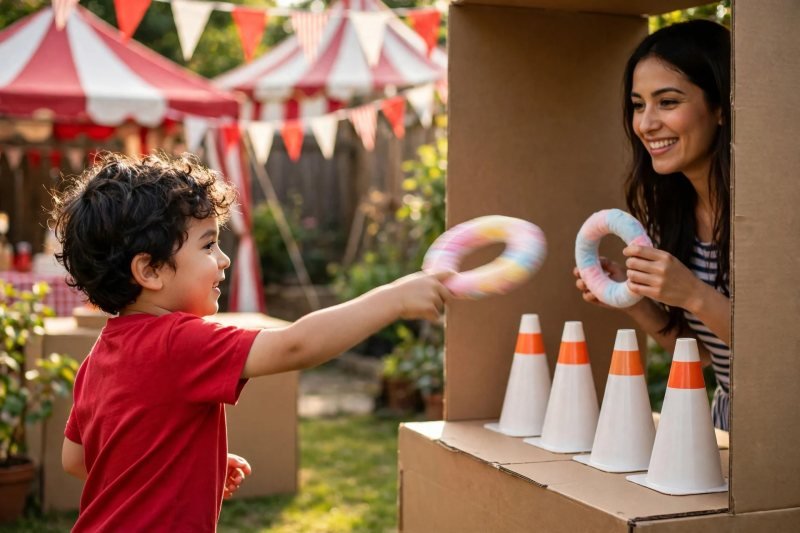
Open the ring toss booth. Set soft, oversized rings beside a row of stable, weighted cones or bottles and mark two throwing lines on the grass — a close line where younger 4-year-old guests cannot miss the fun, and a farther line the birthday 5-year-old can graduate to as his aim warms up. Children play in short turns of three rings each, collecting one play ticket for every turn completed — landed or not — so effort, not accuracy, fills the ticket roll. This is the step where fine motor activities hide in plain sight — gripping a ring, aiming, judging distance, and releasing at the right moment are exactly the hand-and-eye work that builds control, dressed up as a carnival game. Stand retrievers to the side, never in front of a thrower; rings are tossed underarm only; and the next child steps up only when the lane is clear. Say, "Three soft rings, take your time — every toss earns a cheer at this booth."
-
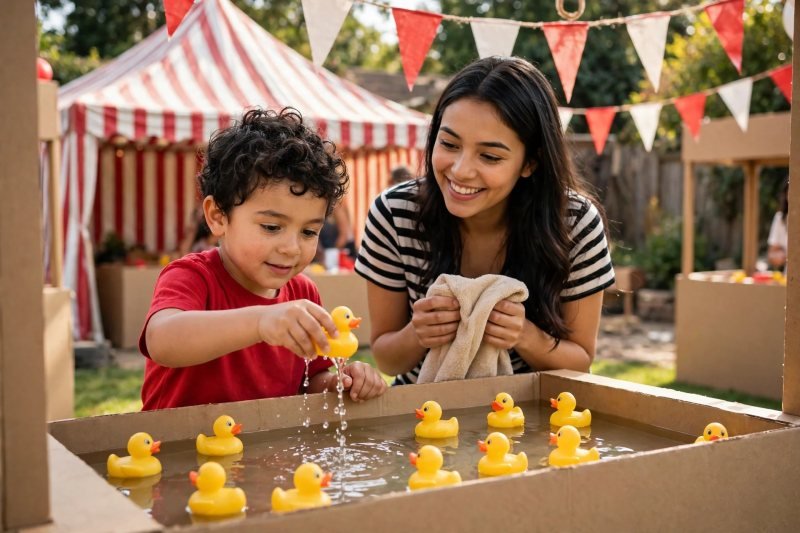
Run the duck pond and ticket booth. Fill a wide, shallow basin to just a few inches and float the plastic toy ducks, each carrying one plain hidden mark underneath that an adult checks when a child lifts a duck out. Every duck is a winner by design: a plain mark means a small prize now; a star mark means the grand pick from the prize basket; and no mark at all still earns a ticket, because at four and five the pond must never disappoint. Between catches, children bring their tickets back to the ticket booth to count them aloud with the booth adult — one, two, three tickets laid in a row — which is exactly the counting, matching, and turn-taking practice celebrated in preschool learning activities. Hands go in the water; heads, cups, and snacks stay out; an adult stays at the pond for every minute it is open; and a towel lives on the counter for wet sleeves. Say, "Pick a duck, peek underneath — everyone finds a winner at this pond."
-
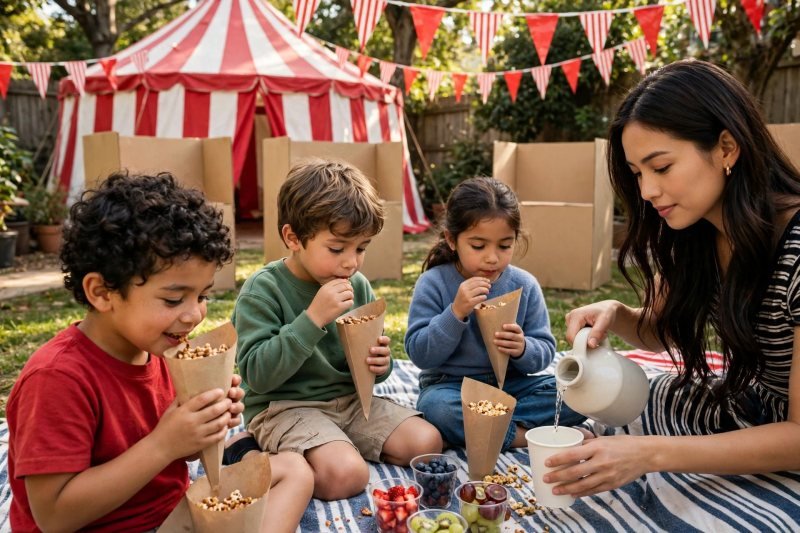
Serve the circus snacks. Bring the performers to the striped blanket for snacks you checked against the allergy list twice: popcorn or puffed corn in paper cones — served seated, in small handfuls, with an adult watching and puffed corn offered to any child not ready for popcorn; mini sandwiches cut small with fillings every parent has cleared; fruit cups bright with melon and berries; and water poured often in the yard heat. Every grape, and any round food of similar size, is halved lengthways by an adult before it reaches a child, without exception — on plates and in fruit cups alike. Children eat seated with cones and cups on the blanket, booths pause completely while mouths are full, and the break is deliberately unhurried — hungry performers are the only schedule risk left in the show. Say, "Snacks first, seated and together — then the show goes on."
-
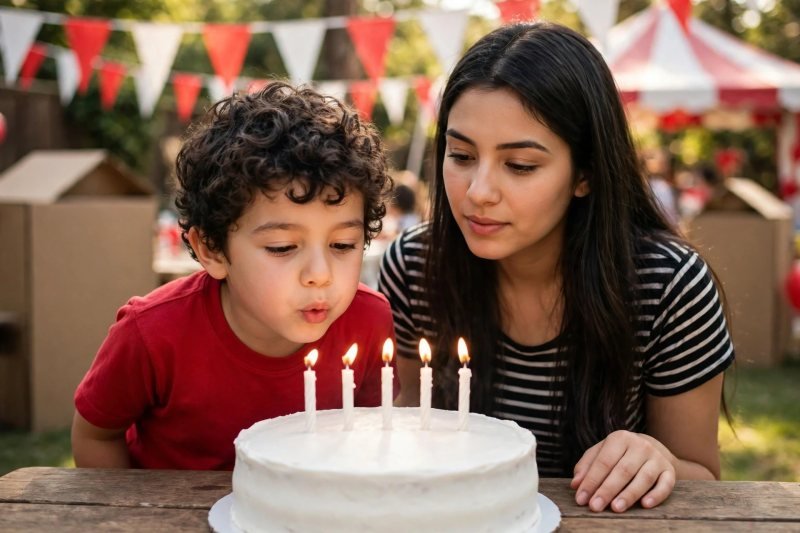
Bring in the cake with exactly five candles. Clear a steady table at the edge of the ring, seat every performer in a half-circle on the blanket facing it, and carry in the birthday cake — held by an adult, set down firmly, with exactly five candles standing on top. Count them aloud together before any flame appears — one, two, three, four, five candles for five years — and photograph the cake now, before the song, so the five candles are on record. An adult — and only an adult — lights the five candles, stays beside the cake for every second they burn, and keeps loose costume pieces, paper hats, and reaching hands well back until the flames are out. The group sings, the birthday child blows, and an adult removes the candles before small slices are served on the blanket. Say, "Five candles for five wonderful years — make a wish, birthday star."
-
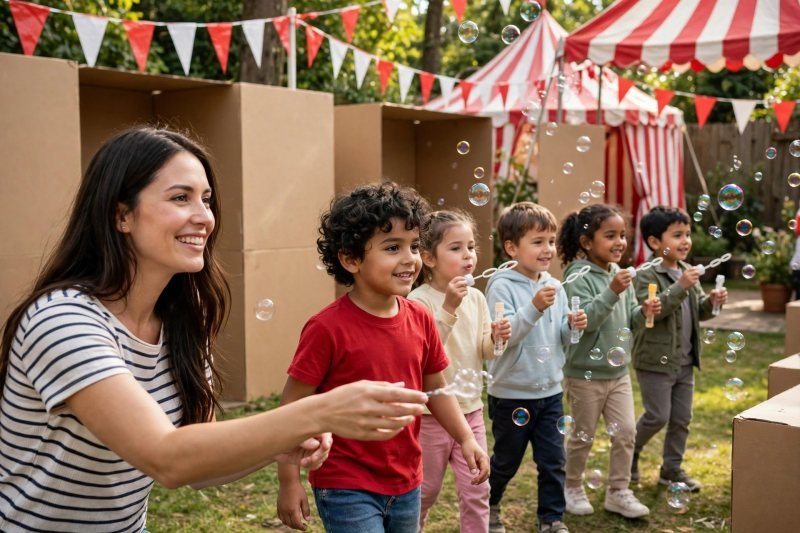
Parade around the ring and blow bubbles. Spend the cake energy gloriously: put on music the children know, line the performers up behind the birthday star, and parade one proud lap around the booth lane — waving to the grown-ups, bowing at the ticket booth, marching and freezing whenever the music pauses, with an adult leading the front and another bringing up the rear. Hand out bubble wands on the grass after the lap, keeping bubble solution in a shallow, stable tray at adult height between turns; wands are waved or gently blown rather than swung, and the bubble circle stays on flat ground away from the snack blanket. Four-year-olds freeze when they feel like it and march through the freezes when they do not; at this age that is not cheating, it is choreography. Say, "Take your bow, performers — one big parade lap, then bubbles to celebrate."
-
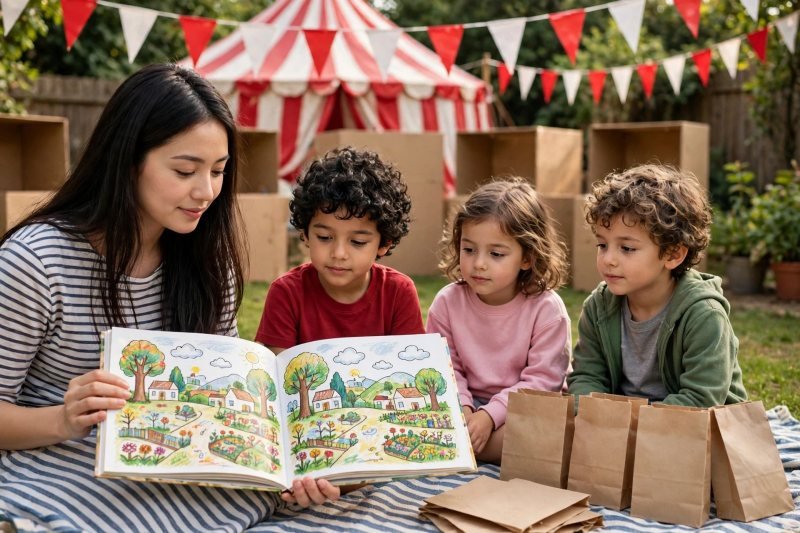
Hand out prizes and wind down. Gather the performers back to the blanket for the landing: tickets are traded in together — every roll, long or short, exchanges for one plain prize bag filled with large, age-safe prizes only, nothing small enough to be a choking risk and nothing that goes around a neck — so the day ends equal, not ranked. Admire the bag contents side by side, swap duplicates kindly with adult help, and read one short picture book about performing or celebrating, slowly, while energy settles. Walk families to the gate with a finale ritual: hats waved, thanks said, one last group bow. As each parent takes over, pass the handover notes that matter: what their child ate, any scrape or wobble and how it was handled, and where their prizes are. Say, "You were all stars of the show — thank you for making this the greatest party on Earth."


Make it easier
Buy the booth fronts pre-cut as plain cardboard shapes and skip the invitations craft — stamp plain ticket cards yourself the night before; the children's stamping and carrying is the part that matters. Shrink the arc, not the child: run one booth instead of two — keep the duck pond, the snacks, and the cake — and a joyful 90-minute party that ends happy beats a two-hour party that ends in tears. Snack simply: one puffed snack, one sandwich filling, water, and the cake — paper cones and a striped blanket do the circus work that a long menu only exhausts you with.
Make it harder
Add a third booth: a beanbag throw through a large cardboard star — soft beanbags only, the same two-distance lines, and the same ticket-for-every-turn rule so the new booth never creates a loser. Grow the counting game: let 5-year-olds run the ticket booth in pairs with an adult — counting tickets in rows of five, trading five small tickets for one big star ticket, and stamping hands themselves under supervision. Invite the grown-ups in: a parents' parade lap and a family photo moment under the bunting gives adults a role beyond spectating and photographs beautifully.
Other ways to play it
- Indoor rainy-day version: the same arc in the living room — bunting high on walls, booths against the furniture, the duck pond as a dry version with ducks hidden under cups on a tray, and bubbles traded for ribbon dancing so floors stay dry.
- Park pavilion version: reserve shade, bring every booth pre-built, weight bunting lines and booth bases against wind, and run the parade lap in a tight, adult-ringed circuit of the pavilion so no performer wanders toward the wider park.
- Late-afternoon finale version: for a family party that runs later, serve snacks first and the cake as the finale while light remains — candles glow beautifully, though an adult still handles every flame and the parade finishes before dusk.
- A different theme next year: if the circus was a hit, superhero birthday party ideas reuse the same booth-and-parade arc with a new costume and new colors.
How it changes by age
- Age 4: Four-year-old guests thrive at the close lines and the guaranteed wins: ring toss from the nearest mark, duck pond catches with an adult hand hovering nearby, and tickets for every completed turn so their roll grows as fast as anyone's. Keep their snack portions small, their turns early while patience is fresh, and a quiet blanket corner with a familiar adult available for regrouping. They will not follow the whole two-hour arc — and do not need to; an hour of starring inside it is a complete party at four.
- Age 5: The birthday child's own age runs the full show: he can throw from the farther line, count his tickets in a row and trade them at the booth, wait (mostly) for his turn to blow out five candles, and lead the parade lap as star of the ring. Give fives jobs — holding the bunting end during setup photographs, handing out rings, leading the line to the next booth — because responsibility at five feels like being honored, and an honored host is a gracious ringmaster.
What they're learning
Gross and fine motor control: tossing soft rings with aim and release, lifting ducks without tipping the basin, gripping bubble wands, and marching a parade lap — whole-body and hand control practiced inside pure play. Counting with meaning: five candles for five years, tickets counted in rows and traded at the booth, three rings per turn — numbers attached to things a child cares about stick. Turn-taking and fairness: waiting for a clear lane, cheering a friend's throw, trading every ticket roll for the same prize bag — the party as a gentle lesson in how a show works for everyone. Confidence and performance: bowing at arrival, starring in a parade, and being applauded by name — early practice in being seen kindly and enjoying it. Our pretend play guide has more ways to keep that starring role going at home.
Clearing up
Send prize bags home the same day — they are favors and finale in one — then walk the yard once with a bag for paper stars, ticket stubs, and stray rings before they become lawn confetti. Tip the duck pond water onto the garden, dry the ducks and basin, and stack the cardboard booths flat with the bunting folded into one storage box for the next performance. Leftover fruit is refrigerated or composted, sandwich remnants discarded, and the cake, once candles are fully out and removed, covered and stored out of small reach. Wipe or shake out the snack blanket, collect every ring and wand for a damage check before storage, and photograph the empty, tidy yard — next year's party planning starts with proof of how manageable this one was.
Questions parents ask
How long should a circus birthday party last for a 5-year-old?
How many children should you invite to a circus birthday party?
What food do you serve at a circus birthday party for preschoolers?
How do you make carnival game booths work for 4- and 5-year-olds?
What should the birthday cake look like for a circus 5th birthday party?
More fifth-birthday ideas: our 5th birthday party ideas round-up has more themes that suit this age.


