


Trimming a Toddler Girl's Hair at Home: Bangs, Ends, and Layers
Learning to trim toddler girl hair at home saves the salon for big changes: damp ends, dry bangs, blunt-tip haircutting shears, quarter-inch snips — ends first, sides matched, bangs cut long, and layers kept soft and optional.
To trim a toddler girl's hair at home, seat her in a booster chair with a show on, use blunt-tip haircutting shears, work damp for ends and sides and dry for bangs, and cut tiny amounts: clip the top layer up, take a quarter inch off the back ends, match the sides to her earlobes, then cut bangs dry and longer than the goal — they spring up as they dry.

The short version
- Blunt-tip haircutting shears only — kitchen scissors crush fine toddler ends; never sharp adult/barber shears.
- Damp ends and sides, dry bangs; small sections, quarter-inch snips; you can always take more.
- Section with clips: bottom layer first, top layer last.
- Bangs: cut dry, a half inch longer than the target — damp bangs spring up shorter as they dry.
- Stop rules keep it safe: any lunge or tears, shears down, resume later.
- Age
- Ages 3–4
- Play time
- 10 min
- Mess
- Low
- Where
- Indoor
Why kids love this
A trim at home, done your way, feels nothing like a salon visit. Your toddler sits in her own booster chair, watches her favorite show, and hears your voice narrating every step — no strange chair, no stranger's hands, no waiting room. When you trim toddler girl hair yourself, you also control the pace: two minutes today, the bangs tomorrow, a break whenever the wiggles win. Most home trims are small rescues anyway — bangs creeping into eyes, ends looking wispy, one side mysteriously longer. A parent who can take off a quarter inch with confidence turns all of those from appointments into five-minute fixes, and a toddler who gets praised in the mirror learns that haircuts are just grooming, not an event.
What you'll need
- Blunt-tip haircutting shears with rounded ends, made for cutting hair (not kitchen or paper scissors — dull blades crush and split toddler-fine ends; never use sharp adult/barber shears near a toddler)
- A fine-tooth comb and a soft brush
- A spray bottle filled with plain water
- Two or three sectioning clips or small claw clips
- A towel or cape that clips or ties at the neck, and a booster chair or high chair
- A distraction with staying power: a favorite show on a tablet (screen content is the child's business) or a special toy saved for haircuts
- A hand mirror or a bathroom mirror for the evenness check
- A broom and dustpan waiting in the corner
Before you start
1. Choose the moment like it matters — because it does: after a snack, before tired-o'clock, when she is fed, rested, and in a cooperative mood (step 1 makes this the whole game). If the chair itself is the battle, read our guide to easing haircut anxiety in kids first. 2. Set the chair, cape, show, and tools up completely before she sits down; a toddler's patience clock starts ticking the second she is seated. 3. Read the Safety notes first — especially the scissors rules — and decide your stopping rule: any lunge or tantrum ends the session, and you finish another day.
How to do it
-
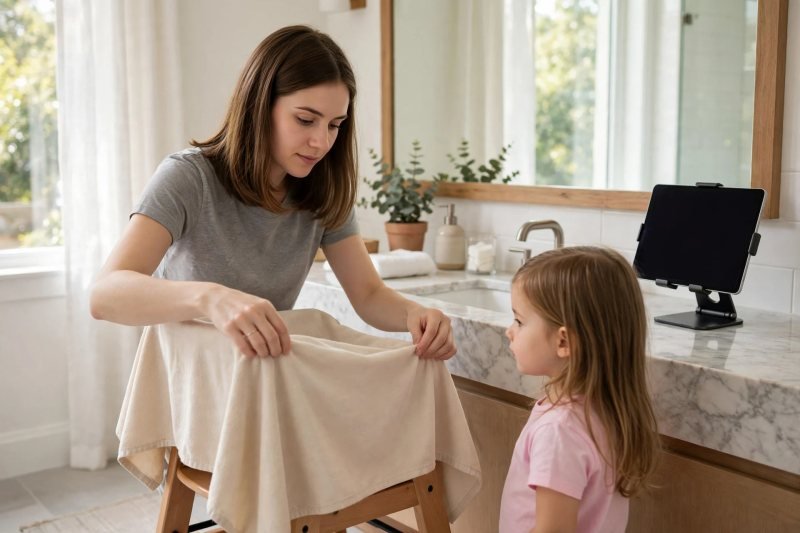
Pick a calm moment and set up the chair, cape, and show. Timing is half this haircut: choose a fed, rested, mid-morning mood, drape the towel cape, settle her in the booster chair in front of the mirror, and start the favorite show before a single tool appears. Say, "It's trim time — you watch your show, and I'll make your hair neat; it won't hurt, and it won't take long." A toddler who connects the chair with her best show and your calmest voice will sit for the few minutes a trim actually needs. From the very first sitting — the territory covered in this toddler's first haircut guide — the chair-plus-show ritual is what makes home cuts routine instead of wrestling.
-
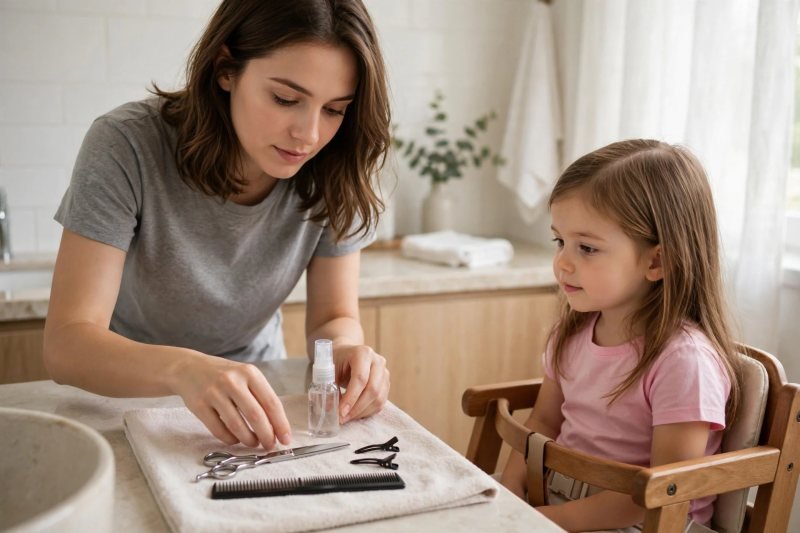
Gather blunt-tip haircutting shears, a comb, clips, and the spray bottle. Lay everything on a towel beside the chair: blunt-tip haircutting shears with rounded ends, fine-tooth comb, two or three clips, spray bottle, brush. The shears matter more than any technique in this guide — hair shears are ground to slice fine strands cleanly, while kitchen and paper scissors fold and crush toddler hair, leaving the split, fuzzy ends you were trying to remove, and sharp adult/barber shears must never be used near a toddler. Check the shears open and close smoothly, keep them closed and point-down when not cutting, and make one rule absolute: scissors live in your hand or closed on the towel, never in hers. Say, "These are grown-up scissors — your job is watching the show."
-
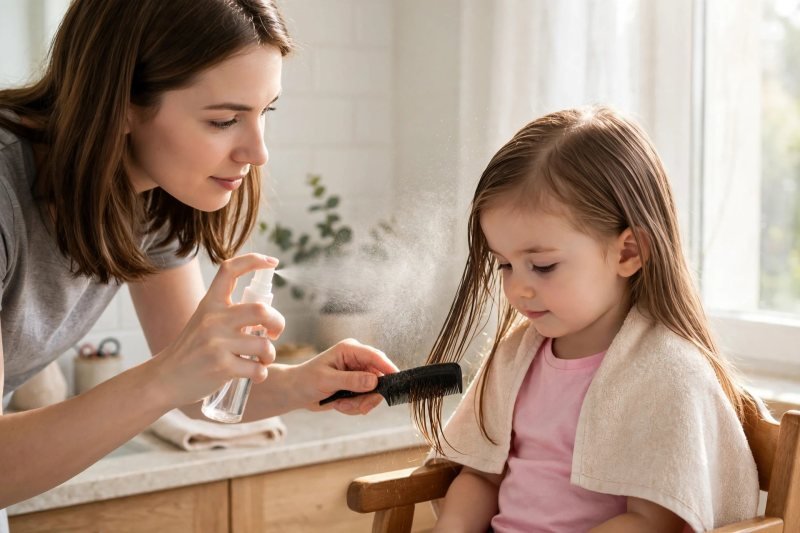
Dampen the hair and comb out every tangle from the ends up. Spray her hair evenly until it is damp, not dripping — spray the back and sides only, and leave the bangs dry for step 7 — damp hair hangs true, so you see its real length and can cut it evenly; dry toddler hair bounces and hides its shape. Comb in small sections starting at the ends and working up an inch at a time, so tangles ease out instead of ripping. Say, "Spritz, spritz — now the comb slides like a slide," and mean the gentle part: a trim that starts with pain-free combing buys you the stillness the scissors need. A face full of spray gets one warning first ("Close your eyes — rain coming!"), then a mist aimed at the hair, not the face.
-
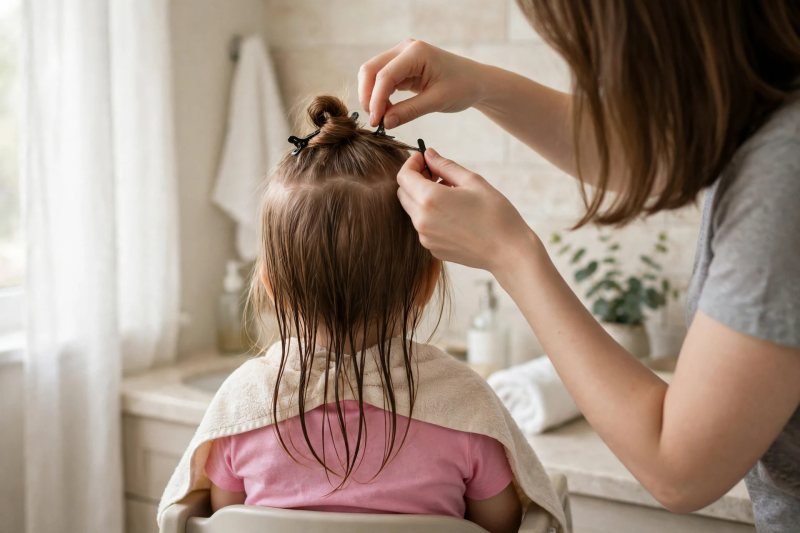
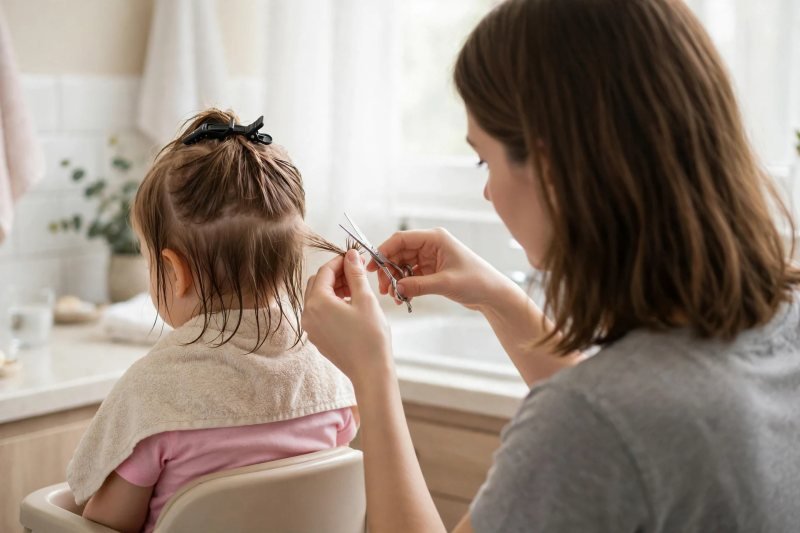
Clip the top layer up and out of the way. Gather everything from about the ears up into a soft top section and clip it on top of her head, leaving the bottom layer — the nape and the lowest ends — free. Say, "Up goes the top — we're doing the bottom floor first, then the top floor." Working one layer at a time is the whole secret of an even home trim: you always know which hair is cut and which is waiting, the clips double as entertainment ("You look like a hedgehog!"), and fine toddler hair stops slipping through your fingers in mixed long-and-short bunches. Keep clips loose enough not to pull — comfort is stillness.
-
Trim the back ends first, a quarter inch at a time. Comb the bottom layer straight down her back, slide two fingers down a small section until a quarter inch of ends pokes below them, and snip straight across just under your fingers. Say, "One tiny bite — snip — that much and no more." Move section by section across the back, combing each one down and re-checking your fingers' height against the cut next door before you snip. A quarter inch looks like nothing in your hand and everything in the mirror — toddler heads are small, and you can always take a second pass; you cannot glue an inch back on. This ends-only pass is the trim most home cuts actually need, and stopping here is always allowed.
-
Bring the sides forward and match them to a landmark. Comb the hair at each side down flat, and compare where the ends land against a landmark on her face — the bottom of the earlobe, the corner of the jaw, mid-cheek. Trim the longer side in small snips until both ends meet the same landmark at the same height. Say, "This side reaches your ear — let's help the other side catch up." Landmarks beat eyeballing because toddler heads tilt constantly; an earlobe doesn't move when she turns to watch the show. Hold the comb, not her head, steady — a gripped head ends cooperation on the spot.

-
Cut the bangs dry and long, with tiny upward snips. Comb the bangs straight down in their natural dry fall and make the defining decision of the whole trim: bangs are always cut dry in this guide, because damp hair stretches and springs up shorter as it dries — for the full dry-cut method, see our guide to trimming toddler bangs at home. Cut them a good half inch longer than your target, using small vertical snips into the edge — points up, tiny bites — instead of one straight chop. Say, "We're giving your bangs a nibble, not a bite — they spring up when they dry." Vertical point-snips leave a soft, forgiving edge where any small wobble disappears into the bangs, and cutting long guarantees tomorrow's dry reveal lands at eyebrow height instead of mid-forehead regret. If the bangs were dampened earlier, wait until they are fully dry before judging length.

-
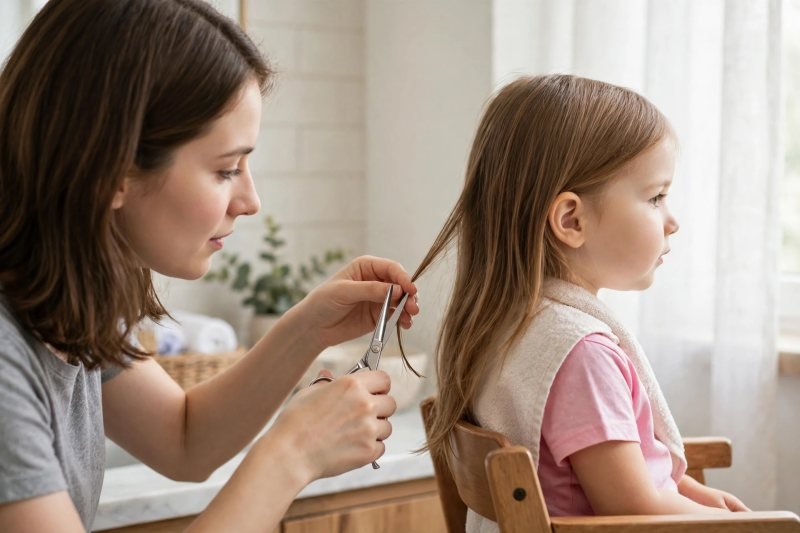
Release the top and add whisper-light face-framing layers — or skip this step. Let the clipped top layer down, comb it smooth, and look before you cut: if the hair already falls happily around her face, this step is officially optional and skipping it is the expert move. If the front corners look heavy, take one thin strand beside her cheek, slide your fingers down it at a gentle outward angle, and trim a whisper off the last half inch below your fingers — then match the other side by landmark. Say, "Just softening the sides so they hug your face." Layers on a 3- or 4-year-old should be felt, not seen: this is shaping, not styling, and one strand per side is plenty.
-
Comb everything down and check for evenness in the mirror. Comb all the hair down into its natural fall, then walk around her slowly, looking at the back, both sides, and the bangs with fresh eyes — and turn her gently to the mirror so she can admire the evidence. Compare side to side against your landmarks once more, and snip only genuine strays: one strand hanging longer than its neighbors. Say, "Mirror check — shake your head… look how it swings!" Stop while you're ahead: the check-and-fix loop seduces parents into evening-up forever, each pass shorter than the last. Even enough for a toddler is a real standard — she moves too fast for anyone to audit your hemline.

-
Brush off, rinse the itchies away, and write down what you did. Loose clippings itch, so brush her shoulders and neck, pop the cape off with the hair folded inside, and do a quick rinse or bath so no stray snips ride home on her skin. Praise the specific thing she did well — "You sat so still for the bangs!" — because the review she hears now is the cooperation you get next time. Then note the date and what you trimmed (a quarter inch off the back, bangs cut long and dry) in your phone: in a couple of months, that note is your maintenance schedule, the same keep-it-routine trick the first-haircut guide recommends for salon visits. Sweep the corner, close the shears away out of reach, and the salon is officially closed.



Make it easier
Do the trim in two sittings — ends and sides today, bangs tomorrow; a toddler's cooperation is a per-day budget. Skip the layers entirely; straight ends plus soft bangs look neat on every 3- and 4-year-old. Trim just the bangs between fuller cuts — it's the two-minute job with the biggest before-and-after. Pair the trim with a calm bath first — our guide to washing toddler hair without tears keeps the pre-trim rinse tear-free.
Make it harder
Practice the full routine on a doll first — combing, clipping and mirror-checking with zero stakes. Let your child hold the hand mirror for the final check and vote on the final stray — early grooming autonomy. Let your child "check" each side in a hand mirror and vote on the final stray — early grooming autonomy.
Other ways to play it
- Growing out the bangs: skip step 7 and instead trim a soft side-swept angle — comb the bangs to her natural part side and snip the longest corner so it tucks behind an ear; clips and a tiny braid hold the grow-out gracefully. For the full dry-cut method, see our guide to trimming toddler bangs at home.
- Curly toddler hair: cut far less and cut curls dry — curls spring up as they dry, so take off far less than you think and judge the length dry. Comb with fingers, snip curl by curl at the very ends, and skip the layers.
- Pre-salon practice: if a big-girl salon cut is coming, do one full home run of this exact routine first so the chair — cape — show — mirror sequence feels familiar, then let the stylist's visit feel like a field trip, not a first.
How it changes by age
- Age 3: Bangs and a whisper off the ends are the whole job at three — total scissor time under five minutes, ideally across two sittings. Layers are a skip, side-matching is approximate, and the show does most of the parenting. A three-year-old's hair is still baby-fine; the goal is neat, not styled.
- Age 4: Fours tolerate the full routine in one sitting and start having opinions — offer the mirror check as a real review and let her vote on the bangs length between two sane options. Face-framing layers (step 8) become genuinely useful as hair thickens toward preschool weight.
What they're learning
Patience in small doses: sitting through a ten-minute routine with a known end is self-regulation practice with a built-in reward. Body awareness and vocabulary: nape, bangs, earlobe, jaw — a trim teaches the map of her own head and face. Cause and effect: watching a too-long side get matched teaches comparing, measuring, and fixing — pre-math in a cape. Trust in routines: a calm, repeatable grooming sequence that ends in praise builds the template for dentists, doctors, and every future chair.
Clearing up
The cape is the cleanup: fold it inward over the clippings and shake it straight into the trash, then sweep the bathroom corner where the chair stood — toddler hair hides in grout lines like it pays rent. Quick-rinse her (or full bath if the day allows) so itchy snips don't migrate to the car seat and pajamas. Wash the comb, dry the shears completely before storing them — damp blades rust and dull — and put them back in their out-of-reach home. Restock the kit in one small bag or box so the next trim starts at step 1, not with a scavenger hunt. For how often baths and rinses should happen around trims, see our guide on how often to wash toddler hair.
Questions parents ask
How do I trim my toddler girl's hair at home without ruining it?
Should I cut my toddler's hair wet or dry?
How do I cut toddler bangs so they don't end up too short?
What scissors should I use to trim toddler hair?
How do I keep my toddler still during a home haircut?
What if I mess up my toddler's home trim?
Trim timing is general parent guidance, not a clinical schedule: bangs more often than ends, with a full tidy roughly every couple of months. For the safety standard this guide follows, see our guide to cutting toddler hair at home safely.

save it for later
Pin this for the next rainy afternoon
Keep it on a board so it is there when you need it, rather than when you happened to find it.
Save to Pinterest

