


A Shape Hunt Round the House
Circles, squares and triangles are already everywhere. Give them a list and let them find them.
Draw four shapes on a piece of paper and send children round the house to find real objects matching each one. Needs paper and a pen, suits ages 3 to 6, and takes about 20 minutes.

The short version
- Do the first one together so they understand the job.
- Follow, do not suggest — the finding is the activity.
- A squashed circle is still a circle.
- Age
- Ages 3–6
- Prep
- 2 min
- Play time
- 20 min
- Mess
- Low
- Difficulty
- Easy
- Where
- Indoor
Why kids love this
It is a hunt, so there is running about, and shapes are genuinely everywhere once you start looking — which produces a satisfying stream of discoveries rather than a slow search. It also turns the whole house into the activity, which beats sitting at a table.
What you'll need
- A sheet of paper
- A pen
- Optional: a clipboard, which makes it feel official
- Optional: a camera or phone to photograph the finds
Before you start
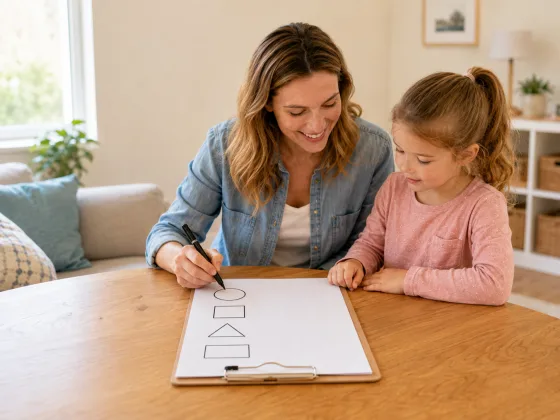
Draw four large shapes down one side of the paper — circle, square, triangle, rectangle — with space beside each. Two minutes. For a younger child, use two shapes rather than four.
How to do it
-
Draw the shapes down the left-hand side of the paper.
-
Name each one together and trace it with a finger.

-
Explain the job: find something in the house shaped like each one.

-
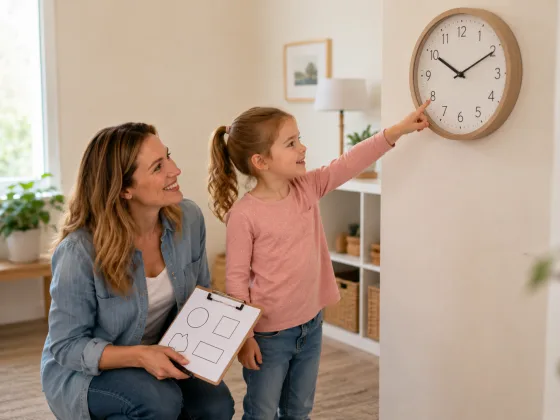
Go together for the first one so they see how it works — a clock is a circle, a door is a rectangle.
-
Let them lead from then on. Follow rather than suggest.

-
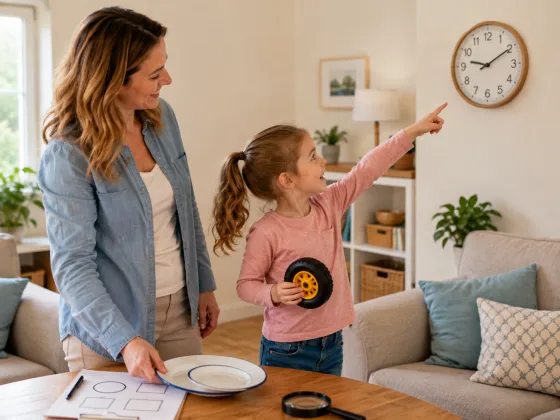
Draw a tick, or a tiny drawing of the object, next to each shape as they find it.
-
When all four are done, go round again and see how many more they can find for one shape.

-
Count up the total at the end.

Make it easier
Two shapes only — circle and square — and stay in one room. A whole house with four shapes is a long game for a three-year-old.
Make it harder
Add hexagons and ovals, or ask for three examples of each. Or ask them to find a shape inside another shape, like the circles on a rectangular remote control.
Other ways to play it
- Photograph each find and make a shape book afterwards.
- Do it in the garden or on a walk instead.
- Hunt for one shape only and see how many they can find in five minutes.
- Add harder shapes for older children — oval, hexagon, semicircle.
- Swap roles: they name a shape and you have to find it.
How it changes by age
- Three: two shapes, one room, lots of pointing.
- Four to five: four shapes, whole house, they lead.
- Six and up: harder shapes, three of each, and a drawn record.
What they're learning
Recognising a shape in the wild is much harder than recognising it on a card, because real objects are the wrong colour, the wrong size and at the wrong angle. That transfer is exactly what makes this worth doing. Squashed and rotated shapes still count, and saying so keeps them looking.
Clearing up
Keep the sheet. Doing it again in a month with the same paper shows how much more they spot.