


Memory Games for Preschoolers: 16 Classic & DIY Games
Sixteen memory games for preschoolers: 8 classics for ages 3–4 plus 8 no-prep DIY games from things you already own. Build working memory, attention, and turn-taking — start with just two pairs.
Start with two pairs of matching cards, face down. Let your child flip two at a time and celebrate every match, even accidental ones. Keep sessions under ten minutes and stop while it is still fun. Memory games for preschoolers build working memory and attention — no apps needed. Repeat favorites; repetition is where learning lives.

The short version
- Start with 2–4 pairs, not 20 — tiny games build confidence.
- Play round one as a team; let your child lead round two.
- Think aloud so they can copy your strategy.
- Add one pair or one item at a time when it gets easy.
- Stop while it is fun — five joyful minutes beats fifteen ending in tears.
- Age
- Ages 3–4
- Mess
- None
- Where
- Both
Why kids love this
The child can genuinely beat a grown-up — and they notice, and they adore it. Every flip carries drama: is it a match? The tray game has the suspense of "what disappeared?" And sock matching feels like a real grown-up job, the highest compliment a 3-year-old can give.
What you'll need
- Pick only what your game needs: matching-pair cards (store-bought or homemade), 3 cups and a pom-pom, a tray with 4–6 small objects and a tea towel, 4–6 small jars with fillers, a basket of clean unmatched socks, nature finds.
Before you start
Choose ONE game per session. Set it up while your child watches — naming each item as you place it is the first memory pass. Start card games with just 2–4 pairs. Decide the cleanup spot up front: "the cards live in this tin."
How to do it
-
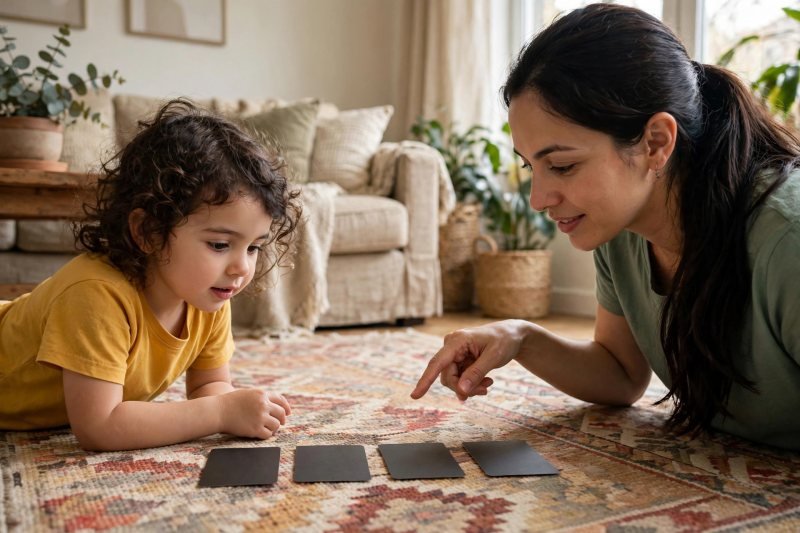
**Set out the cards while your child watches.** Sit down together on the rug with just two pairs of cards — a dog pair and a truck pair work beautifully. Lay them face down in one short row, naming each picture as you place it: "Here's the dog, and here is his twin… here's the truck, and here is his twin." That first pass of naming is round zero of the game — her eyes are already memorising where everything lives. Point to the little tin at the end of the rug and agree the cleanup spot now: "When we finish, the cards go to sleep in this tin." She is watching, not flipping yet, and that is exactly the plan.
-
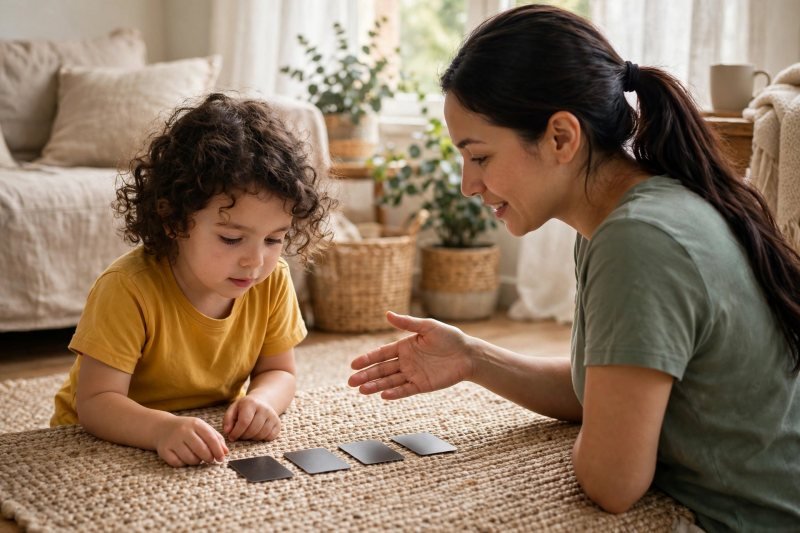
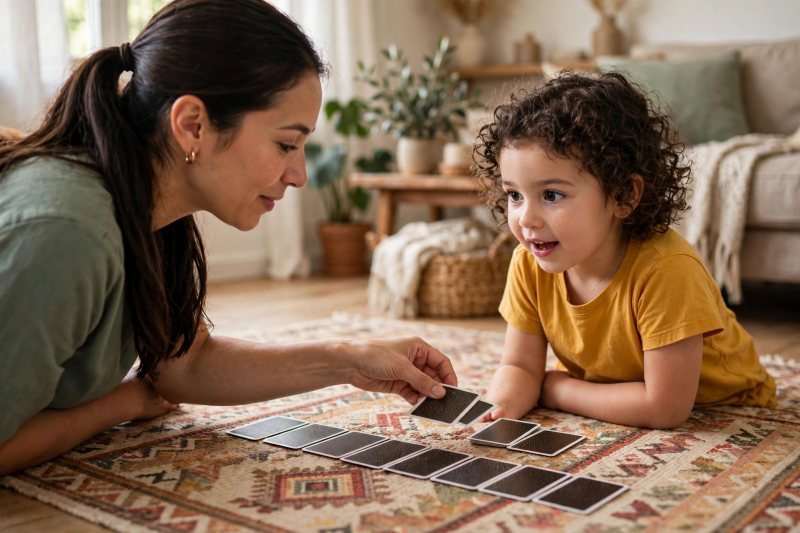
**Keep the game tiny.** Four cards in one short row, nothing more — resist the temptation to lay out the whole pack, because four fits inside a three-year-old's working memory and twenty does not. Let her lean in and study the little row for a moment, then ask: "Which one shall we turn over first?" She picks one and turns it — "It's the dog!" — then picks a second: "Is this his twin?" If it is not, cheer anyway — "No, it's the truck — remember where the dog is hiding!" — and turn both back over. The whole lesson of this round is that missing is not failing; it is collecting clues. Keep her hands the only ones flipping here.
-
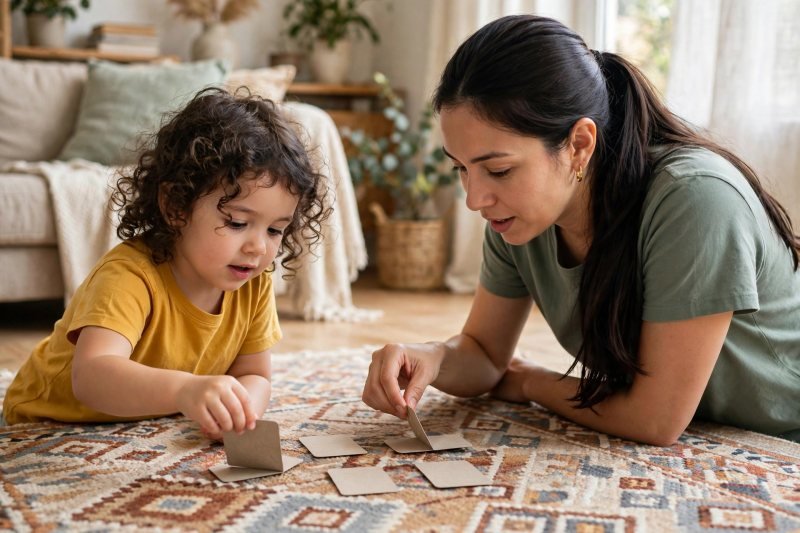
**Play round one as a team.** Now flip alongside her: you take one card, she takes one, and you think aloud the whole way so she can borrow your strategy — "I remember the dog was somewhere near this end… was it this one? No! But now I know where this one is." When a match lands, make it a celebration — high-five, clap, "We found the twins!" When she forgets where a card was, narrate it for her: "The truck was in the middle, remember? Let's peek under the middle one." You are modelling the whole memory process out loud — plan, guess, correct, remember — and she is absorbing it while having the time of her life.
-
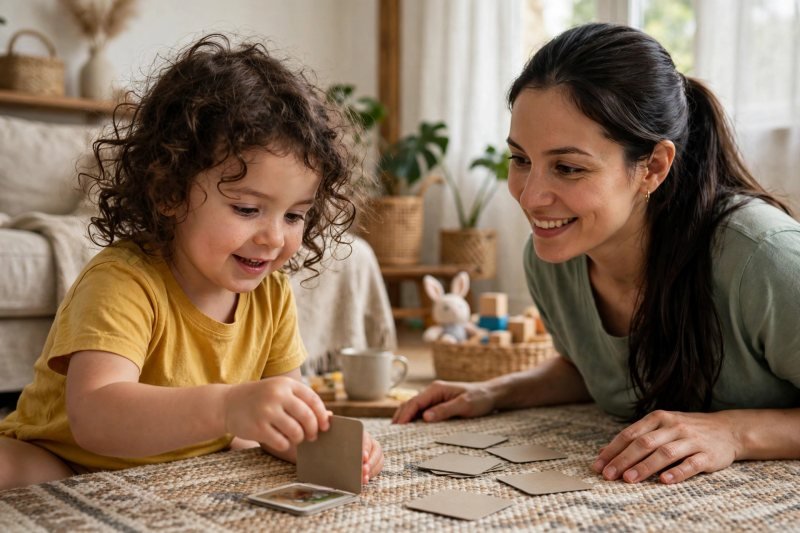
**Hand her the leader's chair.** In round two, she does all the flipping and you only watch and wonder: "You choose. Where do you think the dog is hiding?" Random flipping is completely normal at three — do not correct it, celebrate the strategy instead: "Ooh, you checked that end first — good thinking!" When she finds a match by pure luck, cheer as though it was masterful memory work, because her brain is filing away that this end has a truck and that corner has a dog. If she starts to drift, become her spotter: "Hmm, which one have we not looked under yet?" The moment she matches two on purpose, end the round on that triumph — the confidence is the whole point.
-
**Grow the game by one pair.** When the little set is getting too easy — she is finding matches without thinking — say: "Our game needs to grow! Shall we add one more pair?" Lay the new pair beside the row with a little ceremony: "Here come the ducks — duck one, duck two. Where will they live?" Give her a long look at the full set before the first flip, then let her lead the new, bigger round. If the new pair makes the whole game fall apart — forgotten positions, wild flipping, a little sigh — do not push; simply whisk the new pair back out and say: "Tiny game today, big game another day." Growing over days beats one big leap every time.
-
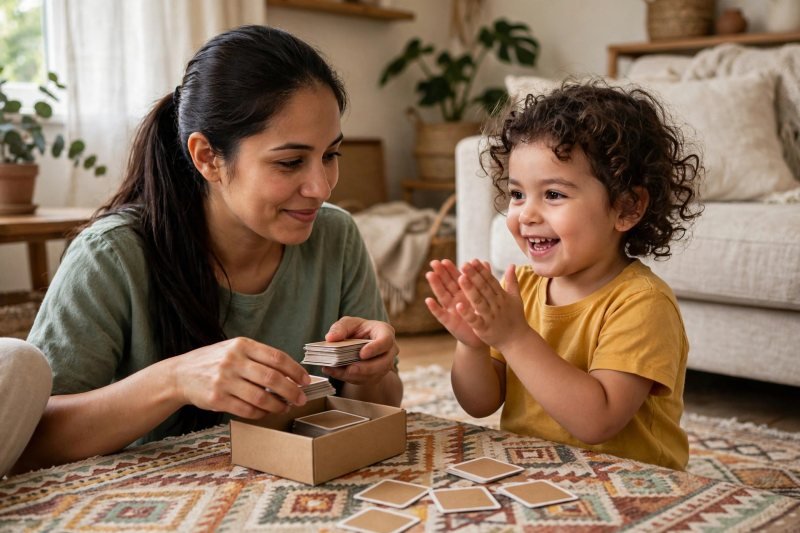
**Stop while everyone is smiling.** End after a win, not after a wobble — careless flipping, cards being flung rather than turned, and the wandering eye all mean the session is nearly done. Call it before the mood turns: "One more flip each, then the cards go to sleep!" When she finds her last match, burst into applause with her, then start the tidy-up ritual together, stacking the cards into the little tin while she claps for herself: "The memory game sleeps in its tin now — goodnight, cards!" A short session that ends in giggles will have her asking for the game tomorrow; a long one that ends in tears teaches her it is no fun.
-
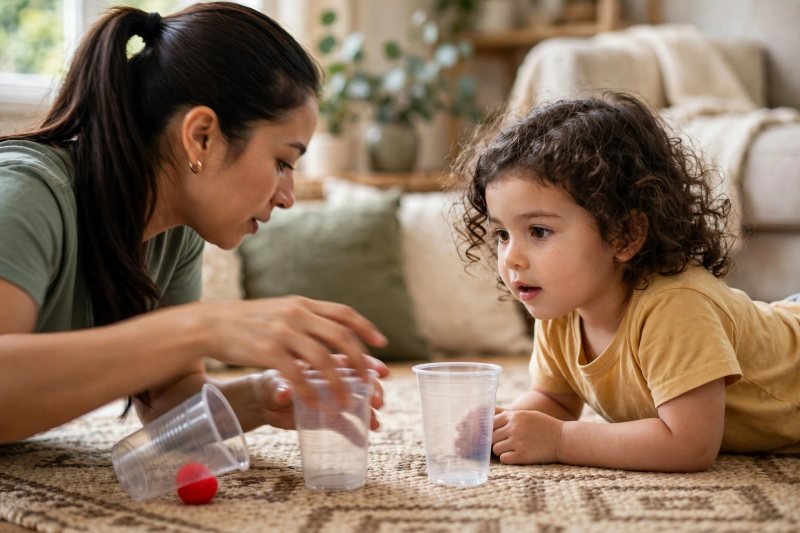
**Next day, bring out the cups.** Grab three plastic cups and a red pom-pom — the whole no-prep game fits in one hand. Tuck the pom-pom under one cup in front of her, nice and visible: "The little red ball is hiding under THIS cup." Then shuffle the cups slowly, narrating: "Round and round… keep your eyes on the hiding cup!" She points — "That one!" — and lifts it to check. Celebrate the guess, not just the win, and keep the shuffling deliberately slow at first; speed is a dial you turn up only when she is getting it right. Then hand her the cups: "Your turn to be the shuffler — hide it from Mum!" Being the hider is secretly the harder memory job, and she will rise to it.
-
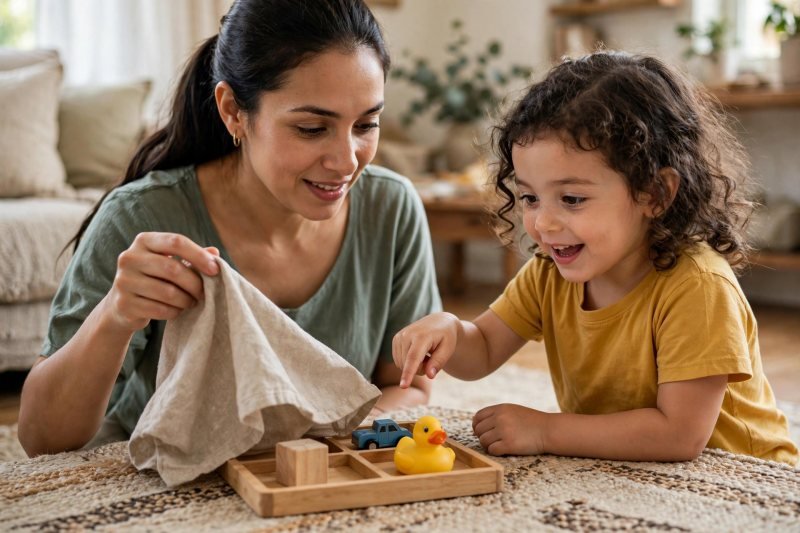
**Try the "what's missing?" tray.** Set three or four small toys on a tray — a rubber duck, a toy car, a wooden block — and name each one together: "Duck, car, block — look at them really hard." Cover the tray with a cloth, sneak one toy away, then lift the cover with a flourish: "Something has vanished — what disappeared?" She scans and points, delighted, when she spots the gap: "The car is gone!" If she struggles, lift the cloth for a peek, or study the tray longer before covering next time. When she is getting them all, swap roles and let her be the sneak — hiding and remembering what she took is double the memory workout, and she will glow with the power of it.
-
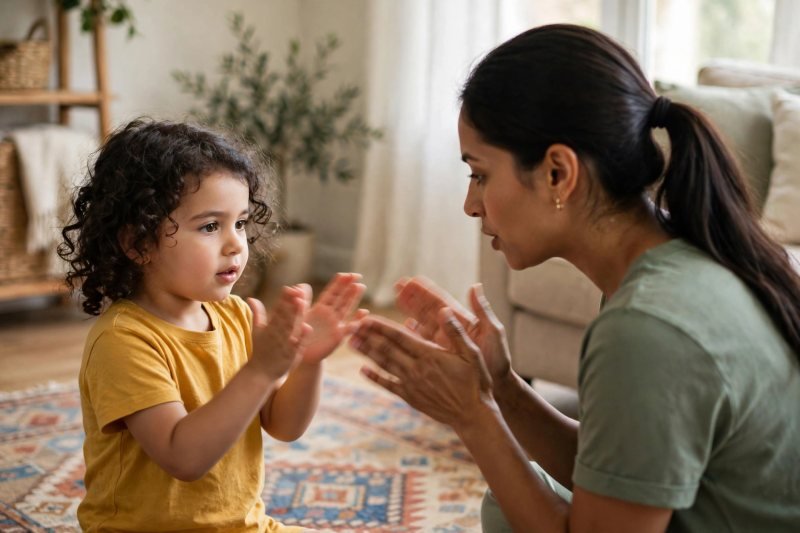
**Sneak in a listening game.** Ears need memory games too — and these are perfect for the car, the bus, or any waiting room. Clap a short rhythm — clap, clap… pause… clap — and say: "Can you make my clap?" She copies it, you cheer, then she adds a beat and you copy hers: "Now you make one for me!" Keep rhythms to two or three beats for a three-year-old; copy-the-clap rounds, follow-the-leader clapping, and whispered counting games all build the same auditory memory muscle without a single picture card. It is the same game wearing a different hat — and it hands her a memory tool she can play anywhere.
-
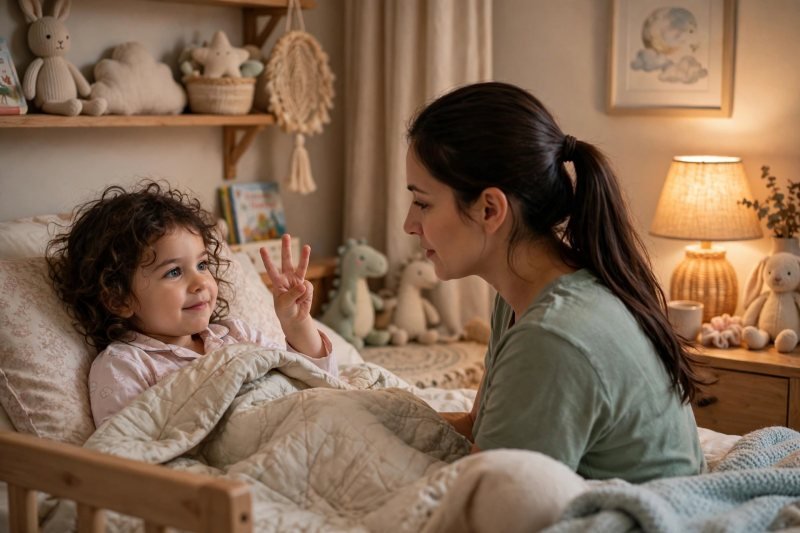
**Finish with bedtime recall.** At bedtime, tuck her in and ask: "What did we do today? Can you tell Mum three things?" She holds up three little fingers and counts them off — the cards, the cups, the clapping game — and if she can, put them in order: "First the cards, then the cups, then the clapping!" Prompt gently when she stalls: "Was there something with a red ball…?" This is pure episodic memory practice, and it takes two minutes. The games are tidied away, the tin is shut, and her very last thought of the day is her own memory working beautifully — which is exactly how you build a child who loves remembering.


Make it easier
- Fewer items: 2 pairs of cards, 3 objects, 2 jars. - Let them peek, or study the tray longer before covering. - Play open-face first — the memory layer can wait a week. - Play cooperatively so nobody loses.
Make it harder
- Add one pair or one item at a time. - Use lookalikes: two different dog cards, rice versus lentils. - Stretch the delay: cover the tray, sing a song, then ask. - Let your child teach the game to a sibling — explaining rules from memory is an advanced workout.
Other ways to play it
- **Themed card sets:** animals, foods, vehicles, family faces — new pictures, same rules.
- **Movement memory:** copy a 3-move dance sequence, adding a move each round.
- **Grocery list game:** give your child 3 items to remember at the store.
- **Sound walk:** walk quietly for one minute, then name every sound.
- **Matching pairs, preschool edition:** lay 4 cards face down (2 pairs); take turns flipping two — matches are kept, misses flip back. Builds visual memory and turn-taking.
- **What's missing? (the tray game):** arrange 4–5 objects on a tray, name each, cover it, and sneak one away — which vanished? Builds visual discrimination and recall.
- **Kim's game:** rearrange two tray objects instead of removing one — what changed? Or cover the tray and name everything from memory. Builds observation and working memory.
- **Simon Says, memory edition:** chain 2–3 actions ("touch your nose… clap twice…"); skip trick-outs at 3. Builds auditory memory and impulse control.
- **I went to the store…:** take turns adding one item to a growing list; keep it to 3–4 items — silly items make it stick. Builds sequential memory and vocabulary.
- **Copy the clap:** clap a short rhythm; your child copies it, then adds a beat each round; switch roles so they lead. Builds auditory pattern memory.
- **Hide and find the toy:** let your child watch you hide a toy in a visible-ish spot, leave, and come back to find it. Builds spatial memory and attention.
- **Picture bingo:** make 4-picture bingo cards (animals, foods, shapes); call out pictures one at a time and your child finds each match. Builds visual scanning and listening attention.
- **Sock matching:** dump a basket of clean socks — start with 3 pairs — and find the matches; a household job disguised as a game. Builds visual and tactile discrimination.
- **Cup shuffle:** hide a pom-pom under one of three cups and shuffle slowly; start exaggeratedly slow, then speed up a little. Builds visual tracking and focus.
- **Photo memory cards:** tape family photos onto index cards in pairs — making them is half the game. Builds visual memory and personal connection.
- **Scavenger hunt recall:** name 3 things to find ("a red sock, something soft, a spoon"); when they return, ask what the list was. Builds working memory tied to movement.
- **Story retelling:** after a picture book, close it — what happened first? Then what? Builds sequential memory and narrative skill.
- **Sound jars:** fill pairs of small jars with matching contents (rice and rice, beans and beans); seal, mix up, shake two — same or different? Builds auditory discrimination.
- **Nature tray memory:** on a walk, collect 5 finds; at home, arrange, study, cover, remove one — what is missing? Builds observation and recall.
- **Bedtime "what did we do today?":** in bed, take turns naming three things from the day, in order if you can. Builds episodic memory and conversation skills.
How it changes by age
- At 3, most children manage 2–4 pairs of cards, 3–4 tray objects, and 2–3 item lists. Forgetting mid-game is normal; the real attention span is 5–10 minutes. By 4, many handle 6–8 pairs and start using position strategies ("it was in the corner"). Not ready yet? Start open-face and revisit in a month.
What they're learning
**Working memory:** holding information in mind while using it — the core skill here. **Attention and focus:** staying with one task through a full round. **Visual discrimination:** telling similar pictures, objects, and sounds apart. **Sequencing:** remembering what came first, next, and last. **Turn-taking:** waiting, handling not winning, playing fair. Why memory games work: a preschooler's working memory — the mental notepad that holds information while they use it — is small and growing. Memory games exercise that notepad playfully. Holding "the truck was in the middle row" in mind while choosing the next card is the same skill later used to follow directions and remember names.
Clearing up
Under a minute: cards in their tin, tray objects returned, jars on the shelf, matched socks in the drawer. Make cleanup the final step — "the memory game sleeps in its tin now" — and 3-year-olds will do it happily.
Questions parents ask
What are good memory games for 3-year-olds?
How many matching pairs should a preschooler start with?
Do memory games really help brain development?
What should I do when my child gets frustrated with memory games?
Can memory games help my child focus better?
How long should a memory game session last for a preschooler?
Keep one tiny game in the car or diaper bag — six cards or three cups carry you through any waiting room. Rotate which game is "out" each week. And play badly on purpose sometimes — losing graciously keeps them coming back.
**Keep reading:** for more screen-free play ideas, try our [counting games for toddlers](/activities/counting-activities-for-toddlers/) and [toddler learning activities at home](/activities/toddler-learning-activities-at-home/).

save it for later
Pin this for the next rainy afternoon
Keep it on a board so it is there when you need it, rather than when you happened to find it.
Save to Pinterest