


Popcorn and the Five Senses Activity
A five senses popcorn activity that explores sight, hearing, smell, touch and taste with one familiar snack. Kids watch it pop, listen to the crackle, smell it warm, feel the textures and taste big pieces safely — all from one bowl.
A five senses popcorn activity is a guided exploration where a child aged 4–5 looks closely at popcorn, listens to it crackle, smells it warm, feels its textures, and tastes a few big pieces while sitting still. One familiar object, all five senses, about 20–30 minutes. An adult pops the corn; only large popped pieces are used.

The short version
- One familiar object — popcorn — explored through all five senses, one sense at a time.
- Ages 4–5 only: popcorn is a choking hazard for under-4s, so toddlers need a different activity.
- An adult handles all the hot popping; only big, fully popped pieces reach the child.
- Tasting rules first: sit still, one piece at a time, chew fully, no talking with popcorn in the mouth.
- 20–30 minutes total; exploring comes before eating so little hands stay off the bowl.
- Describing words are the learning: bumpy, crackly, toasty, warm, crunchy.
- Age
- Ages 4–5
- Prep
- 5 min
- Play time
- 25 min
- Mess
- Low
- Difficulty
- Easy
- Where
- Indoor
Why kids love this
This five senses popcorn activity slows snack time down and turns it into detective work. Your child studies ONE familiar thing — popcorn — and discovers what is hiding in it: the shapes inside a single piece, the tiny crackle when crushed, the warm toasty smell, the bumpy places under their fingers. Four-year-olds love being experts, and by the end they genuinely are: they can describe this one thing with all five senses. For more ways to explore the senses, try our five senses activities for preschoolers.
What you'll need
- 1/4 cup popcorn kernels, a stovetop pot with lid or an air popper
- A little oil for the stovetop method (adult handles everything hot)
- One large bowl and one flat tray or baking sheet
- A small cloth for wiping the table
- Plain popcorn only — no salt, butter, or seasonings for young children
Before you start
Adults only at the stove. Before you start, pick out every unpopped kernel and hard broken bit — only big, soft pieces go in the child's bowl. Seat your child before any tasting begins: explore first, eat second, with tasting in the middle of the activity. Check for corn allergies before you begin.
How to do it
-
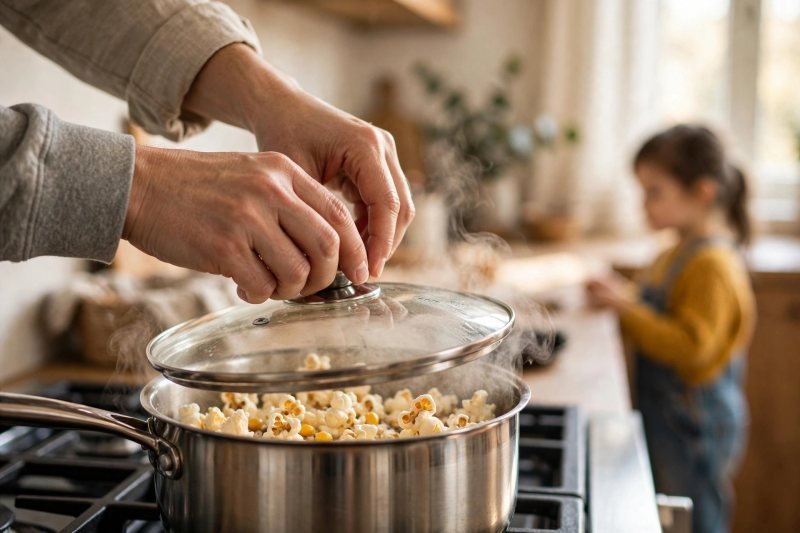
Pop the corn and listen to it change. You handle the heat while your child stands a few steps back from the stove with eyes closed, just listening: silence, then a few slow pops, then a frantic flurry, then silence again — then ask, "How did the popping change from start to finish?"
-
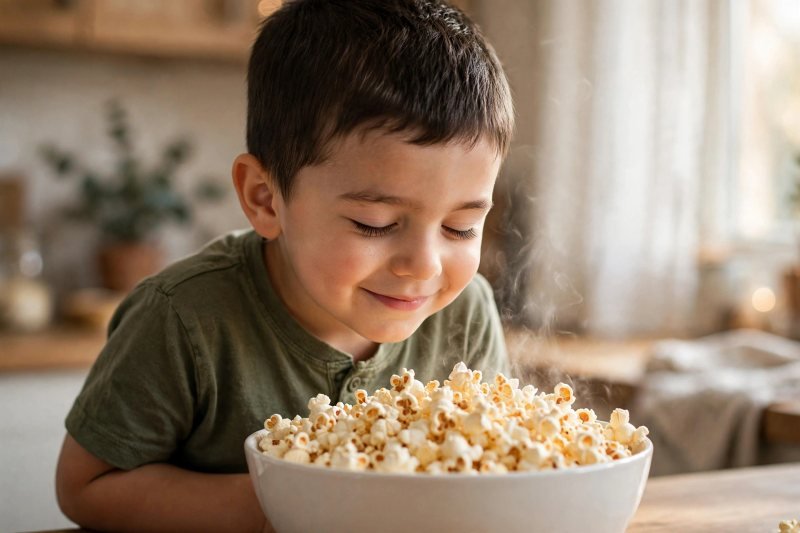
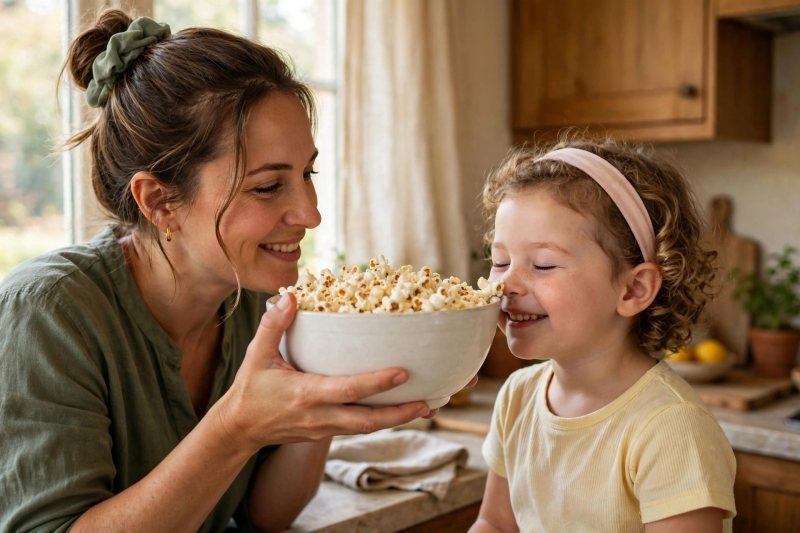
Smell the warm bowl together. Let the popcorn cool to warm, not hot, pour it into the big bowl, then lean over it and breathe in slowly; smelling is the whole step, so do not rush it — offer words if your child shrugs: "I smell something warm and a little sweet."
-
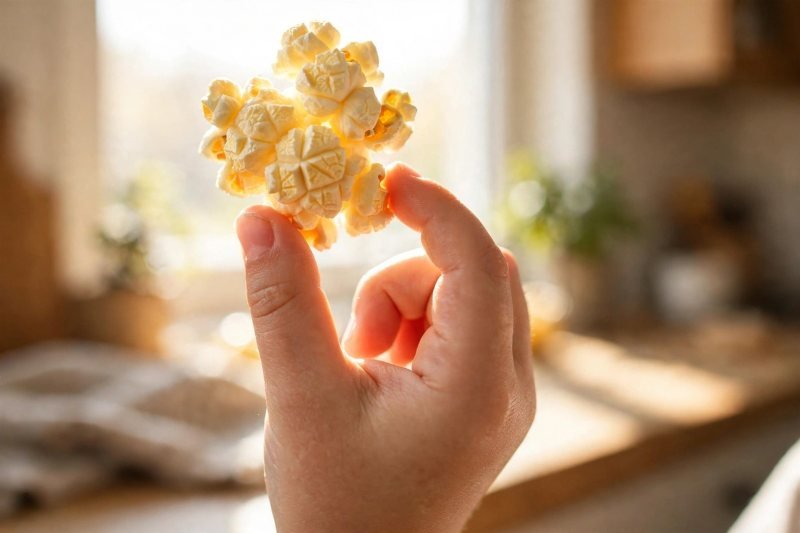
Study one big piece like a scientist. Hold a single piece between thumb and finger at eye level and turn it slowly: "What shape is it? Do you see any cracks? Any fluffy white puffs? Any golden-brown crunchy spots?" Let your child describe it in their own words before you add yours.
-
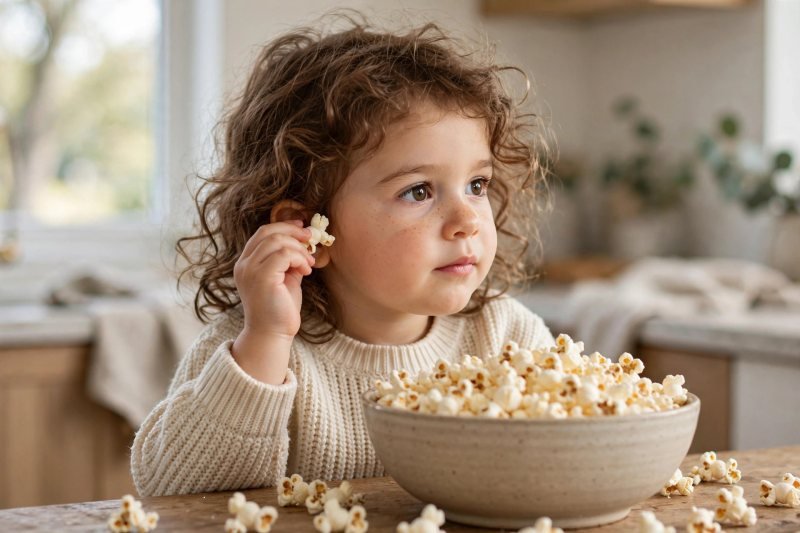
Crush a piece beside your ear. Hold a piece beside your ear and crush it gently between your fingers, listening for the tiny crackle; do it again louder, then as quietly as you can, and ask, "Which crush was the loudest? Which was the softest?"
-
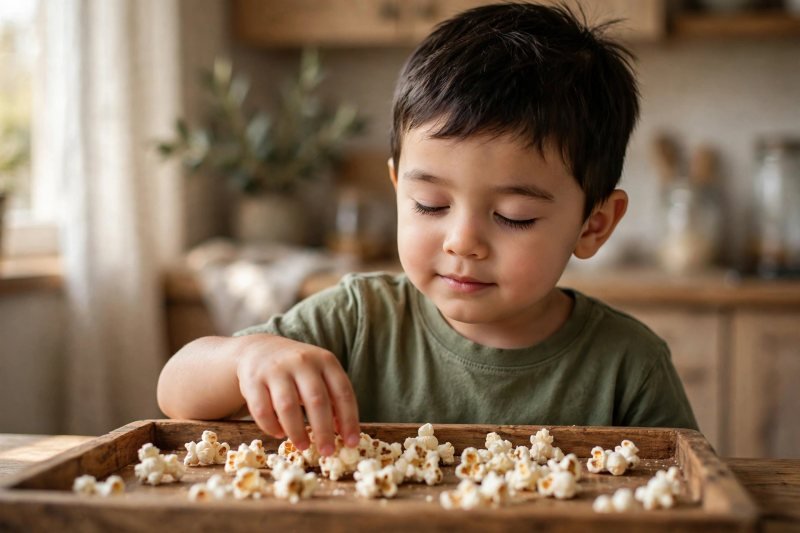
Feel the pieces with your eyes closed. Tip a handful onto the tray and let your child feel each piece with eyes closed — closed eyes make fingers braver — then ask, "Bumpy or smooth? Rough or soft? Can you find the crispiest bit?"
-
Sort the pieces into shape piles. Let your child invent the rules: round puffs in one pile, flat flakes in another; ask, "How many kinds did you find?" Sorting is comparing — grouping things by what they share.

-
Sit down and taste one piece at a time. Rules first: sit still, one piece at a time, chew it all the way, no talking or laughing with popcorn in your mouth; you hand over each piece and watch the chewing, then ask, "Crunchy? Chewy? Does it taste the way it smelled?" Three or four pieces is a full tasting — this is an activity, not a snack session.

-
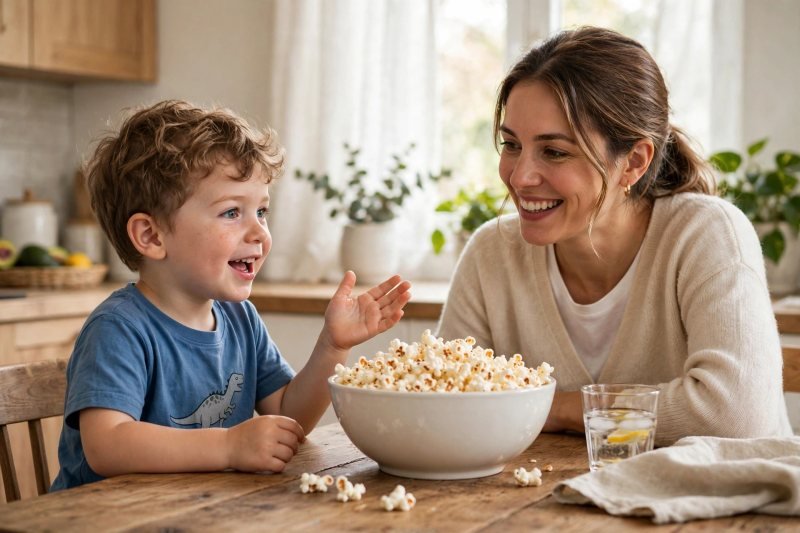
Say one describing word for every sense. Go around the bowl together: "I SAW bumpy white puffs. I HEARD tiny crackles. I SMELLED warm toast. I FELT rough spots. I TASTED a soft crunch." Your child's words count even if they are silly — "It smells like a cozy blanket" is excellent sensory vocabulary.
-
Play the guessing game. Your child closes their eyes while you rattle pieces in a cup, hold the bowl near their nose, or place a piece in their palm; they guess which sense you used, then swap roles and test you — four-year-olds adore catching a grown-up out.
-
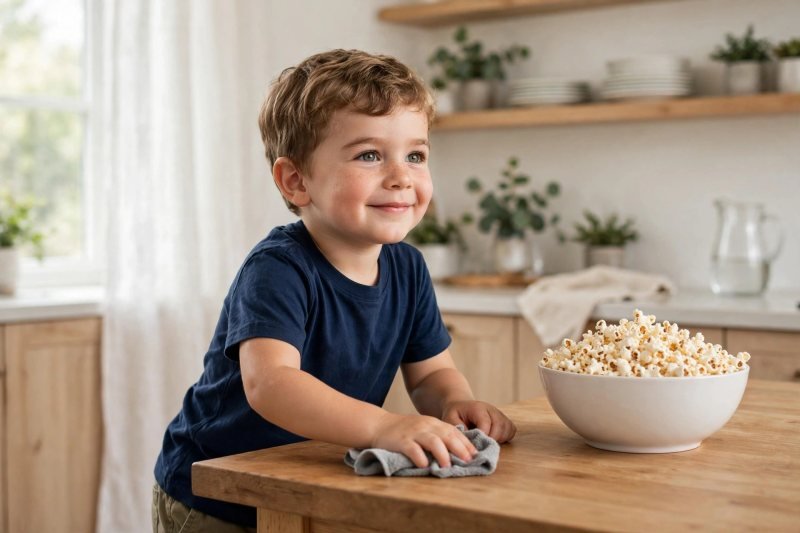
Clean up together. Collect fallen pieces, wipe the table, and bag the leftovers; ask, "Check under the chair — did any escape?" A tidy finish keeps stray pieces away from younger siblings.


Make it easier
Skip the sorting step and the guessing game. Explore just three senses — look, smell, taste — and finish in ten happy minutes. You choose the describing words; your child repeats them.
Make it harder
For confident fives: compare popcorn with a second crunchy food, like an apple slice — "Which is crunchier? Which is louder when you bite?" Or play mystery describer: your child describes a sense without naming it ("It sounds like tiny fireworks") and you guess. Sorting is comparing — build on it with sequencing activities for preschoolers. For another kitchen-table science moment, try the dancing raisins experiment — the same watch-and-describe skills with a fizzy twist.
Other ways to play it
- Movie-night check-in: keep the five-senses words going during family movie night — one sense named per handful.
- Sealed shakers: a few pieces in a taped-shut jar becomes a hearing-only guessing game for another day. For more listening games, try our sound I Spy phonics game.
- Picnic version: pop the corn at home, explore the senses on a blanket outdoors.
- Big-kid leader: an older sibling runs one sense station for the 4-year-old and narrates it.
- Kitchen science: the magic milk experiment is another slow-looking activity for the same age — watch colors move and describe what you see.
How it changes by age
- This activity is for ages 4–5 only — it is not for toddlers. Popcorn is a choking hazard for children under 4, so keep younger siblings in a high chair or another room during the tasting step. At 4, most children can sit still for the tasting rules with gentle reminders. By 5, many narrate all five senses unprompted and invent their own describing words. If your child cannot yet sit still while chewing, wait a few months. Younger siblings need a different activity — try simple activities for toddlers at home instead.
What they're learning
Real observation: looking closely, listening on purpose, and describing what they notice — the foundation of science. Sensory vocabulary — bumpy, crackly, toasty, crunchy, warm — the describing words behind reading and writing. Sorting pieces into piles is early classification — grouping by shape before naming the groups — and you can build on it with sorting games for preschoolers. Cause and effect lives in the popping step: heat turned hard kernels into soft puffs. And the tasting rules practice self-control: sit still, one at a time, chew fully.
Clearing up
Bag leftover popcorn for an older family member's snack. Sweep fallen pieces — they go stale fast. Wash the bowl and tray; the cloth goes in the laundry. Picked-out kernels go back in the jar for next time.
Questions parents ask
Is popcorn safe for a 4-year-old?
What age is a five senses popcorn activity for?
How do you do a five senses activity with just one object?
What words do kids learn from a five senses popcorn activity?
Do you need butter or salt for a popcorn sensory activity?
Can this activity work for a classroom of preschoolers?
Step images 1–10 map to steps 1–10 in order. Instructions restructured 2026-11-26: exactly 10 paragraphs, each starting with a bold action-phrase title; the 7 question-headed H2 sections were removed and their content folded into the steps (pop/listen, smell, look, crush/listen, feel, sort, taste, name words, guessing game, clean up). No duplicate Q&A content remains in Instructions. Internal links (7, all verified live 2026-11-26): five-senses-activities-preschoolers, sequencing-activities-for-preschoolers, dancing-raisins-experiment-preschool, sound-i-spy-phonics-game, magic-milk-experiment-preschoolers, activities-for-toddlers-at-home, sorting-games-for-preschoolers.

save it for later
Pin this for the next rainy afternoon
Keep it on a board so it is there when you need it, rather than when you happened to find it.
Save to Pinterest

