


How to Make Oobleck: Cornflour Slime Recipe for Kids
How to make oobleck with cornflour and water — the classic recipe for ages 4–5. Squeeze it solid, watch it melt to liquid, add color, then clear up the right way (never down the drain).
To make oobleck, mix roughly 2 parts cornflour with 1 part water until it feels like thick custard: it holds solid when you squeeze it and melts into liquid when you let go. It takes five minutes, costs pennies, and gives 4–5-year-olds a gloriously messy first taste of real science. Never tip it down the sink — bin it.

The short version
- Oobleck is just cornflour and water — roughly 2 parts cornflour to 1 part water, adjusted to feel.
- Squeeze or punch it and it goes solid; leave it alone and it flows like liquid.
- Five-minute setup, 20–40 minutes of play, costs less than a dollar.
- Food coloring is optional but spectacular — it stains, so wear old clothes.
- Never pour oobleck down sinks or drains: it sets in pipes. Scrape it into the trash.
- "It changes when you push it" is the whole science lesson — and it's accurate.
- Age
- Ages 4–5
- Prep
- 5 min
- Play time
- 20 min
- Mess
- Some
- Difficulty
- Easy
- Where
- Indoor
Why kids love this
Oobleck is disobedient, and children adore that. It sits in the bowl looking like boring white goo — then you punch it and it fights back like a solid, and the ball you roll melts through your fingers before you can show anyone. At four and five, children live in the "what happens if I…?" phase, and oobleck rewards every test: squeeze, poke, pour, slap, drip. No wrong way to play, no neat end product to get right, and the whole thing costs less than a dollar. Messy with permission — roughly a preschooler's definition of joy.
Why does oobleck act like both a solid and a liquid? The honest answer is wonderfully simple. Cornflour is made of tiny grains, and when stirred into water they float around loosely — which is why unstirred oobleck flows like a liquid. But squeeze or punch it and those grains get rammed together and jam: they can't slide past each other, so the whole mixture locks up and behaves like a solid. Stop pushing and the grains drift apart again — back to liquid. Scientists have a proper name for this — a shear-thickening fluid — but you will never need to say those words to a four-year-old. "It changes when you push it" is the complete lesson, and it is accurate. If your child asks why (and they will), try: "The little cornflour bits get squished together when you push, so it goes hard. When you let go, they float apart again." Then let them test that explanation fifty times. That's not stalling — that's science.
How do I talk about oobleck science with a 4-year-old? Three moves, used on repeat. Predict — "What will happen if you squeeze it really hard?" Observe — "Look! It's dripping through your fingers!" Compare — "It was solid when you punched it — is it solid now?" That's the entire scientific method at age four, and every round builds vocabulary: solid, liquid, squeeze, pour, push, melt, flow. Wonder out loud alongside them rather than explaining at them. "Hmm, I thought it would stay a ball — it didn't!" is more scientific than any lecture, because it models exactly what scientists do: notice, guess, test, go "huh". And don't correct their theories too fast. If they decide the oobleck is "sleeping" when it's liquid and "awake" when it's solid, that's a perfectly good four-year-old model of the world.
What you'll need
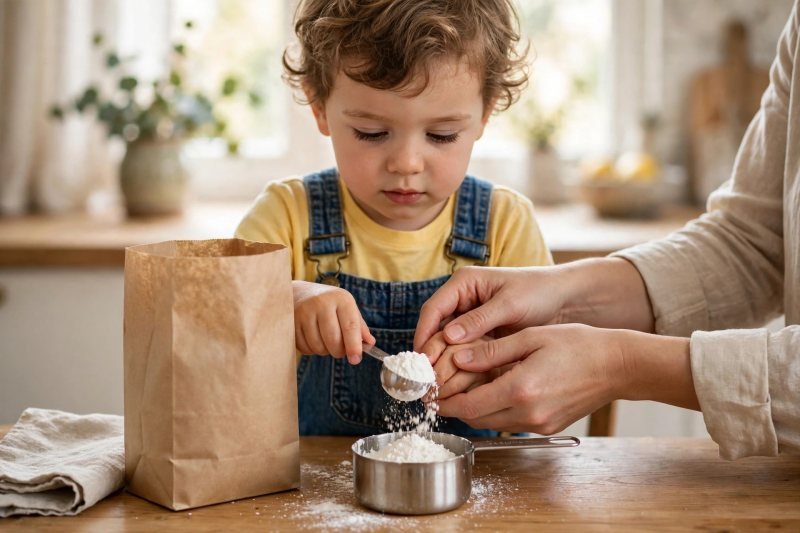
- Cornflour — about 250g (about 2 cups; a standard 500g box does two batches; in US stores, look for cornstarch)
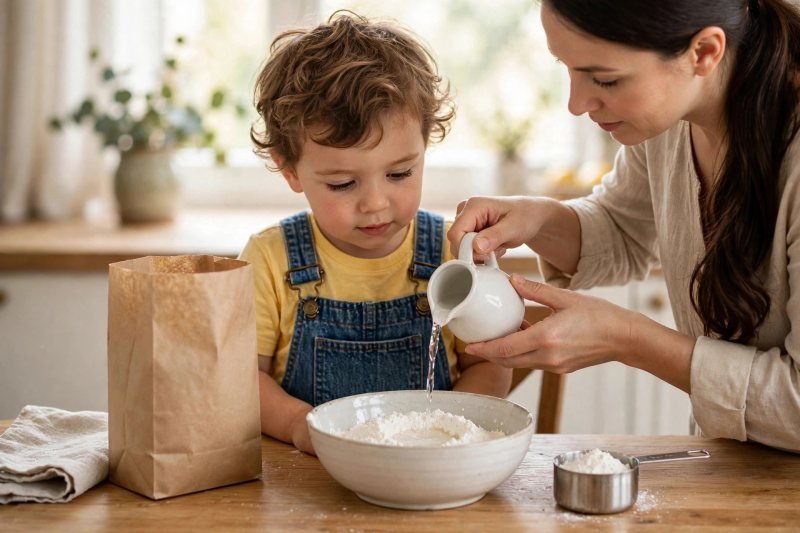
- Cool or room-temperature water — about 200ml (just under 1 cup)
- A large bowl or dishpan for mixing
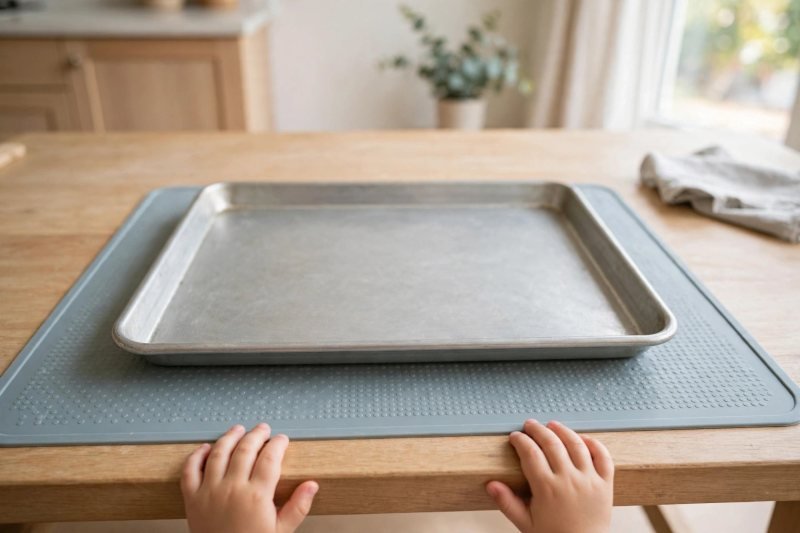
- A baking tray or roasting pan with a rim, for the play surface
- An old towel, wipeable tablecloth, or shower curtain to go under the tray
- A spoon for the first stir
- Food coloring (optional — a few drops go a long way)
- Old clothes or an apron for your child
- A trash bag or kitchen trash can nearby for clean-up
Before you start
Lay the towel or wipeable cloth on the table and put the tray on top — this is the play zone, and everything messy happens inside the tray. Let your child fill the water mug from the tap (great pouring practice) and open the cornflour box for them, or decant it into a jug if the box is full and heavy. Pop the food coloring beside the tray, lids on. Old clothes on, sleeves up. That's it — five minutes, and you're ready.
How to do it
-
Set out the tray. Put the baking tray on the wipeable cloth and declare it the oobleck zone. Everything gloopy stays in the tray — this one rule saves your table.
-
Measure the cornflour. Let your child scoop roughly two mugs full of cornflour into the bowl. Precision doesn't matter; the feel of the finished mixture is the real measure.
-
Add the water gradually. Pour in about half the water and stir, then add the rest a splash at a time. Slow adding is the difference between perfect oobleck and cornflour soup.
-
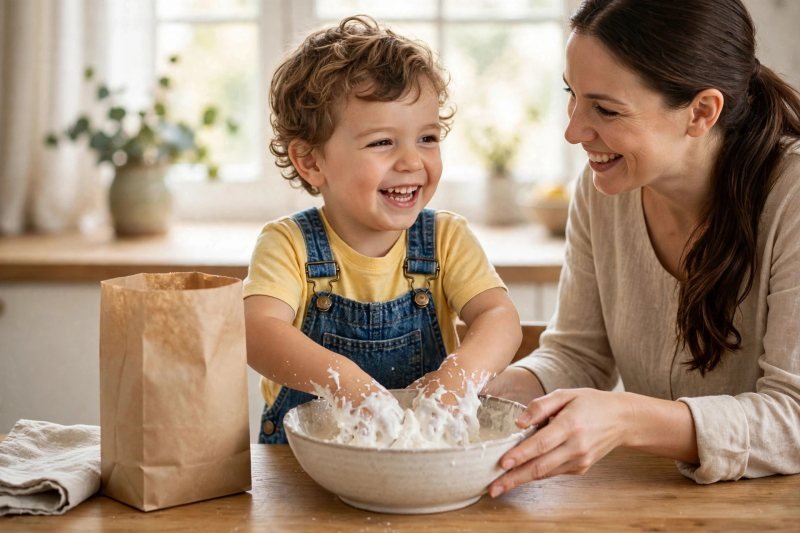
Mix with your hands. Ditch the spoon — squishing with bare hands is the best part and mixes far better. Keep going until it feels like very thick custard: resistant when stirred fast, runny when stirred slowly.
-
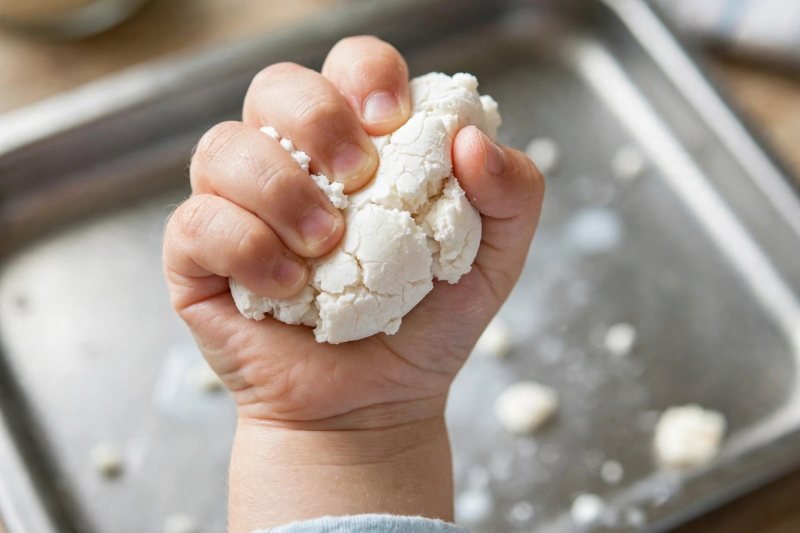
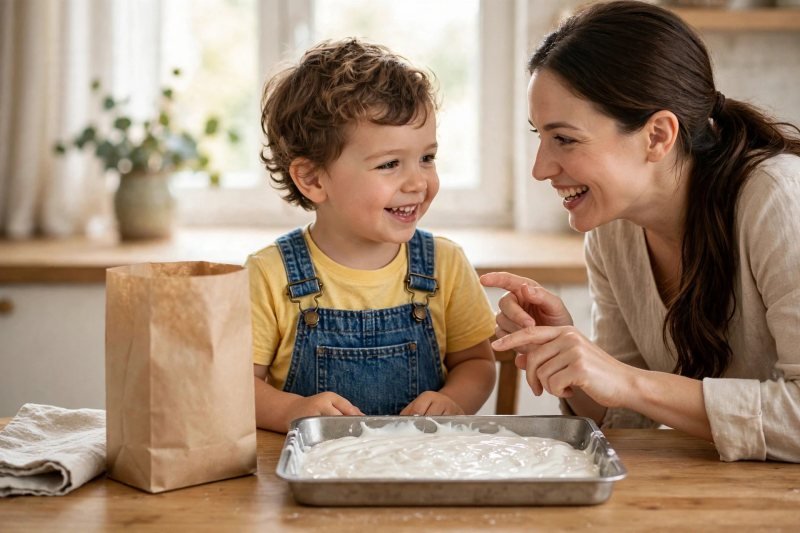
Test the squeeze. Grab a handful and squeeze hard — it goes solid, like a snowball. Open your hand — it melts and drips through your fingers. Solid, then liquid. Let the gasping commence.
-
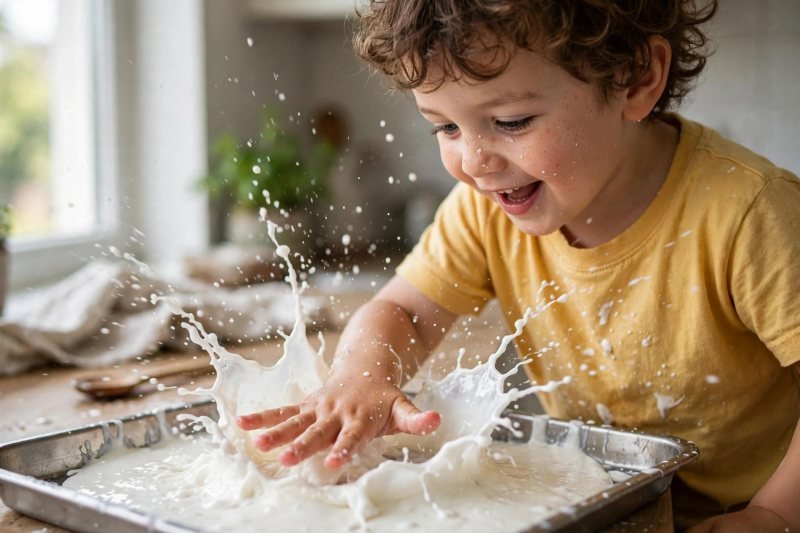
Try punch vs pour. Punch the surface flat-handed: it resists like something solid. Now scoop some up and pour it from a height: it flows like a liquid. Same mixture, two opposite behaviors.
-
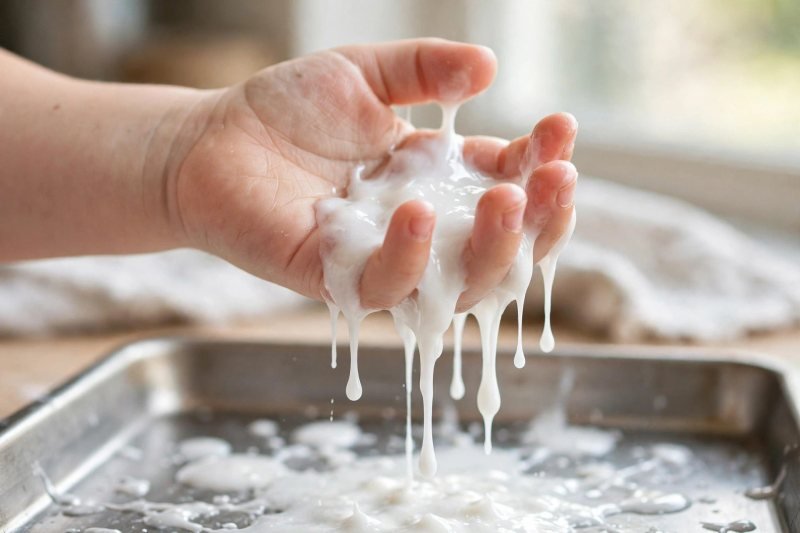
Roll a ball that melts. Squeeze a ball in your fist, hold it up proudly — then open your hand and watch it melt into a puddle on your palm. How many seconds before it's liquid again?
-
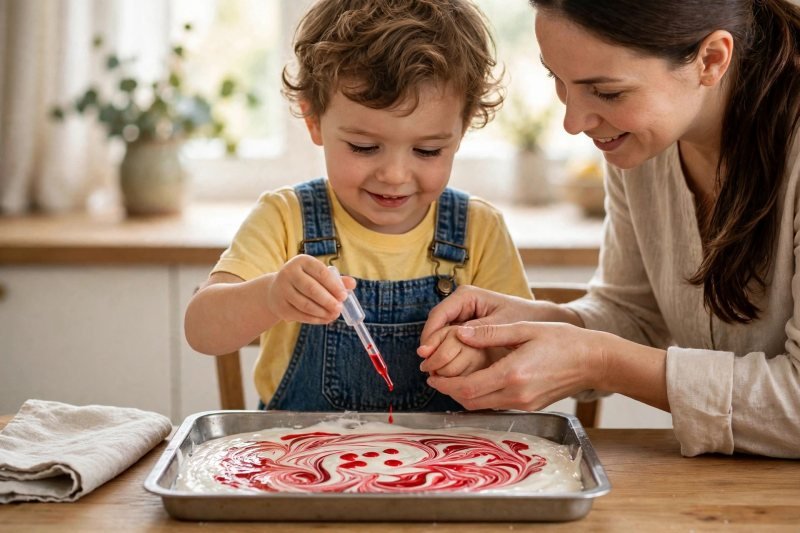
Add food coloring (optional). Drop a few drops onto the surface and swirl through with a finger — red marble oobleck is spectacular. Warn them it stains fingers for the day. For more color play, see our color-mixing activities for preschoolers.
-
Have the simple science chat. "It's both! Push it and it goes solid. Leave it alone and it goes liquid." That's the whole lesson, and it's enough. Let them test the rule: push, release, push, release.
-
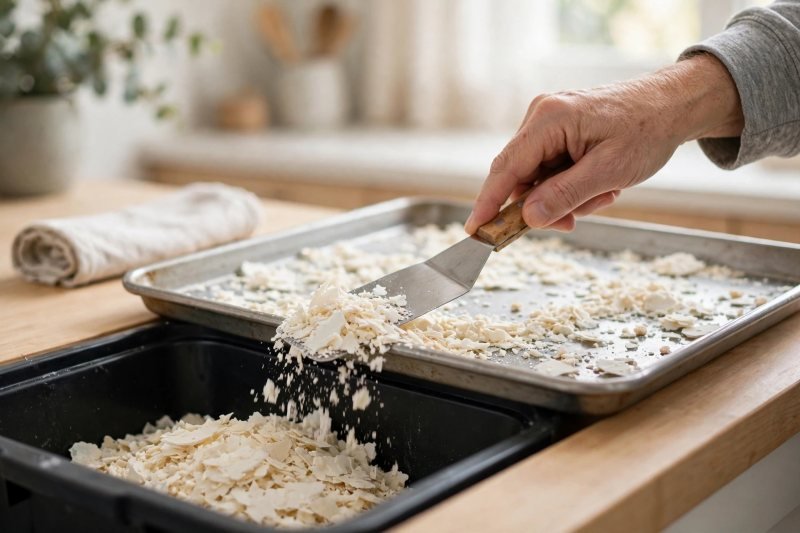
Clean up the right way. Scrape every last bit into the trash — never down the sink or drain (it sets in pipes like cement). Wash hands with warm soapy water.


Make it easier
Pre-measure the cornflour and water before your child sits down, so they just do the fun combining. Use a shallow tray rather than a deep bowl — it's easier to reach and harder to spill. Skip the food coloring this round; plain white oobleck is magical enough. And do the water pouring yourself if your four-year-old is more of a "dump it all in" personality.
Make it harder
Turn it into a proper experiment. Before each test, ask for a prediction: "What will happen if we add more water?" Add a spoonful and find out. Try tools — a fork, a whisk, a toy car: which sinks, which skims across? Challenge them to roll the longest-lasting ball, or to carry oobleck across the tray on a spoon without dripping. Older fives can "record" results by drawing solid vs liquid on paper.
Other ways to play it
- Giant garden batch: Double everything into a dishpan and take it outside on a warm day. Whole-body oobleck — feet included — is unforgettable.
- Color layers: Make two small batches, color one red and one blue, and pour one over the other. Watch the colors marble without fully mixing.
- Oobleck vs playdough: Put a lump of playdough beside the tray. Which holds a shape? Which melts? A first, hands-on lesson in comparing materials.
- Buried treasure: Hide a few chunky toys or large shells in the oobleck and let your child dig them out — superb fine-motor work. (For more squeezing, pouring, and scooping ideas, our fine-motor activities for preschoolers collection is full of them.)
How it changes by age
- Written for ages 4–5. Four-year-olds will need you to handle the measuring and the final clean-up; five-year-olds can run most of it themselves, including the predictions in Make it harder. Keen three-year-olds can join in — just expect more splashing and less hypothesizing, and keep the food coloring out of reach. Older siblings make excellent "lab assistants" and will happily demo the squeeze test on loop.
What they're learning
Early ideas about states of matter (solid vs liquid — the big one); cause and effect ("I squeezed it and it changed!"); prediction and testing, the bones of the scientific method; sensory vocabulary (squishy, runny, firm, dripping, smooth); fine-motor strength from squeezing, pouring, and rolling. Keep exploring in our science collection. Pair it with our dancing raisins experiment for a full kitchen-lab afternoon.
Clearing up
Scrape all the solids into the trash first — a spatula is perfect. Then wipe the tray with a damp cloth; rinsing just a thin film off is fine, it's the bulk that blocks drains. Clothes rinse best in cold water before a normal wash. Dried cornflour dust brushes off tables and floors easily. If you colored it, a paste of bicarbonate of soda and water lifts most of the tint from the tray.
Questions parents ask
What is oobleck made of?
Why does oobleck go solid when you squeeze it?
Is oobleck safe for kids?
How do you dispose of oobleck?
Why is my oobleck too runny or too dry?

save it for later
Pin this for the next rainy afternoon
Keep it on a board so it is there when you need it, rather than when you happened to find it.
Save to Pinterest

