


Last-Minute Toddler Halloween Costumes: 15 Quick Ideas
Last minute toddler Halloween costumes from your own closets and drawers: 15 no-sew ideas for ages 2-3 — cats, pumpkins, bees, superheroes and more — assembled in minutes over everyday clothes, with no neck ties and no face-covering masks.
Last minute toddler Halloween costumes for ages 2–3 use only household clothes, paper, tape, and face paint: dress your child in a color base over normal clothes, add one or two paper signals like ears, spots, or a tall hat, keep faces uncovered and necks free, and finish in 5–15 minutes with no shopping and no sewing.

The short version
- Every costume starts from drawers you already own — a color base (black, white, orange, yellow, red) worn over everyday clothes.
- One or two signals sell each character: paper ears, tape stripes, paper spots, a cushion pumpkin belly, or a tall paper chef hat.
- Safety is built in: no face-covering masks, nothing tied or looped at the neck, and capes, tails, and wraps stop above the knees.
- Faces stay visible with whiskers, noses, and stitches in washable face paint — the pirate patch is paint only, never a string.
- Fastest picks for the truly last minute: cat, superhero, and pumpkin each take under ten minutes with tape as the only tool.
- Age
- Ages 2–3
- Mess
- Low
Why kids love this
Toddlers love Halloween most when the costume still feels like themselves — their own soft clothes underneath, their face uncovered so they can grin, breathe, and be recognized, and a transformation that happens right in front of them in the living room. These last minute toddler Halloween costumes deliver exactly that magic without a shopping trip: a paper headband turns a familiar black shirt into a cat; an orange top stuffed with a cushion becomes a pumpkin round enough to pat; extra sock legs make a spider they can wiggle themselves. Because every idea goes on over everyday clothes, nothing itches, pinches, or needs to come off for the bathroom, and because you build it together from the laundry basket, the getting-ready becomes part of the fun — choosing ears, holding the tape, and practicing the animal noise in the mirror before anyone knocks on a single door.
What you'll need
- Everyday clothes in costume colors — black, white, orange, yellow, red, brown, and striped tops and leggings or pants from your child's own drawers
- Plain paper and thin cardboard — for ears, dots, emblems, hats, and antennae; plus child-safe scissors for adult cutting only
- Washable face paint or an eyeliner pencil you already own — for whiskers, noses, and stitches, never for covering the whole face heavily
- A roll of removable tape and a few safety pins used by an adult only — for stripes, dots, bones, and holding paper pieces to clothes without sewing
- Soft household extras — a small cushion or pillow for pumpkin stuffing; spare socks for spider legs; a clean towel for a superhero cape; toilet paper or white fabric strips for a mummy wrap
- Hats you already own — a straw hat, a dark cap, a winter hat, and a headband to carry paper ears and antennae
- A laundry basket or box as the dress-up station — everything gathered in one place so nothing needs hunting for mid-costume
- A mirror at toddler height, a damp cloth for face-paint fixes, and closed-toe shoes for walking outdoors
Before you start
1. Tip the laundry basket and drawers into one dress-up station: pull out tops and bottoms in black, white, orange, yellow, red, and brown, plus towels, spare socks, hats, and a small cushion, so every color decision takes seconds. 2. Set up a small making spot at the kitchen table — paper, cardboard, tape, scissors for adult hands only, and face paint — and cut nothing in advance; each costume below tells you the two or three cuts it actually needs. 3. Agree the safety frame before you start: costumes go over normal clothes, faces stay uncovered with hats and headbands instead of masks, nothing ties or loops around the neck, and hems and wraps stop well clear of little feet so nothing trails or trips.
How to do it
-
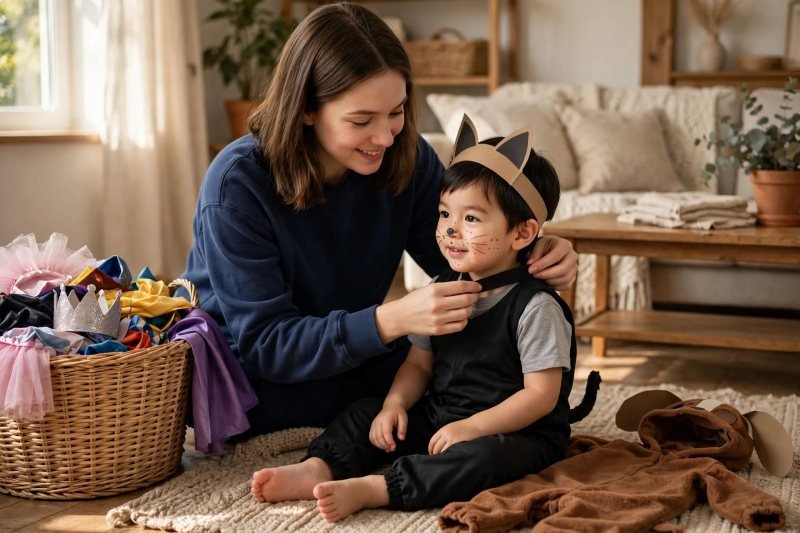
Start with the animal classics. Raid the black clothes first for (1) Cat — dress your toddler in a black top and black leggings or pants over a thin base layer if the evening is cool; cut two paper triangles, tape them to a headband so the ears sit up without any pins near skin; draw three whiskers on each cheek and a tiny pink nose with face paint; and tuck a rolled spare sock or a soft belt loosely into the back waistband as a tail that hangs short and never trails on the ground. Right beside it in the same drawer dive comes (2) Puppy — swap to a brown top and pants; cut two long floppy paper ears and tape them to the sides of a headband or a soft cap so they flop when he bounces; paint a round brown nose and a few freckle dots; and add a paper circle spot taped to the tummy for instant puppy charm. Both costumes take under ten minutes, use no sewing at all, and keep the face completely open. If you want a paper craft warm-up while the paint dries, the ideas in Halloween crafts for toddlers use the same paper-and-tape toolkit. Say, "Ears on, whiskers on — listen, I can hear a tiny cat and a tiny puppy in our living room."
-
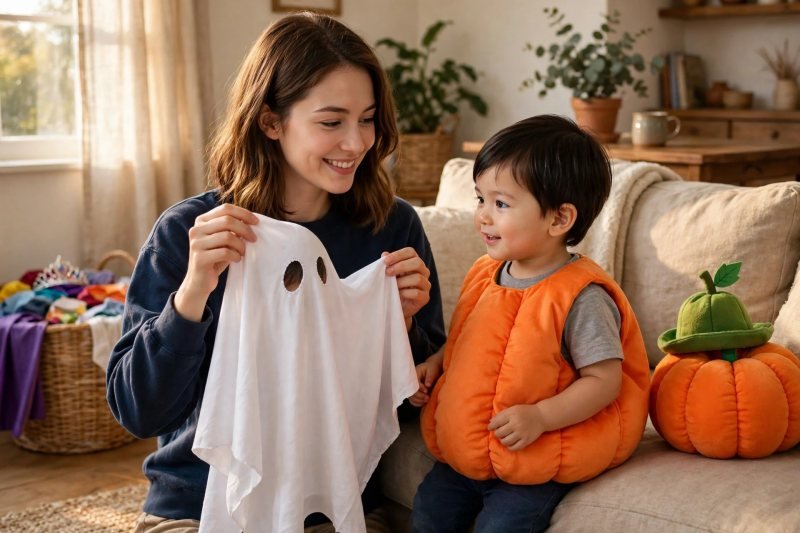
Turn white and orange into instant icons. For (3) Ghost, skip the classic sheet entirely because toddlers need their faces free and their feet untangled — instead dress him in a white top and white or pale pants; dust a little pale face paint on the cheeks and forehead so he looks ghostly pale without anything covering his eyes, nose, or mouth; cut two soft white paper ovals and tape one to the chest and one to the back as a gentle ghostly glow; and fluff his hair up with your hands for a floaty finish that cannot slip, slide, or trip him. For (4) Pumpkin, pull on an orange top one size roomy if you have it; slide a small cushion or folded pillow inside the front of the top to make a round pumpkin belly he can pat; cut a green paper leaf and tape it to a green or brown winter hat as the stalk; and draw two triangle eyes and a wide smile on a paper circle taped to the belly rather than on his skin if he dislikes face paint. Both outfits stay soft, breathable, and fully open at the face and neck. Say, "A friendly ghost who can still smile, and the roundest pumpkin in the whole patch."
-
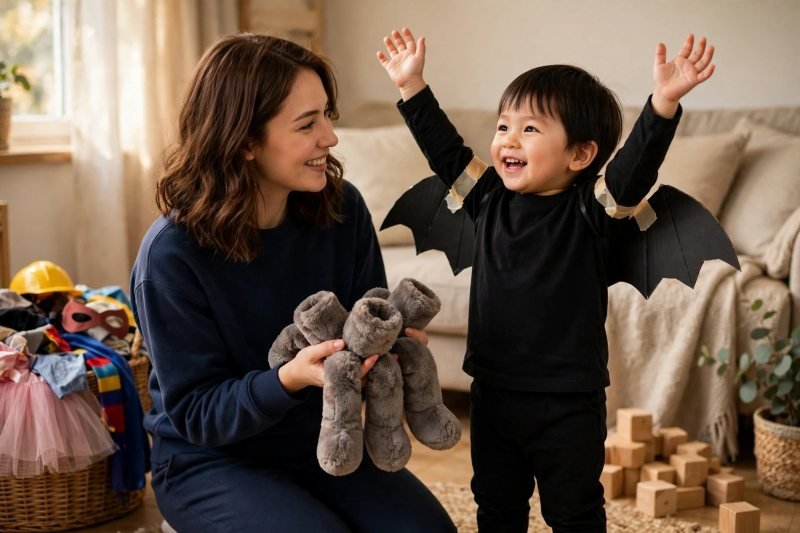
Build the creepy-crawlies from socks and card. For (5) Bat, dress him head to toe in black; cut two wing shapes from black paper or thin cardboard — wide triangles with two gentle scallops along the bottom edge; tape one wing securely to the back of each sleeve and the side of the top so the wings lift when he raises his arms and fold down when he rests them; add two small paper triangle ears on a headband; and keep the wings short enough that they never brush the floor or catch on furniture. For (6) Spider, stay in the same black base; stuff four spare socks lightly with tissues or other socks so they stay soft and floppy; pin or tape two stuffed socks to each side of the top at waist height with adult hands doing every pin and the pin closures facing outward away from skin — or tuck them firmly through belt loops if you prefer no pins at all; cut two big white paper circles with black centers and tape them to the chest as spider eyes; and let him wiggle so all eight legs bounce. Nothing here hangs from the neck and nothing trails behind him. Say, "Flap for the bat, wiggle for the spider — eight legs and every single one is wiggly." The spider in this step pairs naturally with a paper-plate spider web on the porch, made from the same card and tape in about the time the face paint takes to dry.
-
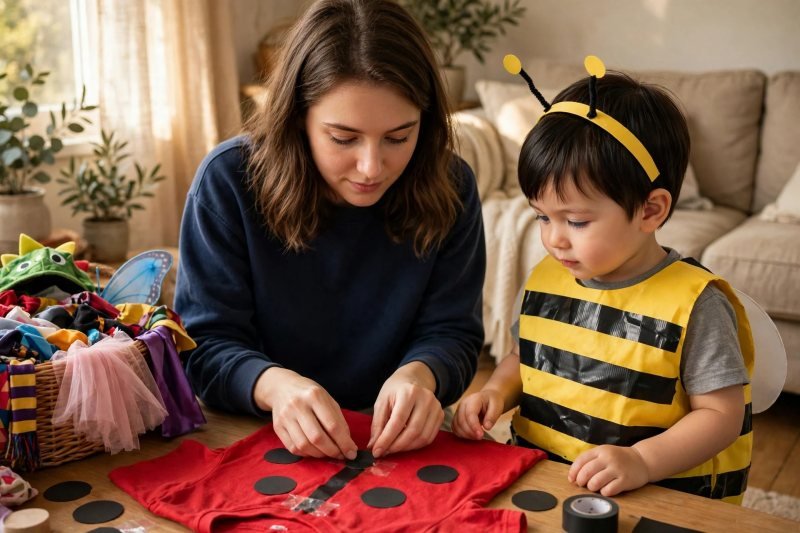
Stripe and dot your way to the garden bugs. For (7) Bumblebee, start with a yellow top and dark pants; lay three strips of dark tape or dark paper strips taped at the ends straight across the tummy and back to make bold bee stripes; twist two short pipe-cleaner-style antennae from paper strips — or roll two thin paper tubes — and tape them to a headband with a paper ball on each tip so they bob as he walks; and cut two pale paper wings and tape them flat to the back of the top between the shoulders. For (8) Ladybug, swap to a red top; cut six to eight black paper circles and tape them across the front and back as spots; reuse the same headband trick with two short paper antennae; and add black pants or leggings to finish the beetle silhouette. Both bugs are bright enough to spot at dusk, both keep wings flat and short so they never trail or snag, and both come off in seconds because every stripe and spot is only tape on clothes. Layering either bug over a warm base follows the same common-sense approach as toddler winter outfits for ages 2-3 — costume on top, warmth underneath, shoes still sensible. Say, "Buzz from the bee, scuttle from the ladybug — the whole garden is awake tonight."
-
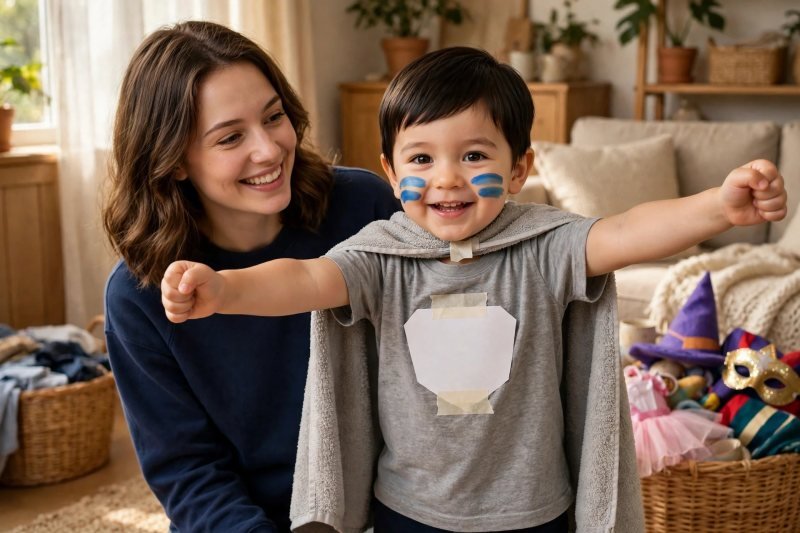
Save the day with a towel superhero. For (9) Superhero, you need exactly three things — a clean towel or small blanket for the cape; a paper emblem cut into a circle or shield shape; and tape. Dress him in his brightest top and pants first; tape the paper emblem to the center of his chest and draw a simple star or lightning shape on it with a marker before it goes on; then attach the cape safely — never tied, looped, or knotted around the neck — by tucking the top corners of the towel firmly over the shoulders and securing them to the shoulder seams of the top with tape or adult-placed clips so the cape hangs from the shoulders, releases if it catches, and stops at the back of the knees so it cannot be stepped on. Paint a bold eye stripe across the cheeks and nose bridge with face paint instead of using any mask, so his eyes, nose, and mouth stay completely clear. Practice one hallway hero run together, arms out, cape flying at knee length and no longer. Say, "Shoulders hold the cape, paint makes the hero — off you fly, short and safe and super." A towel superhero needs an audience, so give him one in pretend play — a hallway rescue, a porch wave, and a bow — before the real route, while the cape is still a novelty.
-
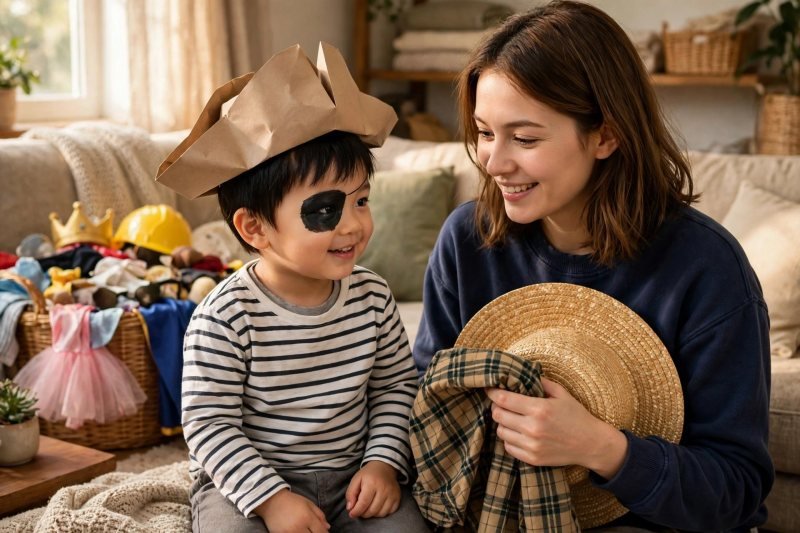
Dress the storybook pair in ten minutes. For (10) Pirate, pull out a striped top and dark pants; roll a paper tricorn or fold a simple paper pirate hat and let it sit loosely on his head so it lifts straight off; draw an eye patch with face paint over one eye area — paint only, with no string, strap, or elastic anywhere near his face or neck; tape a paper parrot or a paper coin circle to one shoulder; and tuck a rolled paper telescope into a belt or waistband where it cannot trail. For (11) Scarecrow, layer a plaid or checked shirt over a top with jeans or brown pants; add the straw hat you already own or any wide soft hat; tuck a few strips of yellow paper or spare fabric scraps just inside the cuffs and collar so they peek out like straw without being tied anywhere; and paint stitched lines — a dotted smile line and a triangle nose — with face paint while he watches in the mirror. Both characters read instantly from across the street, both hats come off the second he wants them off, and neither uses a single cord, tie, or loop. Say, "A pirate with a painted patch and a scarecrow with paper straw — two storybooks walking down our street."
-
Cook up a chef with paper and an apron. For (12) Chef, dress him in a white top and light pants; tie an adult apron loosely at the back of the waist only — never at the neck, with the neck strap left untied and tucked away or the apron folded down if it has one — or skip the apron and tape a big white paper rectangle to the front of the top as a chef's front panel; make the tall hat from a band of white paper taped into a circle that sits loosely on his head with a pouf of white tissue or a second crumpled paper sheet taped inside the band to puff upward; and hand him a wooden spoon and a soft pot lid as props he can carry or drop without any risk. Draw a tiny curled mustache with face paint if he will sit still for it, and skip it cheerfully if he will not. The hat is the whole costume — tall, white, and unmistakable — and it lifts off in one motion with nothing fastened at the throat. Say, "Tall hat, big spoon — the tiniest chef in town is ready to taste everything."

-
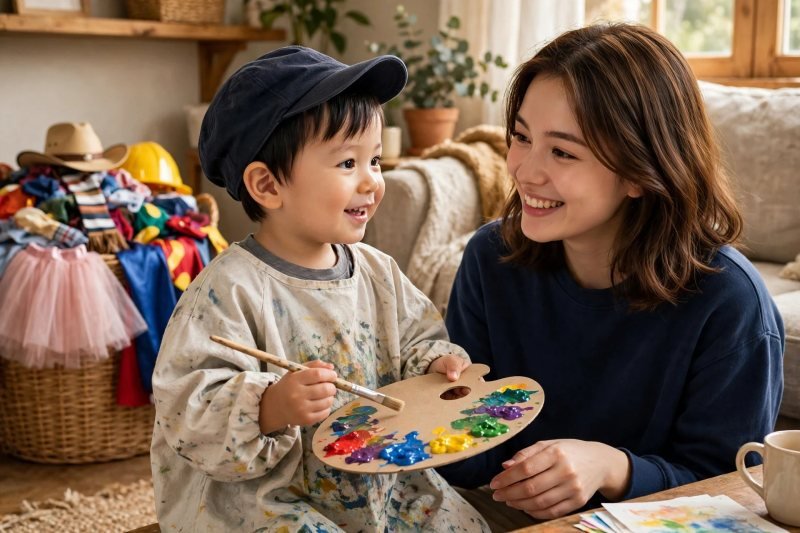
Make an artist from a hat and a palette. For (13) Artist, dress him in any colorful top and pants you do not mind calling a smock outfit — or pull an oversized adult shirt on over his clothes as a painter's smock with the sleeves rolled well clear of his hands; cut a painter's palette from cardboard into a kidney shape and dot it with blobs of face paint or marker color; add a soft hat, a dark cap worn at a jaunty angle, or a scarf draped loosely over one shoulder and tucked into the waistband so nothing hangs free at the neck; hand him a clean, dry paintbrush to carry; and dot three tiny paint speckles on one cheek with face paint for the finishing joke. Everything is carried or worn flat, nothing dangles, and the palette does the storytelling from a distance. If the smock shirt is long, fold and tape the hem up so it clears his shoes completely before he takes a single step. Say, "A palette, a brush, and paint on your cheek — you look like you just finished a masterpiece."
-
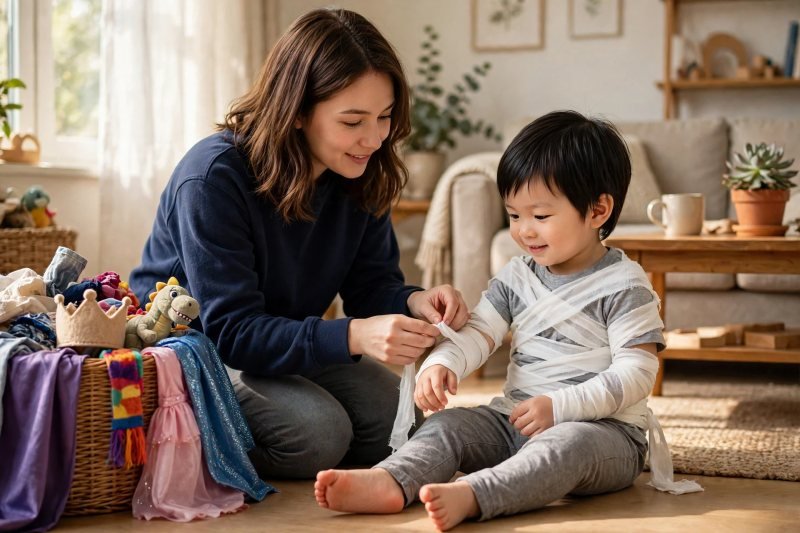
Wrap a mummy without covering the face. For (14) Mummy, dress him first in a white or pale top and pale pants as the base layer so the costume works even if the wrap loosens; wrap toilet paper or torn white fabric strips loosely around the torso over the top, then around each arm and each leg over the clothes, tucking every end in firmly so nothing unwinds into a trailing strip; leave the head, face, neck, hands, and feet completely unwrapped and clear; tear the strips at the knees and elbows a little so he can bend, walk, and climb steps normally; and keep every strip short and tucked, checking behind him that nothing hangs below the backs of his knees. This is the costume to build last and wear for the shortest stretch — photographs first, a short walk second — because paper wraps loosen as toddlers move, and a base outfit underneath means a loosening strip is funny rather than a costume failure. An adult walks beside him and re-tucks any strip the moment it slips. Say, "Wrapped up, face free, feet ready — the friendliest mummy ever to shuffle down the path." The paper-and-tape toolkit in this step is the same one behind Halloween crafts for kids, so a mummy that survives the evening usually starts with the same patient taping as a paper pumpkin or ghost.
-
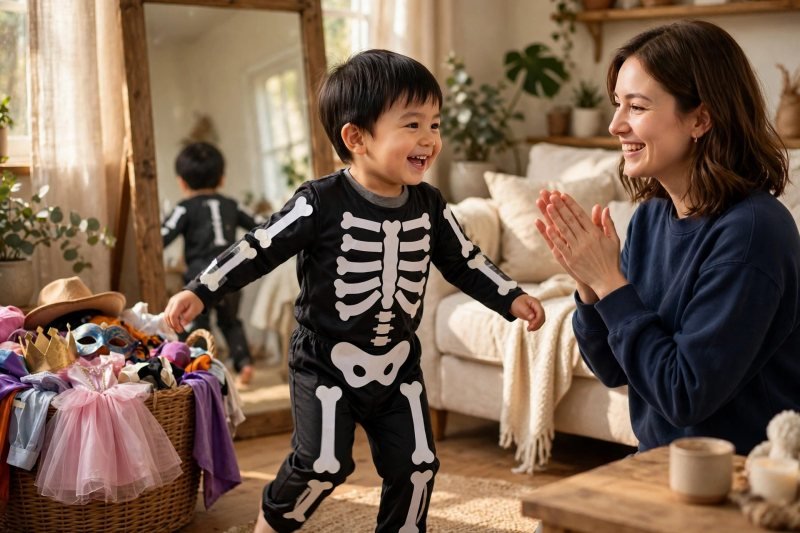
Finish with bones, checks, and one last twirl. For (15) Skeleton, return to the black top and black pants base; cut bone shapes from white paper — long bones for the arms and legs, a rib row for the chest, and a round skull-free face alternative in the form of two white cheek circles with face paint — and tape one long bone to the front of each sleeve and each trouser leg, a row of short curved rib strips across the chest, and the cheek circles in place so his real smile does all the skull work. Do a final safety lap together before anyone leaves — the lap you run for every costume in this list: face completely uncovered with no mask and no hood over the eyes; nothing tied, looped, or fastened around the neck; capes, tails, wings, and wraps all stopping above the backs of the knees with nothing trailing on the ground; shoes closed-toe and tied by an adult; and a warm layer underneath if the evening air bites. End at the mirror for one last twirl and one practice wave, because a toddler who has rehearsed being seen is a toddler who walks out glowing. Say, "Bones that glow, a smile that shows — one last twirl, skeleton, and off we go." When the last costume is chosen, toddler Halloween costumes offers more dress-up ideas for the days after Halloween, when every one of these quick builds becomes dress-up again.


Make it easier
Pick the two-minute costumes first: the cat needs only a headband and face paint over black clothes, and the superhero needs only a towel at the shoulders and a paper emblem — both read clearly even if you skip every optional extra. Batch the making: cut all paper pieces for siblings or friends at once — ears, spots, stripes, and bones from the same paper pile — and let tape do every join so nobody waits for anything to dry. Dress over pajamas on very late starts: a costume layered over the pajamas he will sleep in means the evening can end with face wiped, costume off, and straight into bed.
Make it harder
Add a matching grown-up element in the same five minutes: matching paper ears for you beside his cat, a paper emblem beside his superhero, or stripes beside his bee — toddlers find a twinning adult hilarious and it photographs beautifully. Build a two-costume evening: start with a soft base layer in black or white that serves two ideas — cat first, skeleton later, or ghost first, mummy later — so a mid-evening change is a tape swap, not a full redress. Let a confident 3-year-old direct the details: which spot goes where on the ladybug, how many ribs the skeleton gets, and whether the chef's mustache curls up or down — choosing is the challenge he will remember.
Other ways to play it
- Sibling set from one drawer dive: the black base serves cat, bat, spider, and skeleton in turn; the white base serves ghost, chef, and mummy — dress siblings from the same color family and the whole group looks coordinated in minutes.
- Warm-night version: swap long sleeves for short sleeves in the same colors, skip stuffing and extra layers, and lean on face paint and paper pieces to carry each character so nobody overheats.
- Daycare parade version: choose the costumes with no loose props and no wrap — cat, pumpkin, ladybug, and skeleton travel best, survive a whole morning, and come off for naps without help from extra adults.
- When tape will not stay put: tape fails fastest on fuzzy sweaters and in damp air, so press paper ears and spots onto a smooth top or headband base instead of re-taping the same spot — if a piece needs a third repair, swap it for face paint, which cannot fall off.
How it changes by age
- Age 2: Two-year-olds need the costume to be mostly clothes they already trust: black leggings and a top for the cat or skeleton, an orange top for the pumpkin, with just one added signal — ears, a stalk hat, or painted whiskers — worn for as long as it delights them and removed without fuss the second it does not. Keep face paint to a single whisker set or nose dot, expect hats to be carried as much as worn, and choose the ideas with no wrap, no cape, and no small taped pieces they can peel and mouth. Photograph early; at two, the first five minutes in costume are usually the happiest five.
- Age 3: Three-year-olds can carry the fuller builds: spider legs they wiggle on purpose, a chef's tall hat they adjust with pride, and a mummy wrap they help hold while you tuck. Let them choose between two ideas, hold the paper while you cut, and check the mirror after each addition — the assembling is half the event at three. They can also manage the short superhero cape and bat wings, provided the final safety lap still passes: face free, neck free, nothing trailing, and an adult close by outdoors after dark.
What they're learning
Symbolic thinking and pretend play: a towel becomes a cape, a cushion becomes a pumpkin belly, and socks become spider legs — holding an object as two things at once is the core of imagination, storytelling, and later abstract thought. Body awareness and vocabulary: ears on the headband, ribs on the chest, bones on the arms and legs — naming and placing body parts while dressing builds language and self-knowledge through the hands. Fine motor control: holding paper steady while an adult cuts, pressing tape flat, placing spots and stripes, and gripping a spoon, brush, or telescope — small, purposeful hand work inside a game he chose. Confidence and social courage: rehearsing a twirl, a wave, and an animal noise at the mirror before meeting neighbors turns a potentially shy evening into a performance he has already practiced and can enjoy.
Clearing up
Costume clearing up takes five minutes because nothing was sewn and nothing was bought: peel tape pieces off clothes straight into the bin, gather paper ears, spots, and emblems into one recycling pile or one keepsake envelope if he wants to save his cat ears, and shake the pumpkin cushion and spider socks back into the laundry basket for washing. Face paint comes off with a damp cloth and warm water before pajamas, towels and smocks go into the wash, and hats return to their hooks. Photograph the tidy dress-up basket before you close it — next year's last-minute costume starts with proof of how much was already in the house.
Questions parents ask
What is the fastest last-minute Halloween costume for a toddler?
How do you make a toddler Halloween costume with no sewing?
Are masks safe for 2- and 3-year-olds at Halloween?
What household items make the best toddler costumes?
How do you keep a last-minute toddler costume safe?
Full 15-idea enumeration: (1) Cat; (2) Puppy; (3) Ghost; (4) Pumpkin; (5) Bat; (6) Spider; (7) Bumblebee; (8) Ladybug; (9) Superhero; (10) Pirate; (11) Scarecrow; (12) Chef; (13) Artist; (14) Mummy; (15) Skeleton.


