


Kids Summer Capsule Wardrobe: The 7-Piece Beach Kit
A kids summer capsule wardrobe built around one 7-piece beach kit: swimsuit, rash guard, shorts, tee, cover-up, sun hat, sandals — all in three mix-and-match colors. Build it once, pack in five minutes all summer.
Build a kids summer capsule wardrobe around one 7-piece beach kit: a swimsuit, a rash guard, quick-dry shorts, a breathable tee, a light cover-up, a wide-brim hat with a strap, and water-friendly sandals — all solids or small prints in a three-color story so every piece matches. Test the mixes in a flat-lay, pack it all in one bag, and rinse-and-hang after trips.

The short version
- The 7 pieces: swimsuit, rash guard, quick-dry shorts, t-shirt, cover-up, wide-brim sun hat, water-friendly sandals.
- A three-color story is the system: every piece on-team means every combination works.
- Edit what you own first — most families already have five of the seven pieces.
- Prove the capsule with the flat-lay test: at least five distinct outfits from seven pieces.
- One bag is the enforcement: if it doesn't fit, it doesn't come.
- Care loop after every trip: rinse swim pieces, shake out sand, hang dry, never store damp.
- Age
- Ages 4–5
- Prep
- 30 min
- Play time
- 5 min
- Mess
- Low
- Difficulty
- Easy
- Where
- Indoor
Why kids love this
Kids love a kit that's theirs: one bag, their colors, outfits they can assemble without a negotiation. The flat-lay game — "how many outfits can you build?" — turns getting dressed into a puzzle they win daily, and a 4-year-old who can dress herself for the beach feels ten feet tall.
What you'll need
- Piece 1: a swimsuit that fits comfortably and stays put in the water
- Piece 2: a rash guard or swim shirt for sun coverage
- Piece 3: quick-dry shorts
- Piece 4: a breathable t-shirt
- Piece 5: a light cover-up, sundress, or overshirt
- Piece 6: a wide-brim sun hat with a chin strap
- Piece 7: water-friendly sandals that stay on
- One tote or small suitcase that will be the kit's home
- A mesh laundry bag for wet pieces
- Sunscreen and sunglasses (kit extras, not counted pieces)
Before you start
1. Pull every summer and swim item your child owns onto the bed before the session — capsules are built by editing what exists first, shopping second. 2. Check fits now, not at the beach: suits get a stretch test (bend, reach, pretend-swim), sandals get a hallway walk, hat straps get adjusted. 3. Start a donate/pass-down pile beside the bed for outgrown pieces — capsule sessions double as the season's closet cleanout. 4. Keep the session playful and short: one snack break beats a marathon sort with a preschooler.
How to do it
-
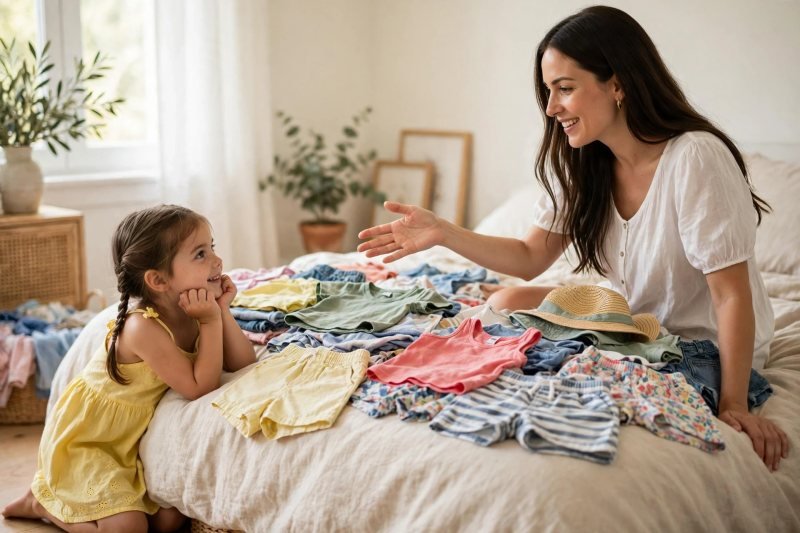
Start with the capsule idea: seven pieces, endless outfits. Spread the summer clothes on the bed and explain the game to your child: "We're building a beach kit with just seven pieces — and every piece has to be friends with every other piece." A kids summer capsule wardrobe isn't about owning less for its own sake; it's about choosing pieces that all mix, so any grab from the bag makes a working outfit. That one rule — everything matches everything — can end the morning outfit battle, shrinks the laundry pile, and makes packing a five-minute job. Seven pieces is the working count, not a promise of endless outfits: the flat-lay test below proves at least five distinct outfits from the seven. Let your child hold the title of Chief Picker from the start; a kit they helped choose is a kit they'll happily wear. Idea set, the first real decision is the one that makes the rest easy: color.
-
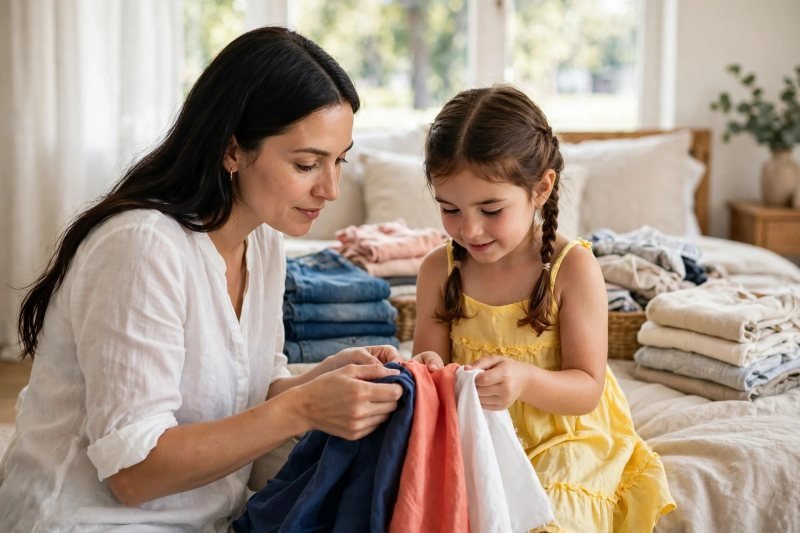
Pick a three-color story together. From the pile, pull out your child's favorite color, then add two partners that look good with it and with each other — classic summer stories are navy + coral + white, teal + yellow + white, or pink + denim + cream. Say: "These three are our team colors — every piece we keep has to wear the team colors." Solid colors and small patterns mix easiest; one fun print is welcome as long as its colors are in the story. Anything off-story goes to the everyday drawer or the pass-down pile, no guilt attached — it's not banned clothing, it's just not on this team. Holding up two pieces and asking "team or not team?" is a game a 4-year-old can genuinely play. Colors locked: start building from the water out.
-
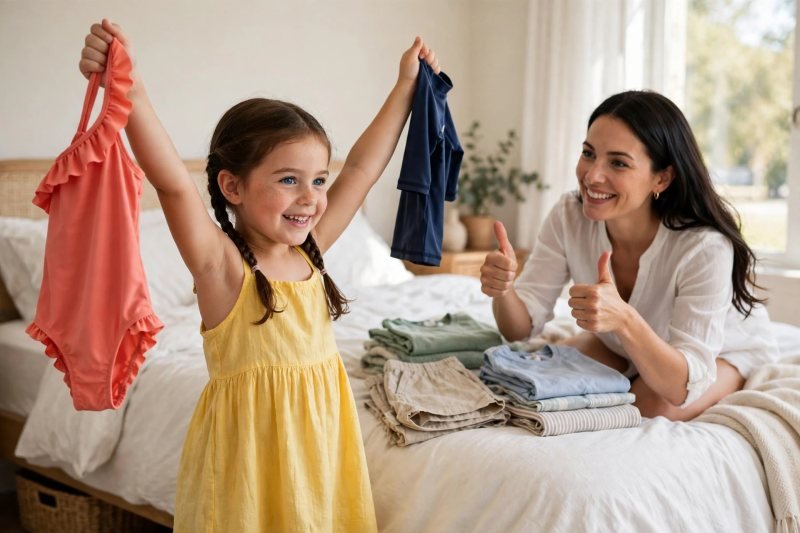
Choose pieces 1 and 2: the swim base. Every kit starts at the water. Piece 1 is the swimsuit — the one already proven comfortable, because a suit that rides up or slips gets rejected by its owner within one beach trip. Piece 2 is the rash guard or swim shirt worn over it, doing the sun-coverage work on shoulders and back during the longest water hours. Say: "Suit first, guard over it — that's our swim uniform." Both pieces must be in the color story, and both get the pretend-swim test: arms up, twist, crouch. If your child swims more than three times a week, note that a second suit (rotated while the first dries) is the one justified exception to the seven — a variation for heavy-use families, not the starter kit. Swim base chosen: now the dry land uniform.
-
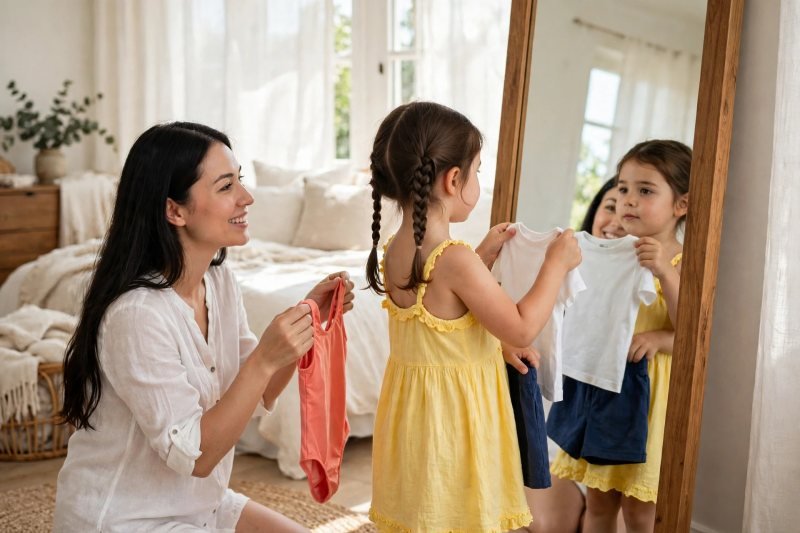
Choose pieces 3 and 4: the dry set. Piece 3 is quick-dry shorts — the pair that goes over the suit for the walk to the snack bar and dries fast enough not to matter. Piece 4 is a breathable t-shirt in a team color, the hardest-working piece in the kit: it covers shoulders in strong sun, layers over the suit, and pairs with the shorts for the ride home. Say: "Shorts plus tee is our land outfit — check they match the suit too." Test the combos standing in the bedroom: shorts over suit, tee over suit, shorts with tee. If any combo clashes with the color story, swap the piece now rather than all summer. These four pieces already make most beach days; the next piece is the one that turns the kit from swimwear into a wardrobe.
-
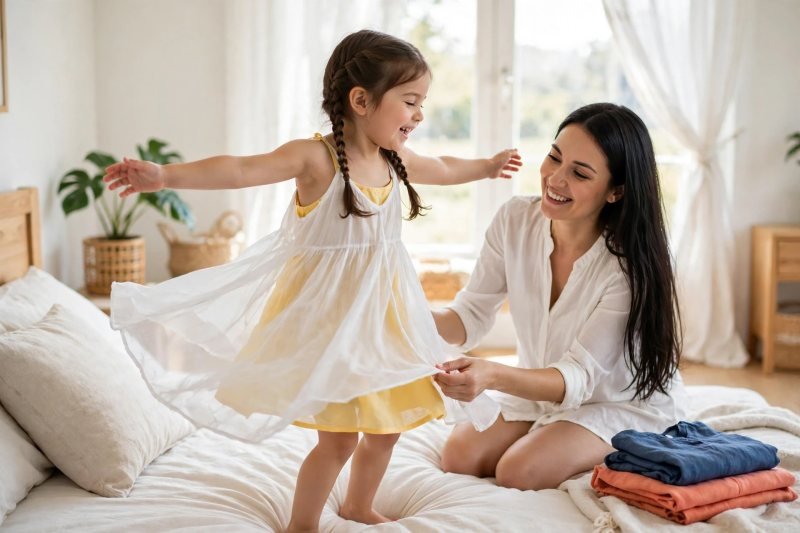
Choose piece 5: the cover-up layer. Piece 5 is the transformer: a light cover-up, a sundress, or an oversized button shirt in a team color. It goes over the suit for lunch out, over the tee for cooler evenings, and serves as the "we're going somewhere" upgrade that means the kit handles a full vacation day, not just the sand hours. Say: "This is our magic piece — it makes everything look dressed up." For girls who live in dresses, the cover-up can be the dress itself; for others, a hooded towel-shirt style cover doubles as the drying-off layer. One piece, three jobs, still on-team. Kit's nearly complete — the last two pieces protect the head and feet.
-
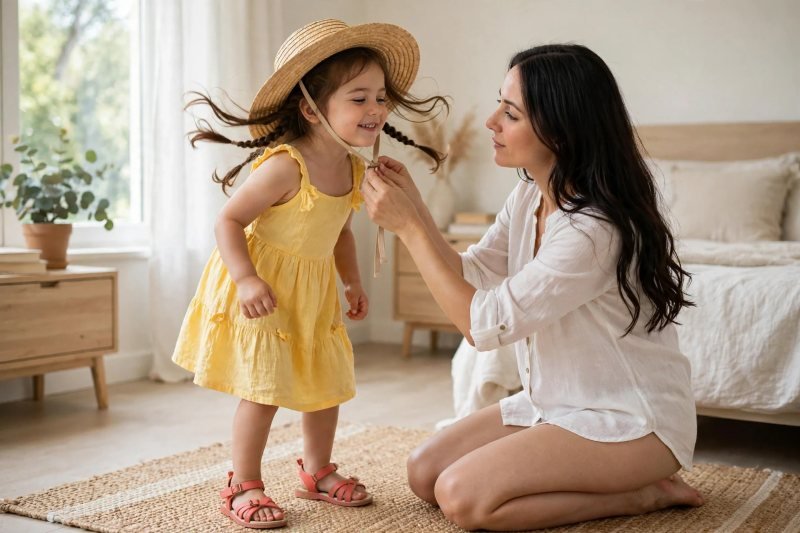
Choose pieces 6 and 7: the sun hat and the sandals. Piece 6 is a wide-brim sun hat with a chin strap — the strap is the difference between a hat that's worn and a hat that's carried. Piece 7 is water-friendly sandals with a back strap: they handle wet rocks, hot pavement, and the walk from car to sand, and they rinse clean in seconds. Say: "Hat shades the face, sandals guard the feet — the kit's bodyguards." Both count fully as capsule pieces because both go with every single outfit the other five pieces can make. Fit-check them like the suit: hat stays on through a head-shake, sandals stay on through a run down the hallway. To picture the seven pieces as finished looks, browse summer outfits for girls and summer outfits for boys for hot-day inspiration. Seven pieces chosen — now prove the capsule promise with the mixing test.
-
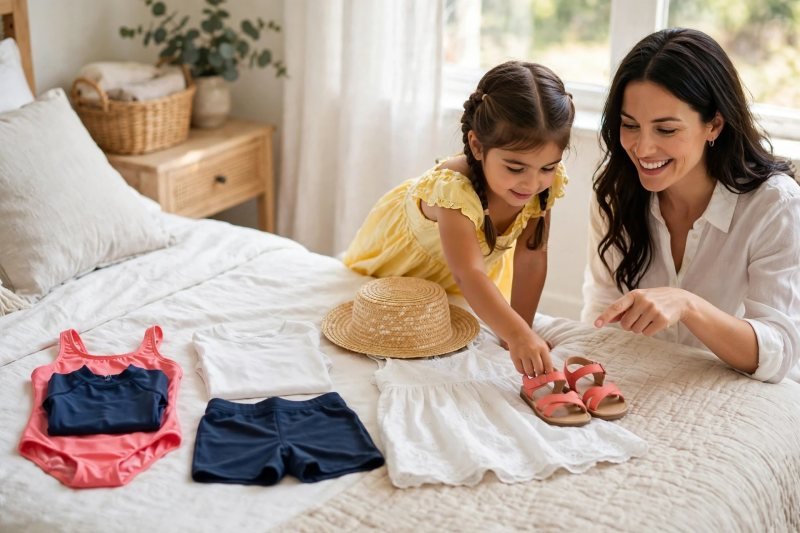
Run the flat-lay test: build every outfit you can. Lay the seven pieces on the bed and play the counting game out loud: "Suit plus guard is swim… shorts and tee is land… cover-up over suit is lunch…" Build each combination as a flat-lay and let your child arrange them: swim set (pieces 1+2), land set (3+4), lunch set (1+5), evening set (3+4+5), full sun set (2+3+6+7), and every outfit includes 6 and 7 when outdoors. Seven pieces, at least five distinct outfits, zero clashes — if any combo fails, that's the piece to swap while the pile is still on the bed. Take a phone photo of each winning outfit; those photos become the packing checklist. Test passed: the final building step is giving the kit a home.
-
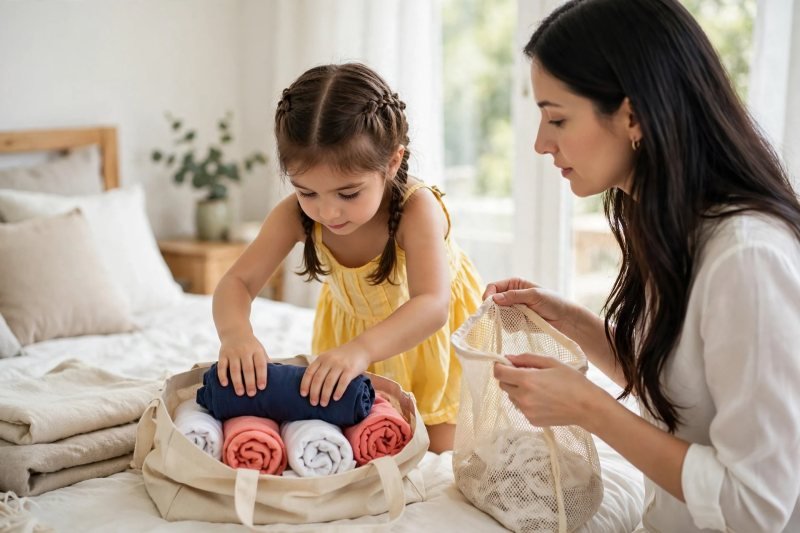
Pack the kit into one bag, rolled. Roll each piece (rolling beats folding for small clothes: less wrinkling, more visible) and pack the whole kit into its one tote or small suitcase, wet things separated by the mesh bag. Say: "If it fits in the kit bag, it's the kit — if it doesn't fit, it's not coming." That physical limit is the capsule's enforcement mechanism, and it's why future packing takes five minutes: grab bag, check the photo list, go. Store the bag where beach departures happen — by the door or in the car trunk — with sunscreen and sunglasses in its pocket (extras, not counted pieces). For the rest of the trip, the summer hub gathers warm-weather activities. One bag, packed once, grabbed all summer. There's just one ongoing job left: the five-minute care loop that keeps seven pieces lasting a whole season.
-
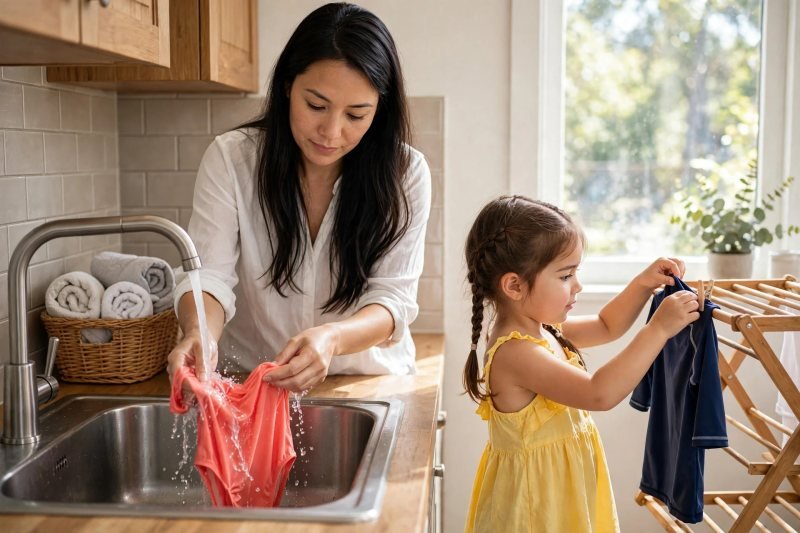
Care for the kit with a rinse-and-hang loop. After every beach or pool trip, the loop runs the same: swimsuit and rash guard rinsed in cool clean water (salt and chlorine are what age swim fabrics), shorts shaken out and checked for sand in the pockets, everything hung to dry before it goes back in the bag — never store the kit damp, which is how mildew moves in. Say it as a rhyme your child can run: "Rinse it, shake it, hang it, bag it." Wash pieces on your normal laundry rhythm, re-check fits mid-summer (growth spurts don't respect capsules), and replace only the piece that fails — the color story means a replacement only has to match the team, not a whole wardrobe. That's the complete system: choose seven, test the mixes, pack once, care in a loop.


Make it easier
Start from what's already owned: most families find five of the seven pieces in the drawer, making this an editing exercise, not a shopping trip. One color story for siblings close in age: hand-downs stay on-team automatically next year. Print the outfit photos and tape them inside the bag lid — a pre-reader's packing list.
Make it harder
Let your 5-year-old pack the kit alone from the photo list and audit her own work with the flat-lay test. Add a second climate layer challenge: rebuild the same system for a rainy-week trip and compare which pieces earn their place in both. Extend the thinking across seasons: the color-story-and-edit method is exactly how these preschool winter outfits come together when the weather turns.
Other ways to play it
- Two-suit rotation: daily swimmers add a second suit in a team color and rotate — eight pieces, same system.
- Dress-led kit: swap the shorts-and-tee land set for two team-color sundresses if that's what your child actually wears; the capsule serves the child, not the template.
- Winter counterpart: when summer ends, the same seven-piece logic builds a cold-weather kit — see these toddler winter outfits for the layering pieces that replace the swim base.
How it changes by age
- Ages 2–3: parent chooses, child picks between two team-colored options at each piece. Keep the flat-lay game — toddlers love lining clothes up — and expect the bag to be parent-packed.
- Ages 4–5: the guide as written. Preschoolers can own the color-story vote, run the mixing test with help, and pack from photos with a quick audit.
- Ages 6–8: kids can lead the whole build, including the edit of their existing drawer, and can be trusted with the rinse-and-hang loop as a standing job. The counting question scales too: how few pieces still cover a two-week trip?
- Fit note for all ages: capsule pieces work hard, so fit matters more than usual — a suit or sandal that's already snug in June will be a battle by August. Allow a little growth room and re-check fit mid-season, rather than buying big — a suit or sandal bought too large gaps, slips, and gets refused.
What they're learning
Decision-making and editing: choosing seven from many, and defending picks against a rule (the color story), is real critical thinking. Color and pattern literacy: matching, clashing, and coordinating are early art and design skills practiced on their own clothes. Independence: a kit they helped build and can pack from photos is a genuine responsibility a preschooler can fully own. Care of belongings: the rinse-shake-hang-bag loop teaches that things last when they're looked after — including by small people.
Clearing up
The session's mess is one bed of clothes: keepers go in the kit bag, everyday pieces back to the drawer, outgrown items straight into the pass-down bag before they migrate back. After trips, the mesh bag of wet items goes directly to the rinse sink — nothing sandy touches the kit bag's clean side. Five minutes now, or sand in everything until September: the loop wins.
Questions parents ask
How many pieces does a kids capsule wardrobe need?
What should be in a kids summer capsule wardrobe?
How do I choose colors for a kids capsule wardrobe?
Is a capsule wardrobe practical for kids who grow fast?
Can a kids capsule wardrobe work for a whole vacation?

save it for later
Pin this for the next rainy afternoon
Keep it on a board so it is there when you need it, rather than when you happened to find it.
Save to Pinterest


