


Keratosis Pilaris in Kids: Bumpy Upper Arms, Explained Calmly
Keratosis pilaris in kids shows up as tiny rough bumps, usually on the upper arms. It's very common and usually harmless. A calm parent's guide: what it is, what it isn't, gentle care that helps skin feel smoother, and when to see a doctor.
Keratosis pilaris in kids is a very common, usually harmless pattern of tiny rough bumps — most often on the upper arms — caused by keratin plugging hair follicles. It is not contagious and not caused by dirt. Gentle care helps most: lukewarm baths, no scrubbing, moisturizer on damp skin, and soft fabrics. See a pediatrician or dermatologist if bumps hurt, spread fast, ooze, or worry you.

The short version
- What it is: keratin plugs in hair follicles making tiny sandpapery bumps, commonly on upper arms, thighs, and cheeks; very common and usually harmless.
- What it is not: not contagious, not dirt, not an infection, and not the child's or parent's fault.
- Home care is gentle by design: short lukewarm baths, fragrance-free cream on damp skin once or twice a day, soft cotton, no scrubbing or picking ever.
- Expect slow, seasonal change; for many children it softens as they get older. One photo a month tracks it better than daily checking.
- Doctor territory: pain, heat, swelling, oozing or crusting, rapid spread, blisters, sleep-breaking itch, or anything that does not match the pattern.
- Age
- Ages 5–6
- Play time
- 5 min
- Mess
- None
- Difficulty
- Easy
- Where
- Indoor
Why kids love this
Children love this routine because almost everything about it is what they would choose: shorter, gentler baths with no scrubbing (the washcloth stops being an enemy), cream smoothed on by hands they trust, soft sleeves that do not scratch, and — most of all — an end to being examined, worried over, and asked about their arms by every relative at every gathering. Kids also love the honesty of the framing this guide hands parents: the bumps are common, they are nobody's fault, they are not dirt, and they are not a problem to be fixed before the child is allowed to feel fine. A 6-year-old whose arms are treated as ordinary is a child who stops hiding them in photographs.
What you'll need
- Good natural light and a calm moment for the first look
- A gentle, fragrance-free cleanser for bath time
- A plain, fragrance-free moisturizing cream (thicker creams suit this routine well — see our best moisturizer for kids with dry skin) — generic and unlabeled in all photos by house rule
- Soft cotton clothing for the days after bath-and-cream time
- Gentle sunscreen for sunny days (step 8)
- Your phone, for one dated photo a month — tracking, not scrutiny (step 9)
Before you start
1. Read this whole guide before the first look, so your face already knows the script: these bumps are very common, usually harmless, and handled gently. 2. Choose a neutral moment — after a bath, during pajamas — rather than a special inspection appointment. Skin checks folded into ordinary care feel ordinary. 3. Have the cream ready at the bath's end so moisturizing happens on damp skin without a cold, naked wait in between. 4. Decide in advance that this is information, not a verdict: keratosis pilaris is a pattern clinicians recognize, but your child's skin deserves an in-person professional if you ever want certainty (step 10 lists when that matters sooner).
How to do it
-
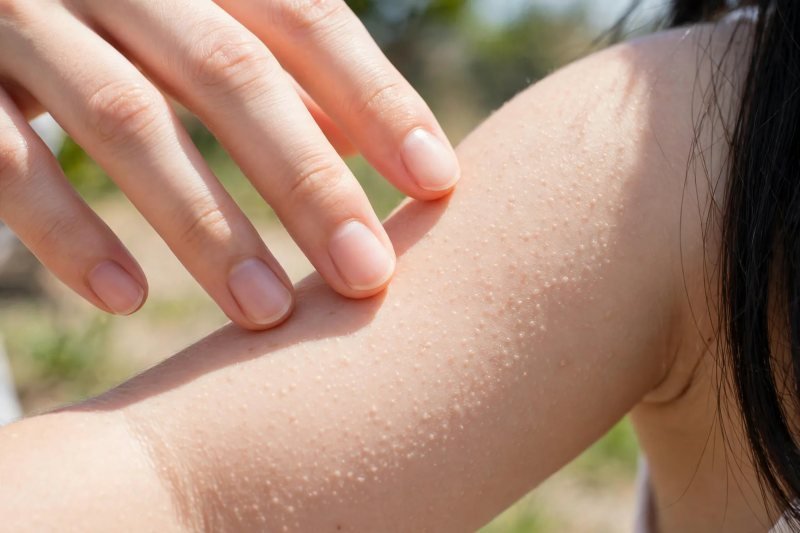
Start with a calm look at the arms in good light. Roll her sleeves up near a window and look at the upper arms — the classic keratosis pilaris neighborhood — and then the other places it commonly visits: the fronts of the thighs, the cheeks, and sometimes the forearms. Say: "Lots of kids have bumpy arms like this. We're just learning what your skin likes." What parents typically see is a field of very small bumps, each one centered on a hair follicle, skin-colored or a little pinker than the skin around them. There is no test to run and nothing to measure — this step is about replacing the midnight worry-search with an unhurried look in honest light, and about your child learning from your tone that her arms are interesting, not alarming.

-
Feel for the sandpaper texture. Run your fingertips — gently, once — across the bumps: keratosis pilaris is famous for feeling rougher than it looks, like fine sandpaper or the skin of a plucked chicken, which is why it is nicknamed "chicken skin." Say: "See? Tiny and rough, like sandpaper. That's its signature." The bumps are dry-feeling rather than hot, oozing, or tender, and most children are unbothered by them — many would never mention them at all if adults did not. Keep your touch to that one light pass: the feel is useful information for you and a reassuringly boring event for her. If anything you felt argues with this description — real heat, pain, or fluid — skip ahead to step 10's list in your mind, because those are different conversations.
-
Learn what keratosis pilaris commonly is. Keratosis pilaris is what happens when keratin — the normal protein that skin makes — builds up and plugs the opening of a hair follicle instead of shedding away. Each tiny plug makes one tiny bump, and a field of them makes the pattern you are seeing. A sentence that lands well is: "Your skin makes a little extra of its own building stuff, and it piles up in tiny doorways. That's the whole story." It is considered common in children and teenagers, tends to run in families, and often keeps company with dry skin. It is also at its most noticeable in drier, colder months and calmer in humid summer ones. This is general information about a well-known pattern — it explains why the care in the next steps is moisturizing and gentle rather than scrubbing and aggressive.

-
Learn what it is not — and say it out loud. Keratosis pilaris is not contagious: nobody catches it from hugs, shared towels, or the classroom. It is not caused by dirt or poor washing — it is keratin, not grime, and scrubbing at it as if it were dirt is the one approach guaranteed to make the skin angrier. The sentence worth repeating is: "Not catching, not dirty, not your fault — not anybody's fault." It is not an infection, not an allergy to a single food you must hunt down, and not a sign that something inside is wrong. Children absorb the household theory of their own skin, so the not-list deserves the same airtime as the is-list: a child who has been told clearly that her bumps are ordinary and faultless carries them very differently into the school photograph.

-
Switch bath time to gentle mode. The care routine starts in the tub: shorter baths or showers in lukewarm — not hot — water, a gentle fragrance-free cleanser used with hands or a very soft cloth, and no scrubbing, buffing, or exfoliating tools on the bumpy areas, however tempting the sandpaper logic feels. Say: "We wash this skin like it's already a little dry and grumpy — because it is." Hot water and friction both strip moisture the skin cannot spare, and since dryness is part of the pattern, bath time's job shifts from "get the bumps off" (impossible, and not the goal) to "leave the skin calm and ready for cream." Five to ten unhurried minutes is plenty; pat dry with the towel rather than rubbing, and leave the skin slightly damp for step 6.

-
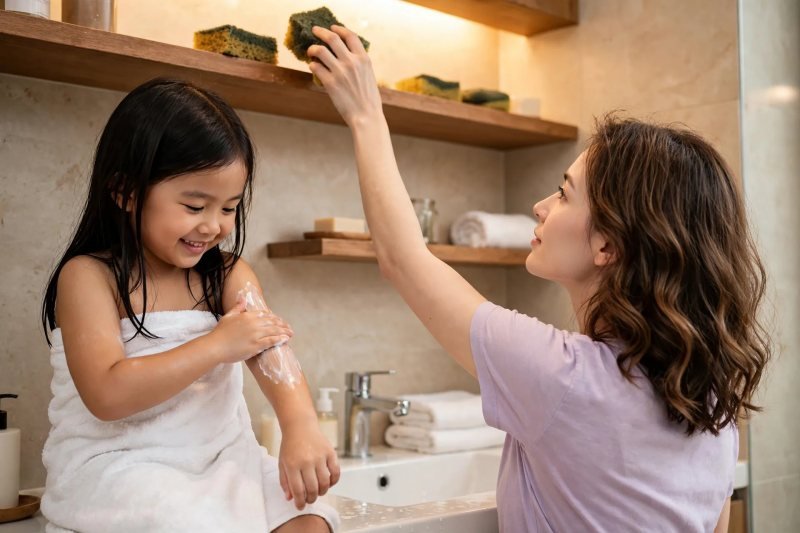
Moisturize right after the bath, on damp skin. While the skin is still a little damp — within a few minutes of stepping out — smooth the moisturizer over the bumpy areas and everywhere else it wants to go: this is the same damp-skin timing this site's simple kids skincare routine teaches, because damp skin accepts and holds cream far better than dry skin does. Say: "Cream is the main job. The bath just opens the door." A plain, fragrance-free cream, applied once or twice a day and always after baths, is the whole engine of home care — and if you are choosing between pots and pumps, cream versus lotion for kids explains why thicker creams suit this routine. No cream can unplug follicles by force, but well-moisturized skin feels smoother, looks calmer, and itches less. If a new cream ever stings or reddens the skin, stop that one product and go back to the plainest cream you have — one change at a time, so any reaction has an obvious suspect. Let her smooth her own arms if she wants a job — her technique will be imperfect and her ownership total, and ownership outlasts technique.

-
Ban the scrubbing, picking, and squeezing. Every instinct says rough skin should be scrubbed smooth; with keratosis pilaris that instinct backfires — friction and picking irritate the follicles, deepen redness, invite soreness or infection, and can leave marks that outlast the bumps themselves. When fingers wander, the redirect is: "These bumps are not splinters. Nothing in them needs to come out." Keep nails short, redirect picking fingers to the cream pot ("smooth, don't pick"), and if a grandparent suggests a vigorous loofah, deputize this step: gentle is not the lazy option here, it is the correct one. If one bump ever looks genuinely different — angry, swollen, painful, or crusted — that single spot leaves the home routine and joins step 10's list.
-
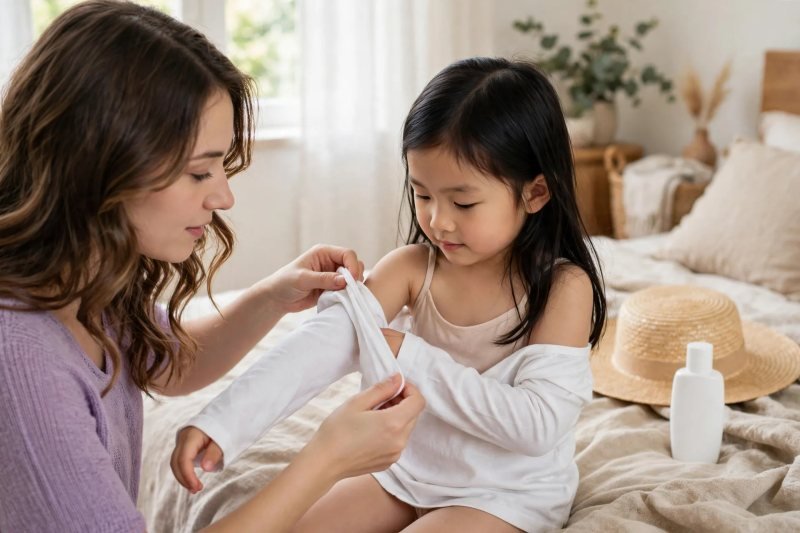
Dress the pattern kindly: soft fabrics and ordinary sun care. Rough fabrics and tight synthetic sleeves dragging across bumpy arms all day add the friction you removed from the bath, so favor soft cotton against the skin, especially after cream time — the same gentle-first approach in our sensitive skin care guide for children. Say: "Soft sleeves are part of the treatment — the comfy ones were right all along." For sunny days, bumpy areas get the family's normal gentle sun routine — shade, sleeves when practical, and sunscreen on exposed skin — because irritated or freshly picked skin and strong sun are poor companions, and because calm skin of every kind is the goal. Nothing here needs special purchases: the wardrobe and the sunscreen you already own do the work when they are chosen with the bumps in mind.
-
Be patient, and track quietly if tracking helps you. Keratosis pilaris changes on a calendar of months, not days, so set expectations honestly: the realistic goal of home care is skin that feels smoother and looks calmer, with good seasons and drier ones — not a deadline by which arms must be bump-free. A calm answer to "is it gone yet?" is: "Skin changes slowly, like seasons. We'll notice when we notice." If watching helps you, one dated photo in the same light, once a month, shows the trend far better than daily inspection; if watching feeds worry, skip the photos entirely. Parents often hear from clinicians that for many children the pattern softens as they get older — sometimes it fades a great deal, sometimes it simply becomes uninteresting. Either way, a child who was never made self-conscious about it has already received the most important outcome.

-
See the pediatrician or dermatologist when the picture changes or worry persists. Home care has a clear boundary. Book the visit if: bumps become painful, swollen, hot, or start oozing or crusting; the area spreads rapidly or one patch looks very different from the rest; itching is strong enough to disturb sleep; the pattern does not match this guide's description at all (for example, blisters, a single growing lump, or a rash with fever); or months of gentle care change nothing and you want a professional's eyes and options. Say: "Doctors are for questions, not just emergencies — and this is a perfectly good question." Walking in calm is a skill your child is learning from you; the toddler first haircut guide on this site builds the same first-appointment confidence, and a dermatologist visit runs on it. If the rash looks more like eczema than the pattern in this guide, how eczema in kids usually looks can help you compare — but comparing is not diagnosing, and a clinician still decides. A first visit is often just a look and a few questions, not a test, which is worth telling a nervous child in advance. Bring your dated photos if you kept them — clinicians love a timeline.



Make it easier
Anchor cream time to the pajamas, not the clock: bath, cream, pajamas, book. A routine attached to an existing routine needs no remembering. Let her be the cream officer for her own arms while you handle the back and thighs — participation converts a treatment into a ritual. Put a small pot of cream where baths happen and nowhere else; hunting for the cream at damp-skin o'clock is how the good timing gets lost.
Make it harder
Teach her the whole explanation in her own words — keratin, tiny doorways, cream opens the door — until she can give the calm version to a curious cousin herself; teaching is ownership at full strength. Keep a one-line-a-month skin diary together (better / same / cranky, plus the weather) — pattern-spotting across seasons is real early science, and it shows her the trend her mirror cannot. Give her a fabric vote with real authority: she tests new tops against her arms before tags come off, and her verdict on scratchiness is final.
Other ways to play it
- The cheeks version: some children wear the pattern on their cheeks instead — the routine is identical but gentler still, cream amounts smaller; our guide to dry skin on your child's face covers the same gentle approach for cheeks, and any facial redness that is hot, patchy in a new way, or weepy belongs to step 10's doctor list, not home experimentation.
- The winter version: dry months tend to make the bumps more obvious — respond with the routine done more faithfully (cream twice a day, baths shorter) rather than more aggressively; winter is when the no-scrubbing rule is tested hardest.
- The teen-ahead version: as children grow, clinicians can offer additional options for keratosis pilaris that are beyond a parent guide's scope — knowing the pattern's name means that conversation, when she is older, starts from knowledge instead of worry.
How it changes by age
- Age 5: At five, she needs the story more than the routine: keratin, tiny doorways, cream helps, bumps are ordinary. Let her do her own arms, keep the language light, and end every skin conversation with something her body does brilliantly. Your calm is the curriculum.
- Age 6: Sixes notice peers noticing. Arm her with one ready sentence — "It's called keratosis pilaris, lots of kids have it, it's just bumpy skin" — and the subject usually closes in one exchange. If teasing ever sticks, that is a school conversation, and the doctor visit from step 10 can also confirm she has the facts exactly right.
What they're learning
Body knowledge without shame: she can name what her skin does and why — keratin, follicles, moisture — and factual children are far harder to embarrass. Gentleness as the effective strategy: the condition improves with patience and moisture, not force — a strategy lesson her whole life will keep reusing. Self-advocacy: the ready sentence, the fabric verdict, the calm doctor visit — she is practicing speaking about her body with information instead of apology. Trend thinking: monthly photos and slow change teach that some things are read across seasons, not judged in a day.
Clearing up
The routine clears itself: cream pot back by the bath, towel hung, soft pajamas on. The monthly photo, if you keep one, takes ten seconds before pajamas once a month — same window light, same arm, no commentary beyond "there it is." Keep the bathroom shelf honest: when a well-meaning relative's scented scrub appears, it quietly relocates to the adults' bathroom, because the kindest clearing-up in this routine is removing the tools of the wrong strategy. Once a season, re-read step 10's list with fresh eyes — patterns change as children grow, and a calm yearly check-in keeps the boundary between home care and professional care exactly where it belongs.
Questions parents ask
What is keratosis pilaris in kids?
Is keratosis pilaris contagious or caused by poor hygiene?
Does keratosis pilaris go away as children grow up?
What can I do at home to help keratosis pilaris?
When should I take my child to the doctor about bumpy skin?

save it for later
Pin this for the next rainy afternoon
Keep it on a board so it is there when you need it, rather than when you happened to find it.
Save to Pinterest


