


1st Grade Spelling Words: 36 Weekly Lists That Build on Phonics
The complete 1st grade spelling words program: 36 weekly phonics-based lists of 10 words each — short vowels, digraphs, blends, silent-e, vowel teams, diphthongs, and r-controlled — with a 10-step weekly routine, spelling games, and parent FAQs for ages 6–8.
A solid year of 1st grade spelling words is about 360 words in 36 weekly lists of 10, ordered by phonics pattern: short vowels, digraphs, blends, silent-e long vowels, vowel teams, diphthongs, r-controlled vowels, endings, plurals, compounds, and contractions. Practice 10–15 minutes a day with a say-build-trace-write routine; most families master each week's list in five short sessions.

The short version
- 1st grade spelling words work best in weekly lists of about 10 words, all sharing one phonics pattern.
- The 36 lists run short vowels → digraphs → blends → silent-e → vowel teams → diphthongs → r-controlled → endings → word parts, mirroring US phonics order.
- Practice 10–15 minutes daily: say the pattern, build the words, trace the tricky ones, dictate, sort, and play one game.
- If the school sends its own list, use those words with this same routine.
- End each week with a quick Friday check and stickers — celebration, not red pens.
- Age
- Ages 6–8
- Prep
- 15 min
- Play time
- 15 min
- Mess
- None
- Difficulty
- Easy
- Where
- Indoor
Why kids love this
Ten words is a challenge a six-year-old can finish — small enough to conquer, big enough to brag about. Every list shares one sound pattern, so kids crack the code themselves: "Wait — sh always says the same thing!" Weeks end with a game and Friday's check brings stickers, not red pens. Spelling becomes a puzzle they're good at.
What you'll need
- 360 blank index cards or paper slips, and one thick dark marker
- A shoebox or 9 envelopes to hold the unit groups
- Rubber bands or paper clips, one per weekly bundle
- Magnetic letters or letter tiles for building words
- A shallow tray of salt or fine sand for tracing
- A kitchen timer or phone timer
- Stickers and a plain progress chart
- A child-size magnifying glass
- Sidewalk chalk for the hopscotch variation
Before you start
Setting up the 36 lists. Write one word per card in big lowercase letters. Bundle each week's 10 cards, label each bundle, and store all 36 in the shoebox — only ever take out the current week's.
Time each week. Aim for 10–15 minutes a day, Monday to Thursday, plus a five-minute Friday check. Busy week? Spread steps 1–4, steps 5–8, and the game plus Friday check across three days.
How to do it
-
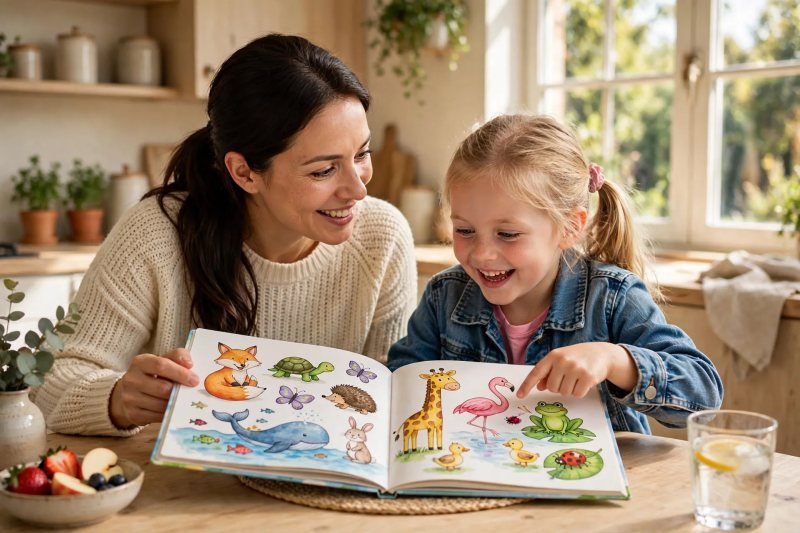
Say the week's pattern first. Say it aloud together — "This week is sh, like shhh!" — then hunt for that sound in a picture book for two minutes. The pattern lands before the words do.
-
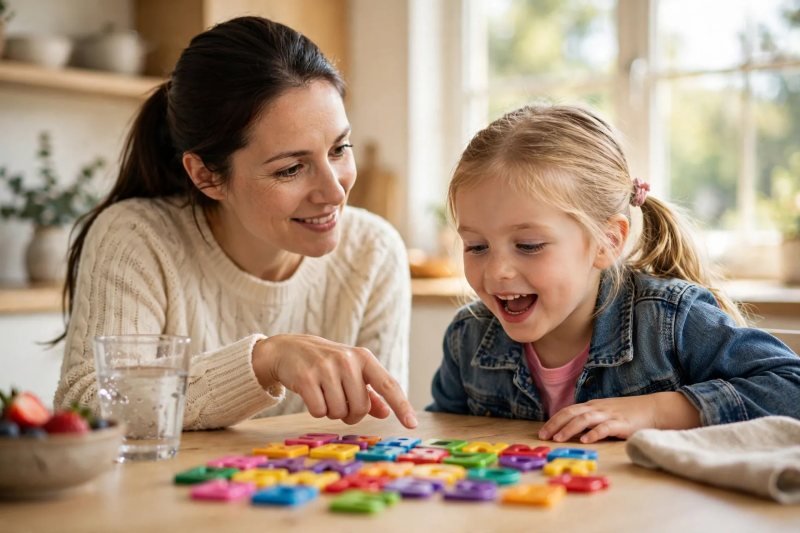
Build the words. Build each word with magnetic letters or tiles, saying every sound as the letter lands: "sh-ih-p, ship!"

-
Read them back. Your child reads each built word; rebuild any wobbles together — no rush, no score.
-
Trace the tricky ones. Finger-trace the three hardest words in the salt tray, saying the letters aloud.

-
Clap and tap the sounds. Clap each word's syllables, then tap one finger per sound.

-
Say it, spell it, say it. Read the word together, spell it aloud letter by letter, say it again.
-
Dictate and write. Say each word slowly; your child writes it, then flips the card to check.

-
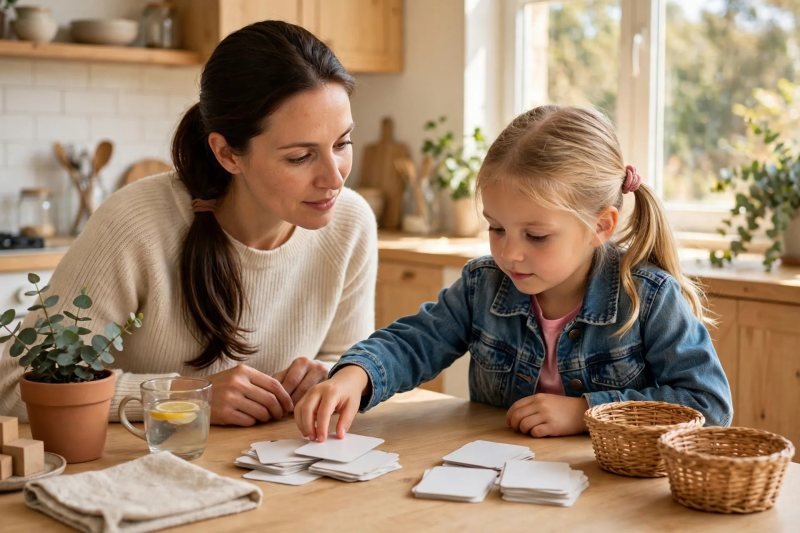
Sort the patterns. Mix this week's cards with last week's and sort into two piles.
-
Play one spelling game. Five minutes: a magnifying-glass word hunt, hopscotch spelling on chalk letters, or silly dictated sentences.

-
Friday check and celebrate. Dictate the 10 words; your child writes each one. Sticker every correct word — a full row retires the bundle to the "mastered" envelope.



Make it easier
Start with five words a week — the front half of each list. You build and read each word first; your child copies and traces. Skip dictation until the words feel familiar.
Make it harder
Dictate full sentences using two or three list words. Tally this week's pattern in your child's own reading books. Add five review words from earlier weeks to the Friday check. Have your child write a silly story using every word on the list.
Other ways to play it
- Driveway hopscotch spelling: chalk the week's letters in big squares; hop letter to letter, shouting each one.
- Car-trip spelling: dictate list words at red lights — no cards needed.
- Sibling quizmaster: an older sibling runs the Friday check.
How it changes by age
- A ready five-year-old who reads simple CVC words can begin with Unit 1. If your seven- or eight-year-old is still shaky on short vowels, start at Week 1 anyway — a confident foundation beats a shaky sprint.
What they're learning
Why do phonics-based spelling lists work so well for 1st graders? Spelling and reading are the same code in opposite directions. When a child spells "ship" as sh-ih-p, they practice the exact mapping that makes "shop" and "fish" readable on sight. Pattern-grouped lists teach the rule, not just the word: learn "cake" and you've quietly learned "lake" and "late." Along the way come plurals, compounds, and contractions — plus writing practice and the habit of checking your own work.
Clearing up
Should I use my child's school spelling list instead of these? If the teacher sends a list home, use the school's words — this routine works with any ten words. These 36 lists are your backup for schools that don't send lists, for summer practice, or for extra pattern work. When in doubt, the teacher's list wins. My child spells words right on Friday but misspells them in writing — is that normal? Completely normal. Spelling from dictation and spelling mid-sentence while thinking about a story are two different jobs — the second takes months to catch up. Keep Friday checks low-stakes and cheerful; the transfer shows up gradually in journals and stories. Do we have to do all 36 weeks in order? The order is deliberate — short vowels before digraphs, digraphs before blends, everything before r-controlled. But real life happens: skip a week for vacation, repeat a wobbly week, jump to the school list whenever it arrives. The sequence is a guide, not a contract.
Questions parents ask
How many spelling words should a 1st grader learn each week?
What spelling patterns do 1st graders learn first?
How can I help my 1st grader practice spelling at home?
Should spelling practice follow phonics order?
How long should 1st grade spelling practice take each day?
What comes after 1st grade spelling words?
Nine units in the order most US phonics programs teach sounds — each week's words share one pattern. Digraph weeks pair with our digraph activities, silent-e weeks with the silent e rule explained, and blend weeks with our consonant blends list.
Unit 1 — Short vowels Week 1 (short a): cat, hat, sat, mat, bat, ran, map, bag, can, tap. Week 2 (short i): pig, big, sit, hit, win, dig, fin, mix, lip, six. Week 3 (short o): hot, pot, top, box, fox, log, mom, pop, hop, not. Week 4 (short u): sun, fun, run, bus, cup, bug, hug, mud, tub, cut. Week 5 (short e): bed, red, pen, ten, pet, get, wet, net, leg, den. Week 6 (short-vowel review): map, win, box, run, pet, hat, dig, fox, bus, red.
Unit 2 — Digraphs (two letters, one sound) Week 7 (sh): ship, shop, fish, wish, dish, shut, rush, brush, fresh, crash. Week 8 (ch): chat, chip, chop, chick, lunch, bench, such, rich, much, catch. Week 9 (th): this, that, then, with, they, thin, thick, bath, moth, path. Week 10 (wh): when, what, white, wheel, whip, whisper, which, where, while, whale.
Unit 3 — Blends and glued sounds Week 11 (l-blends): black, glad, clap, flag, plan, play, sled, sleep, blink, flip. Week 12 (r-blends): brick, truck, frog, grab, drum, trip, crack, grass, print, prop. Week 13 (s-blends): stop, stand, swim, snap, skip, spill, smack, snack, spot, step. Week 14 (-ng): sing, ring, long, song, king, wing, bring, hang, thing, swing. Week 15 (-nk): pink, bank, think, drink, thank, trunk, stink, sink, junk, honk.
Unit 4 — Silent-e long vowels Week 16 (a-e): cake, name, game, lake, made, take, came, late, brave, place. Week 17 (i-e): like, time, five, bike, ride, nice, mine, smile, drive, slide. Week 18 (o-e): home, nose, rope, stone, those, woke, hope, close, phone, globe. Week 19 (u-e): cute, use, cube, tube, flute, rule, June, huge, mule, prune.
Unit 5 — Vowel teams Week 20 (ai, ay): rain, train, day, wait, paint, snail, say, stay, mail, spray. Week 21 (ee, ea): see, tree, feet, green, deep, read, eat, team, beach, clean. Week 22 (oa, ow): boat, coat, road, snow, grow, slow, float, yellow, soap, blow. Week 23 (igh, y): night, light, high, sky, fly, my, cry, try, bright, flight.
Unit 6 — Diphthongs (gliding vowel sounds) Week 24 (ow, ou): cow, how, now, brown, house, out, mouse, cloud, found, town. Week 25 (oi, oy): boy, toy, joy, oil, coin, join, point, soil, noise, enjoy.
Unit 7 — R-controlled vowels Week 26 (ar): car, far, park, hard, star, card, farm, shark, march, yard. Week 27 (er, ir, ur): her, bird, girl, first, turn, burn, hurt, fern, stir, purse. Week 28 (or): for, more, short, corn, horse, morning, north, storm, born, fort.
Unit 8 — Endings and tricky spellings Week 29 (-tch, -dge): hatch, match, witch, watch, patch, badge, bridge, fudge, edge, lodge. Week 30 (soft c, soft g): race, face, ice, cent, giant, gem, page, cage, voice, dance. Week 31 (-y ending): happy, baby, candy, puppy, sunny, penny, jelly, pony, lady, silly.
Unit 9 — Word parts Week 32 (plurals -s, -es): cats, dogs, buses, boxes, wishes, classes, foxes, dishes, babies, puppies. Week 33 (irregular plurals): children, men, women, teeth, oxen, mice, geese, people, sheep, deer. Week 34 (compound words): backpack, sunshine, football, rainbow, popcorn, birthday, cowboy, pancake, snowman, butterfly. Week 35 (contractions): can't, don't, didn't, it's, I'm, we'll, they're, wasn't, isn't, you're. Week 36 (celebration review): your child's 10 favorite "star words" from the whole year — let them choose, and make Friday a spelling party.
The unit order mirrors how most US phonics programs introduce sounds, so these lists usually line up with what your child is sounding out in class that month. Weeks 6 and 36 are review weeks on purpose: the brain keeps what it revisits. Week 35's contractions deserve one extra mention — the apostrophe takes the place of the missing letters ("don't" is "do not" minus the "o"). This pairs beautifully with our sight word games — many families run both in the same fifteen minutes, since the games cover the rule-breakers and these lists cover the rule-followers. For more silent-e words, try our magic e words list. If short vowels are still brand new, our CVC words list is the perfect on-ramp to Week 1.

save it for later
Pin this for the next rainy afternoon
Keep it on a board so it is there when you need it, rather than when you happened to find it.
Save to Pinterest


