


Best Detangling Spray for Kids: How to Choose and Use It
Finding the best detangling spray for kids is really two jobs: choosing well (made for kids, gentle, light) and using it right. This guide covers the label checks, the format choice, and a calm ten-step routine that ends the morning comb battle.
The best detangling spray for kids is a gentle, child-specific spray chosen by label: made for kids, fragrance-free or lightly fragranced, with a short readable ingredient list. Use it right: patch test first, section the hair, spray the ends most, comb from the ends upward with a wide-tooth comb, and switch to fingers for any knot that stops the comb.

The short version
- Detangling spray adds slip and light moisture so strands glide apart — it helps combing; it doesn't repair hair or replace conditioner.
- Choose by criteria: made for kids, gentle, fragrance-free or nearly, short ingredient list, modest claims — never adult styling sprays.
- Spray format suits most heads; a leave-in cream helps the driest, thickest, or curliest ends as a partner.
- Technique matters more than the bottle: sections, ends sprayed most, thirty seconds to settle, comb from the ends upward.
- Fingers before comb on real knots, a sleep braid to prevent tomorrow's, and a patch test before every new bottle.
- Age
- Ages 3–4
- Play time
- 5 min
- Mess
- None
- Difficulty
- Easy
- Where
- Indoor
Why kids love this
Children do not care about sprays; they care about the two minutes the spray deletes from their morning — the pulling, the flinching, the "hold still" chorus. Used the way this guide teaches, detangling spray turns hair care into something close to a non-event: a cool mist she can help spray, sections she can hold, a comb that glides instead of snags, and a finished style she chose. Kids also love the honesty of the system — fingers first for the big knots (because fingers can feel what a comb cannot), and a sleep braid that means tomorrow starts smoother than today did. Predictable, gentle, quick: that is a routine a 4-year-old will eventually run herself.
What you'll need
- One detangling spray for kids, chosen by the step-3 criteria — plain bottle, no brand loyalty required
- A wide-tooth comb (the only comb this routine uses)
- A few plain hair clips for sectioning
- A soft towel for shoulders
- A small mirror at her height, if you have one — watching helps her stay still
- Optional: a light leave-in cream for very dry ends (step 4 explains when it earns its place)
Before you start
1. Do the first full routine on a weekend morning, not a school-day sprint — the method takes five minutes once learned and fifteen the first time. 2. Seat her somewhere she likes being (a stool at the vanity, a cushion on the bathroom floor) with the mirror where she can watch; a child watching her own hair behaves like a partner, not a patient. 3. Put the spray, comb, and clips within your reach and her sight line — tools appearing mid-routine break the calm. 4. Run the patch test from step 5 a day ahead if the spray is new. New bottle, new test, every time.
How to do it
-
Meet the real enemy: the morning tangle. Kids' hair tangles for honest mechanical reasons — fine strands, lots of them, a night of rolling on a pillow, and yesterday's playground still in the ends — and the result is the famous bird's-nest at the nape that no comb survives dry and unaided. Say: "We're not fighting your hair; we're outsmarting it." Understanding the problem shapes the whole solution: tangles are friction, and everything in this guide — the spray, the sections, the fingers, the ends-up combing — is friction management. A detangling spray for kids exists to give hair "slip" so strands slide past each other instead of locking, and step 2 is about exactly what that does and does not mean.

-
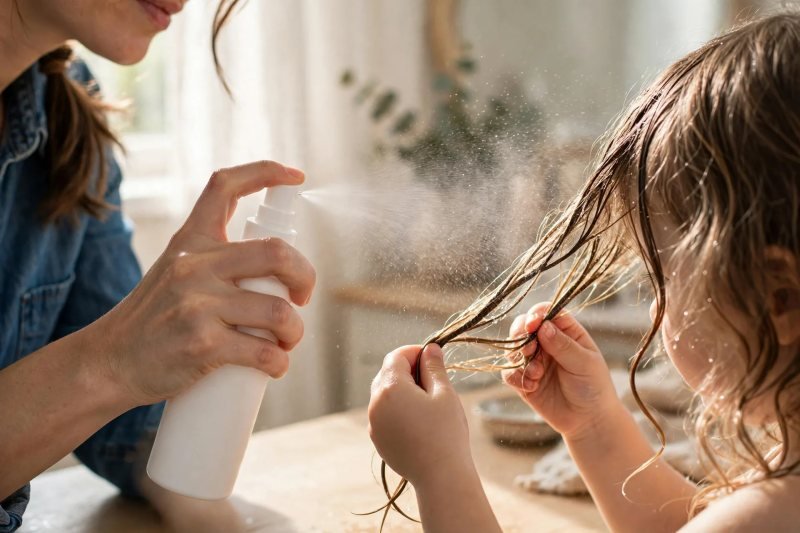
Know what detangling spray actually does. A detangling spray coats each strand with a light, slippery layer and adds a touch of moisture, so when the comb arrives the hairs glide apart instead of gripping, snapping, and hurting. Think of it this way: it makes hair slippery, not magical — the technique still matters. That is the whole honest claim, and it is enough: less friction means less pulling, less breakage, and a child who stops dreading the comb. It does not repair damage, change hair type, or replace conditioner on wash days — it is a lubricant for the combing moment, used on wet or dry hair. Judge any bottle by that job alone, and you will never be sold a miracle in a spray cap.
-
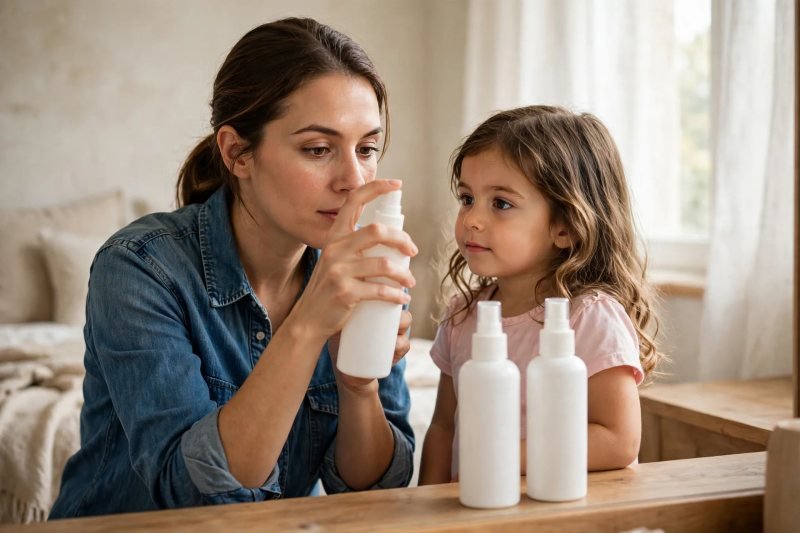
Choose by label criteria, not by the front of the bottle. The best detangling spray for kids is the one that passes a short, strict checklist, the same label-reading habit this site teaches for the simple kids skincare routine: made specifically for children (formulated gentler than adult styling sprays); fragrance-free or very lightly fragranced, because the spray lives inches from her face; a short, readable ingredient list you can actually pronounce your way through; and claims that stay modest — "helps detangle" is honest, anything promising transformation is marketing. In the store, hold two bottles side by side and compare them on the checklist alone — the shorter ingredient list, the lighter scent, and the clearer "made for kids" wording wins, whatever the character on the front is doing. Say: "We buy the checklist, not the cartoon on the front." Skip adult detanglers and multi-purpose styling sprays: they are built for grown-up hair and grown-up tolerance, and kids' products exist precisely because the brief is different.
-
Pick your format: spray, cream, or both. Spray is the everyday champion for most kids — light, even, hard to overdo, and usable on dry morning hair without re-wetting the whole head. A leave-in cream is richer: better for very dry, thick, or curly ends that drink a spray and still feel thirsty, but easier to over-apply into greasiness. The short version: spray for daily glide, cream for the driest ends — some heads keep both, most need one. If her hair is fine and straight-ish, spray alone will almost certainly carry the year; if it is thick, curly, or long enough to sit on, the cream may earn its shelf space as the step-7 partner on the last few inches. When in doubt, start with the spray — you can always add, and the simpler kit is the one that gets used.

-
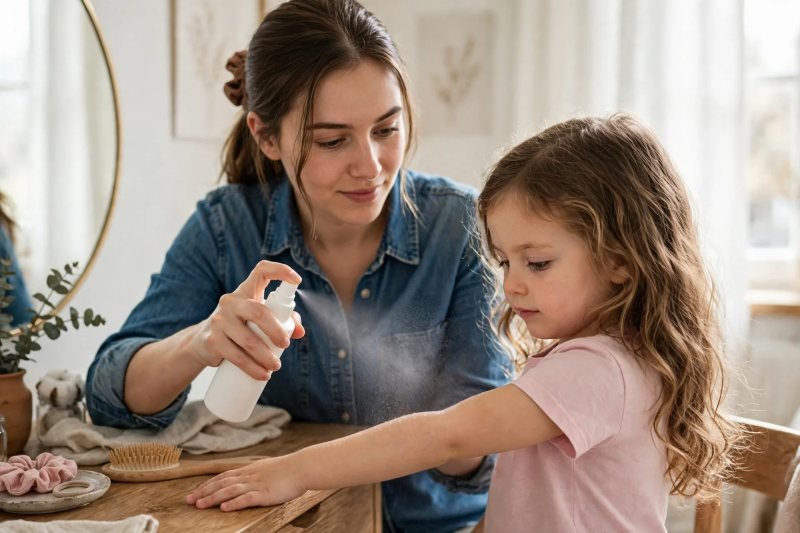
Patch test every new bottle, a day ahead. Even a spray chosen by perfect criteria meets one specific child's skin, so test it the way this guide tests everything gentle: spray a small amount onto the inside of her forearm (or work a little into a small section of hair and skin at the nape), then wait and watch across the day for any redness, itching, or complaint. Say: "New bottle, test first — it's the house rule, like helmets." No reaction means the bottle joins the routine; any reaction means it leaves the house, and the criteria in step 3 start again with a shorter ingredient list. It costs one day and buys total confidence on every school morning after — the cheapest insurance in the whole hair-care drawer.
-
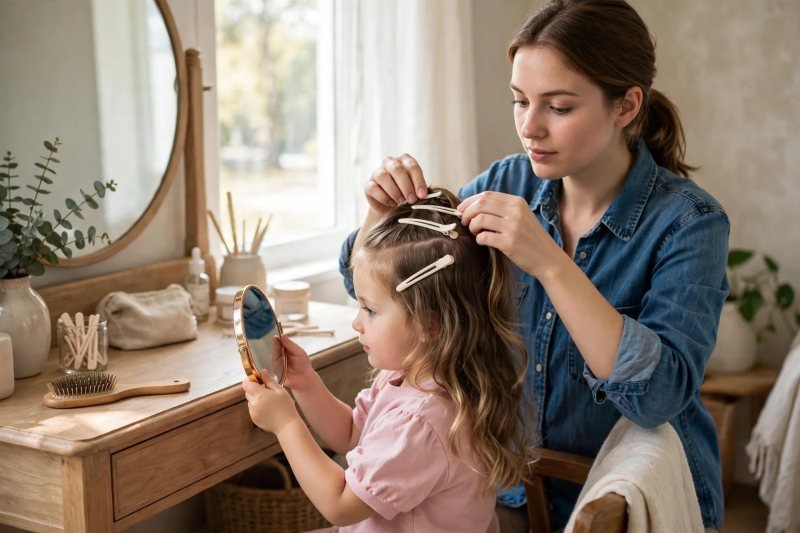
Section the hair — never attack the whole head at once. Clip the top and sides up and out of the way and start with the underneath layer, where the worst tangles live, working in three or four sections total. Small sections, easy wins — the hair gets freed a neighborhood at a time. Short hair needs the same method on a smaller scale: one section at the nape is often the whole job, and the rest is a quick smooth-over. Sections do three jobs at once: the spray can actually reach every strand instead of wetting only the surface; the comb meets a manageable amount of hair; and your child sees progress, section by section, instead of one endless battle. Hold each section gently in one hand while you work it — your hand is also a shock absorber, taking the comb's pull so her scalp does not.
-
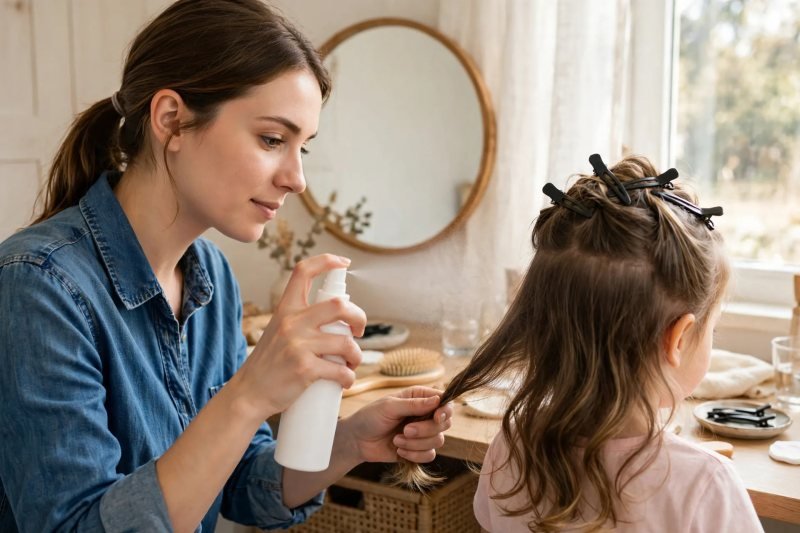
Spray the ends first, from a hand's distance. Hold the bottle roughly a hand's length from the hair and mist the section with the ends getting the most — the oldest, driest, most tangled part — and the mid-lengths getting less; the roots need almost none. Say: "Ends are the thirsty part; roots just get wet for no reason." Two to four sprays per section is the usual working range; you want the hair damp and slippery, not dripping. If you are using the cream partner from step 4, this is its moment too: a pea-sized amount warmed in your palms and smoothed over the last few inches after spraying. If she hates mist near her face, spray into your palm first and smooth it over the front pieces instead of aiming at them. Then wait thirty seconds — slip needs a breath to settle in — before any tool touches the hair. If the hair looks greasy afterward, you used too much: one spray fewer per section next time, and any buildup washes out with the next shampoo.
-
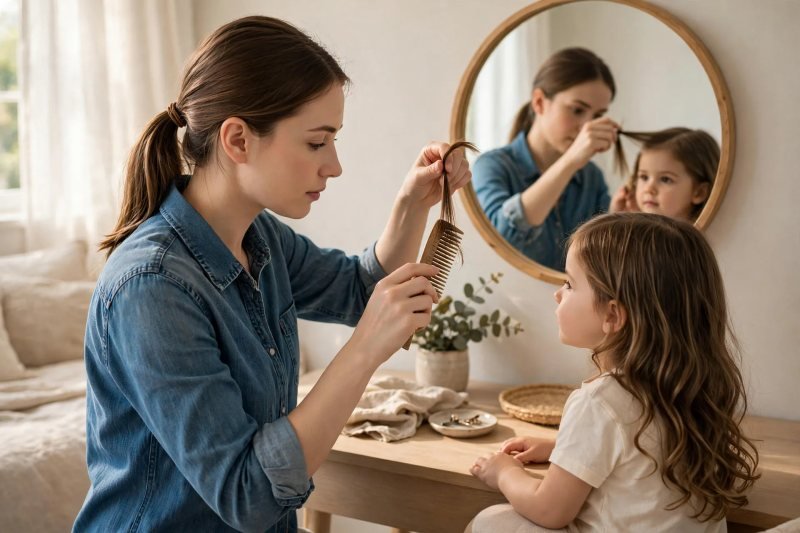
Comb from the ends upward, in small bites. Start the wide-tooth comb an inch or two from the bottom of the section and comb down; when that glides, start a little higher, and keep walking up until you are combing from root to tip in one smooth pass. Think of it as climbing a ladder rung by rung — never jump from the roof. This single technique is responsible for most of the peace in this routine: combing downward from the roots packs every tangle into one knot at the bottom, while ends-up combing frees each snarl at the height where it lives. Keep your free hand holding the section above where the comb works, and let her hold the mirror — a child watching tangles dissolve combs herself sooner than any instruction can teach.
-
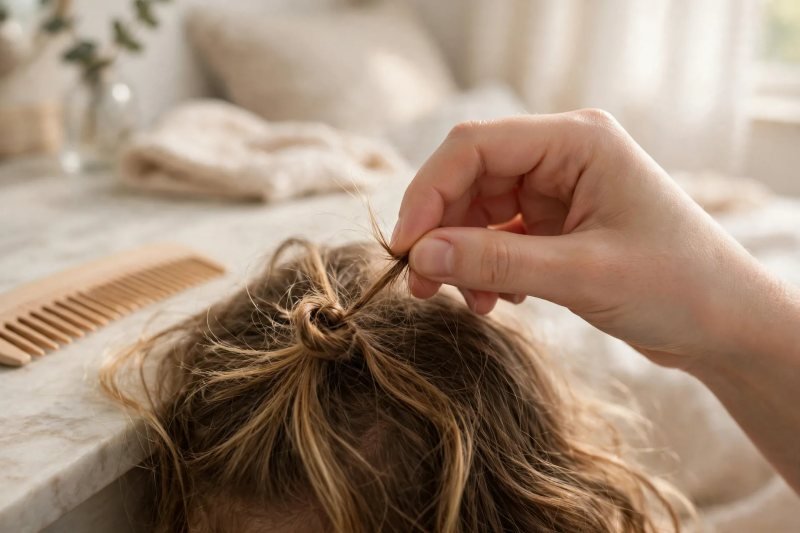
For the knot that stops the comb, fingers go first. Sooner or later a knot refuses the comb entirely — a true nest, wound tight. Put the comb down: spray the knot once more, then tease it apart with your fingers, pulling single strands free from the edges, loosening before you ever pull. Say: "Fingers can feel what a comb can't — knots get fingers, tangles get the comb." Fingers sense tension and stop before snapping a strand; a comb only knows force. Work the edges, rotate the knot, and when it has loosened to ordinary tangle status, the comb may return for the finishing passes. If a knot has truly matted (it happens after illness weeks and forgotten braids), work it across two sessions rather than declaring war — hair forgives patience and remembers force.
-
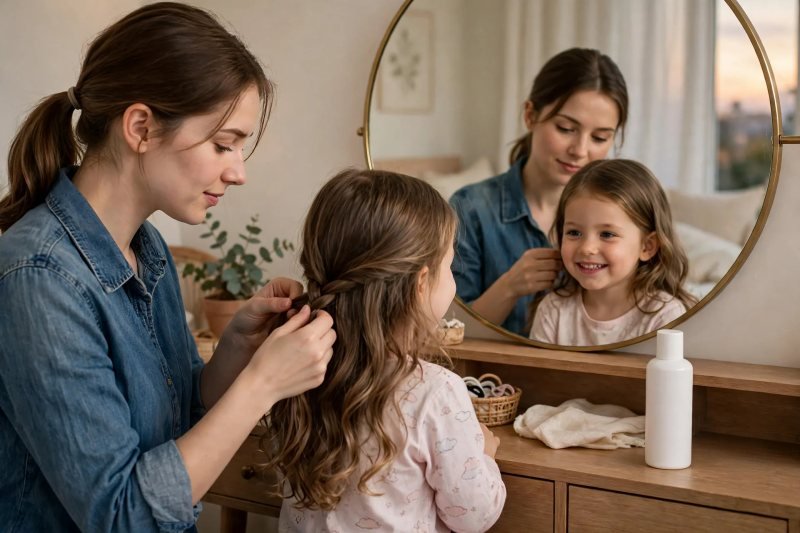
Finish with a style that prevents tomorrow's tangles. The routine ends by buying tomorrow: smooth the finished hair into the day's style — loose, in a ponytail, or in braids — and for sleep, a single loose braid or two is the difference between a two-minute morning and a ten-minute one. Say: "Tonight's braid is tomorrow's easy morning." Store the spray upright with the other hair tools, cap on, out of the sun; most heads use it daily on school mornings and less on weekends, and very dry or curly hair may want a light refresh before afternoon activities — and if buildup ever appears, that is a sign to check how often to wash toddler hair rather than to add more spray. And keep the long view: the child whose hair has never hurt is the child who books her own toddler first haircut guide memories kindly and trusts every chair after — gentle routines compound, and this one pays out for years.


Make it easier
Keep a travel-size spray in the school bag for after-nap and after-PE hair emergencies — the routine travels because it lives in sections, not in the bathroom. Let her spray the last section herself (aimed with your hand guiding) — participation is the fastest known solvent of hair-care resistance. On the most rushed mornings, spray and comb only the underneath nape layer and smooth the top with your palms; a 60% routine done calmly beats a 100% routine done in tears.
Make it harder
Teach her the ends-up combing on a doll or on your own hair first, then let her comb one full section of her own hair while you hold it — technique plus trust. Build a hair journal together for a month: which days tangled worst (swimming? hats? windy days?) — patterns teach her to request the braid before the tangle day, not after. Graduate her to sectioning: she clips up the top layers herself while you work the underneath — a real partner role that makes the routine hers.
Other ways to play it
- The curly-hair version: spray more generously, comb only when damp (dry combing breaks curls and the peace), and let fingers do proportionally more of the work — the cream partner from step 4 usually becomes a permanent resident.
- The post-swim version: rinse chlorine or salt out with plain water first, then spray and comb — detangling spray over pool chemicals just spreads them around; a small bottle lives in the swim bag next to the towel.
- The wash-day version: on bath nights, conditioner in the bath does the heavy detangling with the comb under the tap's patience, and the spray becomes the morning-after refresher rather than the main event — if bath-night combing is the hard part, the same ends-up method in our guide to wash toddler hair without tears is the place to start.
How it changes by age
- Age 3: At three, she is the client and you are the entire salon: keep sessions to the underneath layer plus a smooth-over on busy days, narrate everything before the mist lands ("spray coming, it feels cool"), and let her hold the comb between sections. Success at three is a routine she does not dodge.
- Age 4: Fours can hold sections, spray with a guiding hand, and start the first inch of ends-up combing themselves. Give her the mirror and the vocabulary — sections, ends, slip — because the child who can say "that part needs fingers" is managing her own hair care in embryo.
What they're learning
Patience as technique: ends-up combing and fingers-first knots are a physical proof that working gradually beats pulling hard — a lesson with applications far beyond hair. Cause and effect: sleep braids prevent morning nests; pool days demand rinses — she is learning that hair has a logic she can run. Body autonomy: a routine that never hurts teaches that her "ow" is information adults act on — the foundation of every health conversation after. Self-care skills: sectioning, spraying, and combing in the right order are the literal curriculum of doing her own hair, arriving one scaffolded step at a time.
Clearing up
There is almost nothing to clear, which is part of the design: comb rinsed and back in its pot, clips in their cup, spray capped and standing with the hair tools. The one habit worth building is the evening braid check — thirty seconds while pajamas happen saves five minutes at dawn, so braid where the pajamas are if the bathroom is far. Wipe the vanity mist ring weekly (spray settles where it is sprayed), replace the bottle when the pump starts spitting instead of misting, and keep the travel size refilled from the main bottle so the school-bag kit never quietly empties.
Questions parents ask
Does detangling spray really work on kids' hair?
How often should I use detangling spray on my child's hair?
Can I use detangling spray on dry hair, or only wet?
What is the difference between detangling spray and leave-in conditioner?
Can I use my adult detangling spray on my child?

save it for later
Pin this for the next rainy afternoon
Keep it on a board so it is there when you need it, rather than when you happened to find it.
Save to Pinterest


