


Setting Up a Room So Play Happens Without You
The highest-leverage thing on this whole site. Fewer things out, at their height, in containers they can open.
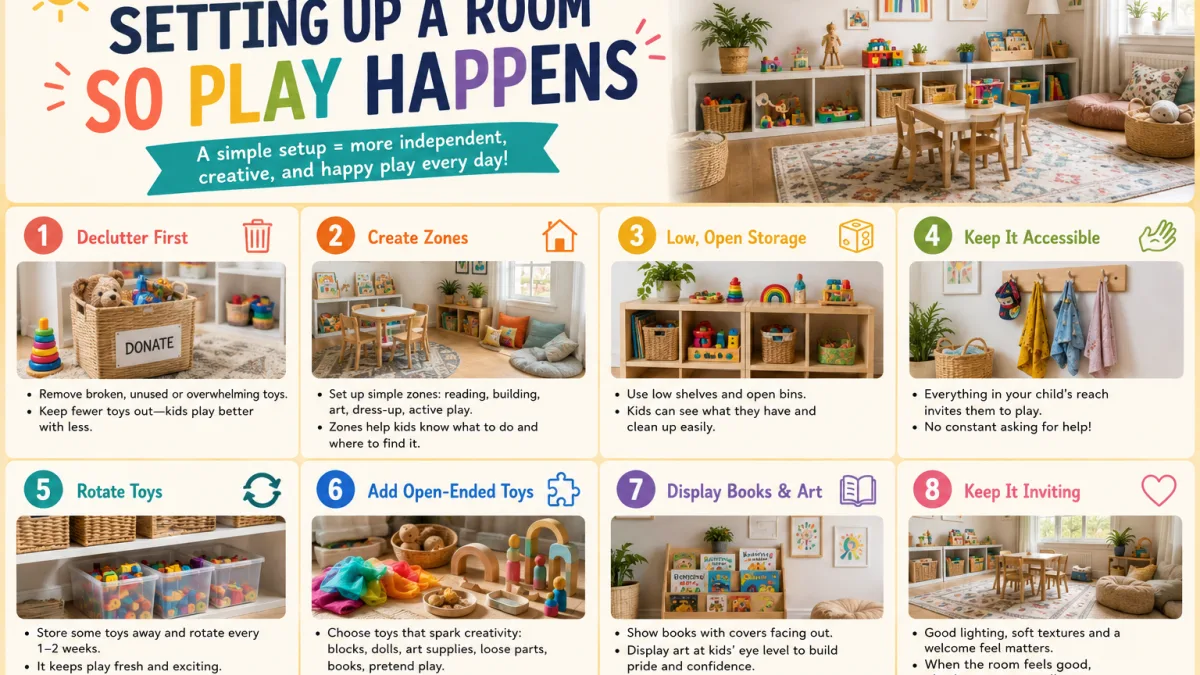
How to arrange a room so children play independently: put out fewer toys, at child height, in open containers with a clear place to return them, and rotate the rest.
The short version
- Fewer things out. This is the biggest single change.
- At their height, or it does not exist.
- Open containers with an obvious home.
- Set one thing out before they arrive.
- Rotate the rest every few weeks.
- Age
- Ages 1–8
If you change one thing after reading this site, change the room rather than the routine.
How much is out, how high it is, and whether a child can get something and put it back without asking decides more about how much they play alone than any activity ever will.
Put out less. This is counterintuitive and it is the single biggest change. A shelf with six things on it gets used; a box with sixty things in it gets tipped out and abandoned, because finding anything in it is work. Aim for a number you could count at a glance.
Put the rest away, and swap some of it every few weeks. Toys that have been in a cupboard for a month come back out as new, which is a cheaper way of getting novelty than buying any.
Get it to their height. Anything above their eye line effectively does not exist, and anything they have to ask for is not independent play — it is a series of interruptions with a toy at the end.
Use open containers rather than lidded boxes, and make sure each has an obvious place to live. A basket with a picture on it beats a drawer, and both beat a big toy box. The rule is that putting it away should be easier than leaving it out.
Leave some space clear. Children need somewhere to actually build, and a room with every surface covered has nowhere for anything to happen.
Set one thing up before they wake, or before they come home. A puzzle half-started, a few animals arranged on a shelf, a tray with something on it. An invitation on a table gets picked up far more often than the same thing in a box.
None of this needs money or a playroom. Half of it can be done in ten minutes with what you already own, and the difference is usually visible the same day.