


Building a Quiet Hour After the Naps Stop
Quiet time is learnable. Start at ten minutes, same time every day, with a small box of things that only appear then.
How to build quiet time when a child stops napping: same time daily, a visible timer, a dedicated box of quiet things, and starting at ten minutes rather than an hour.
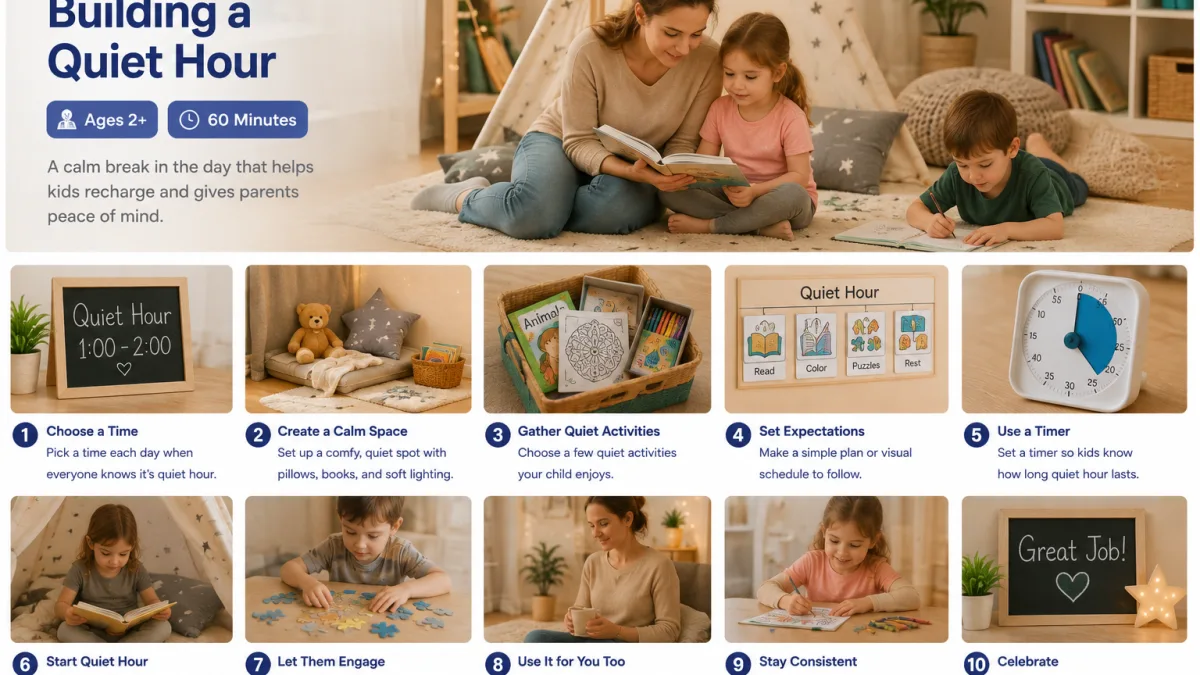
The short version
- Start at ten minutes, not an hour.
- Same time every day, ideally after lunch.
- A timer they can see, and it always means what it says.
- A box of things that only appear at quiet time.
- Never use it as a punishment.
- Age
- Ages 2–6
When the nap goes, something has to replace it — for them and for you. Quiet time is that replacement, and most children can learn it, provided it is built rather than announced.
The mistake nearly everyone makes first is starting too long. An hour on day one will fail, and failing on day one makes day two harder. Start at ten minutes. Ten minutes that works is worth more than an hour that does not.
Same time every day is the second thing. Straight after lunch works in most houses, because it is roughly when the nap used to be and because a full child settles more easily than a hungry one.
Give them a timer they can see. A sand timer or a visible clock face beats "I'll tell you when", because it removes the question — and the question is what breaks quiet time. When the sand runs out, they come out. That has to be true every time, or they will stop believing it.
Keep a box of things that only come out at quiet time. Not their favourite toys, and not anything new and exciting — a few puzzles, a sticker book, some picture books, a torch. The point is that these are mildly interesting and always available, which is a much better combination than thrilling and occasional.
Stay nearby at first. In the room, doing something dull, saying very little. Then out of the room for two minutes. Then longer. The progression matters more than the destination.
It will go backwards. Illness, a new sibling, a bad week at nursery — any of these will undo a fortnight of progress, and none of them mean it has stopped working. Go back to ten minutes and build again.
One last thing: quiet time is not a punishment and should never be used as one. The moment it becomes somewhere a child is sent, it stops being somewhere they will settle.