


Space Birthday Party Ideas That Are Out of This World
A complete space birthday party for a 7th birthday: turn your living room into mission control with galaxy decor, kit out young astronauts, build cardboard rockets, play moon games, serve orbit snacks, and finish with a seven-candle galaxy cake.
For a space birthday party 7-year-olds love, plan a two-hour mission: send star-sealed invitations, turn the room into mission control with galaxy swirls and planet shapes, kit out astronauts with foil badges, build cardboard rockets, play crater toss and a moon walk relay, serve orbit snacks, count down over a seven-candle galaxy cake, and send everyone home with a flight-kit favor.

The short version
- The arc is the party: kit up, games, build, snacks, cake, flight kits — two hours, three zones.
- Decor needs no words: galaxy swirls, silver stars, and planet shapes say space.
- The rocket build is the centerpiece: foil, fins, and star stickers — and the crew photo.
- Games are elimination-free: crater toss and a slow-motion moon walk relay burn energy without losers.
- The birthday commander leads: the countdown, the cake wish, and handing out the flight kits.
- Age
- Ages 6–8
- Prep
- 180 min
- Play time
- 120 min
- Mess
- Some
- Difficulty
- Medium
- Where
- Both
Why kids love this
Six-, seven-, and eight-year-olds don't attend a space birthday party; they crew a mission. There's a helmet moment, there's a rocket they built with their own hands, there are craters to toss and a moon to walk across. Every child gets a job (pilot, engineer, commander), the room glows like a galaxy, and the birthday astronaut leads the crew from countdown to cake.
What you'll need
- Navy and dark-purple streamers, silver star cutouts, and glow-in-the-dark star stickers for galaxy decor (shapes only — no lettering)
- Large cardboard boxes, silver and white paint or foil, tape, and child-safe scissors for the rocket craft
- Plain navy cards, star stickers, and envelopes for invitations (no words needed on the outside)
- Paper or foil for simple astronaut badges and a roll of silver ribbon
- Navy or star-print paper plates, cups, and napkins; a dark table cover for the "orbit table"
- Snack supplies: star-shaped sandwiches, fruit, cheese, crackers, and drinks for mission fuel
- A birthday cake (homemade or bakery) with galaxy swirl frosting, plus exactly 7 candles
- Favor supplies: small paper bags, a glow star pack or small planet ball and stickers per child
- A speaker for countdown sounds or party music, and a camera for crew photos
Before you start
1. The week before: send invitations (step 2), gather cardboard for rockets, and buy glow stars and star cutouts. 2. The day before: bake or collect the cake, prep snack items that keep, and cut all streamers and stars. 3. Party morning: transform the room (step 3), set the orbit table (step 5) in a separate zone, and stage the rocket craft station (step 7) with boxes and foil ready. 4. Brief your fellow flight directors: who runs the craft, who runs games, who owns the camera. Two hours, three zones: mission control (decor/table), the workshop (rocket craft), the launch pad (games).
How to do it
-
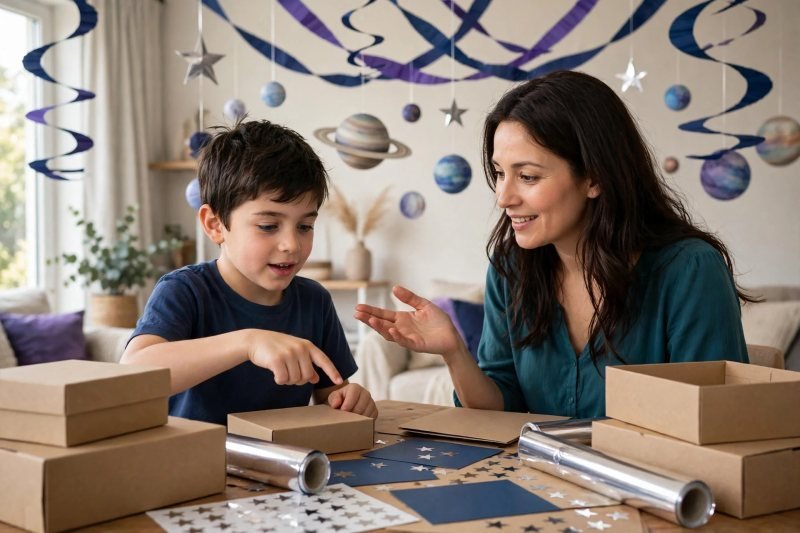
Plan the mission before you hang a single star. A great space birthday party starts with the flight plan, not the streamers: for ages 6–8, plan a two-hour mission with a clear arc — astronauts arrive and get kitted out; mission control opens for the rocket build; moon games burn the big energy; the orbit table serves mission fuel; the cake ceremony closes the mission; flight kits send everyone home. Keep the guest list to a size your space and your flight directors can honestly crew (for this age, eight to ten astronauts is a full and happy ship) — the 7th birthday party ideas guide plans for the same crew size. Say the theme out loud to your birthday astronaut: "You're the commander. This is your crew." Every later choice — decor, games, food — serves that story. If you love pairing parties with a little real science, the fizzing logic behind a baking soda and vinegar volcano for preschoolers is the same kitchen chemistry that makes a great pre-party rocket demo for older siblings. Flight plan mapped, call the crew in.
-
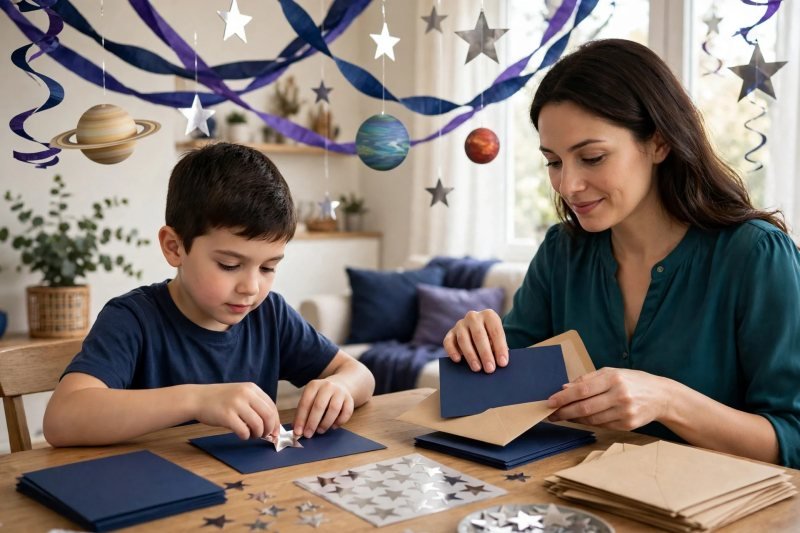
Send the launch notice: invitations that start the countdown. Invitations set the mission tone a week early: navy cards sealed with a silver star sticker, carrying the essentials inside (who, when, where, what to wear — "crew clothes you can build and crawl in"), plus one line that builds the fiction: "Report to mission control at 2. Bring your best countdown voice." Ask about allergies and photo preferences on the reply, because the orbit-table menu depends on it. If your birthday child is crafty, let them press the star sticker onto each card — a commander who issued the launch notice owns the mission differently. Keep a simple list of who's coming; the badge count and rocket-box count in later steps are built from it. Invitations out: on party morning, the galaxy appears.
-
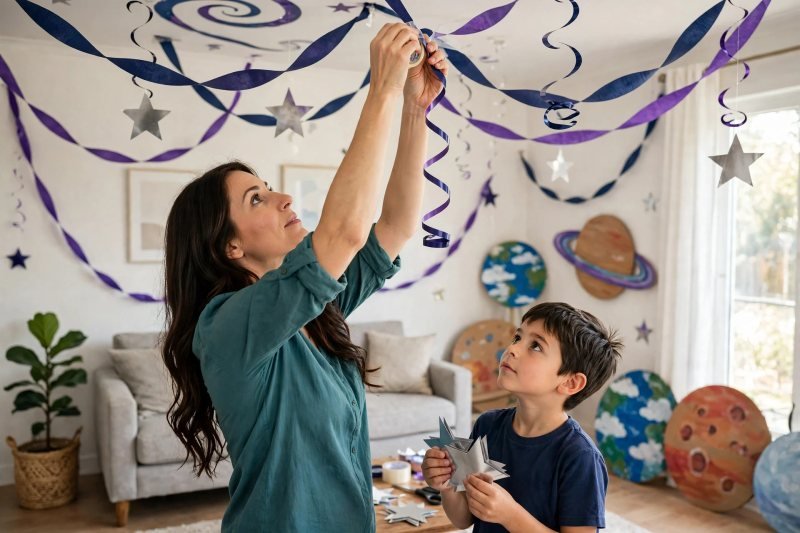
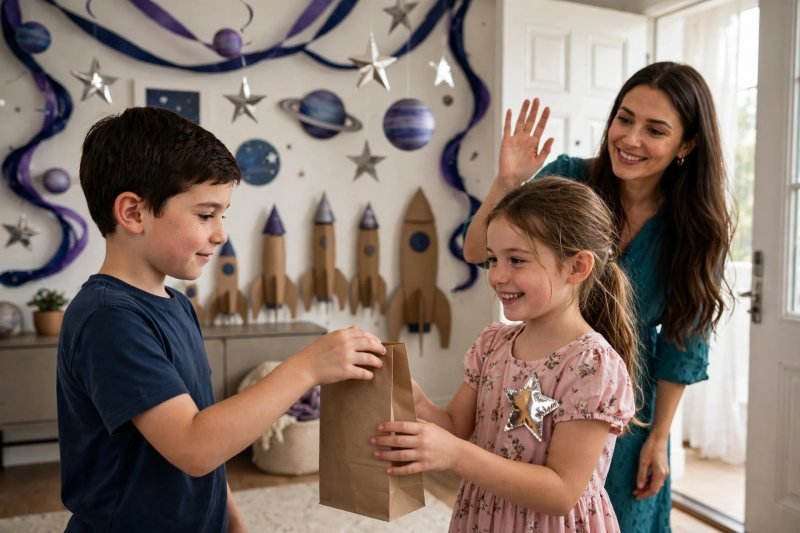
Turn the room into mission control. Decorate for immersion, not for photographs: navy and purple streamers twist across the ceiling as galaxy swirls, silver star cutouts cluster in corners and around the snack table, and glow-in-the-dark stars dot the walls and ceiling so a lights-low moment later feels like real space. A trail of silver star shapes leads from the front door to mission control. Cardboard planet shapes — painted circles in purple, teal, and orange, rings optional — lean against walls and hang from thread at different heights. Nothing needs words on it: stars, planets, and swirls say "space" louder than any banner. Say, as the first astronauts arrive: "Mission control is open! Crew, report for duty." Room transformed, kit out the crew.
-
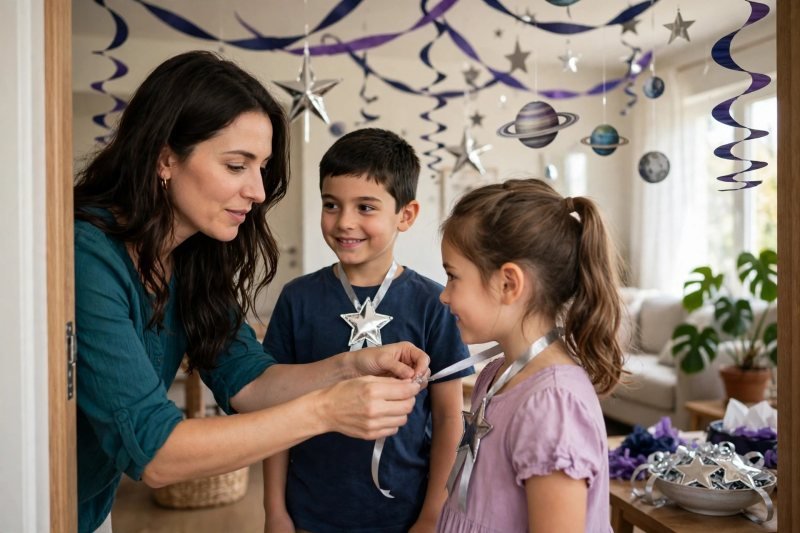
Kit out every astronaut: badges, ribbons, and a mission briefing. At the door, each child receives their crew kit: a simple foil badge (a silver star on a navy card circle, pinned or hung on silver ribbon) and their crew assignment for the day — pilot, engineer, or commander’s crew — drawn from a bowl so it feels like a real assignment. The gear does real work: badges make the group photo, assignments give shy arrivals an instant role, and both turn a room of guests into a crew in ninety seconds. Announce the mission with full flight-director ceremony: "Astronauts! Today we build our rocket, walk the moon, and bring our commander home for cake." The birthday astronaut gets one extra — the commander’s silver ribbon sash or the first turn with the countdown clicker. Kitted and briefed: the table is set next so the day has no gaps.
-
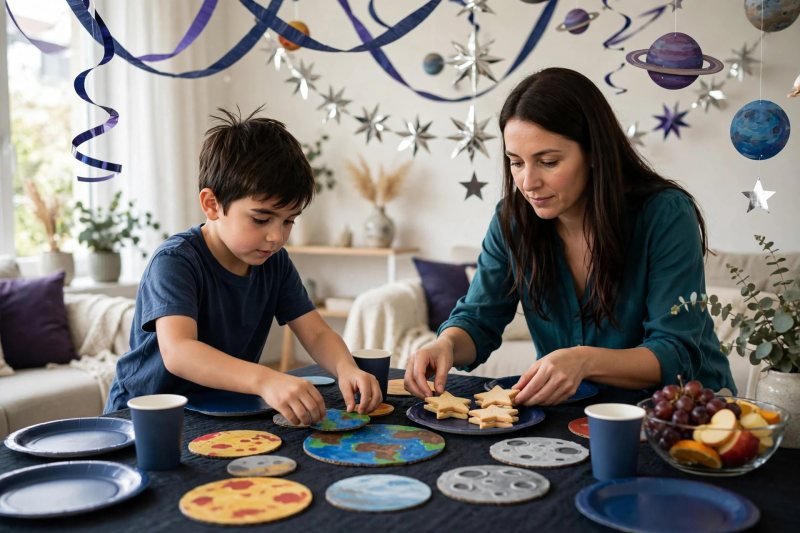
Lay the orbit table for mission fuel. In the food zone, set the table before the games begin: a dark cover scattered with silver star cutouts, navy or star-print paper plates and cups, and a centerpiece made from your roundest planet shapes guarding a bowl of fruit. Keep the cake out of sight until its moment; a spotted galaxy cake ends all building discipline. Water cups stay filled and reachable all party long — real missions are thirsty work. Label nothing with words; a drawn planet picture sign (a ringed circle, no letters) marks the zone if you like — the orbit table is where the crew comes to refuel. Table ready, it's time to release the crew onto the moon.
-
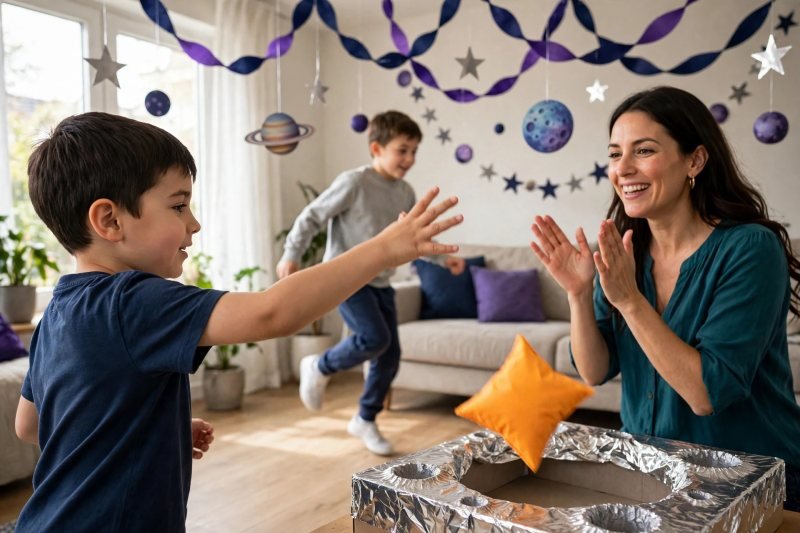
Play the moon games: crater toss and moon walk relay. Game one, Crater Toss: set three foil-ringed "craters" (shallow boxes or hoops lined with silver foil) at increasing distances and let astronauts toss soft planet balls (beanbags or balled socks in bright colors) into them; each crater a child lands earns a cheer and a star sticker on their badge, and nobody is ever "out." Game two, the Moon Walk Relay: astronauts cross the room in slow, giant, bouncing moon steps — both feet off the ground in exaggerated slow motion — down the course and back, tagging the next astronaut in line. Keep both games short, silly, and prize-light; the victory is the bouncing. Games like these run on the same recall-and-wait muscles as tabletop memory games for preschoolers, scaled up to a whole galaxy. Flight directors watch for the energy dip that means the crew needs the workshop — which is exactly where the mission goes next.
-
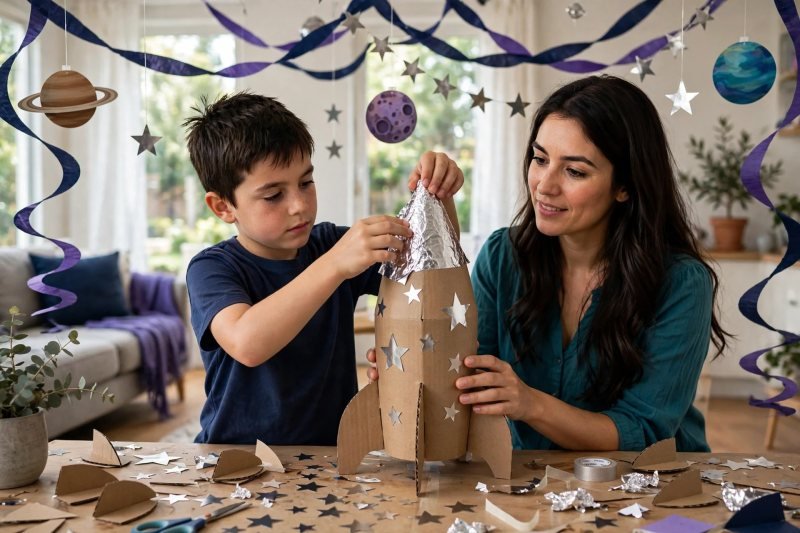
Build the crew rocket: the craft that becomes the party. At the workshop table, each crew (or each astronaut, if boxes are plentiful) builds a rocket: a large cardboard box becomes the body; silver foil wraps the nose cone; painted paper fins tape to the base; star stickers decorate the hull — shapes only, no lettering, so every rocket reads as pure design. Adults run the cutting; astronauts own the foiling, taping, and sticker placement, which is a full fine-motor workout disguised as engineering. The rocket is the showpiece, but it sits happily among other birthday crafts if your crew wants a second make-and-take. Say the engineer’s script as you work: "Real rockets are built by teams. Check your partner’s fin. A straight fin flies straight." When the fleet is finished, line the rockets up for the crew photo — this is the image parents will keep — and let the commander inspect each ship with a ceremonial tap. Rockets built: the crew has earned its fuel.
-
Serve orbit snacks the astronaut way. Seat the crew and serve mission fuel: star-shaped sandwiches (a cookie cutter does the magic), fruit skewers with melon and berries, cheese cubes, crackers, and veggie sticks, with water and juice at the orbit table. Serve food before cake, always — hungry astronauts are chaos agents, and the snack course is the party’s calm center where flight directors finally sit down too. Ask the table for mission reports: "Which crater was hardest to hit?" Stories from the games are the entertainment; no screen required. When plates slow down and stories wind up, a flight director quietly fetches the cake. Snacks done: the ceremony every astronaut has been waiting for.

-
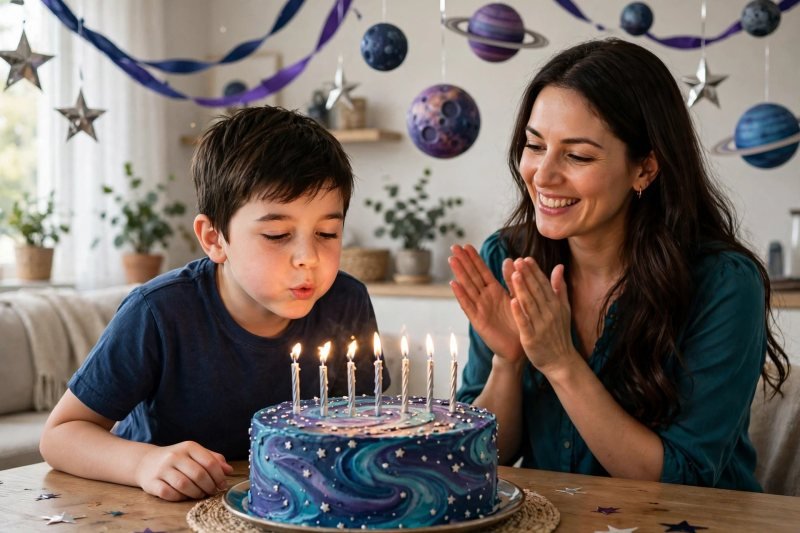
Gather round the galaxy cake — seven candles for the birthday commander. Dim the lights so the glow stars show, gather everyone, and bring in the cake: swirled with navy, purple, and teal galaxy frosting, dotted with silver star sprinkles, and exactly seven candles for the astronaut turning seven. Run a crew countdown from ten, sing the song at full mission volume, let the birthday child make a wish "for the whole crew," and blow. Serve cake with the flight-director system — one adult cuts, one serves, one manages the crowd of frosting critics. Photograph the cake before the first cut and the birthday commander mid-blow; those two frames are the day’s history. If your cake is homemade and gloriously swirly, even better: real galaxy frosting is never tidy. Cake eaten, energy softening: close the mission properly.
-
Send astronauts home with flight kits and a final countdown. End on ceremony, not drift: astronauts line up at mission control to receive their flight kits — a paper bag with a glow star pack or small planet ball, stickers, and one leftover treat — and their badges go home on their ribbons, which parents secretly love (the gear IS the favor). The birthday commander, as mission leader, hands out the kits and thanks each astronaut by name — a supported round of the gratitude habit that younger-party guides like these 2nd birthday party ideas for toddlers build in miniature and this age can carry in full. Finish with the whole crew’s loudest group countdown and blast-off jump for the final photo, then doors open to waiting parents. Flight directors’ debrief is mercifully simple: streamers to recycling, rockets to bedrooms (they will live there for weeks), leftovers to the fridge, and one exhausted commander asleep before dinner. Mission complete.


Make it easier
- Younger siblings in the mix: shorten the rocket build to decorating pre-built boxes, make crater toss one close hoop, and serve their snacks first.
- Smaller scale: the whole party works with 5 guests — the build becomes one big crew rocket everyone decorates together and the relay becomes a moon-walk parade.
- Tight budget: cardboard, foil, and star stickers carry the entire theme; skip glow stars and dim a lamp with a navy scarf for the cake moment instead.
Make it harder
- Add a mission log: each astronaut draws their rocket and their favorite moment on a plain card at the table — early journaling with zero writing pressure.
- Upgrade crater toss into engineering: astronauts adjust one variable (distance, ball size, stance) per round and the flight director charts who lands what — first data thinking, disguised as a game.
- Let crafty guests design their own badge constellation: five star stickers placed any way they like becomes "their" constellation, named out loud for the crew photo.
Other ways to play it
- Backyard launch pad: move mission control outside — the relay runs on grass, crater toss distances stretch, and the rocket fleet lines the fence for the photo.
- Glow mission (for confident 7s and 8s): dim the room for the final game round, hunt glow stars hidden around mission control by badge-light — the same party with the thrill doubled; keep flight directors plentiful.
- Space breakfast: a morning party with pajama astronauts, star-shaped pancakes, and the build run before the day gets hot or the sugar does.
How it changes by age
- Ages 2–3: a "space-lite" — 60–90 minutes, pre-built rocket to decorate with big stickers, one close crater hoop, constant snack access, and badges on ribbons worn only for the photo (some toddlers find gear annoying, and that's fine).
- Ages 4–5: a simplified mission — decorate-only rockets, two game rounds, a two-hour arc trimmed to 90 minutes, and the birthday astronaut in a supported leadership role with a ranger at each elbow.
- Ages 6–8: the guide as written — full build with fin engineering, both moon games, mission-log drawing, and the commander leading the countdown and the kit handout.
- All ages: every game in this guide is elimination-free on purpose — at a birthday, nobody's job is to lose. Adjust challenge, never belonging.
What they're learning
Engineering thinking: fins, cones, and foil teach cause and effect — a straight fin flies straight — through hands-on building. Gross motor control: slow-motion moon steps and crater tossing build balance, aim, and whole-body coordination through pure play. Leadership and gratitude: the birthday commander leads the countdown and thanks each astronaut by name — social milestones wearing a foil badge. Early data habits: adjusting one toss variable at a time and noticing what changes is the scientific method, smuggled into a party.
Clearing up
The galaxy folds fast: streamers and star cutouts go straight to recycling (they're single-party decor and proud of it), glow stars peel off and save in an envelope for the birthday child's ceiling, rockets move to bedrooms as trophies, paper plates and cups are disposable by design, and leftover snacks refrigerate within the hour. The silver star trail peels off last, because it makes everyone smile during cleanup. Twenty minutes and mission control is a living room again.
Questions parents ask
How long should a space birthday party last for 6- to 8-year-olds?
How do you decorate for a space party without a lot of gear?
What is a good space party craft that is not messy?
What food do you serve at a space birthday party?
How many kids should you invite to a 7th birthday party?

save it for later
Pin this for the next rainy afternoon
Keep it on a board so it is there when you need it, rather than when you happened to find it.
Save to Pinterest


