


Free Homeschool Preschool Curriculum: A Complete 36-Week Plan
A complete free homeschool preschool curriculum: a real 36-week plan for ages 3–4 with a weekly rhythm, nine monthly themes, letter and number sequences, and a free-materials list — no purchases required.
Yes — this free homeschool preschool curriculum is a complete 36-week plan for ages 3–4, built entirely from free resources. It runs 45–60 minutes a day, four days a week, across nine monthly themes covering letters, numbers to 20, fine motor skills, art, nature, and songs — using library books, free printables, and household items. The honest trade-off: plan on 30–45 minutes of parent prep every Sunday.

The short version
- A real 36-week plan — nine monthly themes, a weekly rhythm, and letter and number sequences — not a list of links.
- Costs nothing: library books, free printables, and household materials cover every week.
- 45–60 minutes a day, four days a week; the Sunday reset (30–45 minutes) is the parent's real investment.
- Letters start with the child's name, then about one a week; numbers build from 1–2 to 1–20 with real objects.
- Track one page a week; watch for retelling, careful counting, and growing hand control — not test scores.
- Age
- Ages 3–4
- Play time
- 45 min
- Mess
- Low
- Difficulty
- Easy
- Where
- Both
Why kids love this
Three- and four-year-olds love knowing what comes next. The same hello song every morning, a tray waiting on the table, the Thursday walk — that rhythm is the whole magic of a free homeschool preschool curriculum. Nothing here asks a preschooler to sit still for long: letters get traced in sand, numbers get counted with dried beans, and every week ends with paint on small hands. Kids love it because it feels like play with a grown-up who is entirely theirs for an hour.
What does a typical week look like in this free homeschool preschool curriculum? Four "school" days and one free day. Each school day runs 45–60 minutes total: Hello circle (5–10 minutes): the same welcome song, a quick "today is…" chat, one rhyme from the song bank. Focus activity (15–20 minutes): the week's letter, number, or theme exploration — start with these play-based preschool learning activities at home. Read-aloud (10–15 minutes): two or three picture books from the basket — yours or theirs. Art or fine motor (15 minutes): alternate days so neither feels like a chore. Outdoor time (10–20 minutes): the weekly walk, or backyard play with one question to investigate ("How many different birds can we hear?"). Friday: catch-up day, favorite repeats, or a field trip — library story time, the park, or counting apples at the grocery store.
What are the 9 monthly themes in the 36-week plan? Each theme runs four weeks and carries its own letters, numbers, fine-motor focus, art, nature study, and songs. Month 1 (Weeks 1–4): All About Me. Letters: the letters in your child's first name, starting with the first letter. Numbers: 1 and 2, plus rote counting to 10. Fine motor: playdough squeezing and rolling, tearing paper. Art: a self-portrait collage from cut paper. Nature: a texture walk — rough bark, smooth stones, crunchy leaves. Songs: "Head, Shoulders, Knees and Toes," "If You're Happy and You Know It." Month 2 (Weeks 5–8): Fall on the Farm. Letters: M, F, A, P. Numbers: 3 and 4. Fine motor: snipping paper, threading large beads. Art: leaf printing with washable paint. Nature: collecting and sorting leaves by color and size. Songs: "Five Little Pumpkins," "The Farmer in the Dell." Month 3 (Weeks 9–12): Food & Thankfulness. Letters: T, B, C. Numbers: 5, and counting sets to 5. Fine motor: pouring and scooping between containers. Art: a collage placemat for the family table. Nature: sorting seeds and beans by type. Songs: harvest counting rhymes, "A-Hunting We Will Go." Month 4 (Weeks 13–16): Winter Celebrations. Letters: W, S, H. Numbers: 6 and 7. Fine motor: cutting curves and zigzags, peeling stickers. Art: folded-paper snowflakes and shape trees. Nature: watching winter weather — frost, clouds, bare branches. Songs: "Jingle Bells," "Twinkle, Twinkle, Little Star." Month 5 (Weeks 17–20): Winter Animals. Letters: N, D, R. Numbers: 8 and 9. Fine motor: tracing lines and simple shapes. Art: painting animal tracks with toy-animal feet or cut sponges. Nature: bird-watching from a window and counting visitors. Songs: "Five Little Ducks," "The Bear Went Over the Mountain." Month 6 (Weeks 21–24): Community Helpers. Letters: O, E, V. Numbers: 10 — the counting-to-10 milestone. Fine motor: cutting out shapes, gluing collages. Art: a vehicle collage from cut paper. Nature: a neighborhood walk, spotting helpers and their tools. Songs: "The Wheels on the Bus," "Down by the Station." Month 7 (Weeks 25–28): Growing Things. Letters: G, L, K. Numbers: 11 and 12. Fine motor: tweezer transfer of pom-poms, folding paper. Art: flower printing with cut sponges. Nature: sprouting beans in a jar — the year's best science. Songs: "Mary, Mary, Quite Contrary," "Oats and Beans and Barley Grow." Month 8 (Weeks 29–32): Bugs & Spring. Letters: I, J, U, with Q, X, Y, Z swept up together in a celebratory final week. Numbers: 13–15, and rote counting to 20. Fine motor: pre-writing strokes — vertical and horizontal lines, circles, crosses, zigzags. Art: symmetry butterflies (paint one wing, fold, press). Nature: a bug hunt with a magnifying glass. Songs: "The Itsy Bitsy Spider," "Five Green and Speckled Frogs." Month 9 (Weeks 33–36): Water & Review. Letters: review the whole alphabet; practice writing the first name. Numbers: review 1–20, simple AB patterns (red-blue-red-blue), comparing more and less. Fine motor: drawing shapes and the first name. Art: watercolor washes, then assemble the year's portfolio. Nature: puddle science and pouring play. Songs: "Row, Row, Row Your Boat," plus every favorite from the year — and a small celebration in week 36.
Which letters should I teach first in preschool? Start with the letters in your child's first name — the most meaningful print a three-year-old owns. Then follow this order for the rest of the year, about one letter a week: M, F, A, P, T, B, C, W, S, H, N, D, R, O, E, V, G, L, K, I, J, U, Q, X, Y, Z. Any that repeat letters from the name become easy review weeks. For each letter, run the same four-part routine: say its sound (not just its name), trace it big in the sand tray, find three objects that start with it, and spot it in one library book. That routine is the whole phonics lesson — no workbook needed. For more ways to play with letters, try these alphabet activities for toddlers and letter tracing activities for preschoolers.
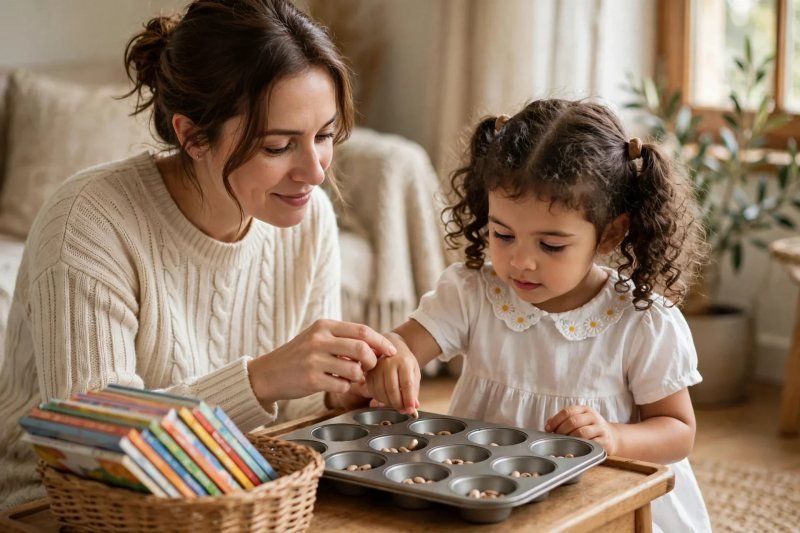
What math should my 3- or 4-year-old learn this year? Real objects first, numerals second. The year's arc: count everything aloud (rote to 10 by winter, to 20 by spring), then attach numbers to quantities one at a time — one bean per muffin-tin cup while saying "one, two, three." By year's end your child should count sets to 10 reliably, recognize numerals 1–10, compare "more" and "less," and copy a simple AB pattern. Skip worksheets entirely: a child who has counted a hundred real beans understands five better than one who has colored it in. These counting to 10 activities use the same real-object approach.
How can I build fine motor skills without buying special materials? Follow the year's progression with household things. September: playdough squeezing (hand strength). October: snipping junk mail and threading beads (control). November: pouring rice between cups (steadiness). December: cutting curves (scissor skill). January: tracing your big drawn shapes (hand-eye coordination). February: cutting and gluing shapes (planning). March: tweezer-transferring pom-poms (pincer grip). April: drawing pre-writing strokes — lines, circles, crosses (writing readiness). May: drawing shapes and the first name. Each skill feeds the next; by spring the hand is ready for real writing. More ideas that build the same grip are in our fine motor activities for preschoolers.
Where do I find free preschool materials? Four sources cover everything. The public library — books, story times, and often free printing — is the backbone of the year. Free printable sites — search "free preschool printables" and pick clean PDFs without watermarks; print only what you'll actually use that week. Your home — cardboard, junk mail, beans, buttons, recyclables, kitchen tools. Outside — leaves, stones, sticks, puddles; the science lab is free. The one thing money can't shortcut is your Sunday prep — say that out loud before you start, and the free plan feels like a choice instead of a compromise.
How much time does a free homeschool preschool curriculum take each day? Forty-five to sixty minutes of focused time, four days a week — plus your 30–45-minute Sunday reset. That is genuinely enough at three and four: short, predictable, and finished while it's still fun beats a tired two-hour morning every time. The rest of the day — the park, errands, helping you cook, free play — is also learning; the plan just gives the morning a spine.
How do I know if the plan is working? Watch for these, not test scores: your child retells a story in their own words; counts objects without rushing; holds scissors and crayons with growing control; sings the month's songs unprompted; asks "why" about nature finds. Your one-page-a-week journal makes this visible — flip back to September in March and you won't need anyone's checklist. If a week flops, repeat it or skip it; the plan serves the child, never the reverse.
What you'll need
- Everything below is free or already in your home:
- A library card — your single most valuable supply
- A basket or box for the weekly book rotation
- Paper of any kind: printer paper, junk mail, paper bags, cardboard
- Chunky crayons, washable markers, a glue stick, and watercolors or washable tempera
- Child-safe scissors
- A muffin tin, dried beans or large buttons, two cups and a small jug
- Playdough — homemade from flour, salt, water, and oil, or any you already own
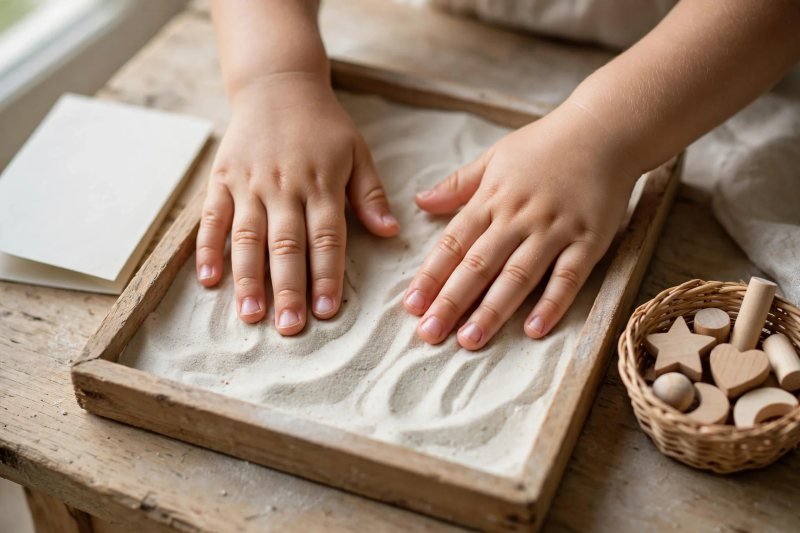
- A shallow tray or baking pan with salt or sand (the letter-writing tray)
- Large wooden beads and a shoelace; tweezers or tongs with pom-poms or cotton balls
- A basket for nature finds
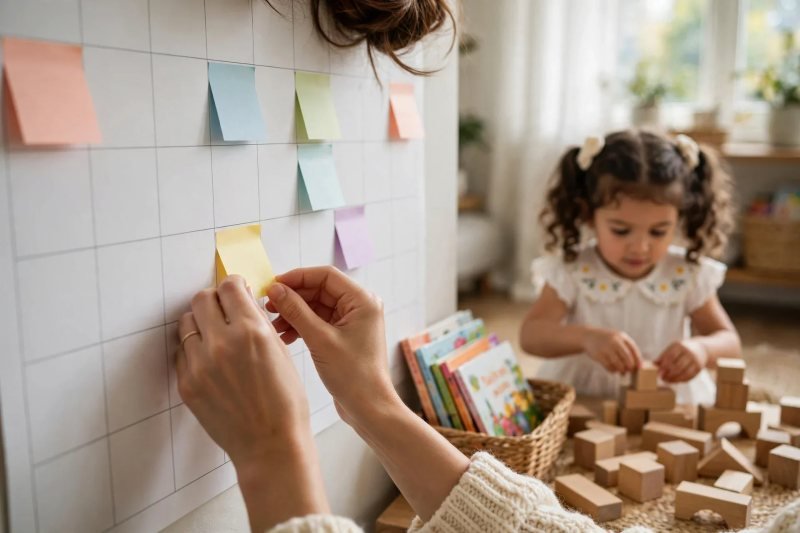
- A blank wall calendar and sticky notes for your own planning
Before you start
1. Get the library card sorted and locate the children's section — you'll visit every one to two weeks. 2. Clear one low shelf or table corner as the "school spot." Reachable beats pretty. 3. Print nothing yet. Week 1 needs only books, crayons, paper, and playdough.
How to do it
-
Map the 36 weeks. Take a blank wall calendar and block out nine 4-week months, starting in September or whenever you begin — keep the theme order either way. Pencil each month's theme at the top of its block: All About Me, Fall on the Farm, Food & Thankfulness, Winter Celebrations, Winter Animals, Community Helpers, Growing Things, Bugs & Spring, Water & Review.
-
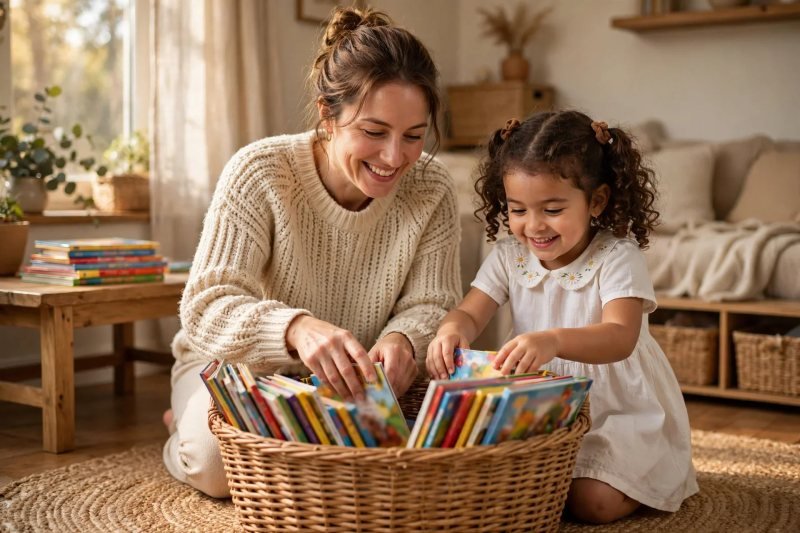
Build the book basket. Each library visit, pull 8–10 picture books: two or three matching the month's theme, a couple of alphabet or counting books, and the rest whatever your child grabs off the shelf. Rotate weekly. Repeats are welcome — preschoolers learn from rereading favorites.
-
Make the letter kit. No flashcards to buy: fold a paper card and draw one big letter on it yourself each week, fill the tray with salt or sand for tracing, and gather three or four small objects that start with the week's sound. Follow the letter order below — roughly one letter a week.
-
Assemble the math box. A muffin tin with dried beans handles one-to-one counting; two cups and a jug cover pouring and comparing; number cards you draw yourself (one big numeral per card) grow with the number plan. Add and remove pieces as the months progress.
-
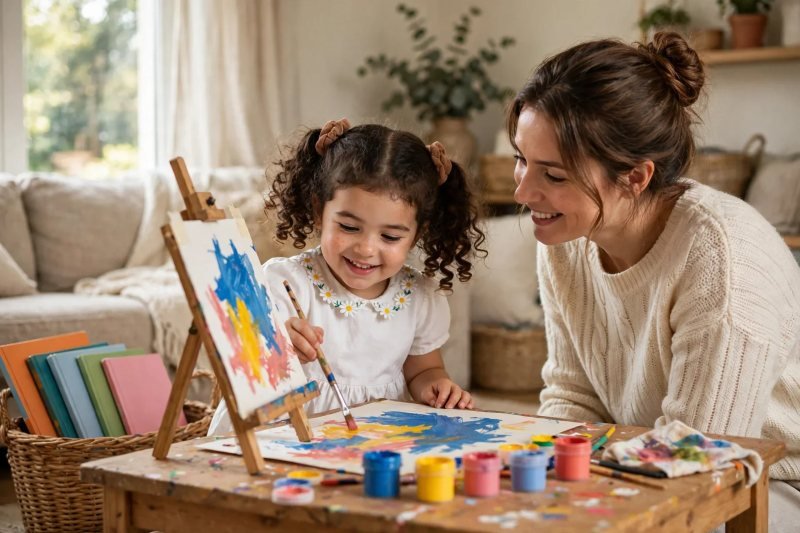
Stock the art shelf. Washable basics only: crayons, markers, watercolors, glue, scissors, paper. Every week's art is process art tied to the theme — no models to copy and no perfect crafts to stress over.
-
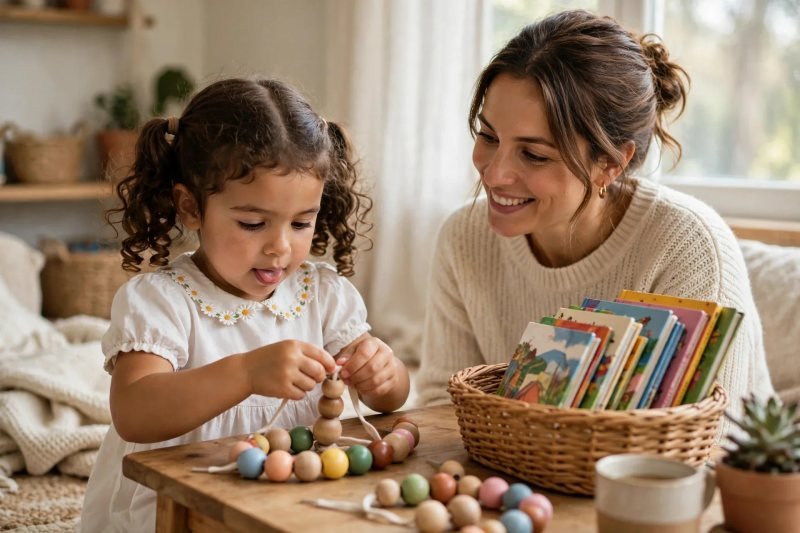
Set up the fine-motor tray. One tray per week, matched to the month's skill: playdough in month 1, bead threading in month 2, pouring in month 3, cutting curves in month 4, tracing in month 5, cutting shapes in month 6, tweezer transfer in month 7, pre-writing strokes in month 8, name practice in month 9.
-
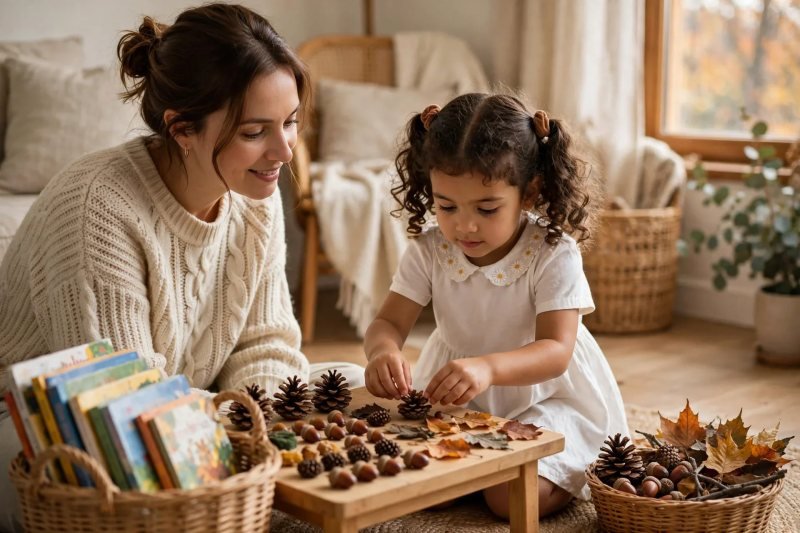
Start the nature ritual. Put a basket by the door and take a short walk on the same day each week. Collect, sort, and display finds on the nature table. Ten unhurried minutes outside teaches more science than any worksheet.
-
Learn the song bank. Choose two or three rhymes per month and sing them daily — in the car, during cleanup, before lunch. Repetition is the entire point: your child will memorize them, and memorized rhymes are early literacy.

-
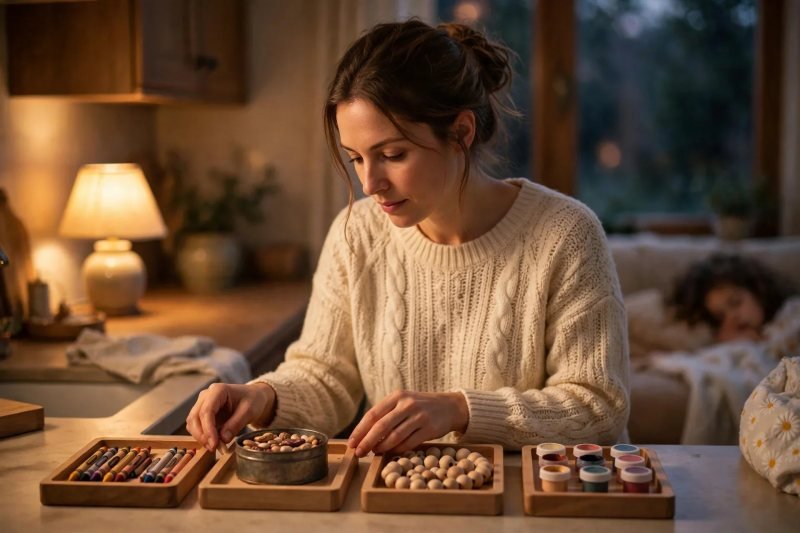
Run the Sunday reset (30–45 minutes). Pull next week's books, set out four trays (letter, math, fine motor, art), and skim the week's plan. This is the honest price of a free curriculum: a slice of your Sunday evening, every week.
-
Track one page a week. Write the date, what you did, and one thing your child said or discovered. In May you'll hold a 36-page record of the whole year — and the growth will be visible on the page.


Make it easier
Do three days a week instead of four — the plan stretches fine. Repeat favorite weeks instead of pushing forward when life gets busy. Let the library do the heavy lifting: ask the children's librarian for themed book bundles and skip half your prep.
Make it harder
Add a second focus activity for a four-year-old who's hungry for more. Start a simple word wall: one index card per week with the letter and a drawing of its object. Invite a friend once a month for a shared theme day — teaching a song to a peer cements it.
Other ways to play it
- Two-year-old sibling along for the ride: hand them their own crayons and playdough; they'll absorb the songs and stories.
- Faith-based flavor: weave your family's songs, stories, and holiday themes into the monthly rhythm.
- Year-round pace: stretch each month to five weeks and homeschool through the summer at the same gentle daily dose.
How it changes by age
- Age 3: Keep focus activities to 10–15 minutes. Expect to repeat letters and numbers many times — that's learning, not failure. Stop while it's still fun.
- Age 4: Fifteen to twenty-five minutes works well. Many fours love the weekly rhythm, choosing trays, and the growing independence of the fine-motor work.
What they're learning
Letter sounds and names through multi-sensory weekly routines; number sense through counting real objects to 10 and beyond; fine-motor strength and control on a genuine progression toward writing; vocabulary and narrative skill from daily read-alouds and memorized rhymes; early science through weekly nature observation; art confidence through weekly process art; and the executive-function basics — starting, persisting, and finishing — inside a predictable rhythm.
Clearing up
"Free means lower quality." The learning comes from the routine, the books, and your attention — none of which has a price tag. Paid programs mostly sell convenience, not better outcomes. "I need workbooks or it isn't real school." At three and four, hands-on beats paper every time. Workbooks can wait for kindergarten. "Thirty-six weeks sounds overwhelming." It's four short days a week of things you'd mostly do anyway — reading, playing, walking — with a plan that removes the "what should we do today?" blank.
Questions parents ask
Can I really homeschool preschool for free?
What is the best free homeschool preschool curriculum?
How many hours a day should I homeschool a 3-year-old?
Do I need workbooks for preschool?
What if my 3-year-old won't sit still for activities?
How is this different from just playing all day?

save it for later
Pin this for the next rainy afternoon
Keep it on a board so it is there when you need it, rather than when you happened to find it.
Save to Pinterest

